Card Fee Support for Small Businesses in Korea: How to Apply
Korea's card fee subsidy for small merchants is run by individual cities and counties, not one national program. Here is how to check eligibility and apply, using real 2026 notices.
 Nathan Brooks
In this post
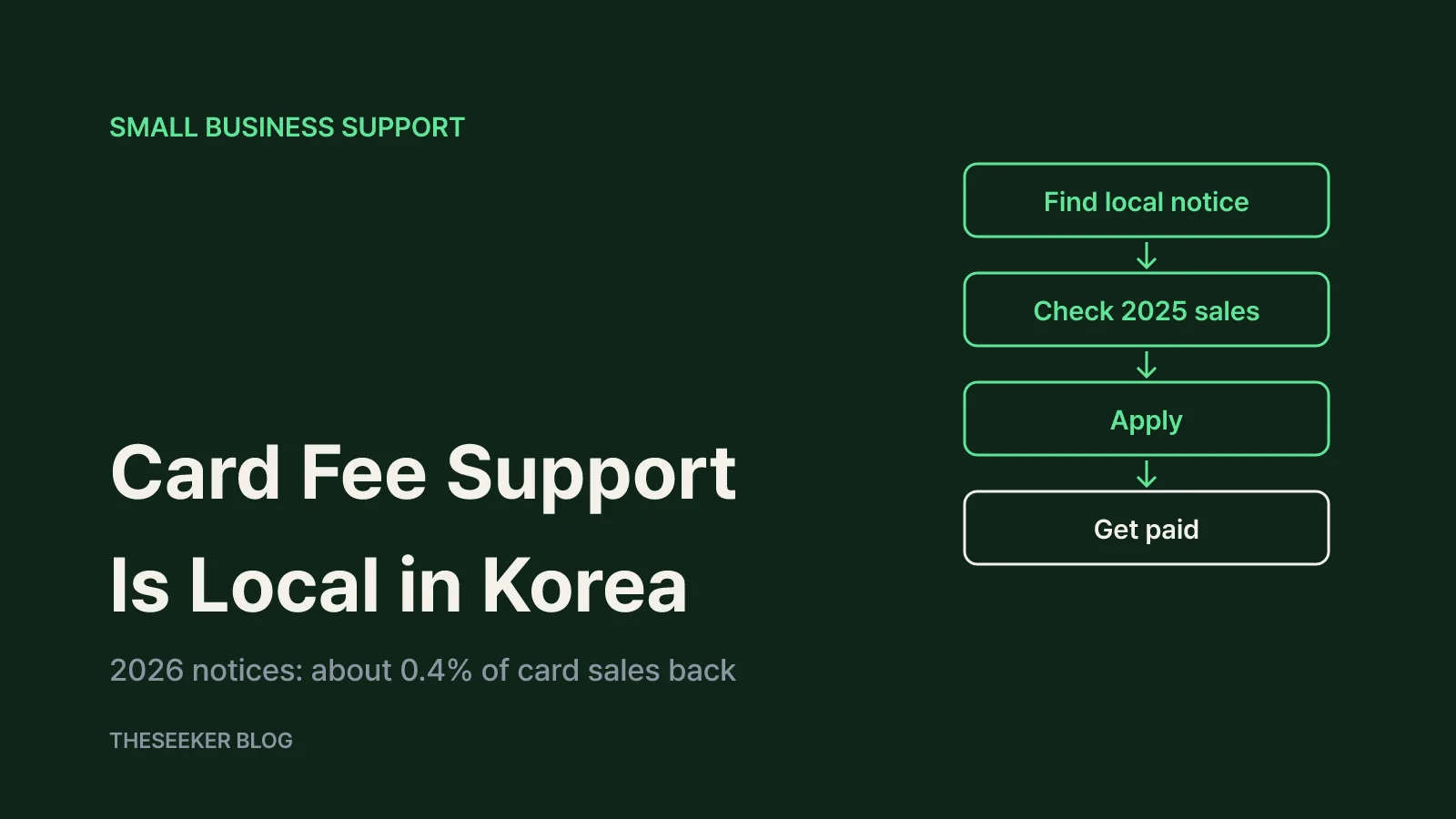
As of October 2026, the "card fee support" that small business owners in Korea keep hearing about is not a single national grant. It is a set of local programs run by cities, counties and districts, each with its own budget, sales threshold, payout rate, cap and application window. Most 2026 notices follow the same pattern: small merchants located in that municipality, with prior-year sales under a set limit, get back roughly 0.4% of their prior-year card sales, with caps ranging from KRW 300,000 to KRW 600,000 in the notices reviewed here. To find out whether you qualify, start with the municipality where your business is registered.
Korean YouTube videos often headline a "KRW 500,000 card fee subsidy." None of the official notices checked for this guide offered a nationwide KRW 500,000 payment, so treat any headline figure as a local cap until you find the notice that applies to your shop.
A local program, not a national grant
Each program rests on local rules. Ulsan's Jung-gu district, for example, cites the national Small Business Protection and Support Act together with its own district ordinance (Ulsan Jung-gu notice). In North Gyeongsang Province, a provincial agency, the Gyeongsangbuk-do Economic Promotion Agency, recruits participating shops county by county (Goryeong County notice).
That structure has practical consequences:
- Your business address decides eligibility, not your home address. Notices typically require the address on your business registration certificate to be inside the municipality.
- Programs are re-announced every year, sometimes every half-year. Gongju City issued a separate second-half 2026 notice, and Ulsan Jung-gu ran an additional recruitment round.
- Funding can run out. Goryeong County lists its application period as "until the budget is exhausted."
- Many windows have already closed. Jeonju City's 2026 program, announced on April 7, was no longer accepting applications (Jeonju application page).
This subsidy is also different from the discounted merchant fees that card companies apply automatically. More on that below.
Who qualifies and how much: 2026 examples
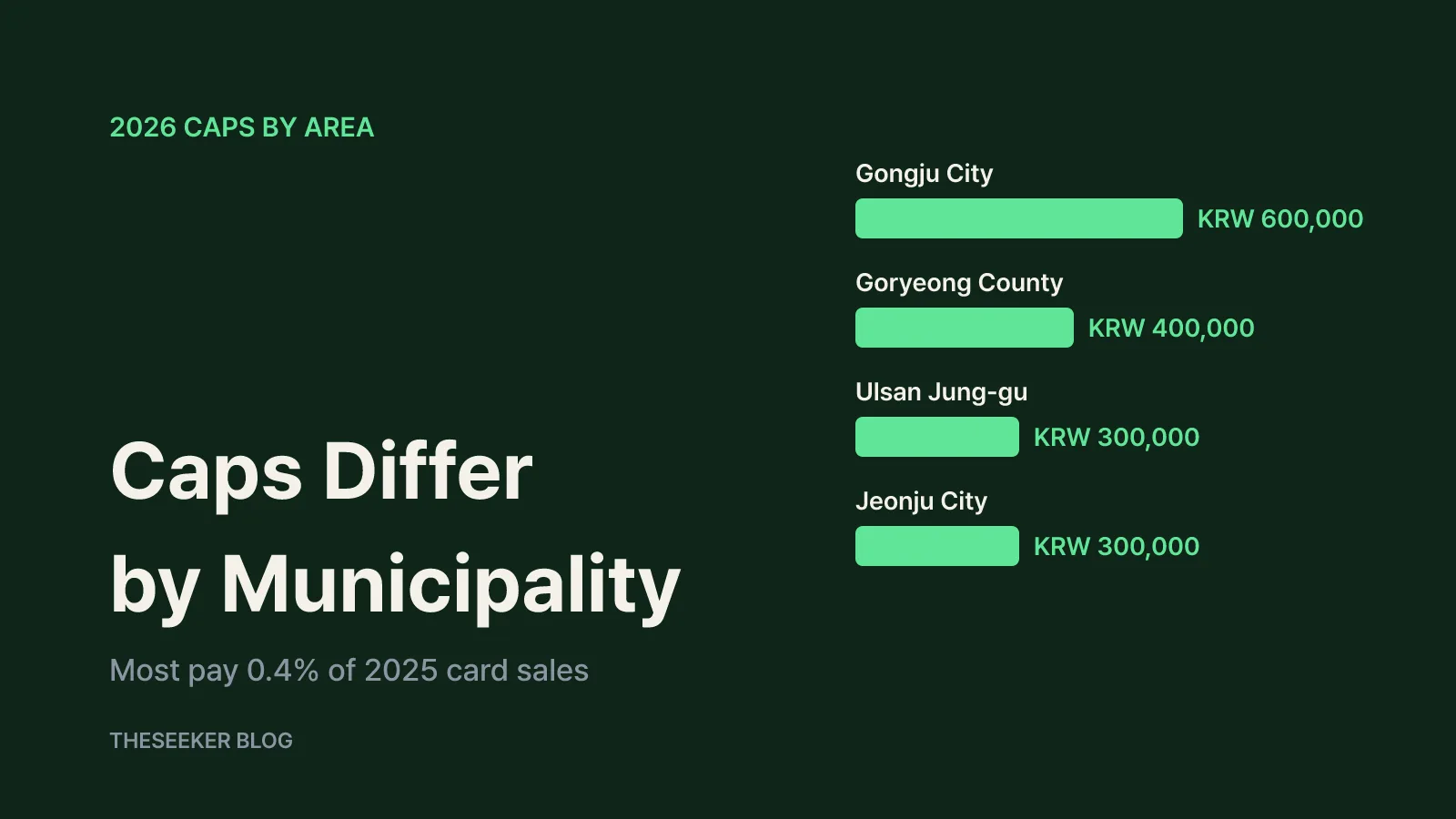
Comparing four 2026 notices shows how much the rules vary.
← Swipe to see more
| Area (2026) | Sales test (2025) | Support | Cap | How to apply |
|---|---|---|---|---|
| Gongju City, S. Chungcheong (2nd half) | Total sales up to KRW 500M | 0.4% if sales up to KRW 300M; 1.0% if KRW 300M–500M | KRW 600,000 | Sosanggongin24 online or in person |
| Goryeong County, N. Gyeongsang | Annual sales up to KRW 300M | 0.4% of card sales | KRW 50,000 minimum to KRW 400,000 | Haengbokcard.kr online or in person |
| Jung-gu, Ulsan (extra round) | Annual sales incl. VAT up to KRW 250M | 0.4% of card sales | KRW 300,000 | In person at the district office |
| Jeonju City, N. Jeolla | Sales up to KRW 300M, fewer than 5 regular staff | Up to 0.4% of card sales | KRW 300,000 | Online (closed) |
Gongju's window runs from October 12 to October 30, 2026 (Gongju notice). Ulsan Jung-gu's extra round ran from September 9 to September 18.
Goryeong even publishes its formula: 2025 card sales ÷ 1.1 × 0.4%. Dividing by 1.1 strips out the 10% VAT. A shop with KRW 33 million in card sales would receive 0.4% of KRW 30 million, or KRW 120,000. Under the same formula, card sales of KRW 110 million hit the KRW 400,000 cap, while very small shops still get the KRW 50,000 minimum.
The 0.4% figure is not random. According to the Financial Services Commission, the preferential credit card fee for merchants with annual sales of KRW 300 million or less is 0.40% for the second half of 2026 (FSC notice). Many local programs use that same rate, so for the smallest merchants the subsidy works roughly like a rebate of a year's credit card fees. Debit card fees for that tier are lower, at 0.15%, so the payout will not match your actual fees exactly.
How to check whether you qualify
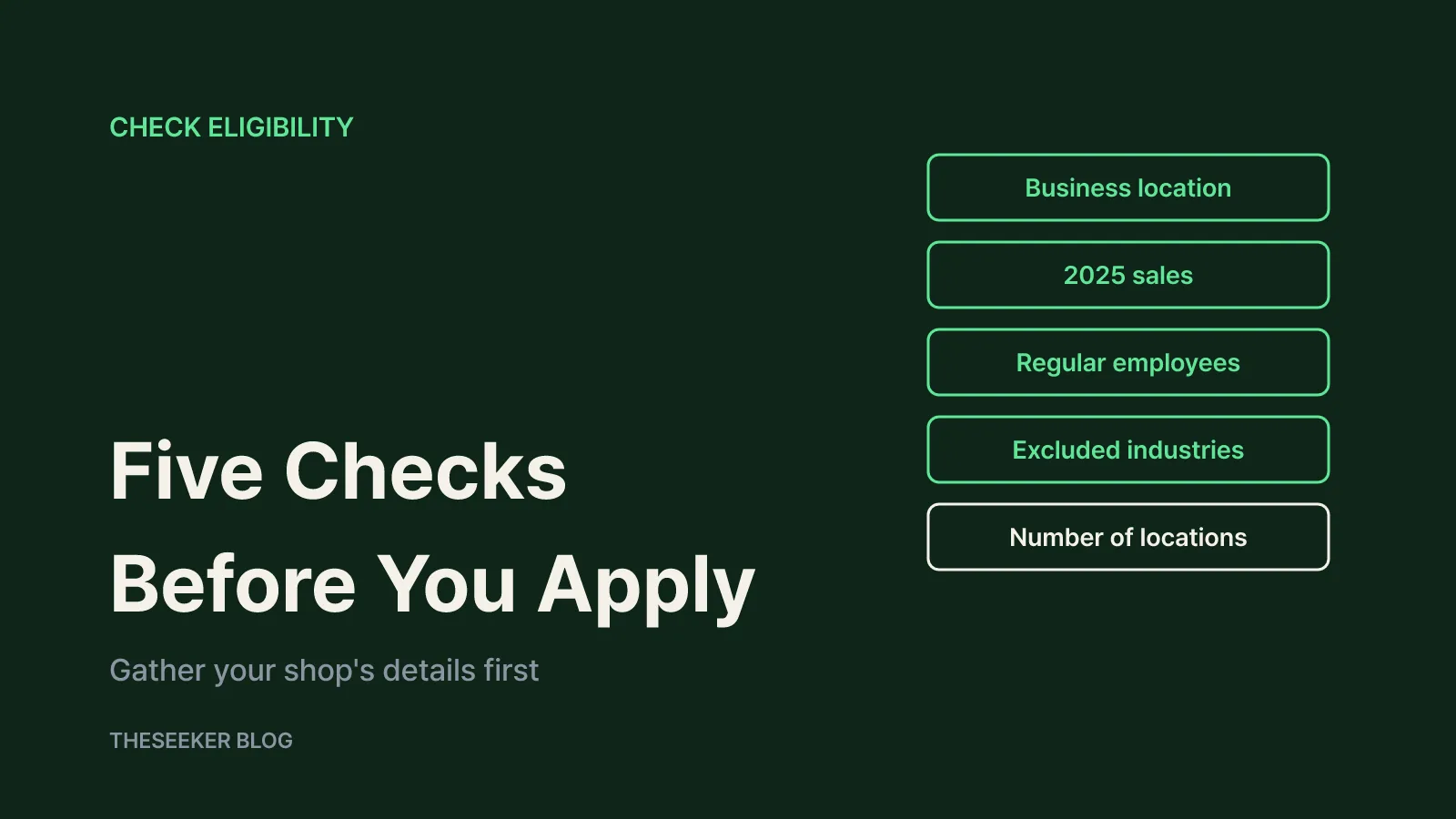
Gather a few facts about your business before you go looking for a notice:
- Business location. The city, county or district on your business registration certificate is what counts. Moving out of the area before the notice date can disqualify you.
- Prior-year sales. Most 2026 programs look at 2025 sales. Goryeong uses the VAT tax base certificate, or the revenue certificate for VAT-exempt businesses. Jeonju says businesses that never filed their sales must file first.
- Regular employees. Jeonju requires fewer than five regular employees (fewer than ten in mining, manufacturing, construction and transport). A regular employee works at least 60 hours a month for at least three months; immediate family members and spouses are not counted.
- Excluded industries. Jeonju excludes entertainment bars and similar venues, legal, accounting and tax services, hospitals and pharmacies, finance, and taxis, which have a separate program. Concession stands inside large stores, where the store pays the card fee, are generally excluded too.
- Number of locations. Jeonju accepts up to two business locations per owner.
With those answers in hand, reading a notice is mostly a matter of matching numbers. Open the attachments as well: Goryeong's notice includes a provincial FAQ, and Gyeongsangbuk-do publishes a list of restricted industries.
The fastest way to find your local notice is to search "카드수수료" (card fee) on Bizinfo (bizinfo.go.kr), the government's business support portal, and filter by region. Searching the same word on your city or district office's public notice board also works.
Where and how to apply
Application channels fall into three groups:
- Sosanggongin24 online. Gongju accepts applications through this national small business portal and keeps walk-in applications mainly for people who struggle with digital services.
- A regional website. North Gyeongsang uses Haengbokcard.kr, plus walk-in desks at community service centers, the provincial economic agency and the provincial small business federation.
- In person only. Ulsan Jung-gu's extra round accepted applications only at the district office's traditional markets division.
Paperwork differs, but every program asks for an application form and a consent form for collecting personal information. Gongju and Goryeong attach those forms as Hangul word-processor files. Some programs ask for proof of sales, while others ask for a power of attorney so officials can request your sales data from the tax office directly; Jeonju's page offers that form for download.
Do not expect instant payment. Jeonju describes the process as: online application, document review, confirmation of recipients, a data request to the tax office, the tax office's reply, and payment after the final amount is set, with payouts made in stages between July and December.
Contact numbers are listed in each notice: Gongju's economy division (041-840-8286), the Gyeongsangbuk-do agency's livelihood support team (1800-8730) and Ulsan Jung-gu's small business team (052-290-8392). Bizinfo itself notes that the agency running each program handles all inquiries and applications.
Related rules: preferential fees and new-merchant refunds
Separate from local subsidies, Korea caps card fees for smaller merchants. From August 14, 2026, preferential rates apply to 3.094 million of 3.235 million credit card merchants (95.7%), according to the FSC:
← Swipe to see more
| Annual sales | Credit card | Debit card |
|---|---|---|
| Up to KRW 300M | 0.40% | 0.15% |
| KRW 300M–500M | 1.00% | 0.75% |
| KRW 500M–1B | 1.15% | 0.90% |
| KRW 1B–3B | 1.45% | 1.15% |
Merchants are re-screened every half-year and need not apply. You can check your rate on the Credit Finance Association's merchant sales lookup service (cardsales.or.kr) or by calling your card company.
If you opened recently, check for a new-merchant refund. New merchants pay the standard rate until their sales are verified; if they turn out to be small or mid-sized, card companies refund the difference. For businesses that opened in the first half of 2026, 159,000 merchants were due refunds by September 28, totaling about KRW 61.47 billion, or roughly KRW 387,000 each. In the FSC's example, a shop with KRW 140 million in credit card sales over about seven months, charged 2.2%, gets back KRW 140 million × (2.2% − 0.4%) = KRW 2.52 million. Businesses that opened and closed within the period also qualify.
In short, preferential rates and new-merchant refunds are automatic; local card fee support requires an application.
Checking viral claims about scholarships and guaranteed loans
Videos often bundle card fee support with "scholarships for small business owners' children" or "special guarantee loans." These are usually run by local governments, regional credit guarantee foundations or public agencies, so amounts and conditions vary by area. A video mixing several regions' programs can leave you waiting for help your area does not offer.
Three checks help:
- Find the original notice on Bizinfo and confirm the issuing agency covers your business address.
- Check the year. Last year's notice is sometimes presented as current; look at the notice date and application window first.
- Apply only through the site named in the notice, such as Sosanggongin24, a municipal website or a regional portal, and never enter personal details through links in texts or video comments.
The payout may look modest, but almost every very small merchant can qualify somewhere. Search your municipality's name together with "카드수수료" to see whether a 2026 notice exists and is still open.
Sources
Frequently asked questions
Is card fee support available to every small business in Korea?
No. Each city, county or district funds and announces its own program, so there must be a notice covering your business address. Sales limits, payout rates, caps and deadlines differ by area.
How much can I receive?
Most 2026 notices paid 0.4% of 2025 card sales, with caps between KRW 300,000 and KRW 600,000. Goryeong County calculates card sales ÷ 1.1 × 0.4%, with a KRW 50,000 minimum and KRW 400,000 maximum.
Where do I apply?
Use the channel named in your local notice. Gongju uses Sosanggongin24 online, North Gyeongsang uses Haengbokcard.kr or walk-in desks, and Ulsan Jung-gu accepted walk-in applications only. Search "카드수수료" on Bizinfo to find notices by region.
How is this different from preferential card fee rates?
Preferential rates are applied automatically by card companies based on your annual sales tier. Local card fee support is a separate payment from your municipality that you must apply for.
I opened my business last year. Can I apply?
It depends on the notice. Most 2026 programs use 2025 sales, so your sales must be filed with the tax office, and some require you to be operating in the area on the notice date.
blog.theseeker.io/en/posts/small-business-card-fee-support-korea-eligibility-application
Nathan Brooks
Nathan covers eligibility, application steps and deadlines for public support programs, working from government notices and starting with who qualifies.
Read our editorial standards