Korea's 10M Won Baby Grant and Self-Employed Allowance
South Korea announced a 10 million won Welcome Baby Grant for first births and a new parental allowance of 500,000 won a month for three months for the self-employed and freelancers. Here is what is planned, who it targets and why it is not yet in force.
 Nathan Brooks
In this post
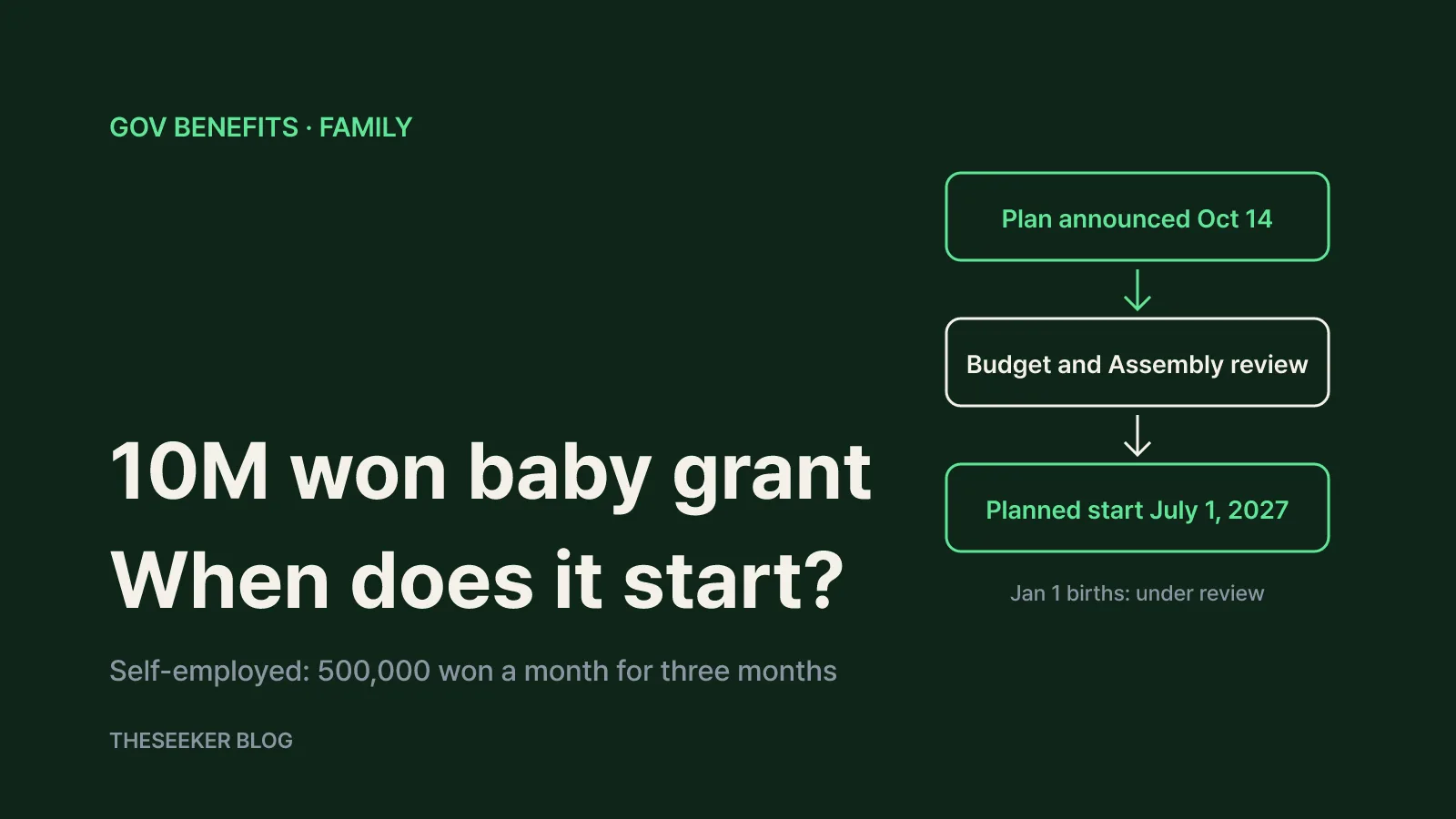
As of October 2026, South Korea's headline-grabbing 10 million won payment for a first child and the new parental allowance for self-employed parents are announced plans, not benefits you can apply for today. The Presidential Committee on Population Strategy presented the main contents of the First National Population Strategy Basic Plan on October 14, 2026, and the government said the plan will be finalized only after a final round of consultation and review by the vice-ministers' meeting and the Cabinet (Korea Policy Briefing). The cash-benefit overhaul is budgeted to start on July 1, 2027, while applying it to babies born from January 1, 2027 is still under review (YTN Radio interview with the First Vice Minister of Health and Welfare).
This guide is for parents in Korea, including foreign residents and readers following Korean family policy, who want to understand what changes, who qualifies and when to check again. It sticks to what the government and the responsible ministries have actually said, and it flags the parts that remain open.
What the plan changes: the Welcome Baby Grant and the Child Basic Allowance
Korea currently pays several separate cash benefits around birth: the First Meeting Voucher (첫만남이용권), the Parent Benefit (부모급여) and the Child Allowance (아동수당). The new plan would fold these into two programs, a lump-sum Welcome Baby Grant (아이맞이지원금) and a monthly Child Basic Allowance (아동기본수당) (Hankyoreh 21, News1 report republished by Korea Real Estate News). Because this is a restructuring, it is a mistake to assume the new grant simply stacks on top of every existing payment.
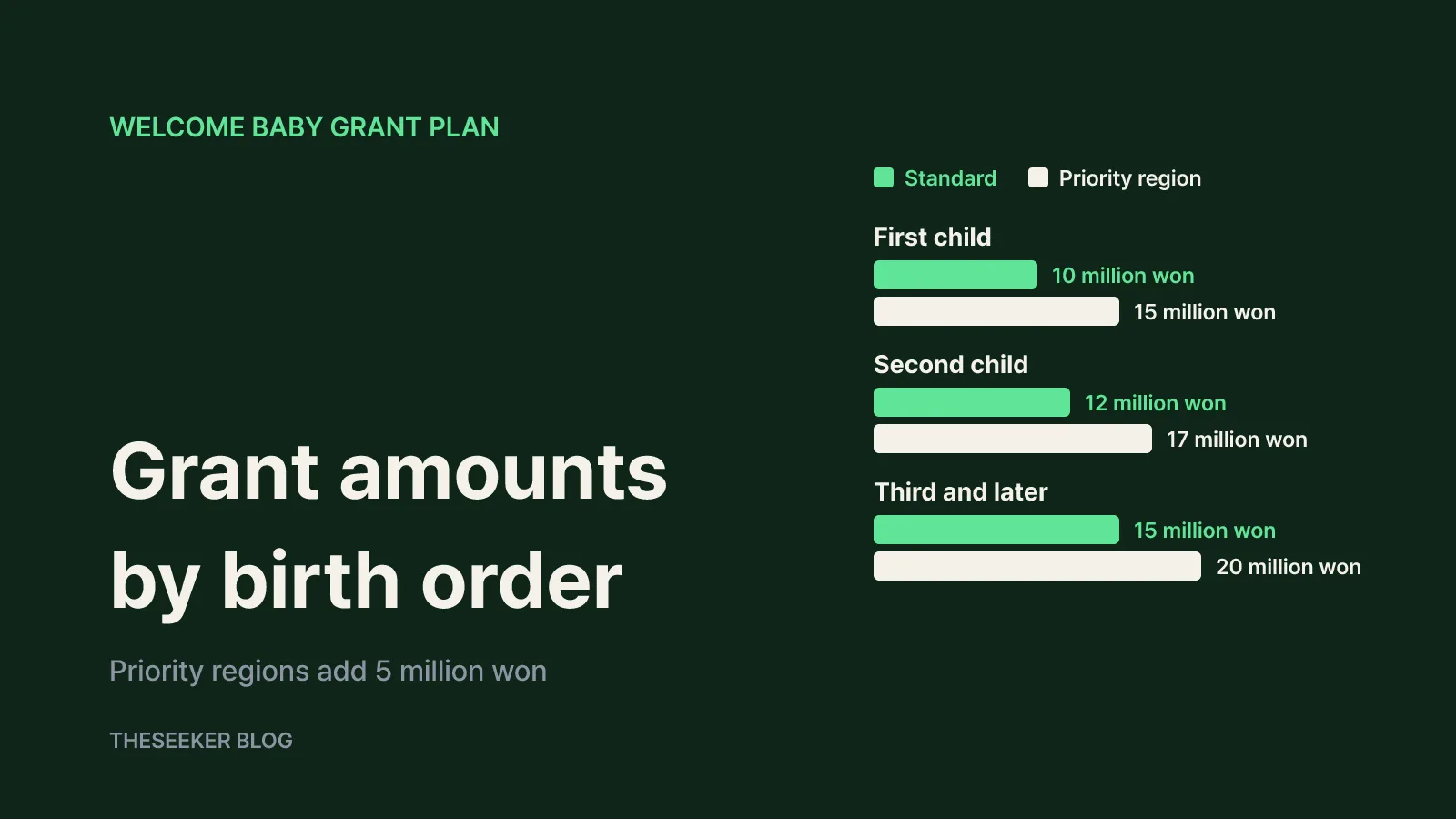
The Welcome Baby Grant scales with birth order:
- First child: 10 million won
- Second child: 12 million won
- Third and later children: 15 million won
- In designated priority regions outside the capital area: 15 million, 17 million and 20 million won respectively
According to First Vice Minister Hyun Soo-yup, the grant would not arrive as a single payment. It would be paid in quarterly installments over the baby's first year. The priority regions are to be designated by the Ministry of the Interior and Safety, and she expected roughly half of the country's cities, counties and districts to qualify (YTN Radio). No official list had been published at the time of writing, so you cannot yet confirm whether your address counts.
The Child Basic Allowance is the monthly piece. Every child would receive 200,000 won a month. Families caring for a child aged 0 to 1 at home rather than using a daycare center would get an extra 300,000 won, and families in priority regions would get an extra 100,000 won, bringing the base to 300,000 won (Hankyoreh 21, News1 via Korea Real Estate News). The vice minister described payments running until age 12, with the base and regional portions split half in cash and half in local currency vouchers, and the home-care portion paid in cash. If you budget around this benefit, treat the voucher share separately, because local currency can usually be spent only within a region.
The new parental allowance for the self-employed and freelancers
The second headline is a parental allowance for people outside the usual parental-leave system. The government said it will create a parental allowance of 500,000 won a month for three months for artists, special-type workers, freelancers and one-person self-employed businesses (Korea Policy Briefing). That is up to 1.5 million won per person, planned for next year (News1 via Korea Real Estate News).
The gap it addresses comes from how Korea's parental leave benefit works. That benefit is funded through employment insurance: an insured employee must take parental leave and generally have at least 180 days of insured employment beforehand. A sole proprietor is not an employee and cannot take parental leave in the legal sense, and many freelancers and platform or contract workers are not covered. The Ministry of Employment and Labor put the program into its 2027 budget proposal as a parental allowance for people not covered by employment insurance. Its described target group includes sole proprietors, special-type workers and freelancers, and also insured employees who fall short of the 180-day requirement and workers on small farms or fisheries with four or fewer employees that are exempt from employment insurance (BabyNews). Detailed eligibility rules, proof-of-income requirements and application deadlines have not yet been issued.
Do not confuse this with a program that already exists: the childbirth benefit for people not covered by employment insurance (고용보험 미적용자 출산급여). According to Gov24, it pays a total of 1.5 million won (500,000 won a month for three months, paid at once) to women who earn income but cannot receive the employment-insurance maternity leave benefit. You must apply within one year of the birth at an employment center, by post or online through Work24, or the right lapses (Gov24). The two look alike on paper, but the existing benefit covers the childbirth stage, while the planned allowance targets lost income during the childcare period after birth (BabyNews). If you are self-employed and gave birth in 2026, claim the existing childbirth benefit within its deadline instead of waiting.
Since February 2026, proof of income for that childbirth benefit has been based on income reported for tax purposes, such as VAT and global income tax filings for sole proprietors, or business income withholding receipts for freelancers (Gov24). The new allowance targets a similar group, so keeping your tax filings complete is the most practical preparation available right now.
When could payments start, and why nothing is final yet
It helps to separate three steps.
- Finalizing the plan. The October 14 announcement covered the main contents of the basic plan. It still needs final consultation, revisions and approval by the vice-ministers' meeting and the Cabinet (Korea Policy Briefing).
- Budget and legislation. The Welcome Baby Grant and the Child Basic Allowance require changes to laws and to the benefit computer systems, so the budget assumes a start date of July 1, 2027 (YTN Radio). The parental allowance is part of the 2027 budget proposal and becomes final only after National Assembly review (BabyNews).
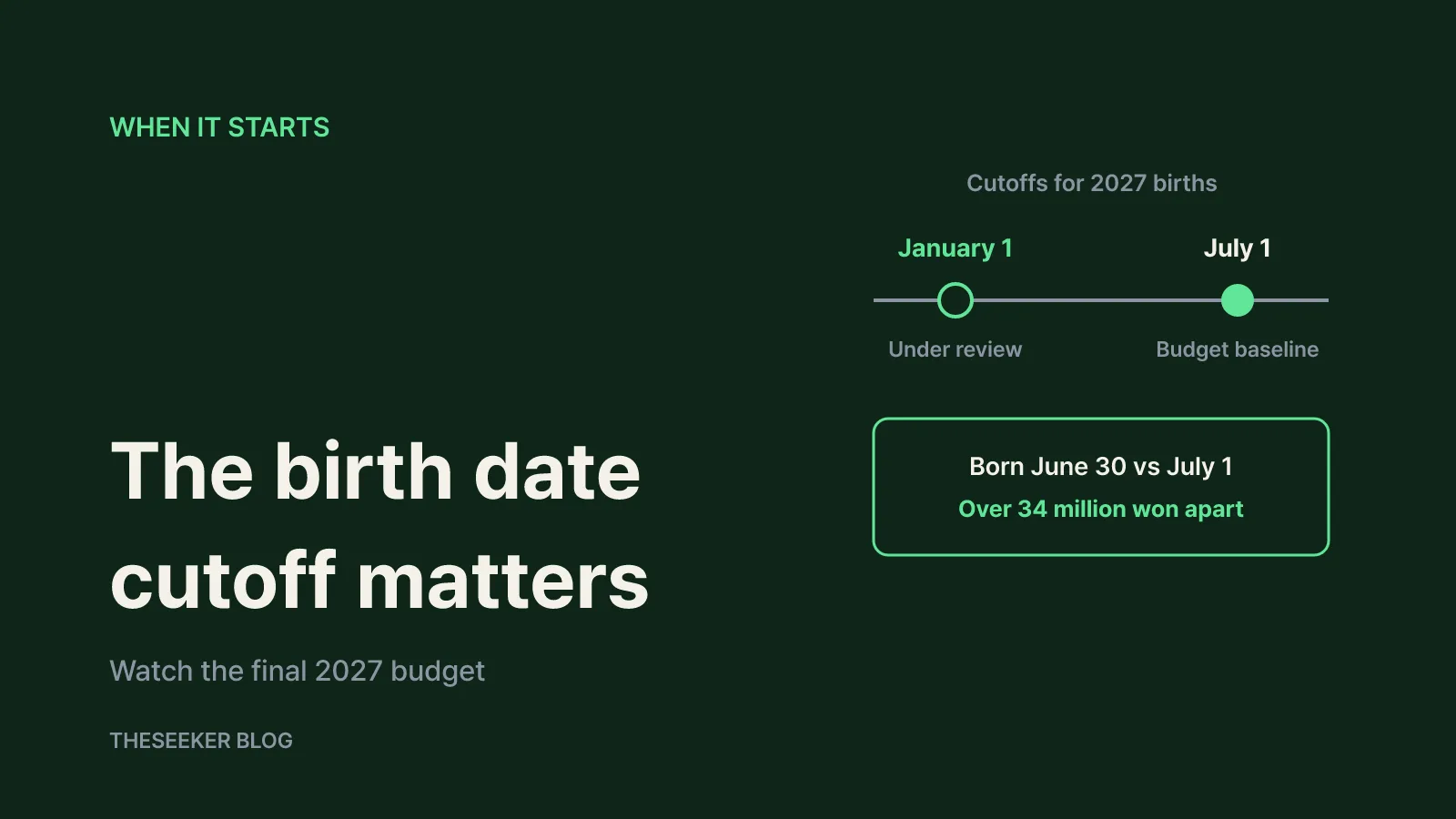
- Which birth dates qualify. A July 2027 start would mean babies born on June 30 and July 1 could receive amounts differing by more than 34 million won. The Ministry of Health and Welfare is reviewing whether to cover babies born from January 1, 2027, which it estimates would need about 250 billion won more in the budget (Hankyoreh 21). The vice minister said this depends on the National Assembly increasing the budget and had not been decided (YTN Radio).
Based on what has been said so far, babies born in 2026 are not covered by the overhaul. If you are expecting in the first half of 2027, the National Assembly's final 2027 budget is the decision to watch. Until the new system starts, the existing voucher, Parent Benefit and Child Allowance remain the rules that apply.
A practical checklist for expecting parents
Announced policies are reported with big numbers, while the real conditions appear only in the implementation notice. These checks will help you act quickly once that notice is published.
- Note your due date against the two possible cutoffs, January 1 and July 1, 2027.
- Check the final 2027 budget to confirm the start date of the Welcome Baby Grant and whether the parental allowance survived the Assembly review.
- Look for the priority-region notice from the Ministry of the Interior and Safety. It decides a 5 million won difference in the grant and the extra monthly allowance.
- Confirm your employment insurance status if you are self-employed or freelance. Whether you are insured, and for how long, decides which program you fall under.
- Claim what exists today. If your baby has already arrived, apply for the current childbirth benefit for uninsured workers within one year, along with the current First Meeting Voucher, Parent Benefit and Child Allowance.
When the implementation notice appears, the Ministry of Health and Welfare and Ministry of Employment and Labor announcements, plus the service pages on Gov24, Bokjiro and Work24, will be the authoritative places to confirm eligibility and apply. News coverage mixes plans, budget proposals and options under review, so pay attention to whether a sentence says the government will pursue a measure or will implement it. I will revisit this topic once the official notice and the final budget are out.
Sources
Frequently asked questions
Can I apply for the 10 million won first-child grant now?
No. As of October 2026 the Welcome Baby Grant is part of a plan that still needs final approval, and its budget assumes a start on July 1, 2027. Covering babies born from January 2027 is under review and needs a larger budget from the National Assembly.
Is the 10 million won paid all at once?
According to the First Vice Minister of Health and Welfare, it would be paid in quarterly installments over the child's first year. Confirm the final method in the official implementation notice.
Is the new self-employed parental allowance the same as the existing childbirth benefit for uninsured workers?
No. The childbirth benefit already exists, covers the childbirth stage and must be claimed within one year of the birth. The parental allowance is a new program in the 2027 budget proposal aimed at lost income during the childcare period.
Can salaried employees get the new parental allowance?
The Ministry of Employment and Labor's budget description includes insured employees who cannot receive the parental leave benefit because they have fewer than 180 days of insured employment. Employees who meet that requirement use the regular parental leave benefit.
Which areas count as priority regions?
No official list exists yet. The Ministry of the Interior and Safety is expected to designate them, and the vice minister estimated about half of Korea's cities, counties and districts would qualify.
blog.theseeker.io/en/posts/korea-first-child-10m-won-self-employed-parental-allowance
Nathan Brooks
Nathan covers eligibility, application steps and deadlines for public support programs, working from government notices and starting with who qualifies.
Read our editorial standards