How to Find Youth Support Grants in Korea by Region
Korean youth support is spread across national ministries, provinces and local districts. Here is how to search Ontong Youth, Gov24 and the Seoul, Gyeonggi and Busan youth portals, then confirm eligibility in the official notice.
 Nathan Brooks
In this post
- How youth support in Korea is layered: national, provincial, local
- Start with Ontong Youth and Gov24's benefit finder
- Regional portals: Seoul, Gyeonggi, Busan and the rest
- Matching programs to your job status
- Age, income and address rules differ by program
- Documents and the application sequence
- Sources
- Frequently asked questions
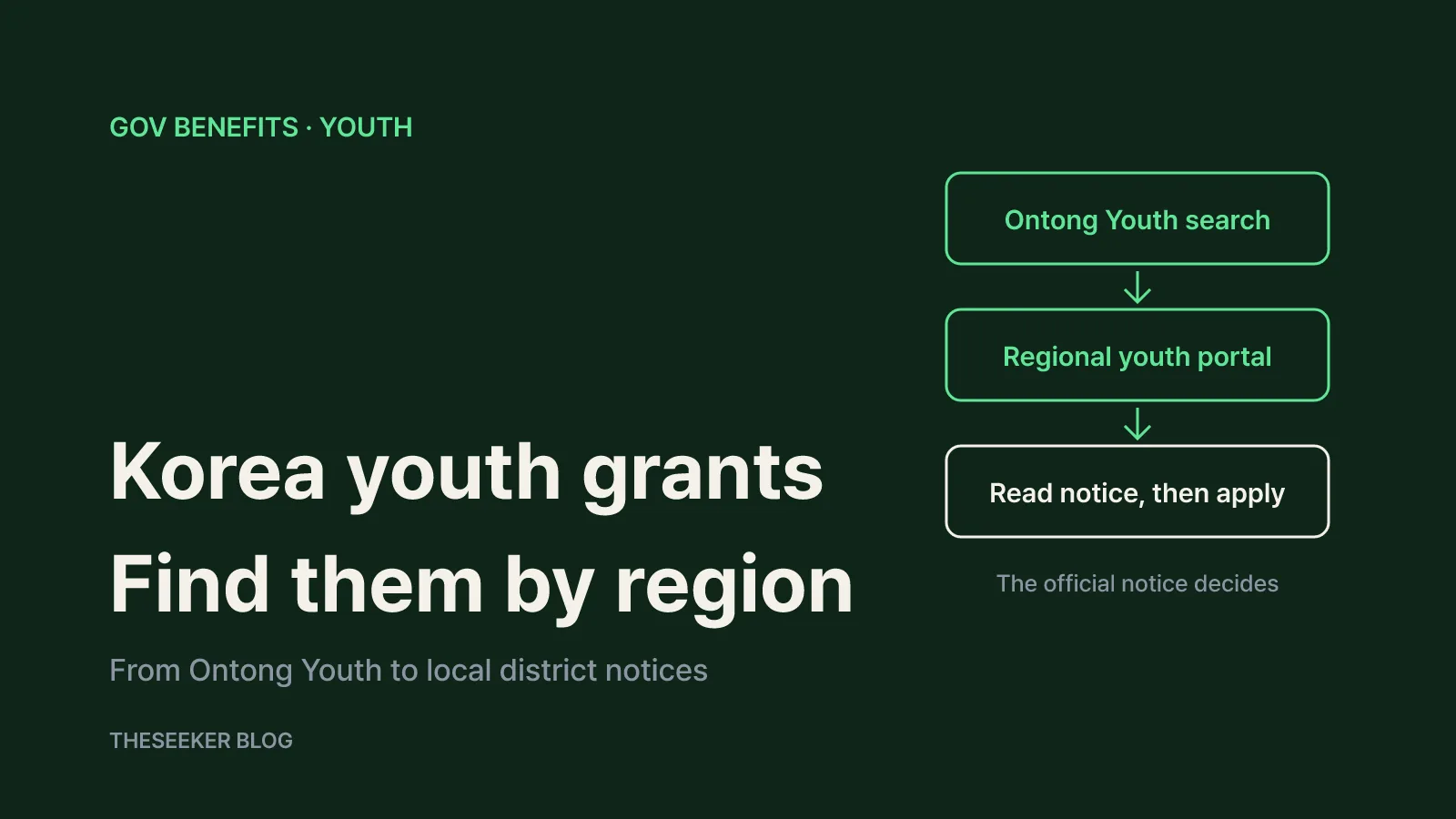
As of October 2026, the quickest way to find youth support grants in Korea is a three-step search. Start with Ontong Youth, the government's central youth policy site, to see national and local programs in one place. Then open the youth portal run by the province or metropolitan city where you are registered, such as Seoul's Youth Mongttang portal, the Gyeonggi Youth Portal or the Busan Youth Platform. Finally, read the original notice from the city, county or district office to confirm who qualifies and what documents are needed. There is no single program called "the youth grant". The term covers hundreds of separate schemes, so narrowing by age, registered address, employment status and income will save more time than searching by payment amount.
How youth support in Korea is layered: national, provincial, local
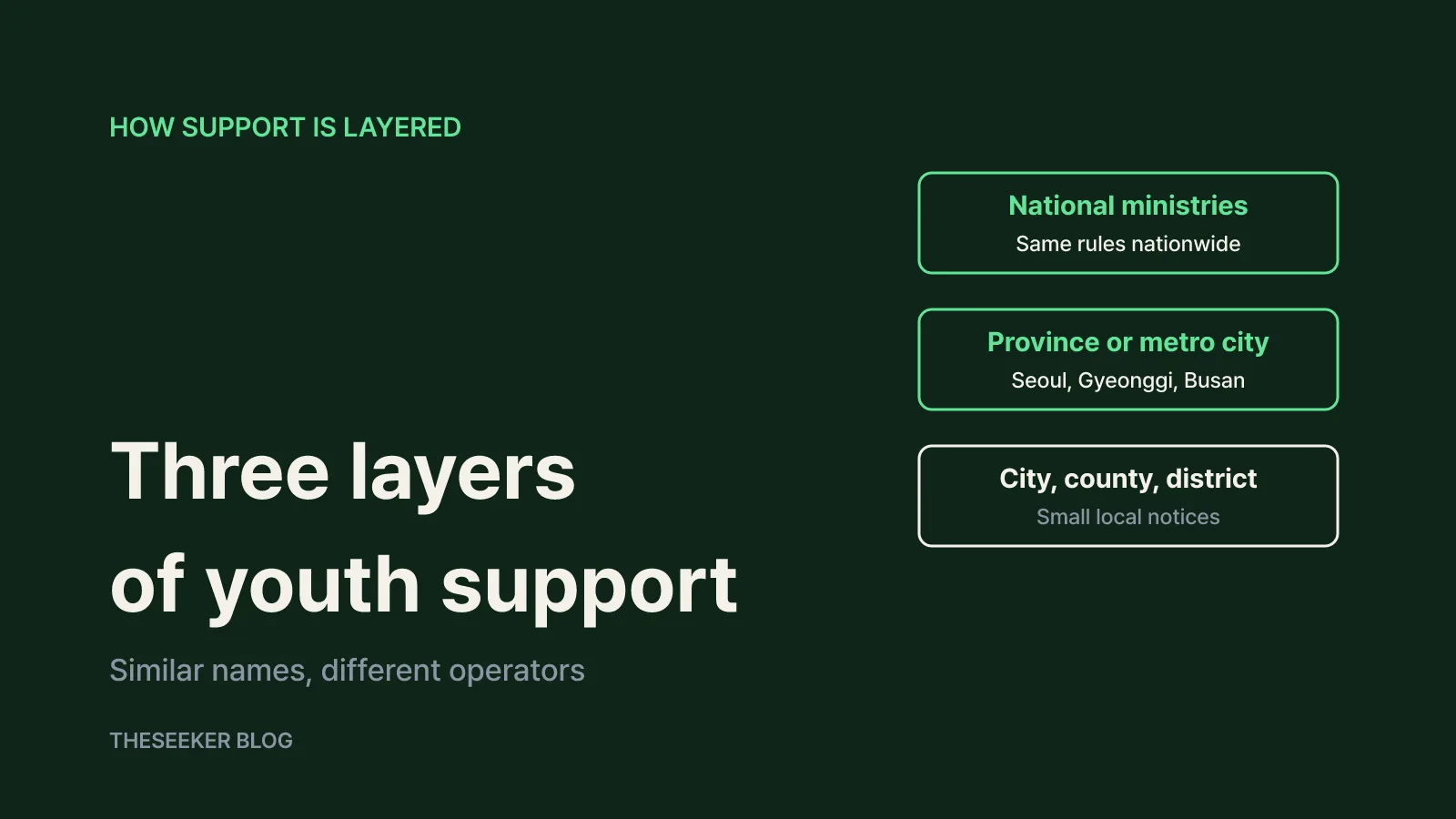
The first layer is national programs run by ministries such as Employment and Labor, Land and Transport, the Financial Services Commission and Health and Welfare. These usually apply the same rules nationwide regardless of where you live. Ontong Youth's policy overview groups them into six areas: jobs, education, housing, finance, welfare and culture, and participation. Familiar names such as the National Employment Support Program, the Youth Challenge Support Program, the Youth Job Leap Incentive and the Youth Tomorrow Savings Account sit in this layer.
The second layer is the metropolitan city or province. Seoul, Gyeonggi and Busan each fund their own schemes for rent, moving costs, culture passes and savings accounts. Programs with similar names can have different age limits, income tests and application windows. A "youth rent support" menu appears on both the Seoul youth portal and the Busan Youth Platform, but each is run and announced separately.
The third layer is the city, county or district (gu). Smaller programs such as interview support, job-search allowances and housing loan interest support are often opened at this level. On the Gyeonggi Youth Portal recent listings included Gapyeong County's youth interview support, open from October 16 to December 31, 2026, and Seongnam City's October program for unemployed youth (ALL-Pass), open from October 16 to October 30. The Busan platform separately lists district notices such as Haeundae-gu's third recruitment round for a youth job-search allowance.
Some programs can be combined, while others exclude people who already receive similar support. Read the overlap rules in each notice before applying so a later selection is not cancelled.
Start with Ontong Youth and Gov24's benefit finder
Ontong Youth is operated by the Office for Youth Policy Coordination under the Prime Minister's Office together with the Korea Employment Information Service. Its introduction page says you can search and compare policies, check eligibility, find youth centers by region and get counseling on jobs, careers and policies. A practical sequence looks like this:
- After signing up, use "My policies" on the My Page to enter your income range and interests. Recommendations are based on the profile you provide.
- In the integrated policy search, set the region to your province or city and pick a field such as jobs or housing. Use the status tags (always open, in progress, closed) to keep only programs you can apply for now.
- Open each program's detail page to see the lead agency and the application site. Ontong Youth aggregates information, but applications are usually filed elsewhere, such as Work24, a local youth portal or a financial institution.
- If the rules are unclear, call the Ontong Youth helpline at 1670-1839 (weekdays 09:00 to 18:00) or book in-depth counseling.
For a cross-check, use the Gov24 benefit notification service. According to Gov24, it uses administrative records to identify benefits you may receive and labels them as "apply" or "check". It also offers a quick finder that works without logging in and a full catalog covering more than 10,000 public services from ministries, local governments and public bodies. Ontong Youth is broader for youth-only programs, while Gov24 also catches general welfare benefits that are not limited to young people.
Regional portals: Seoul, Gyeonggi, Busan and the rest
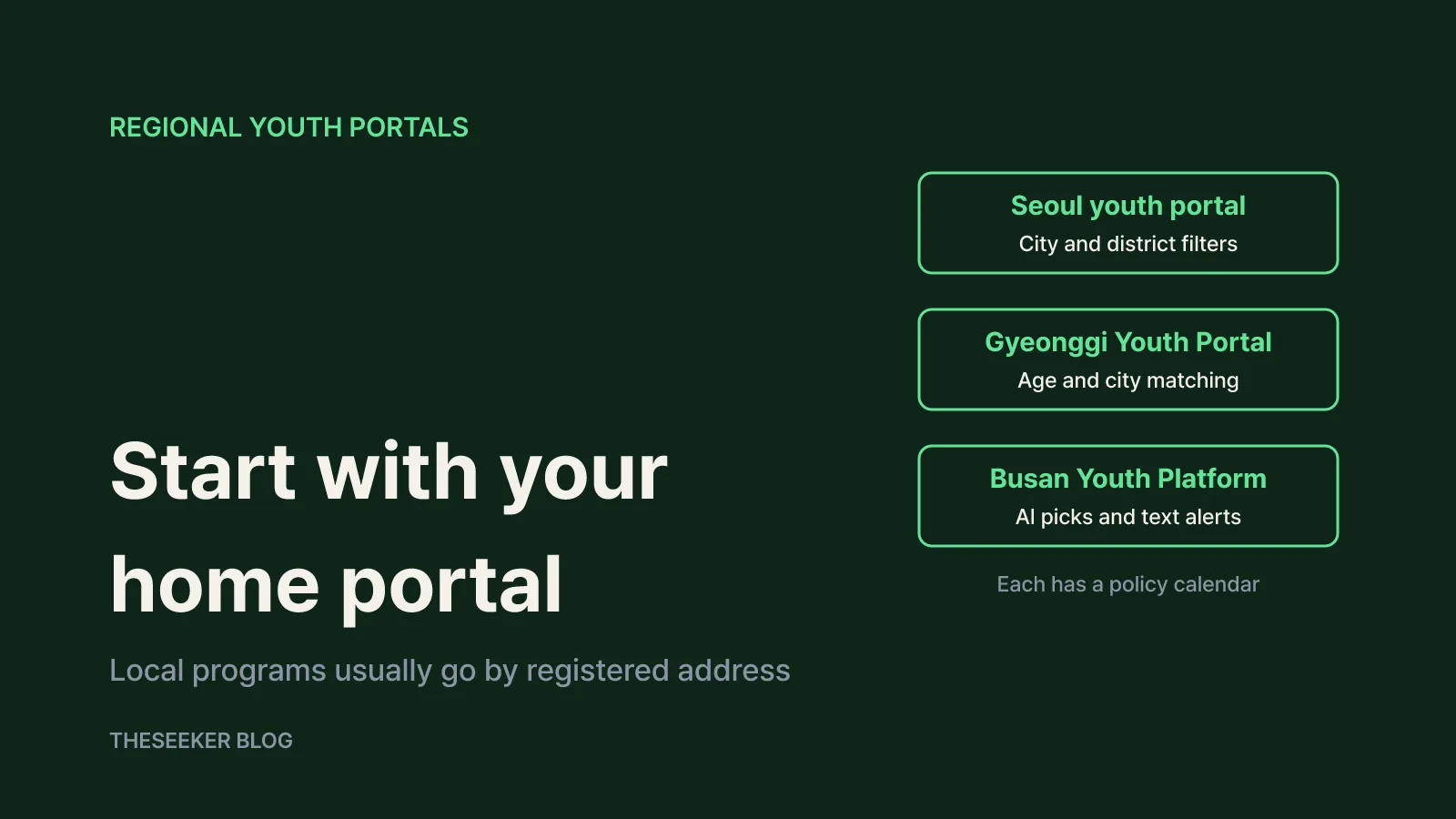
Ontong Youth's nationwide youth platform page links to the youth portals of Seoul, Busan, Daegu, Incheon, Daejeon, Ulsan, Sejong, Gyeonggi, Gangwon, the Chungcheong and Jeolla provinces, the Gyeongsang provinces and Jeju. Open the portal for your registered address first. Local programs normally decide eligibility by registered address rather than where you study or work.
Seoul (Youth Mongttang portal). The policy search is split into Seoul city policies, district (gu) policies, national policies and other regions, so you can separate city and district programs. The housing cost menu groups youth rent support, real estate brokerage fee and moving cost support, deposit loan interest support and jeonse deposit guarantee fee support. A policy calendar shows recruitment dates, and counseling is linked to the Seoul Youth Center.
Gyeonggi (Gyeonggi Youth Portal). The matching tool asks five questions: who you are (high school student, university student, young adult, newlywed, job seeker, aspiring founder, employee and so on), your age band from 13 to 39, the policy field, a detailed field and your city or county among the province's 31 municipalities. Separate menus cover city and county policies, a policy calendar, mental health counseling and support for socially isolated youth.
Busan (Busan Youth Platform). The top menu features a guide to youth policy changes for 2026, a policy calendar and an AI recommendation tool. Housing support includes the Meomuljari deposit loan and interest support, brokerage and moving cost support and youth rent support. Savings support includes the Busan Youth Double Joy Account and the Youth Tomorrow Savings Account. You can also sign up for text alerts about new notices.
National programs are often re-announced on local portals. On October 8, 2026, both the Gyeonggi and Busan portals posted notices about recruitment for the Youth Future Savings program. For other provinces, such as South Chungcheong, apply the same approach: check the policy list and the notice board together.
Matching programs to your job status
The descriptions below follow Ontong Youth's policy overview. Amounts and quotas change each year, so confirm details in the current notice.
Not working and not looking. The Youth Challenge Support Program targets people aged 18 to 34, including discouraged job seekers who have been unemployed for six months or more. It offers counseling, case management and job coaching in courses of 5, 15 or 25 weeks or longer, with participation allowances. A pilot program for socially isolated youth aged 19 to 34 runs through Youth Future Centers.
Unemployed and job hunting. Type I of the National Employment Support Program has a youth track for ages 15 to 34, with up to three years of military service taken into account, and sets conditions of income at or below 120% of the standard median income and assets of 500 million won or less. It combines tailored employment services with a job-seeking allowance. Local options such as Seongnam's ALL-Pass or Gapyeong's interview support can sit on top.
Working at a small or mid-sized company. The Youth Job Leap Incentive is paid to eligible employers with five or more workers that hire young people on permanent contracts and keep them for at least six months, so your employer usually has to take part. One track for industries with labor shortages also supports the young employee. The overview marks the older Youth Tomorrow Chaeum Deduction as closed to new applicants since 2024. Working youth aged 19 to 34 (15 to 39 for low-income recipients) can look at the Youth Tomorrow Savings Account.
Age, income and address rules differ by program
"Youth" has no single age range across programs. The national examples above run from 15 to 34, 18 to 34, 19 to 34 and up to 39 for youth startup academies. Check whether age is measured on the notice date, the application date or by birth year.
Income tests also vary. Some use a percentage of the standard median income, some use annual earnings, and some include household or parental income. Follow the calculation method stated in the notice.
Address rules are central to local programs. A notice may require registration on the application date, continuous residence for a set period, or may stop payments if you move away during the support period. If you plan to move, read the notices in both your current and future regions before deciding when to apply.
Documents and the application sequence
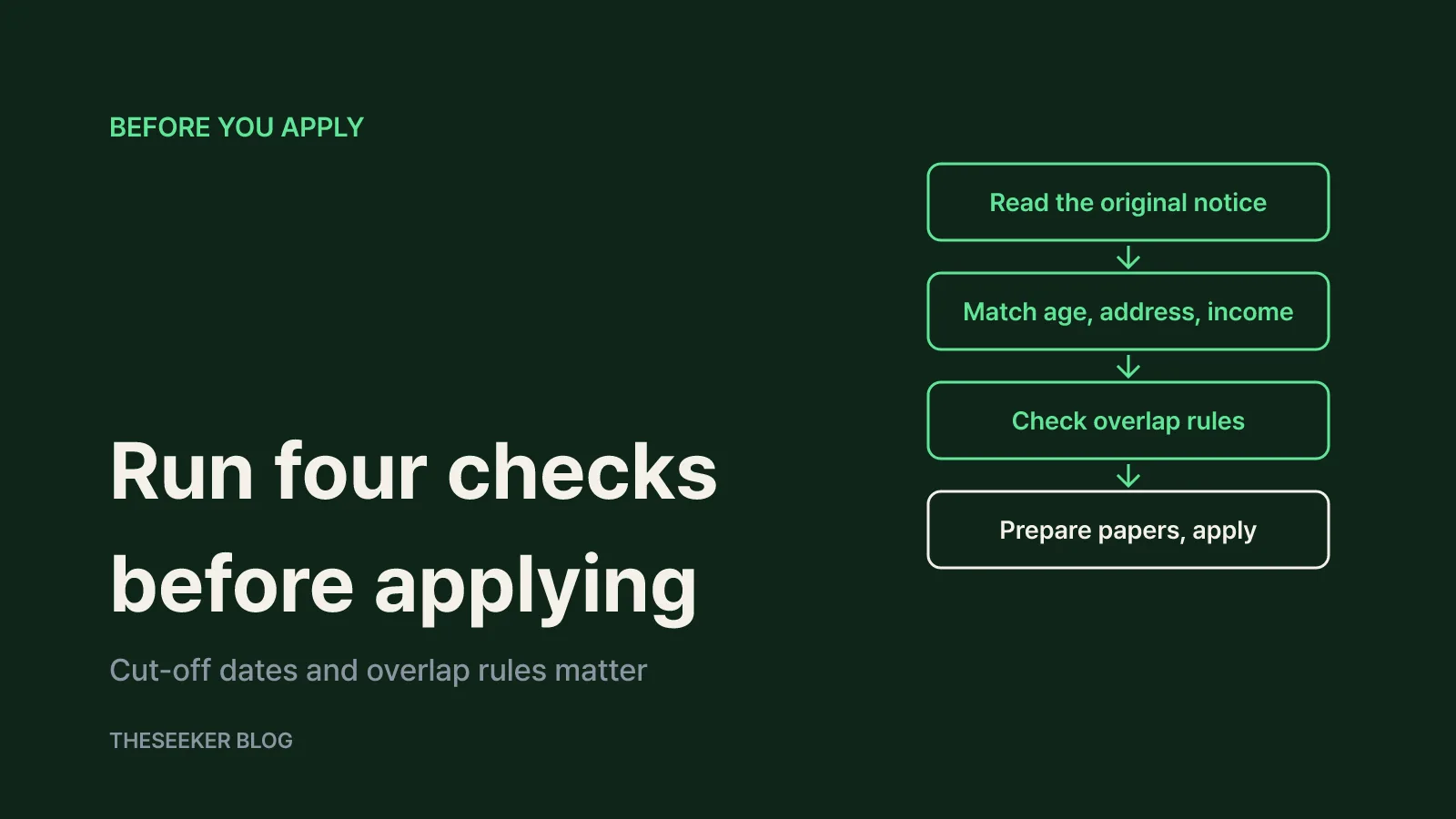
Once you have two or three candidates, work through these steps:
- Read the original notice from the lead agency, not only the portal summary, and note the application window, where to apply and how recipients are chosen.
- Match each condition line by line: age cut-off, address, income and assets, and how employment status is defined.
- Check overlap rules for similar support you already receive or past participation.
- Prepare only the listed documents. Identity, resident registration, income proof, a lease for housing programs and bank details are common, but the notice sets the exact list and issue dates. Gov24 may let you issue some records electronically.
- Keep your receipt and record the announcement date and any conditions for continued payment, such as training, staying employed or staying registered in the region.
The Seoul, Gyeonggi and Busan portals all provide policy calendars, and Busan offers text alerts. Checking Ontong Youth and your local portal once a month will catch most recruitment rounds. Use official helplines such as 1670-1839 or the government call center at 110, and ignore anyone who offers to secure a grant for a fee.
Sources
Frequently asked questions
What age counts as youth for Korean support programs?
It depends on the program. Ontong Youth's overview lists 15 to 34 for the National Employment Support Program youth track, 18 to 34 for the Youth Challenge Support Program, 19 to 34 for the Youth Tomorrow Savings Account and up to 39 for youth startup academies. Local programs set their own limits.
Do I lose regional support if I move from Seoul to Gyeonggi?
National programs often continue regardless of address, but Seoul or Gyeonggi programs usually depend on your registered address. Check whether payments stop when you move out and whether the new region requires a minimum period of residence.
Is there support for young people who have stopped looking for work?
Yes. The Youth Challenge Support Program targets people aged 18 to 34, including those unemployed for six months or more, and a pilot program supports socially isolated youth. Gyeonggi and Busan also have dedicated counseling menus.
Where do I actually submit an application?
Ontong Youth and Gov24 help you find programs, but applications are filed through the channel named in each notice, such as Work24, a regional youth portal, a district office or a financial institution.
blog.theseeker.io/en/posts/korea-youth-support-grants-by-region-how-to-apply
Nathan Brooks
Nathan covers eligibility, application steps and deadlines for public support programs, working from government notices and starting with who qualifies.
Read our editorial standards