Learn Personal Finance Basics: Books, Courses and Videos
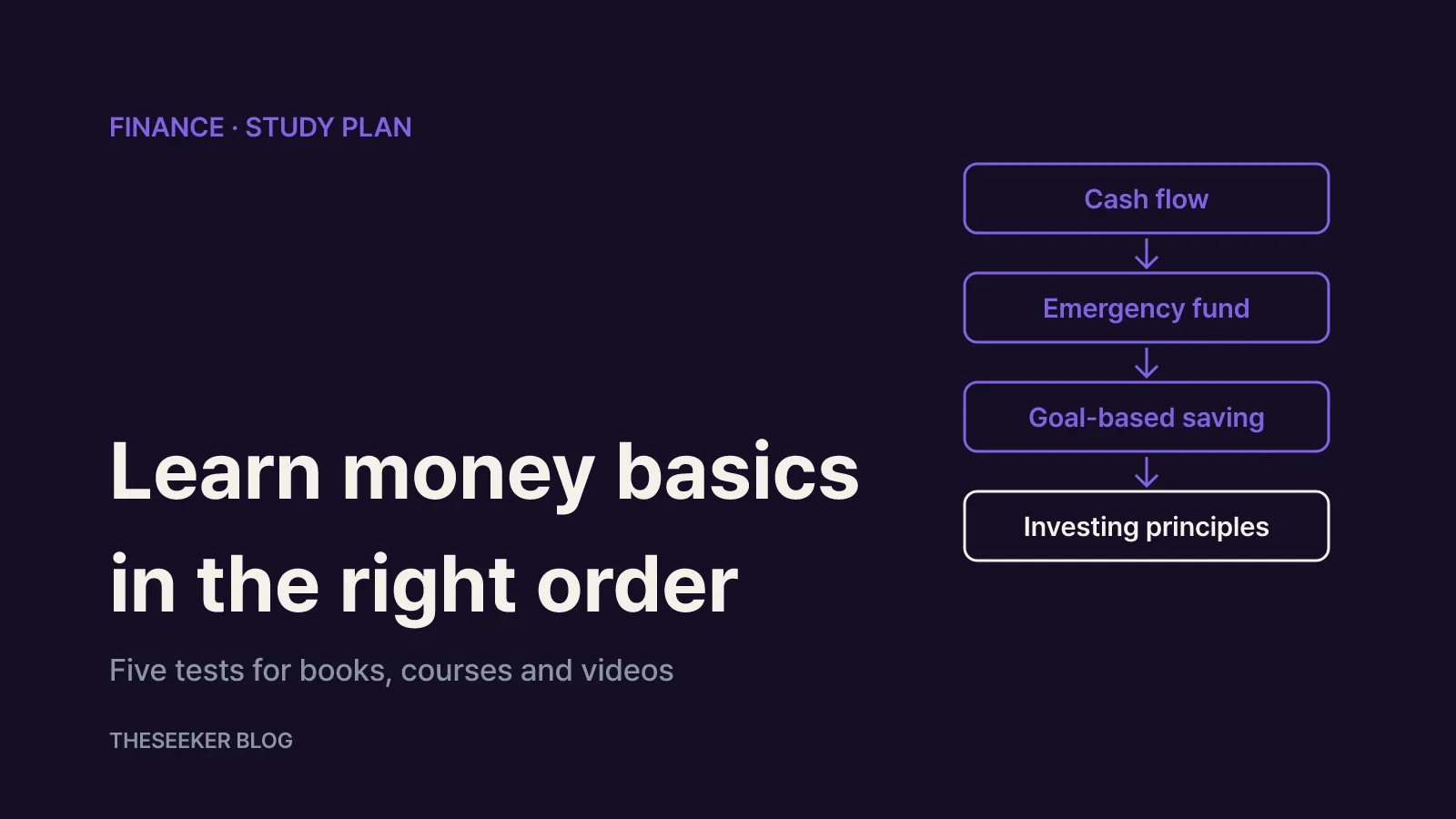
Learn personal finance in a deliberate order: cash flow, an emergency fund, goal-based saving, then tax-advantaged accounts and investing principles. Here is how to vet books, courses and YouTube channels before you trust them.
 Ethan Caldwell
In this post
- Learn personal finance in four stages: flow, buffer, goals, investing
- Your first month: a cash flow sheet and an emergency fund target
- Five tests for choosing personal finance books, courses and videos
- Social media red flags that mean stop
- Build a four-week curriculum from free public material
- A review routine that turns study into action
- Sources
- Frequently asked questions
As of October 2026, the most reliable way to learn personal finance basics is to study in a fixed order: understand your cash flow, build an emergency fund, plan goal-based saving, and only then learn tax-advantaged accounts and investing principles. Choose books, courses and videos by asking whether they fit the stage you are at, how their creator makes money, whether they exaggerate returns, and whether they cite sources and dates. Content that opens with stock picks or promises of high returns does not belong on a beginner's reading list.
This guide is for people starting their first job or taking charge of their money for the first time. It does not recommend any product or security. It draws on public material from the U.S. Securities and Exchange Commission (SEC), the Consumer Financial Protection Bureau (CFPB), and Korea's Financial Supervisory Service (FSS) and government policy portal, because the same beginner questions, and the same scams, show up in both countries.
Learn personal finance in four stages: flow, buffer, goals, investing
Search for "personal finance for beginners" and you get thousands of books, courses and channels at once. Most beginners do not stall because information is scarce; they stall because they consume it in no particular order.
A useful backbone is the financial planning process. A Korean government policy briefing on early-career financial planning, based on an FSS guidebook, splits planning into six steps: set financial goals, gather information, assess your current position with a balance sheet and a cash flow statement, draft a plan, carry it out, and review and revise it regularly. Turned into a study sequence, that becomes four stages:
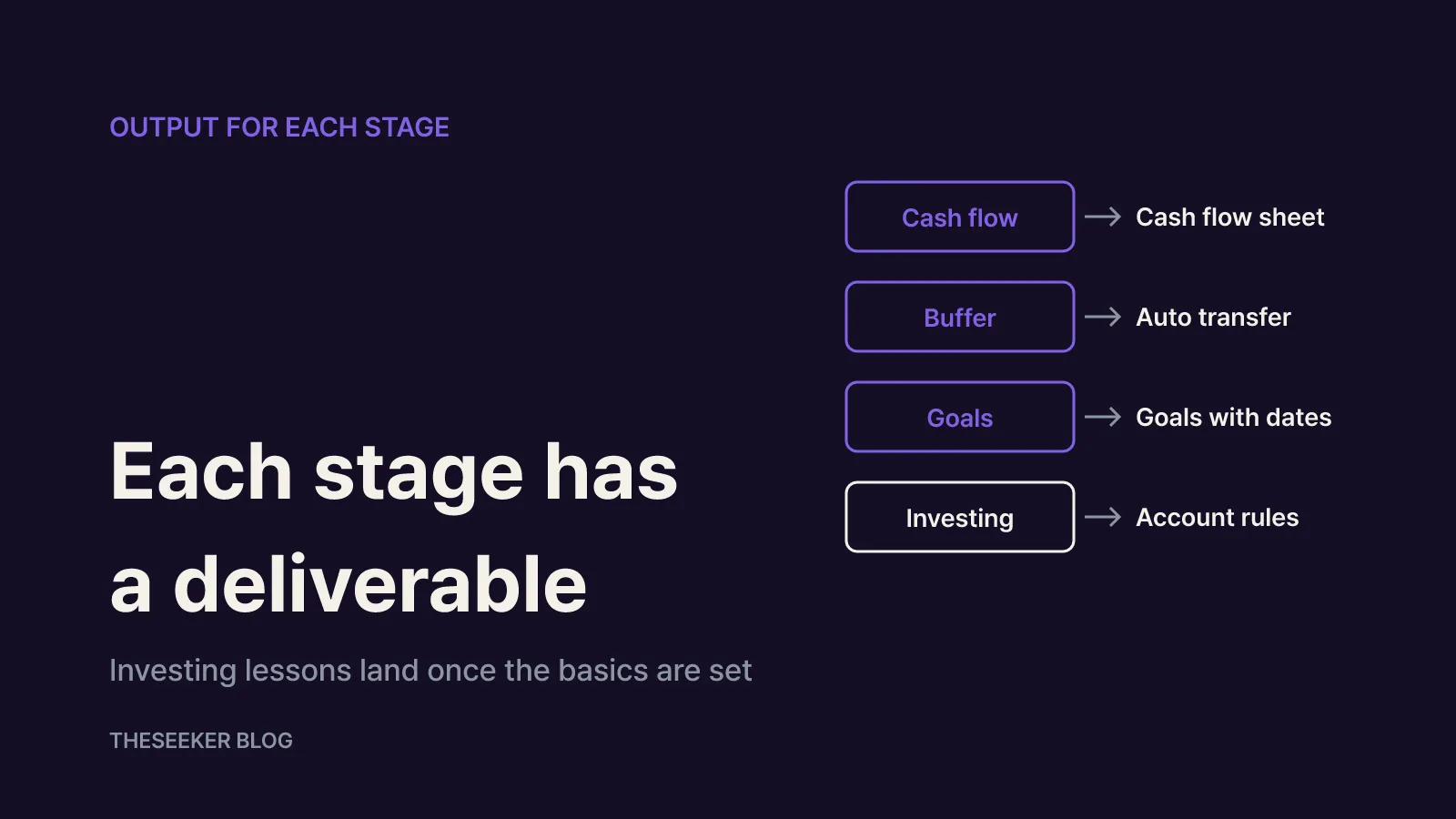
- Cash flow: what comes in each month, fixed costs, variable spending, and irregular costs that hit a few times a year.
- Buffer: an emergency fund, plus the basic idea of insuring against risks you could not absorb yourself.
- Goals: what you are saving for, when you need it, and how much, so each goal gets a method that matches its time frame.
- Tax-advantaged accounts and investing principles: the rules and restrictions of accounts with tax benefits in your country, and core concepts such as risk, diversification and fees.
Investing comes last not because it is unimportant but because money without a defined purpose tends to be pulled out at the worst moment. If an urgent bill forces you to sell, you lock in whatever loss the market hands you that week. Once the first three stages are settled, investing lessons have somewhere concrete to land.
Free public material often follows the same arc. The FSS describes its Life-Cycle Financial Guidebook for early-career adults, developed in 2025, as covering the planning process, income and spending management, the basics of saving and investing, and saving for specific goals. Look for the equivalent from your own country's regulators before buying anything.
Your first month: a cash flow sheet and an emergency fund target
In month one, building your own numbers beats reading more books. A spreadsheet, a budgeting app or a notebook all work. What matters is how you sort the lines:
- Fixed costs: rent, phone, insurance premiums, loan payments.
- Variable spending: groceries, transport, shopping.
- Irregular costs: holidays, gifts, travel, annual renewals.
- Saving and investing: money you set aside as soon as you are paid.
Listing irregular costs separately, then dividing a year's worth by twelve, is what turns a budget from wishful to realistic.
Next comes the buffer. The CFPB's guide to building an emergency fund defines it as a cash reserve set aside for unplanned expenses such as car or home repairs, medical bills or a loss of income. Without one, even a minor shock can push you onto credit cards or loans, where interest and fees can make the original cost significantly larger. The CFPB says the right amount depends on your situation and suggests looking at the unexpected costs you have actually faced and what they cost.
Three of its strategies suit beginners especially well:
- Automate it. Set a recurring transfer from checking to savings, and keep an eye on balances so the transfer does not trigger an overdraft fee.
- Manage cash flow. Track when money arrives and leaves so you are not short at the end of the month.
- Use one-time money. Move part of a tax refund, bonus or cash gift straight into the fund.
The CFPB adds that the fund should be safe, accessible and somewhere you will not be tempted to spend it on non-emergencies, such as a dedicated bank or credit union account.
Five tests for choosing personal finance books, courses and videos
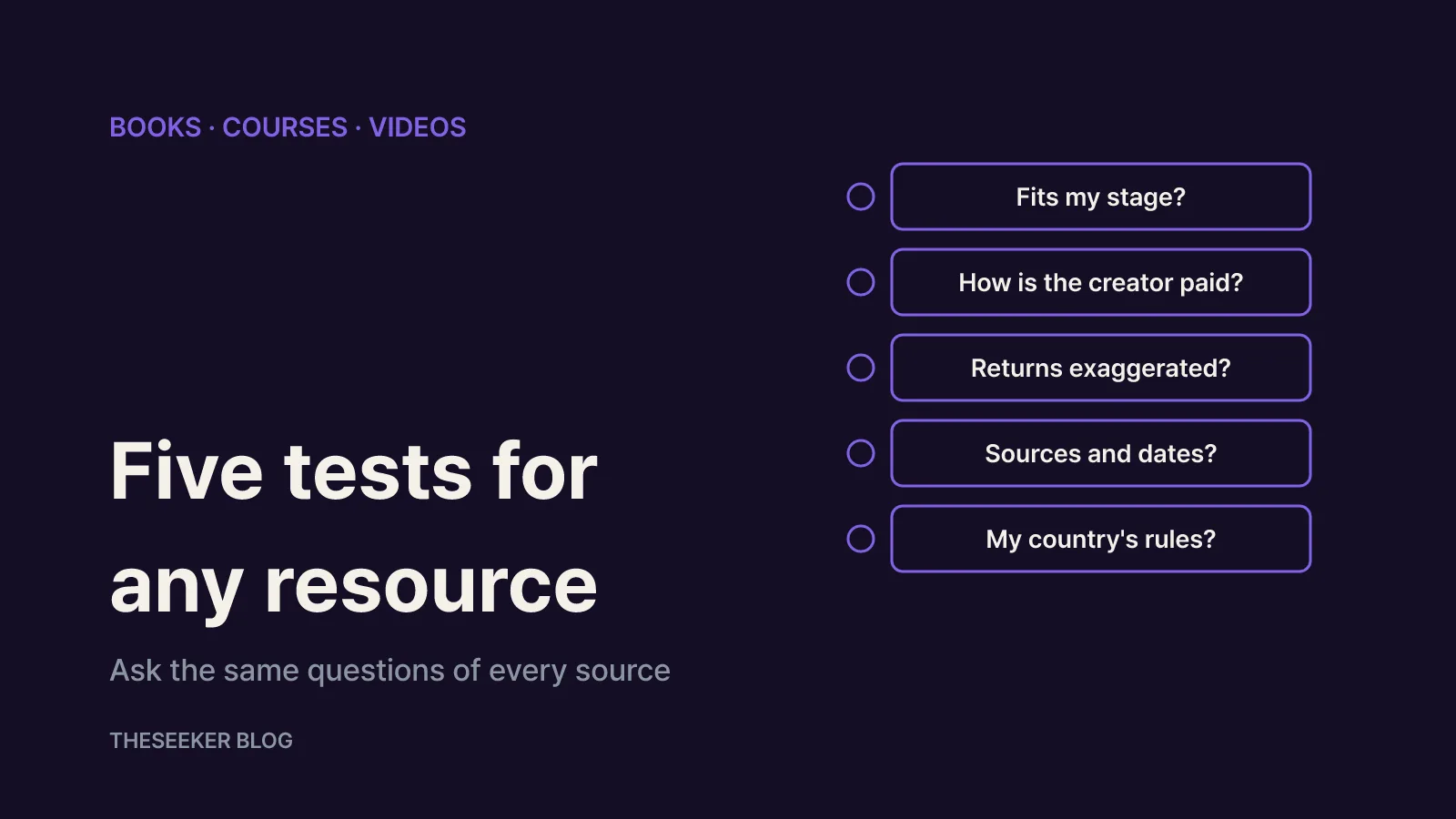
Apply the same five questions to a bestseller, a paid course or a free video.
1. Does it match your stage? A chart-reading course is entertaining, but useless if you have not mapped your cash flow. Label each resource with one of the four stages. At the start, prioritise material on budgeting, emergency savings, goal setting, interest and compounding, and risk and diversification.
2. How does the creator make money? In an Investor.gov piece on finfluencers and celebrities, the former director of the SEC's investor education office lists why social media alone is a poor basis for decisions: these voices do not know your finances or risk tolerance, may be paid for their posts, may chase clicks and leave out important information, may exaggerate their credentials, and are likely not registered investment professionals. Look for sponsorship labels, paid memberships and sign-up links, then ask how the conclusion serves that business model.
3. Does it exaggerate returns? Phrases like "guaranteed", "risk-free" or "double your money fast" should disqualify a beginner resource. Good teaching material discusses losses, time frames and costs alongside potential gains.
4. Does it cite sources and dates? Rates, tax rules and contribution limits change. Prefer material that names the agency behind each figure and the date it applies to. Older books are fine for concepts, but check every rule and number against current official guidance.
5. Is it about your country? Many popular books are written for one tax system. Account names and rules rarely transfer across borders, so keep separate notes for universal concepts and country-specific rules.
Formats have trade-offs too. Books are structured but can be out of date. Courses let you ask questions but cost money, and some end in a sales pitch. Videos are free and current but favour sensational topics. A sensible mix is regulator material for the skeleton, books to deepen concepts, and videos as a supplement.
Social media red flags that mean stop
While learning, you will run into free stock tips and invitations to private groups. In a February 2026 investor alert on social media stock tip scams, the SEC lists three red flags: clicking an ad and being added to an investment group chat, being contacted by someone claiming to be a famous investment professional or an employee of a registered firm, and being promised high returns with little or no risk. It describes scammers first recommending well-known companies to build trust, then steering victims into smaller companies whose prices later plummet.
Korea's regulator reports the same pattern. In FSS consumer alert 2026-3, issued in January 2026, it warned that fraudsters were impersonating staff of well-known brokerages, using AI deepfakes to pose as real experts, and luring investors through links into group chats and fake trading apps. Its advice: be wary of anyone introducing themselves as a brokerage employee, ignore promises of insider information and high returns, never transact with anyone who uses links to push chat rooms or app installs, and stop and report immediately if you suspect an illegal operator.
Both regulators share one rule: verify identity through an official channel you find yourself, never through the link or phone number you were given. In the U.S., the SEC points to the free background search on Investor.gov and to contact details in a firm's Form CRS. In Korea, the FSS offers a lookup of licensed financial companies. A simple beginner policy is to leave individual stock-tip content off your study list entirely.
Build a four-week curriculum from free public material
Spend a month on free material before buying books; you will discover which ones you actually need.
- Week 1, cash flow: read the planning and spending sections of a regulator guide and build your cash flow sheet.
- Week 2, buffer: set an emergency fund target and an automatic transfer, and note what kinds of risk insurance is meant to cover.
- Week 3, goals: split goals into money needed within a year, in a few years, and far ahead such as retirement, with an amount and date for each.
- Week 4, accounts and investing principles: pick one tax-advantaged account available in your country (in Korea, for example, an ISA, a pension savings account or an IRP) and confirm its eligibility rules, early withdrawal penalties and tax conditions from official sources. Then study risk, diversification and fees.
Keep a list of questions that stumped you. The right book is the one whose table of contents answers them.
A review routine that turns study into action
The last step of the planning process is regular review, so build it into your calendar.
- Monthly: update your cash flow sheet and compare budget with actual spending.
- Quarterly: check progress toward your emergency fund and each savings goal.
- Yearly: revisit goals after changes in income, housing or family, and re-check any rules that may have changed.
For each new resource, ask two questions: which stage does this serve, and does it pass the five tests? The goal of learning personal finance is not to know everything, but to be able to explain every decision you make about your own money.
Sources
- 금융감독원 소비자경보 2026-3호: 코스피 및 코스닥 열풍 속 불법 리딩방 주의
- 금융감독원 e-금융교육센터: 생애주기별 금융생활 가이드북 1권 사회초년기
- 대한민국 정책브리핑: [슬기로운 금융생활] 5화. 사회초년기 재무설계
- Investor.gov: Finfluencers, Celebrities, Social Media: Should You Listen To Them?
- Investor.gov: Social Media and Stock Tip Scams – Investor Alert
- CFPB: An essential guide to building an emergency fund
Frequently asked questions
Should I start learning personal finance with a book?
Not necessarily. Free regulator material, such as investor education pages from the SEC and CFPB or Korea's FSS guidebooks, covers the planning process, budgeting and saving basics. Use it first, then pick a book whose contents answer the questions you got stuck on.
Can I learn personal finance from YouTube alone?
Videos work as a supplement, but they lack structure and favour sensational topics. Check whether a video fits your stage, whether the creator is paid or selling memberships, and whether it cites sources and dates.
What should I check before paying for a personal finance course?
Make sure the syllabus matches your stage, that it does not promise guaranteed or high returns, and that it does not funnel you into group chats, app installs or product sales. Regulators flag those patterns as common signs of investment scams.
When should a beginner start learning about investing?
After you have a cash flow sheet, an emergency fund plan and goals with dates. Knowing when you will need the money lets you apply concepts like risk and time horizon to your own situation.
How do I check whether a finfluencer or adviser is legitimate?
In the U.S., use the free background search on Investor.gov and contact firms only through details you verify yourself, such as those in a Form CRS. In Korea, the FSS offers a lookup of licensed financial companies. Never rely on links or numbers supplied by the person contacting you.
blog.theseeker.io/en/posts/how-to-learn-personal-finance-basics-books-courses-videos
Ethan Caldwell
Ethan covers the basics of managing money, from saving and credit to taxes, checking rates and terms against official guidance from banks and government agencies.
Read our editorial standards