Korean Property Registry Types: Land, Building or Aggregate?
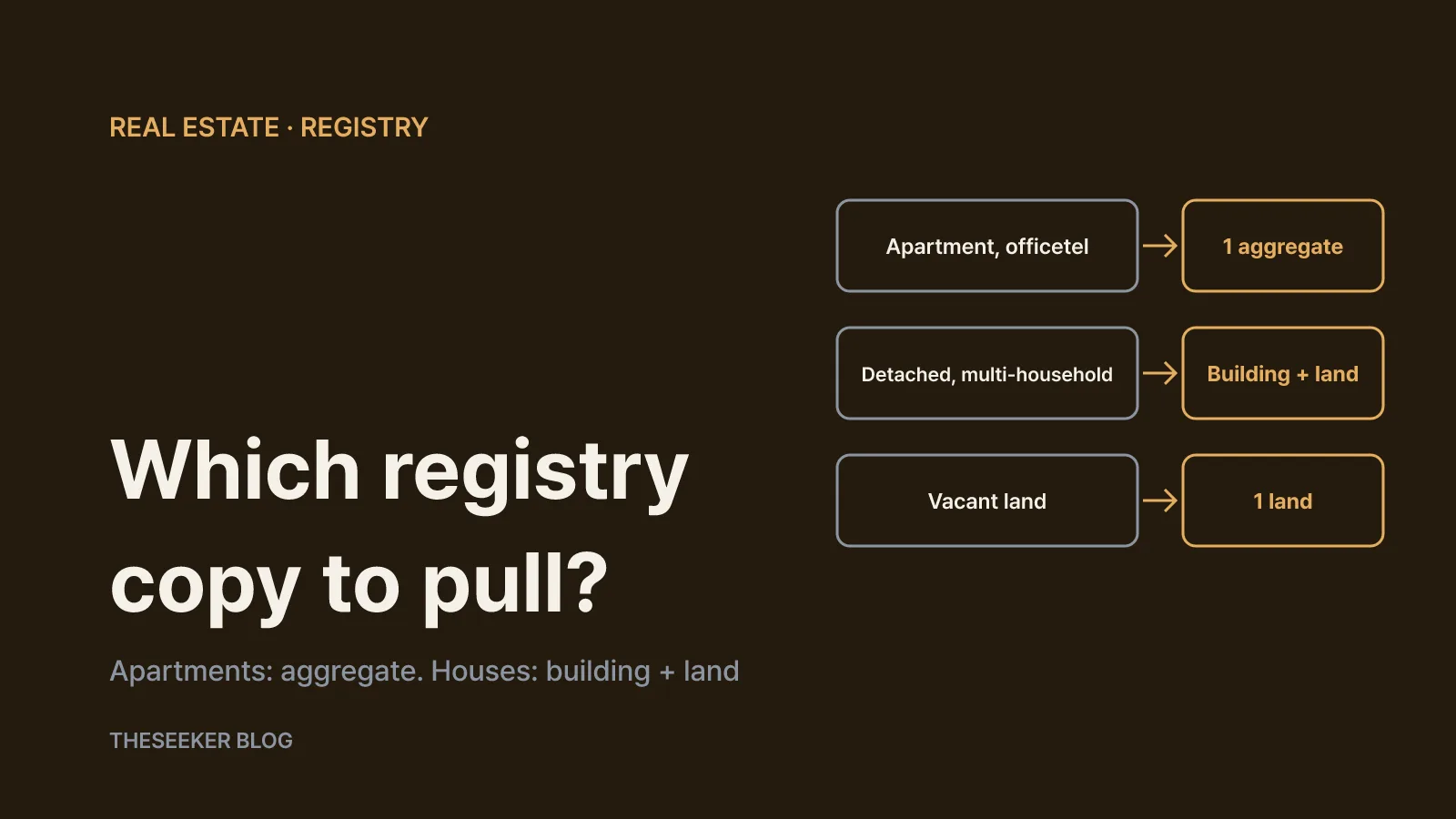
Apartments and officetels need one aggregate building registry copy; detached and multi-household houses need both a building and a land copy. Here is how to choose and what to check.
 Olivia Hartman
In this post
- How land, building and aggregate building registries differ
- Which copy to pull for each type of home
- Reading an aggregate building record: heading, land rights and separate registration
- Why detached and multi-household homes need both copies
- What to check in sections A and B before a lease
- How to issue a copy, fees and options
- What the registry will not tell you
- Sources
- Frequently asked questions
As of October 2026, the short answer is this: if you are renting or buying a unit that is registered unit-by-unit, such as an apartment or an officetel, you need one aggregate building (집합건물) registry copy. If the whole house is registered as a single building, such as a detached house or a multi-household house (다가구주택), you need two copies: one for the building and one for the land. Vacant land needs only the land registry. One exception matters: if an aggregate building record says "separate registration exists" (별도등기 있음) next to the land rights, pull the land registry as well.
In Korea the document people call deunggibu deungbon is officially a certificate of all registered matters (등기사항전부증명서). According to the Korea Housing & Urban Guarantee Corporation (HUG) jeonse fraud prevention guide, it shows the property's address and size along with who owns it and who holds mortgages, leasehold rights or other claims against it. This guide focuses on choosing the right type, then walks through what to read in each one. It is written for tenants and buyers dealing with Korean property; the rules described are Korean rules.
How land, building and aggregate building registries differ
Korean registration treats land and the building standing on it as separate pieces of real estate, so each normally has its own record. That is why a search on the Supreme Court's Internet Registry Office (iros.go.kr) labels results as land (토지), building (건물) or aggregate building (집합건물).
- Land registry: one record per parcel. It lists the lot number, land category, area, owner and any rights such as mortgages on the land.
- Building registry: one record for a whole building owned as a single property, typical for detached houses, multi-household houses and mixed shop-houses. It says nothing about the land.
- Aggregate building registry: a record for a building divided into separately owned units, such as apartments and officetels.
The aggregate record is special because one document bundles the whole building, your specific unit and the unit's share of the land (called land rights, 대지권). Article 30(3) of the Enforcement Rules of the Real Estate Registration Act states that, when issuing a certificate for a sectional building, the heading for the whole building and the record for the individual unit are treated as a single registration record. HUG warns about the opposite case: a building record can look clean while the land record is tangled with debts or seizures.
Which copy to pull for each type of home
← Swipe to see more
| Home type | Copy to pull | Also check |
|---|---|---|
| Apartment | 1 aggregate building | Land registry if "separate registration exists" appears |
| Officetel | 1 aggregate building | Building ledger use: residential or business |
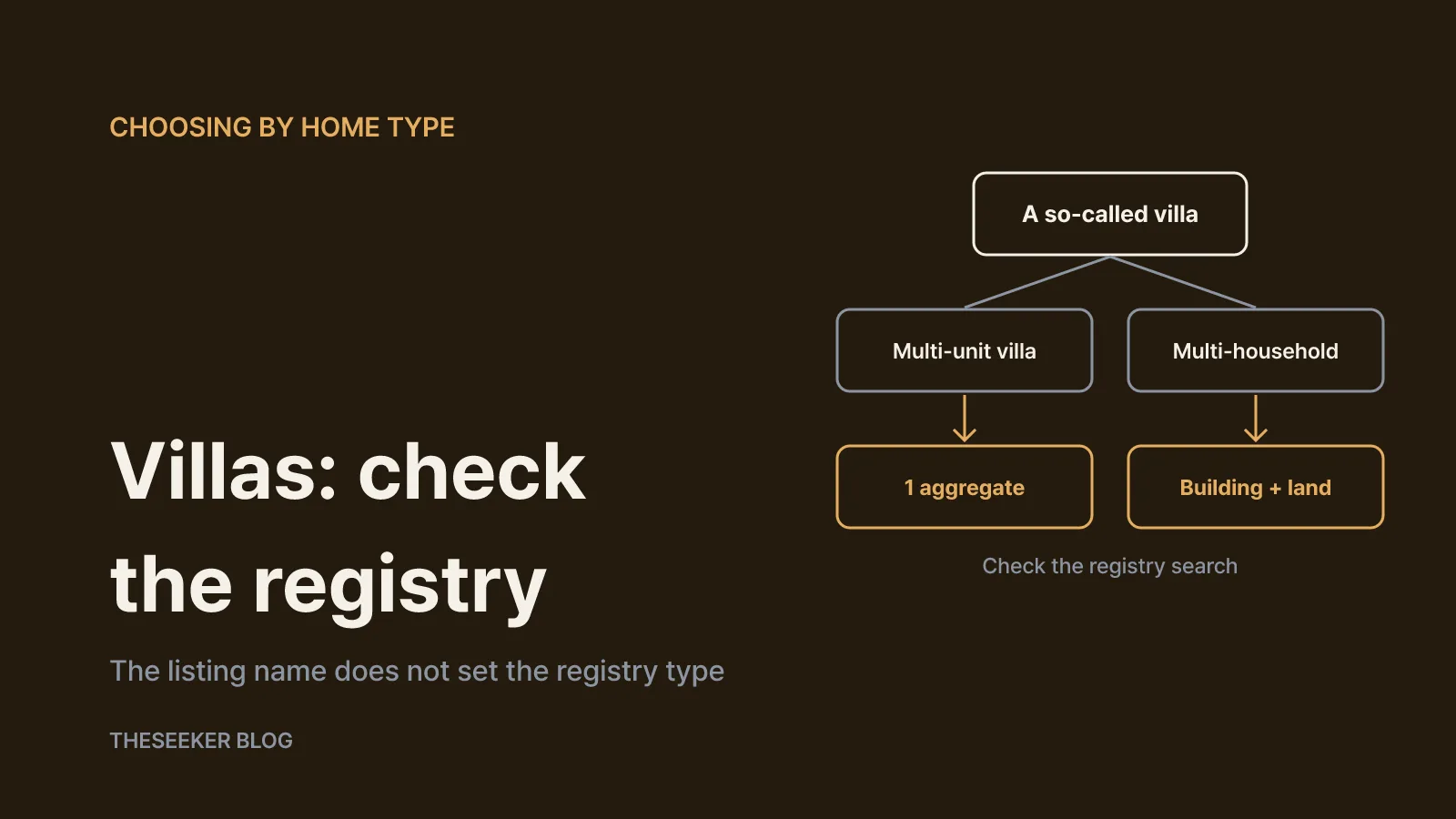
| Multi-unit villa (다세대·연립) | Usually 1 aggregate building | Building + land if search shows "building" |
| Detached house | 1 building + 1 land | Same owner for building and land? |
| Multi-household house (다가구) | 1 building + 1 land | Deposits of tenants who moved in earlier |
| Shop-house or neighborhood facility | 1 building + 1 land | Whether it is legally residential |
| Vacant land | 1 land | Land category and use limits |
The word "villa" causes most mistakes. In everyday Korean it covers both multi-unit houses (다세대·연립), which are usually divided into separately owned units, and multi-household houses (다가구), which have one owner for the whole building. They can look identical from the street. Rely on the property type shown in the Internet Registry Office search result rather than on the listing description. If the same lot shows "land" and "building" but no "aggregate building", pull both. If it shows "aggregate building", pick the exact unit number in your contract.
Reading an aggregate building record: heading, land rights and separate registration
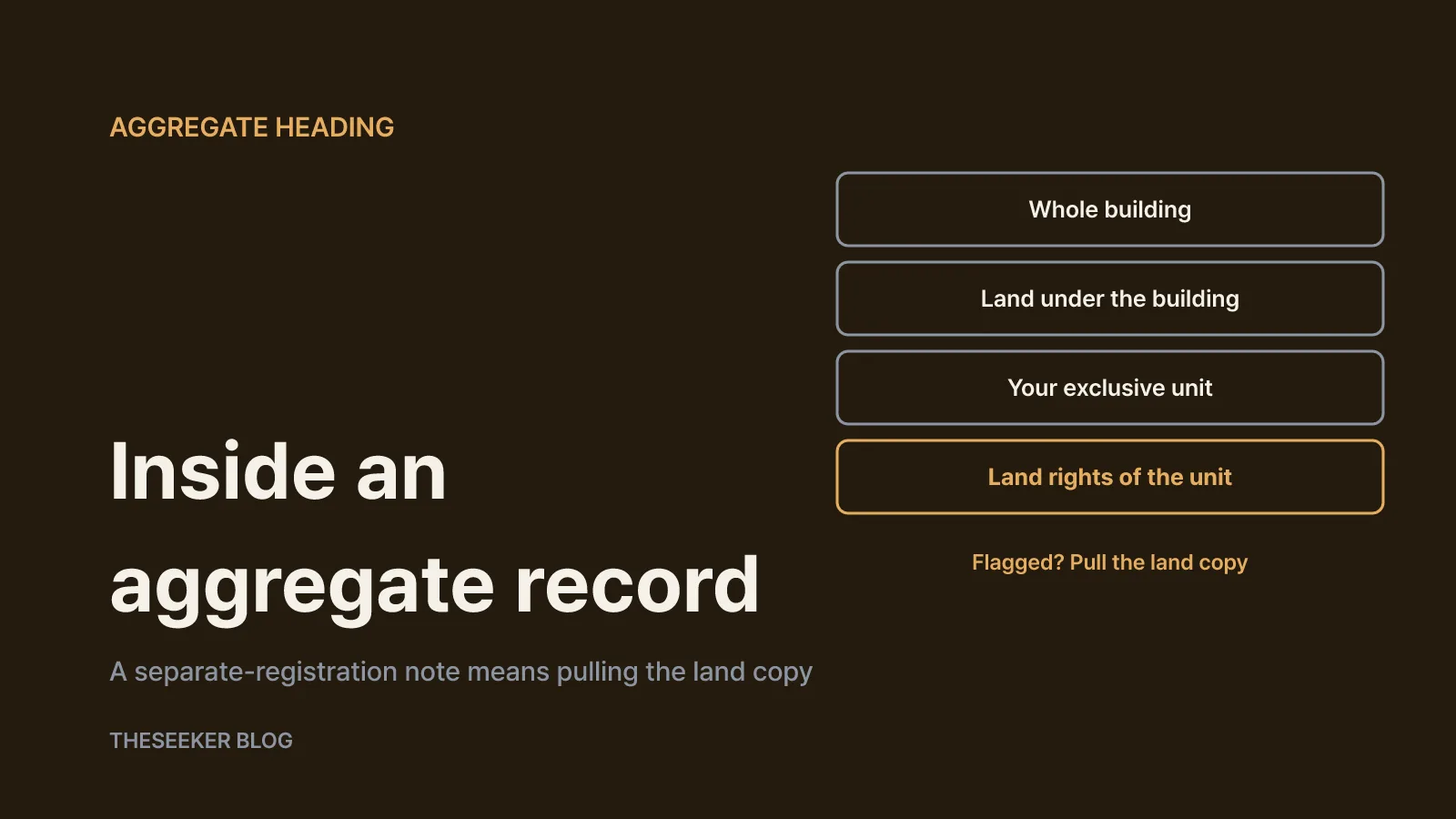
Using HUG's sample layout, the heading section (표제부) of an aggregate record has four parts:
- Description of the whole building: location, road-name address, structure and floor areas.
- Land subject to land rights: lot number, land category and total area of the site.
- Description of the exclusive unit: your unit number and its area, which is the figure used in the lease contract.
- Land rights: the type and share of land attached to the unit, written like "ownership land rights, 10/550".
Check two things here. First, whether land rights exist at all; HUG notes that a unit without land rights may be worth less. Second, look for "separate registration exists" beside the land rights, for example a note that a mortgage is registered on the land. That means the land carries its own claim, so pull the land registry for that lot and see whether the claim is still live. HUG also points out that if the building is a neighborhood facility rather than housing, a jeonse loan may be hard to get, so compare the use shown here with the building ledger.
Why detached and multi-household homes need both copies
With a building-only record you can miss half the picture. Compare the latest owner in section A (갑구) of both copies; if the building owner and land owner differ, find out why. Read section B (을구) of both, because a mortgage may sit on only one of them, and add up the maximum secured amounts across both. Treat seizure, provisional seizure, provisional registration or a trust in either copy as a warning sign.
Multi-household houses add another layer. Because there is one owner, every tenant in the building competes for priority if it goes to auction, and the registry does not show other tenants' deposits. HUG suggests asking the landlord for consent to check fixed-date (확정일자) records, and if the landlord refuses, adding a protective clause and checking the move-in and fixed-date records at the community service center after signing.
What to check in sections A and B before a lease
Every type follows the same three-part structure: heading, section A for ownership and section B for other rights.
- Section A: the last listed owner is the current owner and should match the landlord on your contract. Seizures, provisional registrations or a compulsory auction decision limit ownership, and HUG advises against signing in those cases. If a trust is registered, the landlord generally cannot lease without the trust company's consent.
- Section B: note the maximum secured amount of each mortgage, which HUG says is usually set at about 120% of the loan. HUG's general benchmark is that senior debts plus your deposit should stay at or below 80% of the home's value. Check whether any jeonse right or leasehold registration belongs to a tenant who was never repaid.
HUG recommends checking the registry before signing and again right before paying the balance, since a landlord could take out a loan or sell in between.
How to issue a copy, fees and options
Anyone can obtain a copy; you do not need the owner's consent. The Government24 service page for building registry certificates lists online, in-person and kiosk issuance with no application form or supporting documents. Fees are KRW 1,000 per copy online or at a kiosk and KRW 1,200 in person (page last confirmed September 5, 2024). On-screen viewing costs KRW 700 according to HUG. Online issuance runs through iros.go.kr.
Options matter. Choosing "including cancelled entries" shows past history, such as repeated mortgages or frequent ownership changes. Under Article 30(2), trust documents and joint collateral (jeonse) lists are included only if you request them, so tick those when section A shows a trust or section B shows joint collateral. Under Article 30(4), a property with a pending registration application may be issued with a note that processing is under way; find out what is being registered before you sign.
What the registry will not tell you
HUG lists gaps that no registry type covers. A tenant who has not registered a leasehold may not appear, so check move-in household records and fixed-date records. Unpaid national or local taxes on the property can take priority over your deposit at auction, and only the landlord can request tax payment certificates. If the landlord employs staff, unpaid wages can also rank ahead; a social insurance payment certificate from the landlord offers a clue. Choose the right registry type first, then close these gaps with the landlord's documents before paying the balance.
Sources
Frequently asked questions
Do I need a separate land registry for an apartment in Korea?
Usually not, because the aggregate building record already shows the unit's land rights. If the record notes that a separate registration exists on the land, pull the land registry for that lot as well.
Is a Korean villa an aggregate building or a building?
It depends on how it is registered. Multi-unit villas (다세대·연립) are usually registered unit-by-unit as aggregate buildings, while multi-household houses (다가구) are registered as one building. Use the property type shown in the Internet Registry Office search.
How many copies do I need for a detached or multi-household house?
Two: one building registry and one land registry. Compare the owners in section A and the mortgages in section B of both.
How much does a Korean property registry copy cost?
According to Government24, KRW 1,000 per copy online or at a kiosk and KRW 1,200 at a registry office. HUG lists online viewing at KRW 700. Each copy is charged separately.
When should I check the registry during a lease?
Before signing and again right before paying the balance, because new mortgages or a sale can be registered in between.
blog.theseeker.io/en/posts/korean-property-registry-types-land-building-aggregate
Olivia Hartman
Olivia covers home buying, leases, mortgages and housing taxes, following official notices and legal guidance to explain where the rules and steps change.
Read our editorial standards