How to Check Apartment Subscription Schedules in Korea
Use the Cheongyak Home calendar, the APT listing table and each recruitment notice to find application days, winner announcements and contract dates for Korean apartment subscriptions.
 Olivia Hartman
In this post
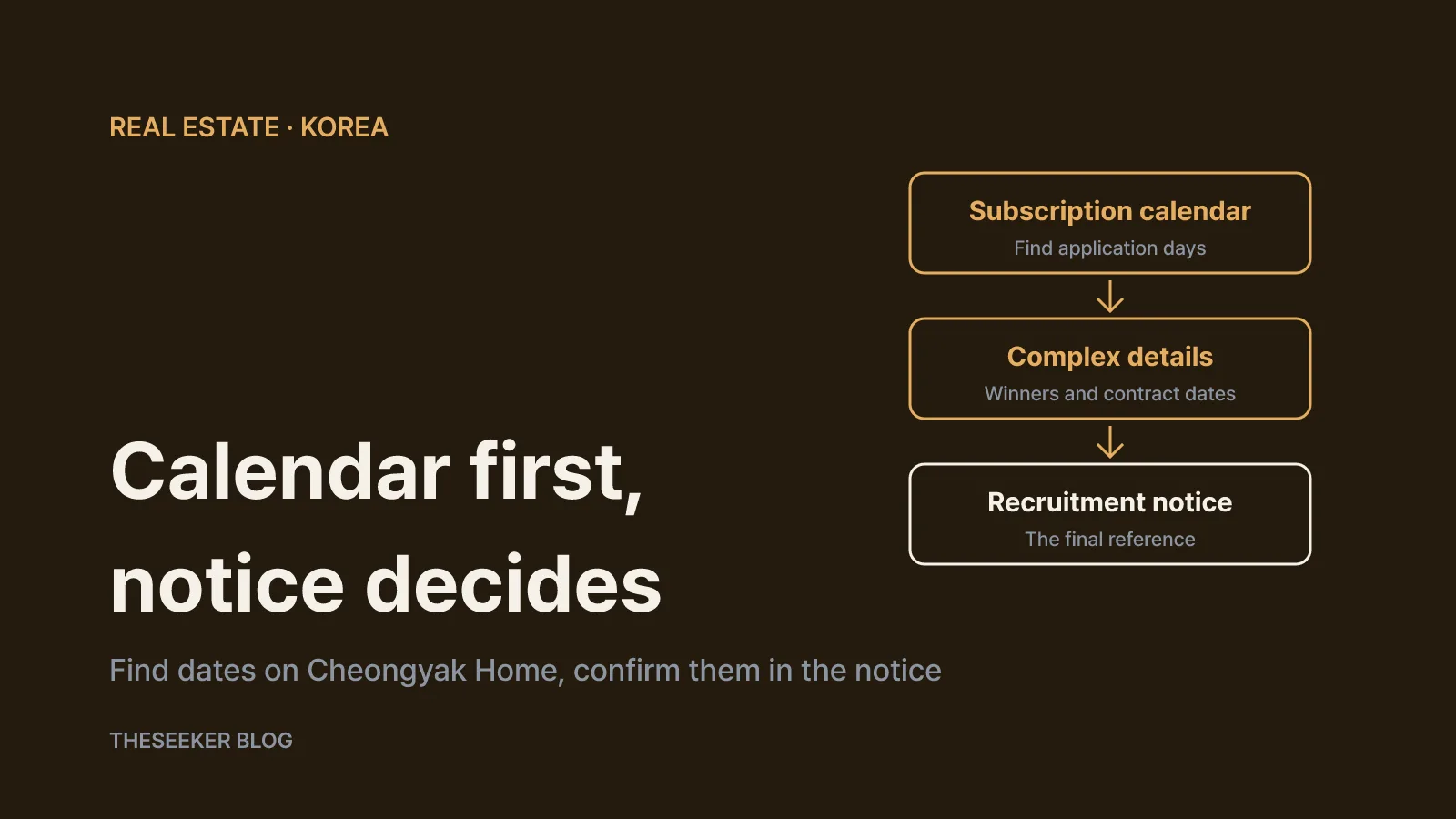
As of October 2026, the quickest way to check an apartment subscription (cheongyak) schedule in Korea is to open Cheongyak Home (applyhome.co.kr), the official application site run by the Korea Real Estate Board, go to Subscription Schedule & Statistics (청약일정 및 통계) > Subscription Calendar (청약캘린더), and then click a complex name to see its detailed schedule. The calendar shows when applications open; the recruitment notice for each complex (입주자 모집공고) is what actually governs your application day, the winner announcement and the contract period. Cheongyak Home's own listing page warns that its summary may differ from the facts and tells applicants to follow the recruitment notice when applying (Cheongyak Home APT listings).
This guide focuses on finding, reading and tracking dates. It does not cover eligibility scoring, special supply qualifications or the pricing of individual complexes.
Finding dates in the Cheongyak Home calendar
The site is in Korean, so it helps to know the menu labels. Under the top menu 청약일정 및 통계, the first item is 청약캘린더(청약일정) (Cheongyak Home calendar). You pick a year and month at the top, and the "today" (오늘) button brings you back to the current month. The grid only has Monday-to-Friday columns, because applications are taken on weekdays.
Two filters make the calendar far more useful:
← Swipe to see more
| Filter | Options shown in October 2026 | Tip |
|---|---|---|
| Supply type (공급유형) | Apartments: special supply, 1st priority, 2nd priority, unranked (무순위), discretionary supply, resupply after illegal activity; officetels and similar units; publicly supported private rentals | Keep only the apartment sub-types if you track regular apartment rounds |
| Supply region (공급지역) | Seoul, metropolitan cities including Sejong, and provinces | Select only the regions where you could realistically apply |
Once filtered, the same complex often appears on several consecutive days. That is expected: special supply, 1st priority and 2nd priority applications are normally taken on different days. Clicking the complex name opens its announcement details. Because the calendar centres on application days, it does not show the winner announcement, document window or contract dates at a glance. Public housing that LH takes applications for directly should also be checked on LH's own application portal (Jupsunow schedule guide).
Comparing complexes in the listing table
If the calendar works date first, the Sale Information/Competition Rates (분양정보/경쟁률) > APT page works complex first (Cheongyak Home APT listings). It covers upcoming complexes and housing supplied within the past five years, and you can search up to 12 months at a time. Filters include housing type (private 민영 or national 국민), region, sale or rental type, and the complex or builder name.
The result columns are region, housing type, sale/rental, complex name, builder, contact number, notice date (모집공고일), application period (청약기간), winner announcement (당첨자발표), special supply status and 1st/2nd priority competition rates. The three date columns are the ones to watch. You can sort by application period or winner announcement, which makes it easy to spot complexes that announce winners on the same day, something worth checking before you apply to more than one.
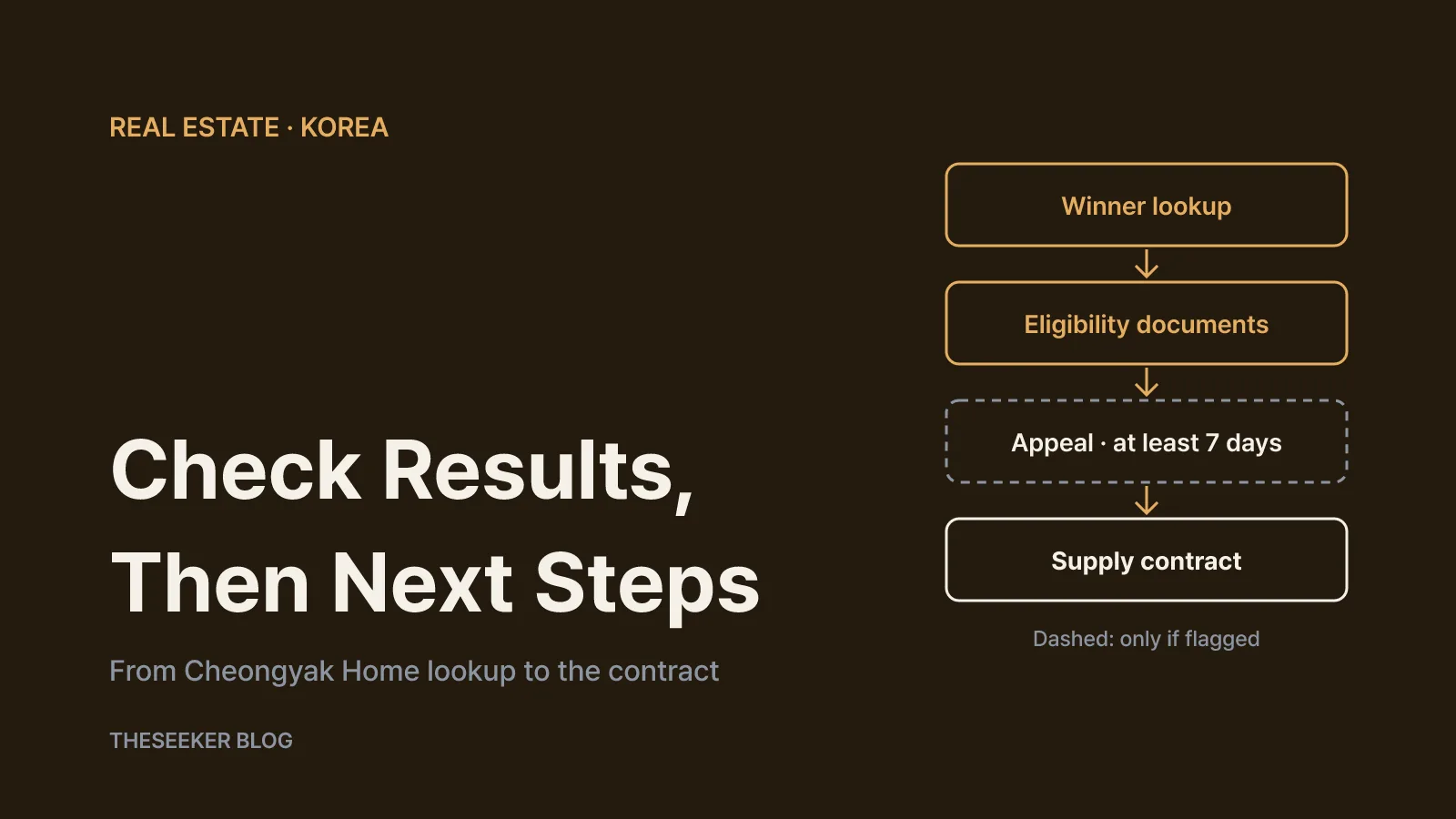
Clicking a complex name opens the recruitment notice, and the notice file can be downloaded from there. Dong-A Ilbo's housing column describes the same route: Subscription Schedule & Statistics, then Sale Information/Competition Rates, then the notice download (Dong-A Ilbo). Officetels, urban-type housing and private rentals sit on a separate tab, so a missing listing on the APT tab does not mean there is no notice.
Reading the schedule table in a recruitment notice
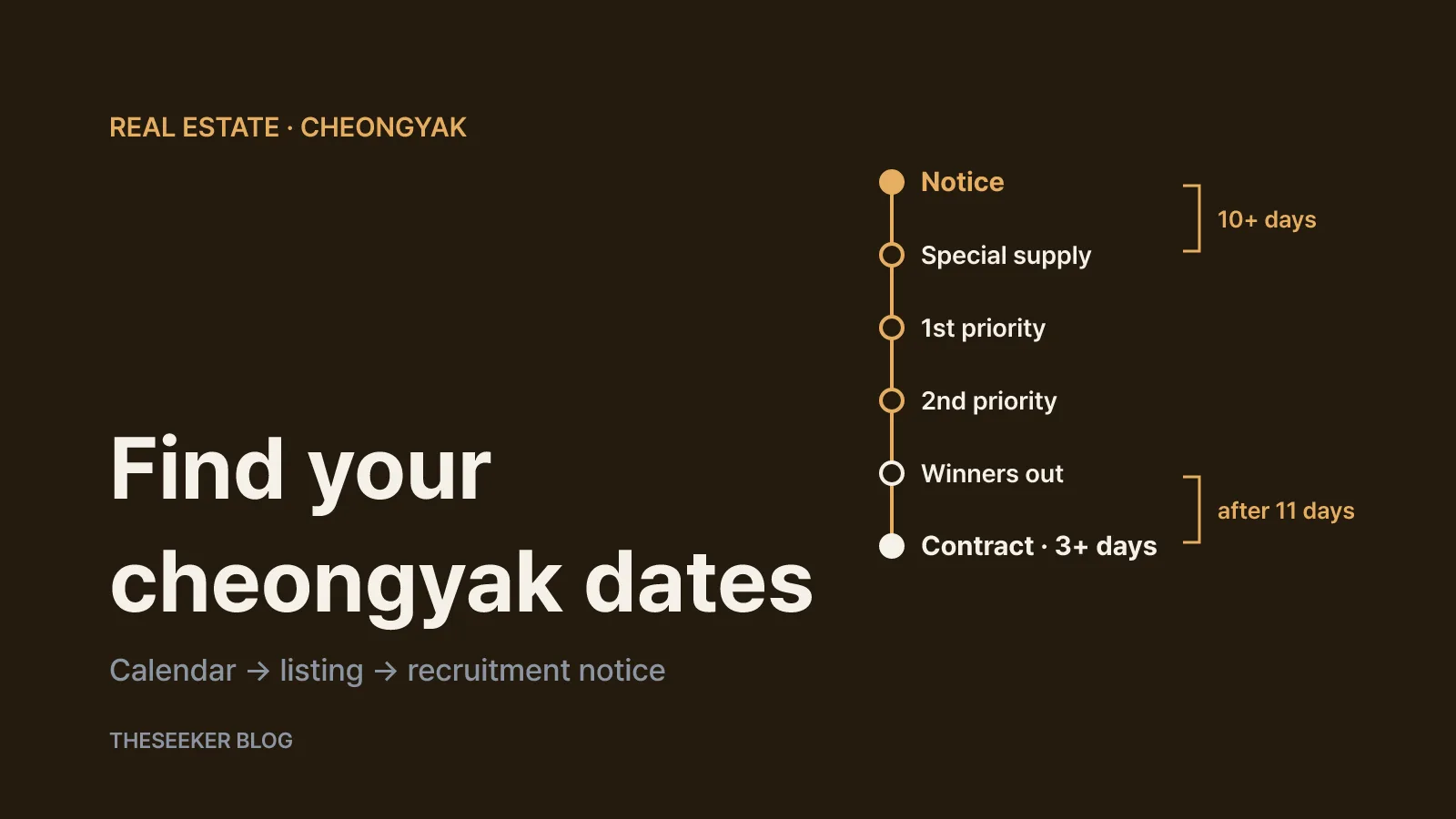
Near the start of every notice is a schedule table. The usual sequence is:
- Notice date: the reference date for eligibility. Residence, length of residence, age and subscription account requirements are judged as of this date, not the application day.
- Special supply applications: for groups such as newlyweds and first-time buyers.
- General supply, 1st priority: in regulated areas, local residents (해당지역) and other-area applicants (기타지역) may apply on different days.
- General supply, 2nd priority
- Winner announcement: Cheongyak Home's results lookup stays open for 10 days from the announcement date.
- Document submission: some notices state that missing this window is treated as giving up the contract.
- Contract signing: plan your down payment around this window.
A real example helps. According to Jupsunow's compilation, a non-regulated private complex in Hwaseong, Gyeonggi was announced on October 2, 2026, took special supply applications on October 12, 1st priority on October 13 and 2nd priority on October 14, announced winners on October 20 and signed contracts on November 2 to 4. That is 10 days from notice to first application and 13 days from announcement to the first contract day.
← Swipe to see more
| Step | Non-regulated example (Hwaseong) | Regulated example (Dongjak, Seoul) |
|---|---|---|
| Notice | Oct 2, 2026 | Jul 2, 2026 |
| Special supply | Oct 12 | Jul 13 |
| 1st priority | Oct 13 (locals and others same day) | Locals Jul 14 / others Jul 15 |
| 2nd priority | Oct 14 | Jul 16 |
| Winners | Oct 20 | Jul 23 |
| Contract | Nov 2 to 4 | Aug 3 to 5 |
The Seoul complex sat in a speculative overheated and subscription overheated district, so 1st priority was split over two days. Whether you count as a local resident decides which day you can apply, so read the regional priority rule before marking your date. Public sale housing can take much longer between announcement and contract because income and asset checks follow document submission; one public complex in Incheon took 55 days.
The minimum intervals behind the schedule
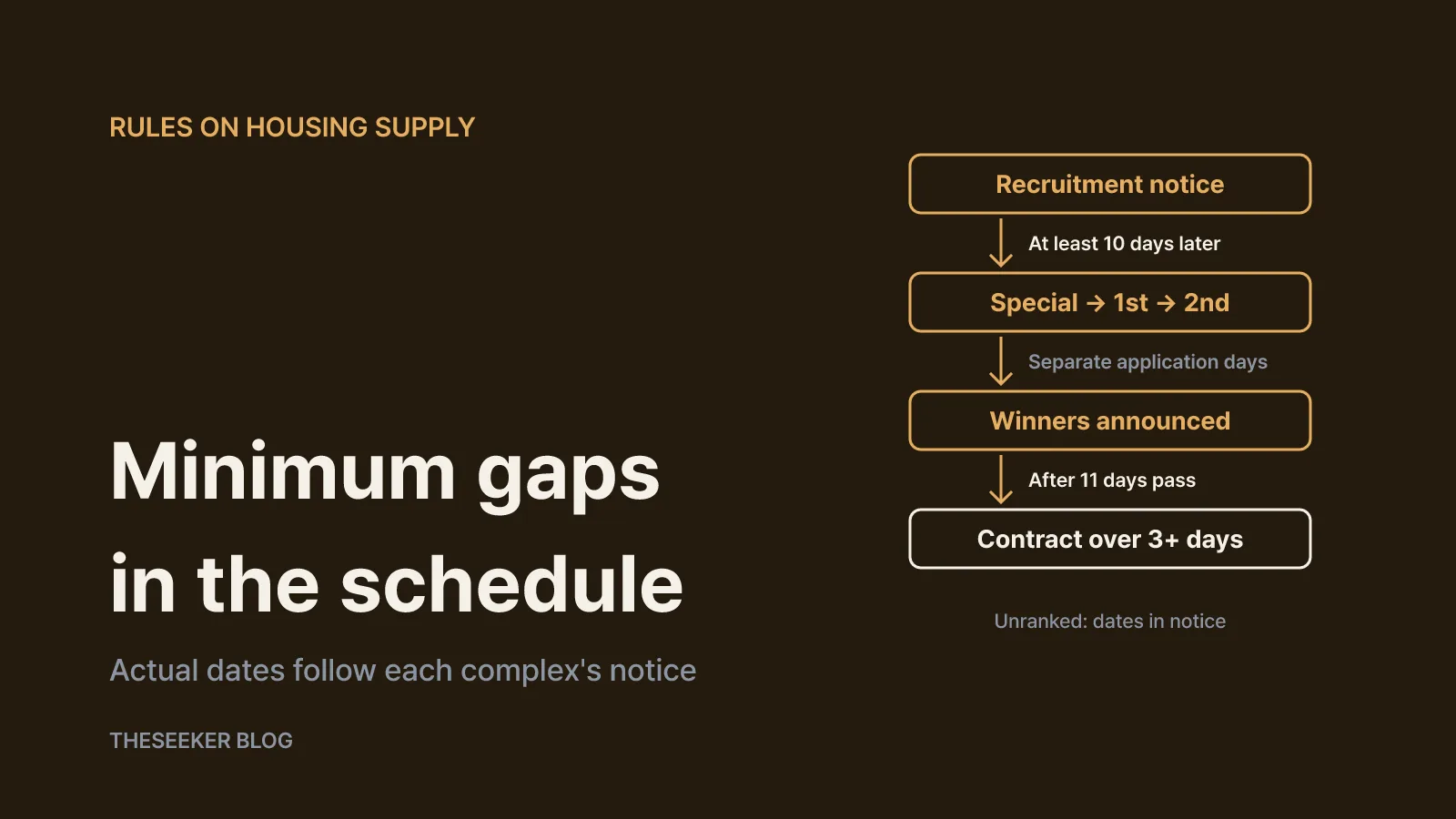
The gaps are not random. Jupsunow's summary of the Rules on Housing Supply, as in force from June 15, 2026, highlights three minimums (Jupsunow):
- A recruitment notice must be published 10 days before the first application day (Article 21). For some institution-recommended special supply, local authorities can shorten this to 5 days.
- In speculative overheated and subscription overheated districts, local and other-area 1st priority applications fall on different days, with locals first (Article 19(4)).
- Contracts are signed over a period of at least 3 days after 11 days have passed from the winner announcement (Article 59).
These are minimums, so use them to estimate when steps will arrive, not to set your own dates. Unranked rounds (무순위) and resupply of cancelled contracts follow contract dates set in the notice instead, and can move from application to contract within days. If you look at an unranked round, check first how little time you have to prepare the down payment.
What else to read in the notice
Dong-A Ilbo's guide suggests reading the regional priority rule near the front, the supply breakdown and prices (the down payment may be 10% at one complex and 20% at another), the eligibility and winner selection rules, and the option costs and cautions near the end. For private housing, any shortfall in the required account deposit must be topped up by the notice date, and closing the account before applying makes you ineligible, even if you met the priority rules on the notice date.
Setting alerts and building your own calendar
Under the same menu, Subscription Alert Application (청약알리미 신청) lets you register regions and supply types so you are notified when matching notices appear; the APT listing page also has an alert button. Login and a certificate are required, so confirm the notification options on the sign-up screen.
Treat alerts as a backup and copy these dates into your own calendar:
- Notice date: check residence, account status and home ownership as of this day.
- Your application day: special supply, local 1st priority or other-area 1st priority. Cheongyak Home accepts applications from 09:00 to 17:30, and cancellations close at 17:30 the same day.
- Winner announcement: check within 10 days, and confirm you have not applied to another complex with the same announcement date.
- Document window: start gathering papers right after the announcement.
- Contract dates: make sure the down payment can be transferred in time.
Before applying, the site's practice mode for announced complexes (공고단지 청약연습) lets you rehearse the screens for private general supply 1st priority. The helpline 1644-7445 (weekdays 09:00 to 17:30) can answer questions, though Cheongyak Home states that its consultations are for reference only and carry no legal effect. The recruitment notice remains the final word.
Sources
Frequently asked questions
Where can I see a complex's schedule before it appears on the calendar?
Confirmed application dates only exist once the recruitment notice is published. Supply plans from providers such as LH give rough timing in advance, but those dates are provisional. Registering your regions in Subscription Alert is the more reliable way to catch new notices.
If I move after the notice date, can I apply as a local resident?
No. Residence and length of residence are judged as of the recruitment notice date, so moving in afterwards does not make you a local resident for that notice.
How long can I check winner results on Cheongyak Home?
The results lookup is open for 10 days from the announcement date. After that, you can check through the subscription restriction lookup under eligibility checks or the APT winner lookup in the community menu.
What time do applications close on application day?
On Cheongyak Home, applications run from 09:00 to 17:30, and cancellations are only possible until 17:30 on the same day. Notices handled through LH's portal set their own hours, so check the notice.
blog.theseeker.io/en/posts/cheongyak-home-calendar-recruitment-notice-schedule
Olivia Hartman
Olivia covers home buying, leases, mortgages and housing taxes, following official notices and legal guidance to explain where the rules and steps change.
Read our editorial standards