How to Compare Mortgage Rates in Korea: What to Check
A step-by-step guide to comparing Korean mortgage rates using the Korea Federation of Banks disclosures, the FSS comparison site and loan comparison apps, including base rates, spreads and prepayment fees.
 Olivia Hartman
In this post
- Three places to compare Korean mortgage rates
- Reading KFB disclosures: base rate, spread and discretionary adjustment
- Using FinLife: minimum, maximum and last-month average rates
- What to check on loan comparison platforms and refinancing services
- Putting prepayment fees and discount conditions in the same table
- A mortgage comparison checklist to build before you talk to a lender
- Sources
- Frequently asked questions
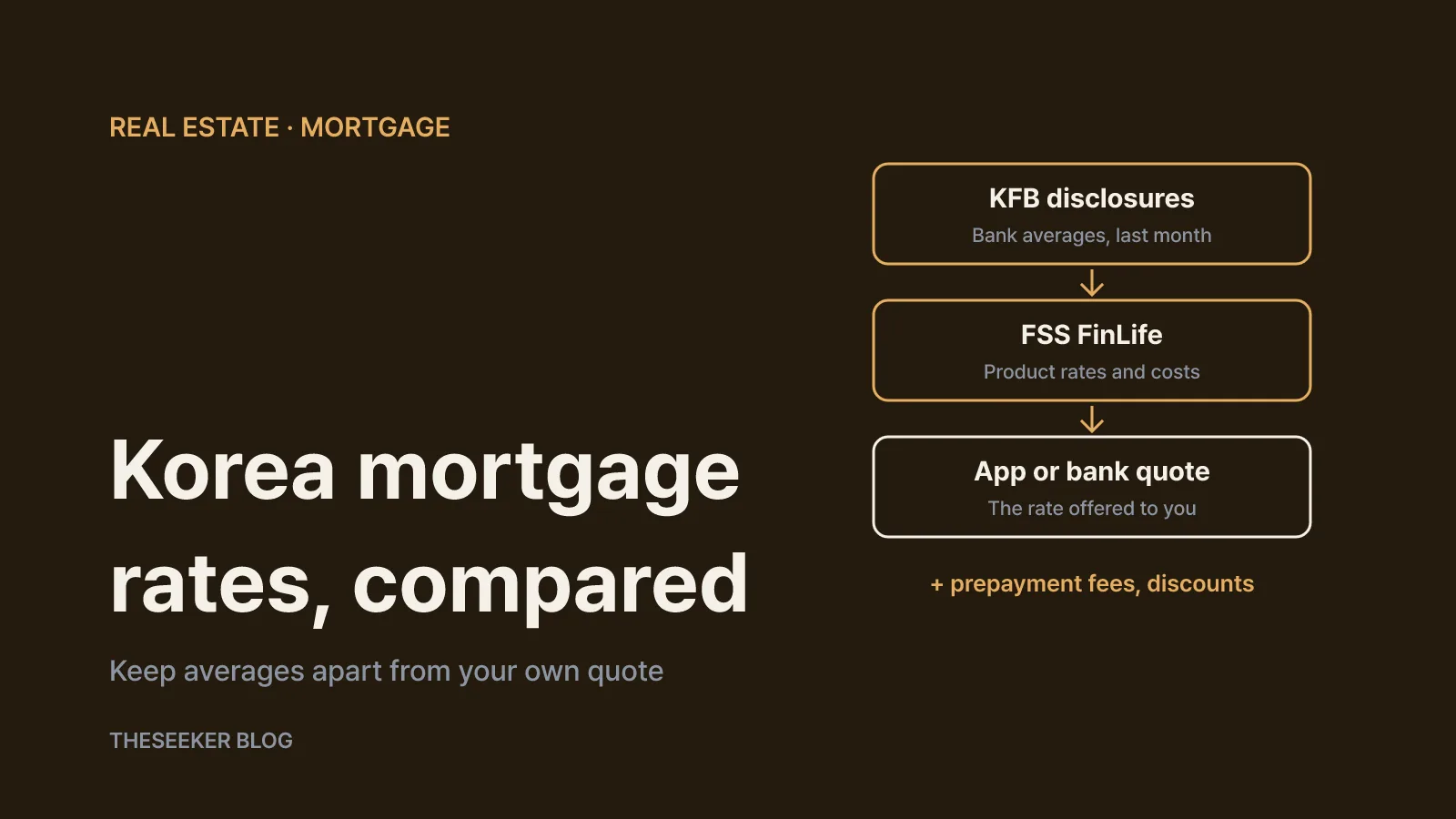
As of October 2026, the most reliable way to compare home loan rates in Korea is to use three tools in sequence. Start with the Korea Federation of Banks (KFB) consumer portal to see the average rate each bank actually charged on new mortgages last month and how that rate was built. Then use the Financial Supervisory Service's comparison site, FinLife ("Financial Products at a Glance"), to compare individual products under your own loan amount, term and repayment method. Finally, get a personalised quote from a loan comparison app or a bank's own app, and record the prepayment fee and discount conditions next to every rate. Disclosure figures describe the past; app quotes describe what is being offered to you. Keeping those two roles separate is what makes a comparison fair.
This guide does not recommend any lender. It explains which fields on each official screen matter, how to read them, and what else belongs in your comparison table, based on the wording the regulators and the KFB publish.
Three places to compare Korean mortgage rates
The three sources look similar but publish different kinds of numbers.
KFB loan rate disclosures. Banks report the rates on loans they newly issued during the previous month, broken down by credit score band. The list covers commercial, regional, internet-only and specialised banks. Because these are weighted averages of real loans, they show roughly where each bank is pricing right now. The KFB itself describes the data as a rough reference for comparing banks and tells borrowers to contact the bank for details.
FSS FinLife. This site lets you search mortgage products from banks, savings banks, credit unions and insurers in one place. You enter the home price, loan amount, term and housing type, and it lists each product's rate range and example repayments. It is product-level and very practical, but the repayment figures assume last month's average rate stays the same.
Loan comparison platforms and lender apps. When the Financial Services Commission (FSC) extended its online refinancing infrastructure to apartment mortgages in January 2024, it allowed borrowers to view their existing loan's rate and balance on a comparison platform and compare it with products from partner lenders. These quotes use your own credit data, so they are closer to what you will pay. The trade-off is that a platform only shows lenders it has partnered with.
In short: KFB shows each bank's recent price level, FinLife shows product terms and cost structure, and apps show the rate actually offered to you. It is normal for the three numbers to differ.
Reading KFB disclosures: base rate, spread and discretionary adjustment
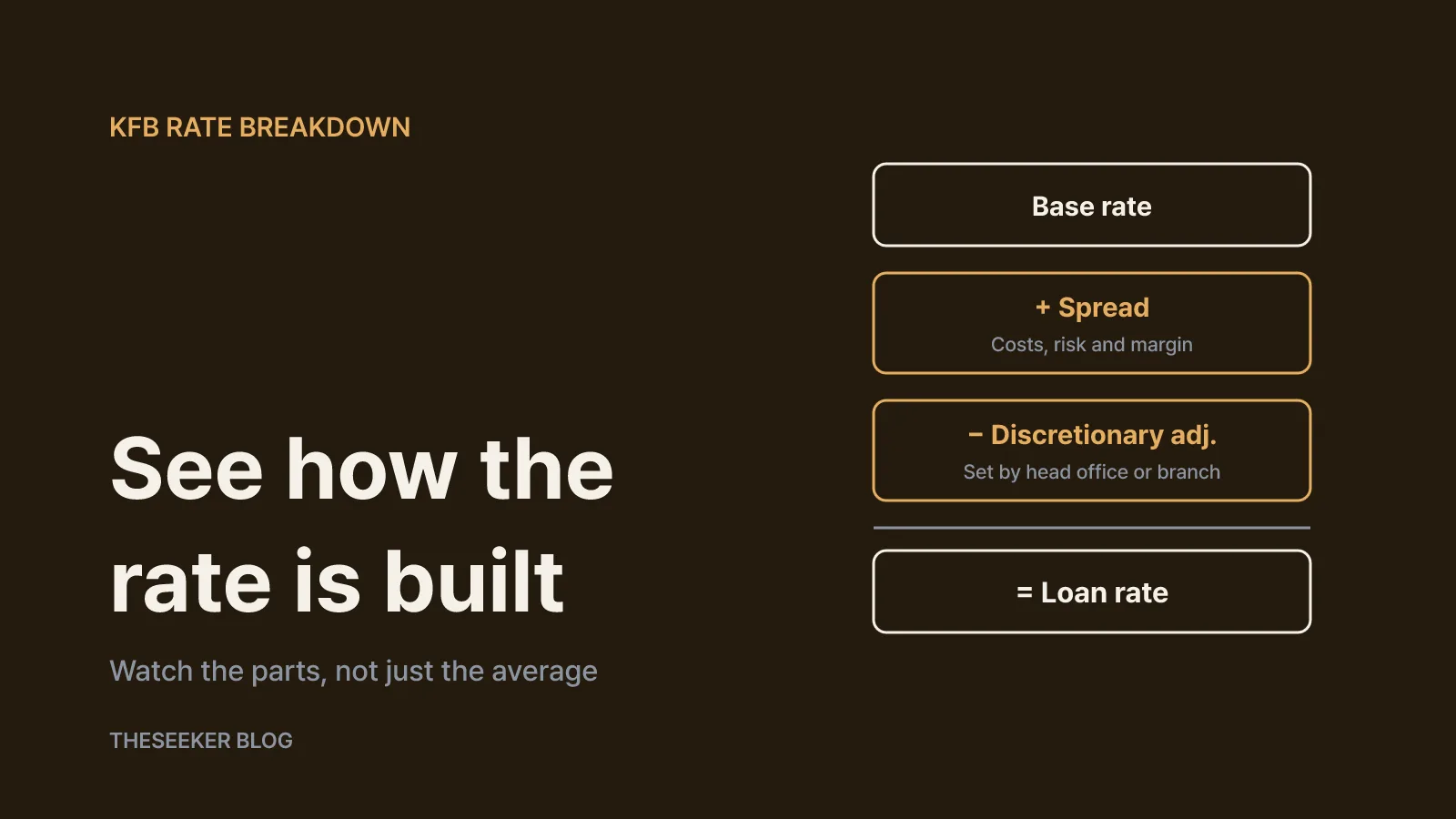
On the KFB household loan screen you choose a loan type, either amortising mortgages or bullet-repayment (interest-only) mortgages, and a detail view: the loan rate, a breakdown into base rate, spread and discretionary adjustment, or the loan-deposit rate gap. Use the breakdown view when you want to know why a rate is what it is.
For amortising mortgages, the disclosure covers household loans secured by housing with a maturity of 10 years or longer, where principal is repaid over the term. If you plan an interest-only loan, use the bullet-repayment screen so you compare like with like.
The KFB explains that a loan rate is the base rate plus a spread. Since July 2019 it has shown the discretionary adjustment separately, so the breakdown reads as loan rate = base rate + spread − discretionary adjustment.
- Base rate: the benchmark the bank uses to price the loan. For a variable-rate mortgage this is the reference index the bank links the loan to, and it can differ between products.
- Spread: what is added on top. According to the KFB it covers operating costs (staff and IT), legal costs (guarantee agency contributions and taxes such as education tax), a risk premium (expected loss by credit grade and collateral type) and the bank's target margin. It can change with expected losses and funding costs.
- Discretionary adjustment: rate changes decided by head office or a branch manager. Discounts such as preferential rates show up here, so a smaller adjustment can keep the final rate high even when the base rate falls.
Also check the credit score bands. Since August 2022 the disclosures use credit bureau scores in nine bands of 50 points, starting from 1,000. Looking at your own band gives a more realistic range than the overall average. However, the KFB notes that these bands are based on credit bureau scores and differ from each bank's internal credit grade, which is what determines your actual rate. A dash in a band means no loans matching that condition were issued that month, not necessarily that the bank refuses such borrowers.
Using FinLife: minimum, maximum and last-month average rates
On FinLife's mortgage page you start with the home price and loan amount. The site calculates a loan-to-value (LTV) ratio, but it is a simple ratio that assumes no senior liens or tenant deposits, so do not read it as your approved limit. Actual limits depend on each lender's collateral valuation, your income and the term.
Next you filter by term, housing type (apartment or non-apartment), rate type (variable or fixed), repayment method (bullet, equal principal or equal instalment), sector (banks, savings banks, credit unions, insurers), region and channel (branch, internet, smartphone, loan agent, phone). Filtering by smartphone or internet isolates non-face-to-face products.
The key result columns are:
- Minimum and maximum rate: the range a product can apply. The minimum usually assumes every discount is met, so do not treat it as your rate.
- Last-month average rate: the weighted average rate on loans newly issued in the month before the disclosure date. It is a more realistic anchor than the minimum.
- Average monthly payment, first and last payment, total borrowing cost (principal plus interest): examples calculated at the last-month average rate. The FSS states these are illustrative and will differ from actual repayments, but they are useful for comparing products under identical inputs.
Watch the rate-type label. FinLife classifies a hybrid loan as fixed if the fixed period is three years or longer, so a product listed as fixed may switch to a variable rate later. Open the details to see the fixed period and how the rate is reset afterwards.
Each product row also has separate tabs for preferential rates, prepayment fees and other details. The FSS warns that lenders change terms frequently and disclosures can lag, so confirm with the lender before signing.
What to check on loan comparison platforms and refinancing services
The main advantage of a comparison platform is that it shows terms based on your own data. According to the FSC, viewing your existing loans on a platform works through MyData, so you need to register for MyData first. At launch, existing-loan lookups and new-loan comparisons were available on business days from 9 a.m. to 8 p.m., and after choosing a product you applied through the lender's app or branch, with screening taking about two to seven days.
If you want to refinance, check eligibility first. Under the rules announced at the January 2024 launch, eligible loans were mortgages of up to 1 billion won on apartments whose market price can be looked up (for example via KB Real Estate prices), and at least six months had to pass since the original loan. You could not increase the amount; the new limit was capped at the remaining balance and the maturity at the original contractual maturity. Loans in arrears or legal dispute, low-rate policy loans and group loans for interim payments were excluded. Because these conditions can change, recheck the platform's current guidance.
Keep three points in mind. First, a platform lists only partner lenders, so checking two or three platforms plus your main bank's app reduces blind spots. Second, the authorities made verification of platforms' comparison and recommendation algorithms mandatory and said they planned to require each platform to disclose its brokerage commission rates; treat the ranking as a starting point, not a verdict. Third, a displayed rate can be an estimate before screening; the final rate is fixed at approval and signing, so recheck the rate structure and repayment method on the agreement screen.
Putting prepayment fees and discount conditions in the same table
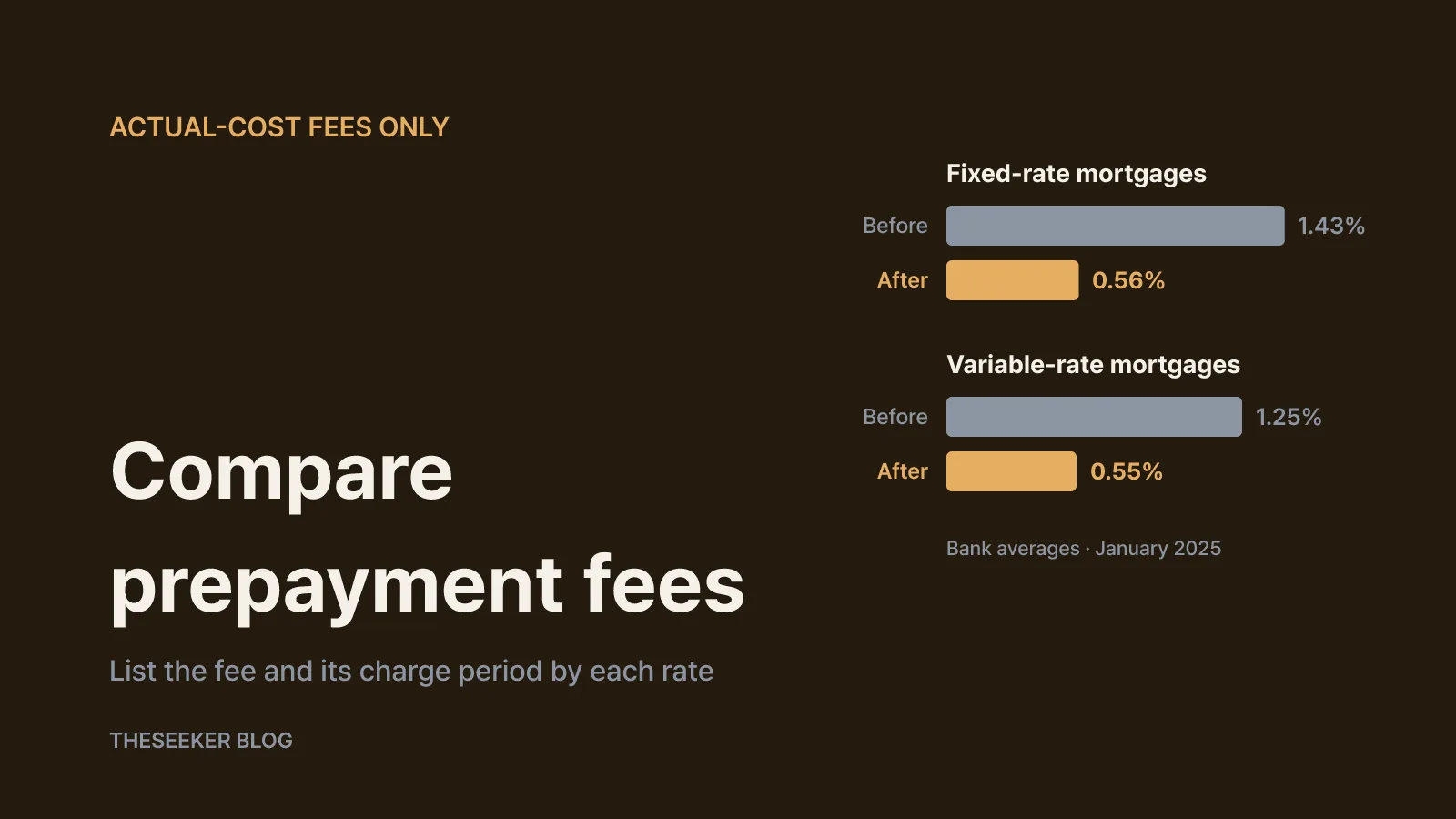
A slightly lower rate can still cost more if repaying early or refinancing later is expensive, so list the prepayment fee next to every rate.
According to an FSC press release, Korea's Financial Consumer Protection Act prohibits prepayment fees in principle and allows them only when a loan is repaid within three years of the loan date. For new contracts signed on or after January 13, 2025, lenders may charge only actual costs: the opportunity cost of disrupted fund management, plus administrative and origination costs such as stamp duty, appraisal fees, collateral registration costs, tenancy investigation fees and broker fees. Adding other items is banned as an unfair business practice.
The average bank fee on fixed-rate mortgages fell from 1.43% to 0.56%, and on variable-rate mortgages from 1.25% to 0.55%, according to the rates disclosed at that time. For the five major commercial banks, the average mortgage fee was reported as falling from 1.4% to 0.65% for fixed rates and from 1.2% to 0.65% for variable rates. In the same table, savings banks' fixed-rate mortgage fee fell from 1.64% to 1.24%, still higher than banks. Lenders agreed to recalculate actual costs every year and post the rates on their industry association websites, so treat these as January 2025 figures and check the latest disclosure for the year you borrow.
Scope matters too. The new rules apply to contracts signed from January 13, 2025, so older loans follow the fee agreed at the time. At the time of the announcement, mutual finance institutions such as Saemaeul Geumgo (MG community credit cooperatives), Nonghyup and Suhyup member cooperatives, and forestry cooperatives were outside the Act and not required to apply the change, so ask those cooperatives about their own fee rules.
Treat preferential rates the same way: record the discount for each condition (for example salary transfer or card spending), when compliance is checked, and what happens to your rate if you stop meeting it.
A mortgage comparison checklist to build before you talk to a lender
Bring everything into one table before you meet a loan officer:
- Fix your inputs: housing type, home price, desired loan amount, term, repayment method and preferred rate type. Compare every product under the same inputs.
- Set a baseline from KFB: for three to five banks, note the latest monthly average, the rate for your credit band, and the base rate, spread and discretionary adjustment.
- Shortlist products on FinLife: record the product name, minimum, maximum and last-month average rates, total borrowing cost, and the fixed period for hybrids.
- Collect real quotes: from platforms and bank apps, always with the date, since rates change often.
- Fill in costs and conditions: prepayment fee rate and charging period, each preferential-rate condition and how long it must be maintained, and the rate reset interval.
- Ask the same questions everywhere: the final rate if all discounts are met, the reference index and reset interval, and how the prepayment fee is calculated.
This table keeps disclosure averages, product terms and personal quotes in separate columns so a single headline number does not drive the decision. Loan limits and approval still depend on income, existing debt and collateral valuation, so use the table to prepare for screening and confirm final terms in the product description before signing.
Sources
Frequently asked questions
Which websites show official mortgage rate comparisons in Korea?
The two official sources are the Korea Federation of Banks consumer portal (household loan rate disclosures) and the Financial Supervisory Service's FinLife site. KFB shows each bank's average rate on new loans last month and its breakdown; FinLife shows product-level minimum, maximum and last-month average rates with example repayments across banks, savings banks, credit unions and insurers. Personalised quotes come from loan comparison platforms or lender apps.
Why is my offered rate different from the disclosed average?
Disclosures are averages of last month's loans grouped by credit bureau score. Your rate depends on the bank's internal credit grade, whether you meet discount conditions, and the base rate, spread and discretionary adjustment at the time you borrow. Use disclosures as a baseline and confirm the final rate after screening.
What is the discretionary adjustment in KFB rate disclosures?
It is a rate adjustment decided by a bank's head office or branch manager. Since July 2019 the KFB has shown it separately, presenting the loan rate as base rate plus spread minus the discretionary adjustment. Discounts such as preferential rates are reflected here.
How are prepayment fees on Korean mortgages regulated?
Under the Financial Consumer Protection Act, prepayment fees are generally banned and may be charged only if the loan is repaid within three years. For contracts from January 13, 2025, fees are limited to actual costs, and each lender's rates are posted on its industry association website. Mutual finance cooperatives may follow their own rules, so ask them directly.
Can I refinance my mortgage through a comparison app?
At the January 2024 launch, apartment mortgages of up to 1 billion won on properties with a searchable market price were eligible once six months had passed since the original loan. The amount could not be increased and the new maturity could not exceed the original one. Check current conditions on the platform before applying.
blog.theseeker.io/en/posts/compare-mortgage-rates-korea-disclosures-checklist
Olivia Hartman
Olivia covers home buying, leases, mortgages and housing taxes, following official notices and legal guidance to explain where the rules and steps change.
Read our editorial standards