Korean Language Teacher Certificate: Routes to Level 2
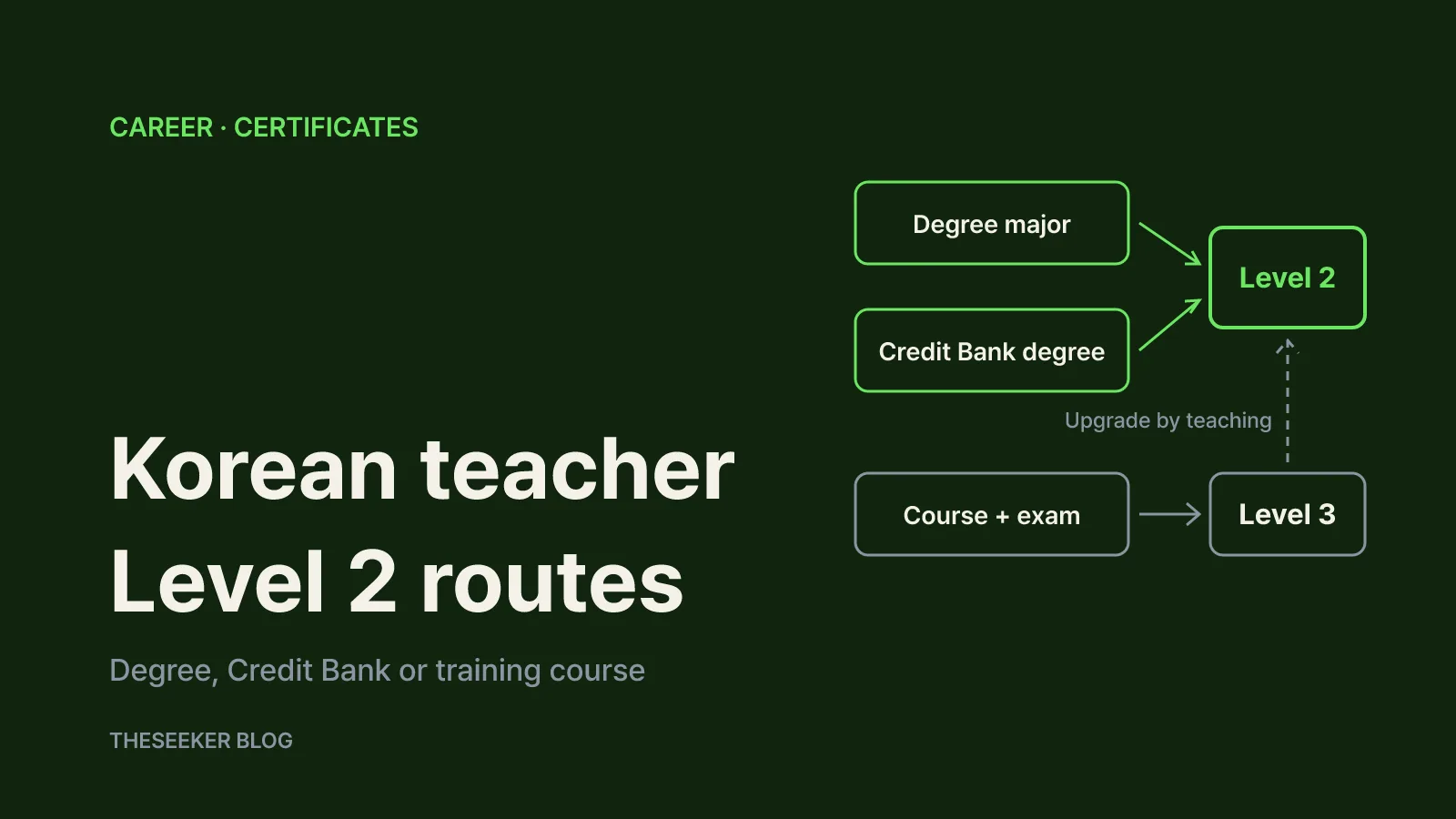
Korea's Level 2 Korean language teacher certificate comes directly only from a degree with 45 qualifying credits. The 120-hour course and exam lead to Level 3 first. Here is how each route works.
 Hannah Price
In this post
As of October 2026, there is only one way to receive South Korea's Level 2 Korean language teacher certificate (한국어교원 2급) on your first application: complete a bachelor's degree or higher at a Korean institution in which teaching Korean as a foreign language is your major or double major, earning the required credits in five subject areas along the way. The better-known 120-hour teacher training course leads to Level 3 once you also pass the national Korean Teaching Proficiency Test, and moving from Level 3 to Level 2 requires years of recognised teaching. This guide is based on the National Institute of Korean Language (NIKL) review criteria, Article 13 of the Enforcement Decree of the Framework Act on the Korean Language and the Academic Credit Bank System notice from the National Institute for Lifelong Education.
The three routes at a glance
Under Article 13 of the decree, a Korean language teacher is someone who teaches Korean to foreign nationals or overseas Koreans. The certificate has three levels — 1, 2 and 3 — and is issued in the name of the Minister of Culture, Sports and Tourism after an individual review handled through NIKL's certification website. It is separate from the licence that qualifies someone to teach Korean as a school subject to native speakers.
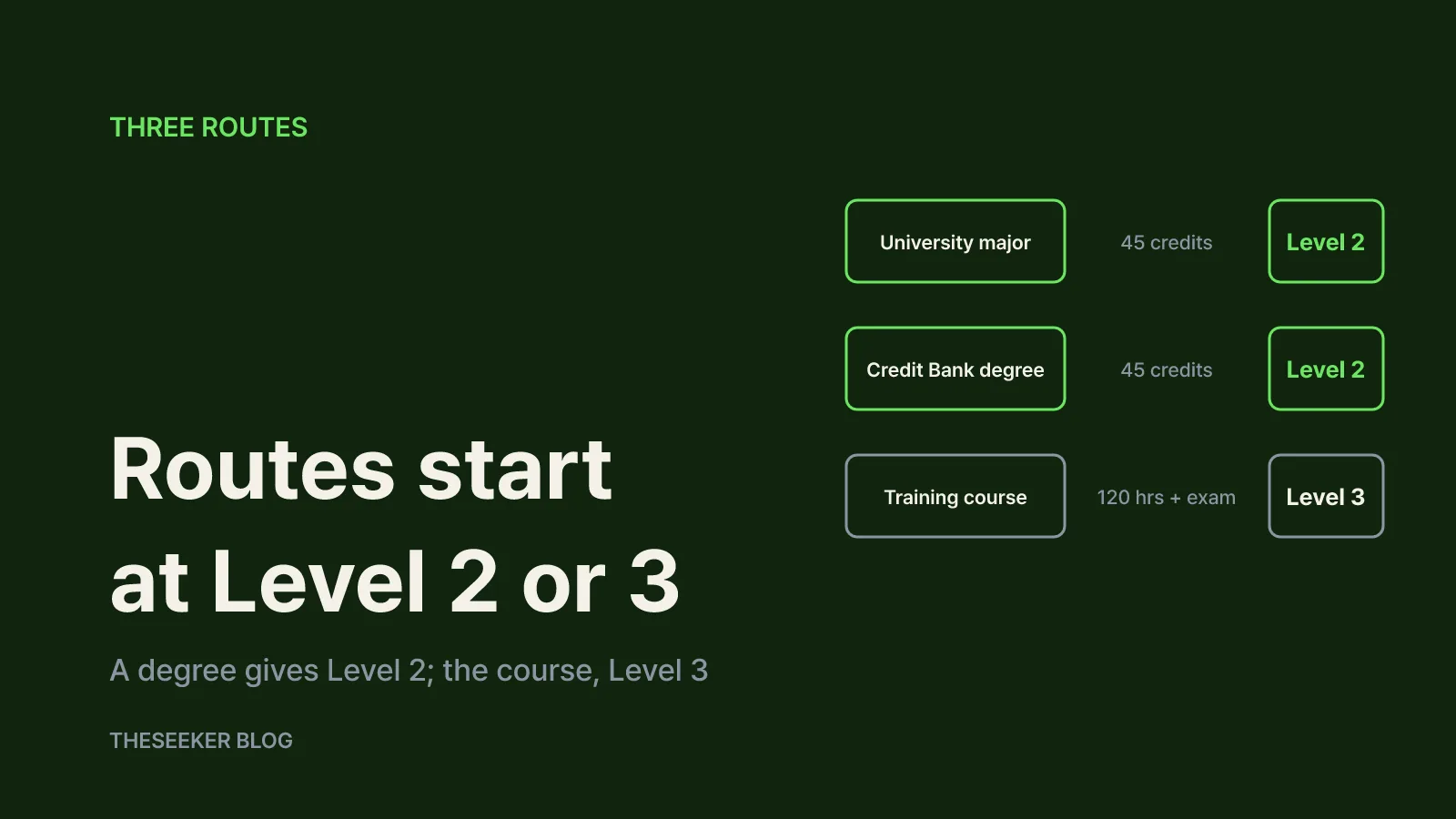
For anyone who enrolled after 28 July 2005, the routes look like this:
- University degree: major or double major in Korean language education, meet the credit requirement in each area and graduate with a bachelor's degree or higher. Result: Level 2. Completing the same field as a minor gives Level 3 instead.
- Academic Credit Bank System: earn a bachelor's degree in Korean linguistics as a foreign language through the Credit Bank System, including at least 45 credits of qualifying courses. Result: Level 2. NIKL treats this as a degree route; its criteria describe applicants who entered "a university or graduate school (including the Credit Bank System)".
- Training course and exam: complete a training course that meets the required hours in each area, then pass the Korean Teaching Proficiency Test. Result: Level 3, with Level 2 available later through teaching experience.
The practical difference comes down to two questions: do you need a degree, and which level do you start at? There is also a hard limit worth knowing early. NIKL states that because the Framework Act applies domestically, degrees from foreign universities are not recognised for this certificate. A Korean-teaching degree earned abroad does not count towards the degree route.
Separate rules apply to people who entered a programme or registered for a training course before 28 July 2005. If that is you, read NIKL's pre-2005 criteria rather than relying on this summary.
The degree route: 45 credits across five areas
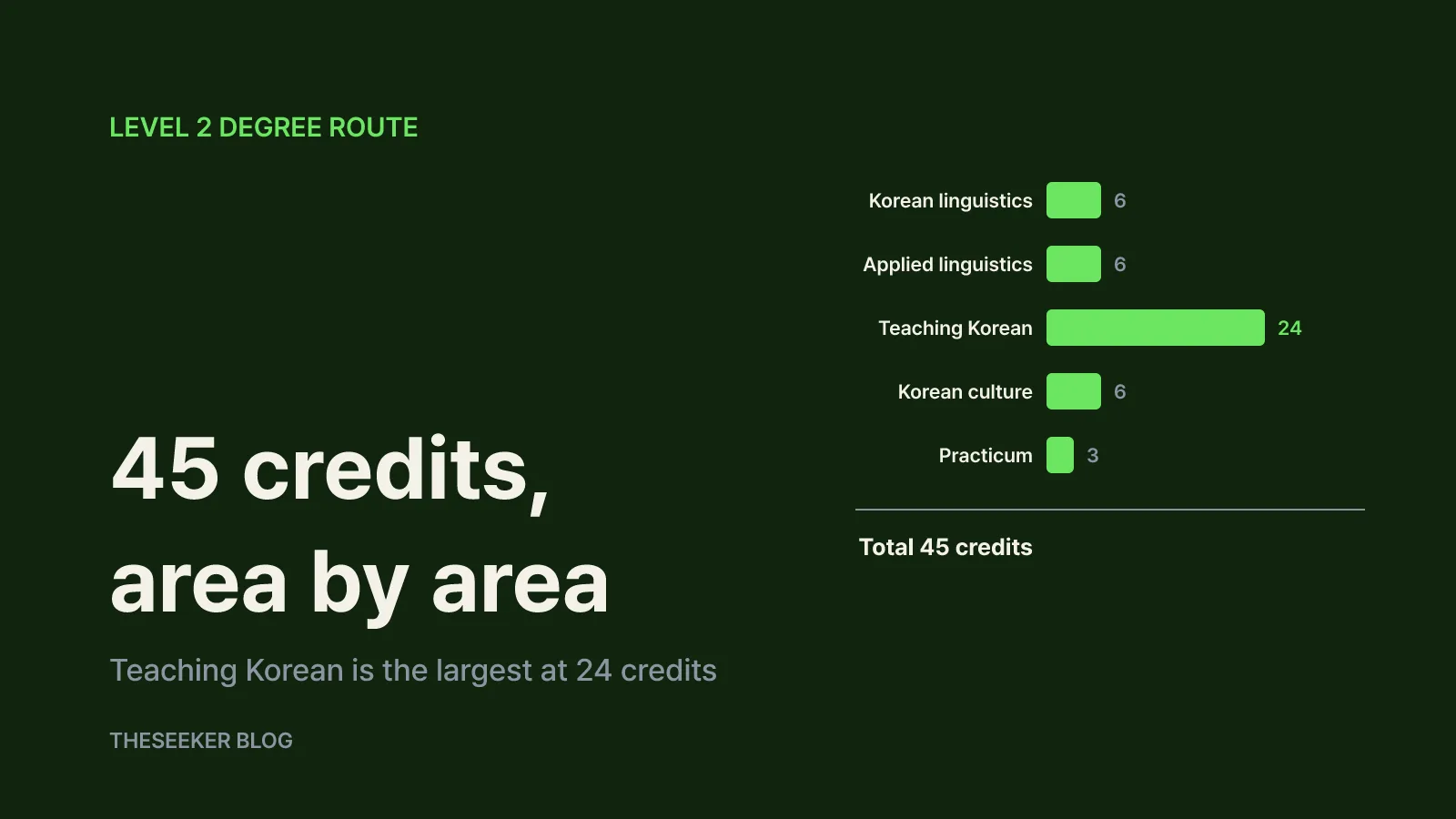
To reach Level 2 through a degree, you must meet the minimum in every area, not just the overall total. The Credit Bank System notice lists the requirement as follows:
← Swipe to see more
| Area | Example courses | Required credits |
|---|---|---|
| Korean linguistics | Korean phonology, grammar, vocabulary | 6 |
| General and applied linguistics | Applied linguistics, contrastive linguistics, second language acquisition | 6 |
| Teaching Korean as a foreign language | Curriculum, assessment, grammar teaching, materials | 24 |
| Korean culture | Folklore, contemporary culture, Korean literature | 6 |
| Teaching practicum | Observation, mock lessons, supervised teaching | 3 |
| Total | 45 |
The largest block is the 24 credits of Korean-as-a-foreign-language pedagogy. Track each row separately while planning your timetable, because surplus credits in one area do not fill a gap in another.
The detail that trips people up is course recognition. According to the NIKL criteria, individual applications are judged against reviews that universities and training providers have already submitted for their curricula. Courses that were never reviewed, or were judged unsuitable, do not count. If the title on your transcript differs from the title that was reviewed, the course is treated as unreviewed. NIKL therefore asks students to look up their institution under the degree programmes list on its website before enrolling in a course.
Other rules from the same page:
- Required credits must be earned within a single degree programme; prerequisite and remedial courses do not count.
- Credits are applied separately for bachelor's, master's and doctoral programmes, so you cannot combine some from each.
- Courses taken through credit exchange must show the partner institution on the transcript, or be confirmed by an official letter naming the course and institution.
- A course later re-judged as suitable is generally recognised only from that decision onwards. Students who took it earlier may submit supporting evidence for the review committee to consider, while corrections of simple title or area errors can apply retroactively.
Because the decree says "a bachelor's degree or higher", meeting the requirement within a master's programme in Korean language education is also a Level 2 degree route.
Using the Academic Credit Bank System
The Credit Bank System is the option many career changers consider when they already hold a degree in another field. The National Institute for Lifelong Education states that, under Article 13(1)2(a) of the decree, earning at least 45 qualifying credits while completing a Credit Bank bachelor's degree in Korean linguistics as a foreign language leads to Level 2.
The key point is that those 45 credits are earned inside a degree. You need to satisfy both the degree-awarding requirements and the Level 2 course requirements, and your application uses the degree certificate and transcript issued by the National Institute for Lifelong Education.
Credit Bank courses go through the same NIKL course review as university courses, and NIKL warns that if some courses are judged unsuitable, applicants can fail for lack of required credits. Before choosing a provider, check that its course titles and area classifications match the approved list on NIKL's site, and ask how the three-credit practicum is delivered. Study length and fees vary by provider and by how many credits you can transfer in, so compare total degree credits, recognised prior credits and the provider's plan for the 45 qualifying credits side by side.
The 120-hour course and the national exam
The training course route replaces the degree with an exam but starts you at Level 3. The required hours set by NIKL are:
← Swipe to see more
| Area | Required hours |
|---|---|
| Korean linguistics | 30 |
| General and applied linguistics | 12 |
| Teaching Korean as a foreign language | 46 |
| Korean culture | 12 |
| Teaching practicum | 20 |
| Total | 120 |
Two deadlines apply. You must finish the whole course within two years of your first class (for students from 1 January 2010), and you must complete it before the date of the written first-stage exam. Passing the exam first and finishing the course afterwards does not qualify.
Course reviews matter here too. NIKL gives the example of a provider offering 46 hours in the pedagogy area where one module, Korean pronunciation teaching, was judged unsuitable; those hours are removed and the applicant fails for lacking hours in that area. Look up the provider under the non-degree programmes list before you pay.
According to NIKL's reference notes, the exam is run by HRD Korea on behalf of the Ministry of Culture, Sports and Tourism. The written stage covers four areas — Korean linguistics, general and applied linguistics, teaching Korean as a foreign language, and Korean culture. To pass you need at least 40% in every area and at least 180 out of 300 points overall (60%). The interview assesses your attitude as a teacher, aptitude and outlook on teaching, character, and Korean proficiency. Dates and past papers are published on HRD Korea's Q-Net exam site.
Passing the exam does not issue the certificate. The exam pass and the teacher certificate are separate; you still apply for an individual review on NIKL's website with the application form, the course completion certificate and the written and interview pass confirmations.
Upgrading from Level 3 to Level 2
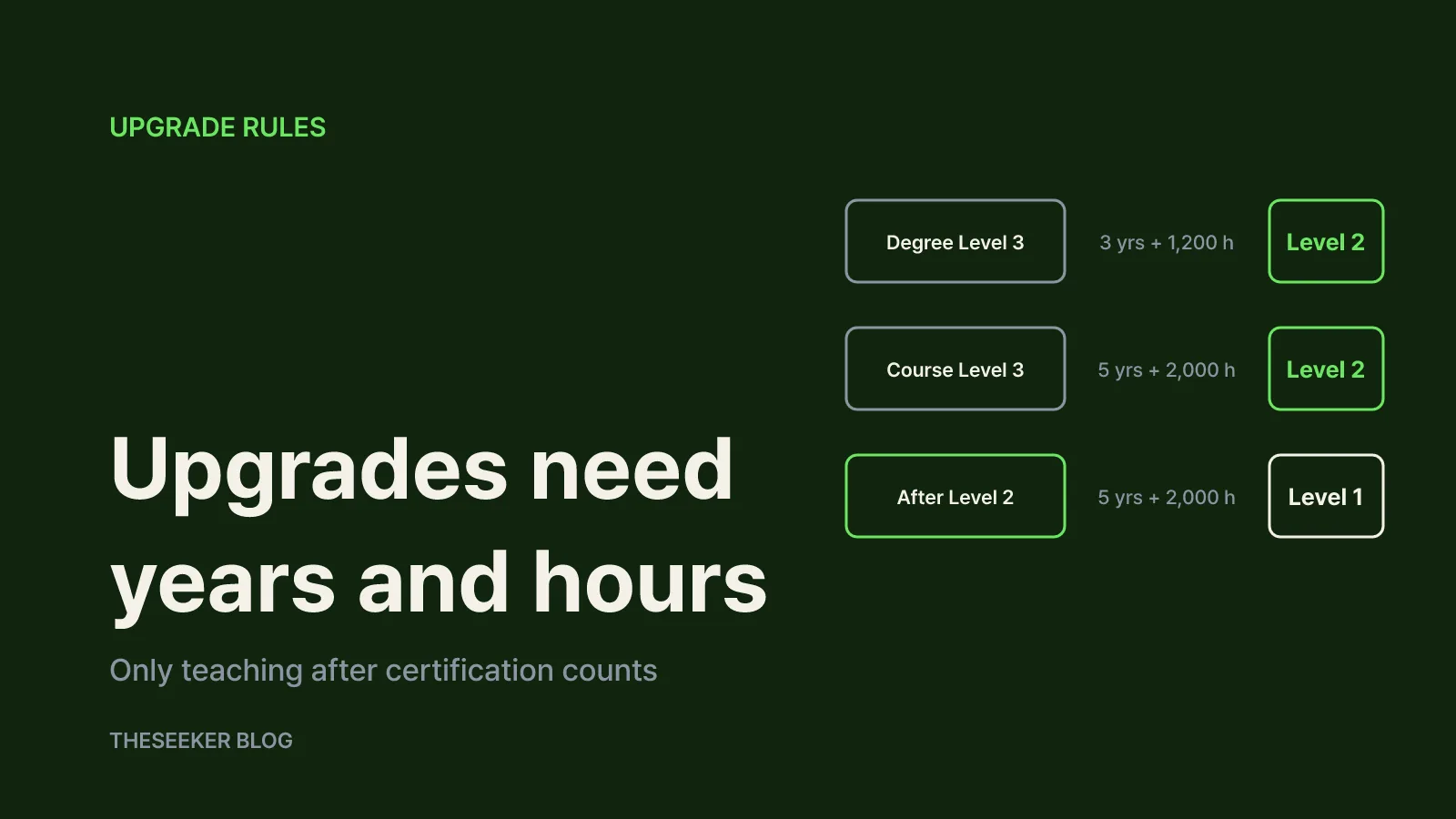
If you start at Level 3, the experience you need depends on how you got there:
- Level 3 through a degree (for example, a minor): at least 3 years of teaching and at least 1,200 teaching hours leads to Level 2.
- Level 3 through the training course (or the older certification test or 800-hour experience route): at least 5 years and at least 2,000 hours leads to Level 2.
- Level 2 to Level 1: at least 5 years and at least 2,000 hours after obtaining Level 2.
The NIKL criteria explain how this is counted. Only teaching after the date you received your current certificate counts, and you must meet both the years and the hours. One year means at least 100 hours, or at least 15 weeks, of teaching in that year. Hours from several employers can be added together, but each employer must issue its own experience certificate on the official form, and certificates from overseas employers need a notarised Korean translation.
NIKL's own examples show how strict this is: four years and 2,800 hours after Level 2 fails the Level 1 upgrade for being a year short, and five years and 1,800 hours after a training-course Level 3 fails the Level 2 upgrade for being 200 hours short.
The employer must also be recognised. The decree lists Korean universities and their affiliated institutes offering Korean as a foreign language, schools in Korea or abroad with Korean classes, government bodies teaching Korean, non-profits commissioned under the Framework Act on Treatment of Foreigners Residing in Korea, and Korean Cultural Centres and Korean Education Centres. Ministry notices add King Sejong Institutes, multicultural family support centres and foreign schools, among others. Volunteer teaching at a recognised institution counts; classes on Korean culture, literature, history, film or drama do not, because they are not direct Korean language instruction.
When and how to apply
NIKL runs individual reviews three times a year: early March to late April, early August to late October, and early December to late January. Exact dates are posted on its website at the start of each year.
Documents depend on the route:
- Degree or Credit Bank: application form, degree certificate, transcript
- Training course: application form, course completion certificate, exam pass confirmations
- Upgrade: application form and one experience certificate per employer
Foreign nationals on the degree route face an extra condition. The decree, amended on 15 April 2025, requires them to pass a test whose type, validity and level are set by ministerial notice, and NIKL's current criteria page asks for a TOPIK Level 6 score report from a test taken within two years of the application window opening. Check the latest notice just before applying. NIKL also states that physical certificates are produced only after you submit identification details through your account.
Choosing the route that fits you
- Currently at a Korean university? Check whether you can take Korean language education as a major or double major. It is the most direct way to Level 2; a minor means starting at Level 3.
- Already graduated and need Level 2? Look at what the employers you are targeting ask for. If Level 2 is a firm requirement, a Credit Bank degree in Korean linguistics is often the realistic path.
- Want to start teaching sooner? Complete the 120-hour course, pass the exam, start at Level 3 and build 5 years and 2,000 hours at recognised institutions to upgrade.
Whichever route you choose, verify each provider's course approvals on NIKL's site before enrolling, keep a running tally by area, and use the site's level-check tool to test your situation. When you pick a first employer, confirm that it is on the recognised list so the hours you teach there count towards your next upgrade.
Sources
Frequently asked questions
Can I get Level 2 by completing the 120-hour training course?
No. The training course plus a pass in the Korean Teaching Proficiency Test leads to Level 3. You can then upgrade to Level 2 after at least 5 years and 2,000 hours of teaching at recognised institutions.
Is taking 45 credits through the Credit Bank System enough on its own?
No. The 45 qualifying credits must be earned while completing a Credit Bank bachelor's degree in Korean linguistics as a foreign language, and the courses must be approved in NIKL's course review.
Do I receive the certificate automatically after passing the exam?
No. The exam pass and the teacher certificate are separate. You must apply for an individual review on NIKL's website during one of the three annual application windows.
Does a Korean-teaching degree from a university outside Korea count?
NIKL states that degrees from foreign universities are not recognised because the Framework Act on the Korean Language applies domestically.
Can I sit the exam before finishing the training course?
To qualify, you must complete the entire course before the written exam date and within two years of your first class.
blog.theseeker.io/en/posts/korean-language-teacher-certificate-level-2-routes
Hannah Price
Hannah covers job searching, the workplace and preparing for professional exams, confirming dates and requirements against notices from the bodies that run them.
Read our editorial standards