Korea's Housing Subscription Accounts: Old Types vs Combined
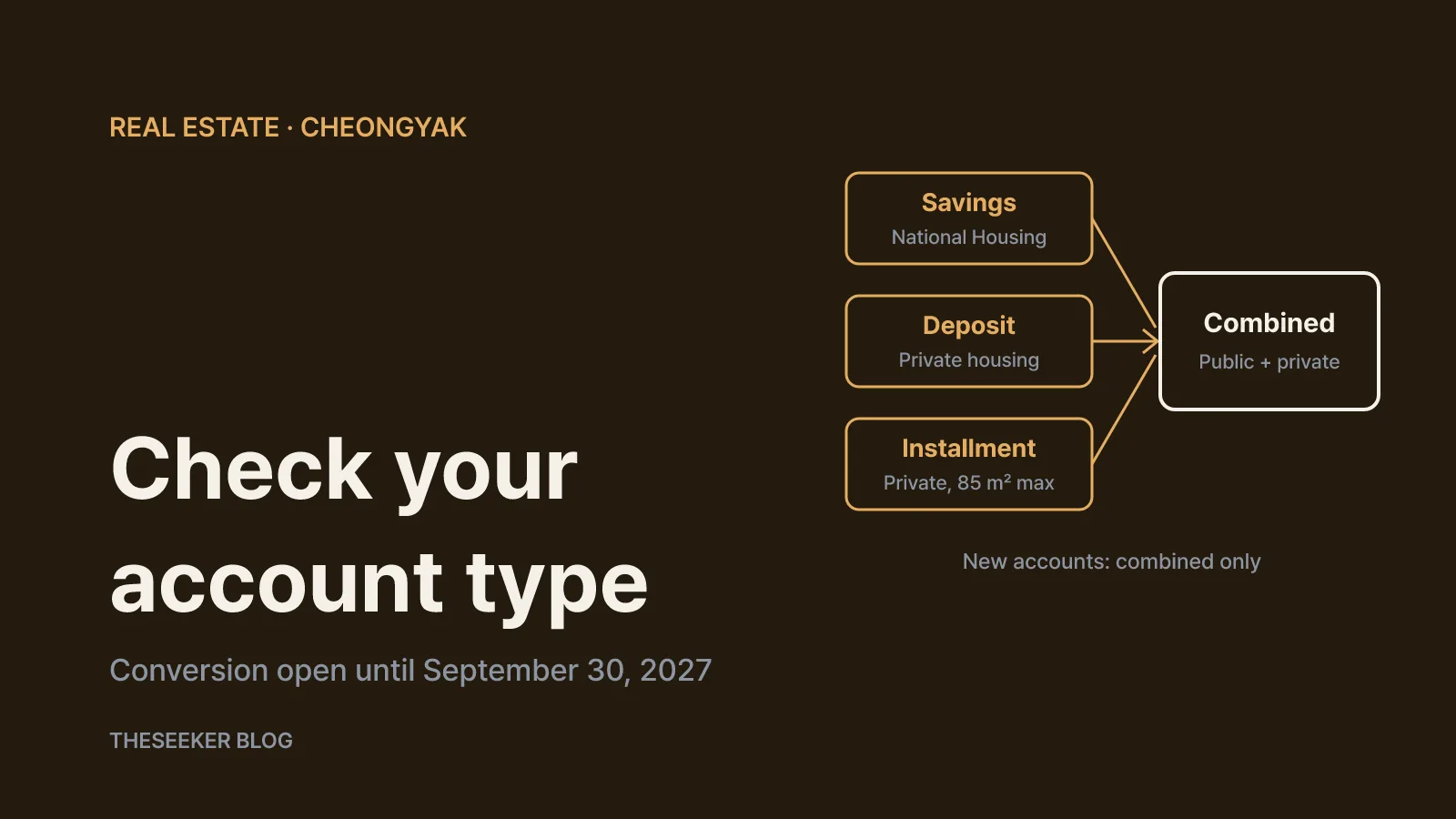
Korea once had three cheongyak accounts, each limited to one kind of housing. Since September 2015 only the Housing Subscription Comprehensive Savings account opens new. Here is how the four types differ, how to check yours and how conversion works until September 30, 2027.
 Olivia Hartman
In this post
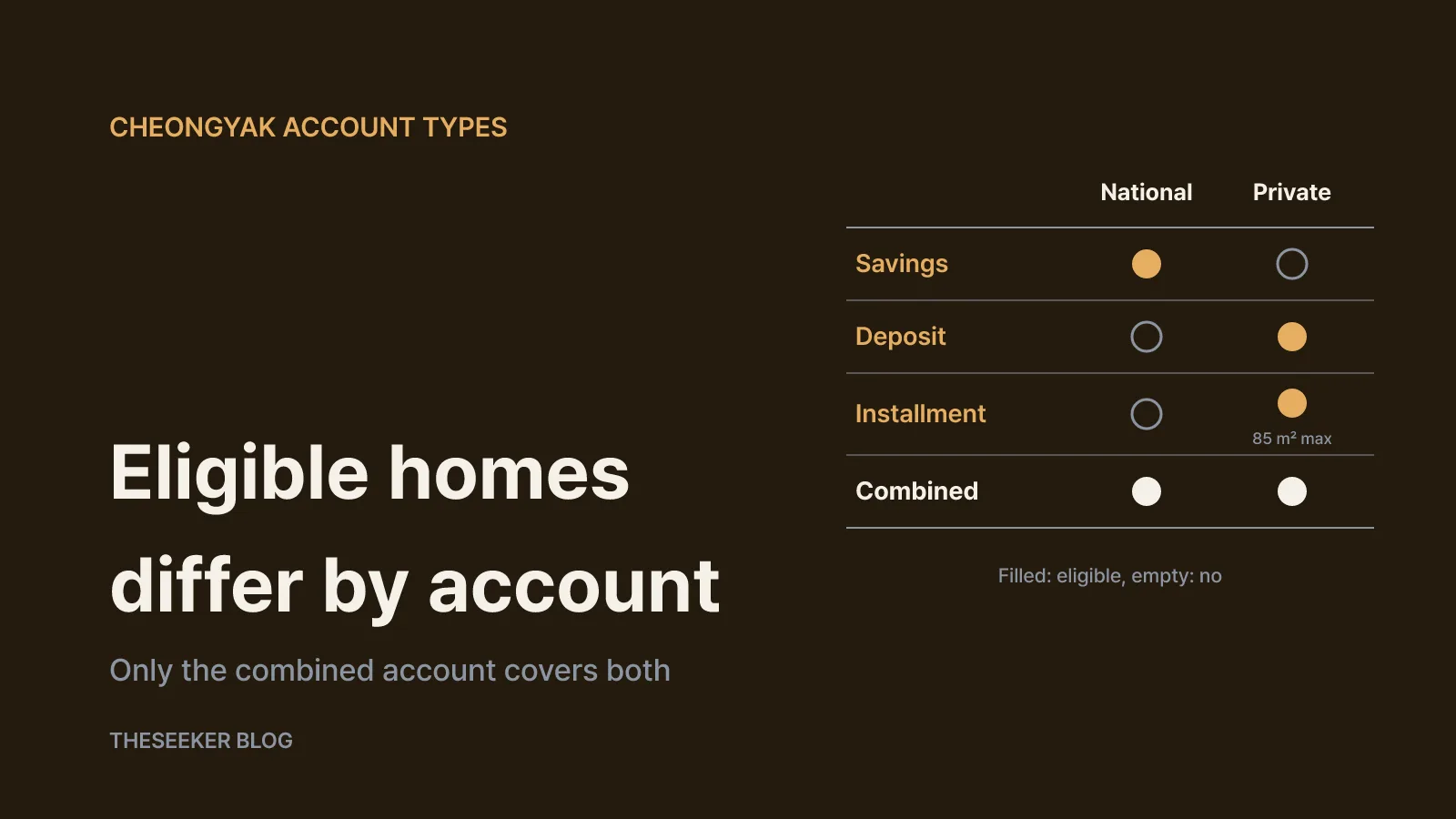
As of October 2026, Korea's housing subscription system (cheongyak) recognises four account names, but only one of them can still be opened: the Housing Subscription Comprehensive Savings account (주택청약종합저축), often shortened to the combined account. The Korea Housing & Urban Guarantee Corporation (HUG) explains in its subscription guide that accounts were unified into this product from September 1, 2015, and that people who still hold an older account can only apply for the housing types that account was designed for. The short answer: subscription savings (청약저축) is for public National Housing, subscription deposits (청약예금) are for private housing, subscription installments (청약부금) are for private housing up to 85 m², and the combined account covers both public and private housing.
This matters if you opened an account long ago, inherited one from a parent's setup, or are new to Korea and see several names in older guides. Holding the wrong type can mean you are simply not eligible for a project you like, or that your first-priority status is calculated differently than you assumed. Below we compare the four types, show how to confirm which one you hold, and walk through the conversion program that Korea's land ministry extended to September 30, 2027.
How the four account types differ
All four belong to the same legal family of housing subscription savings, but they differ in how you put money in and which homes they unlock.
Subscription savings (청약저축) is an installment account: you pay a set amount on an agreed date each month. It lets you apply for National Housing. According to HUG, National Housing means homes of 85 m² or less in exclusive floor area that are built by the state, local governments, LH or local public housing corporations, or built with government or Housing and Urban Fund support. Applicants generally need to be homeless household members living in the supply area on the date the recruitment notice is published. The same account type is used for public rental housing such as permanent and national rental homes.
Subscription deposits (청약예금) work like a lump-sum deposit. They unlock private housing, which HUG defines as homes supplied by private builders without fund support, or homes over 85 m² supplied by public bodies. HUG lists adults aged 19 or older living in the supply area as eligible applicants. The amount you keep on deposit decides which unit sizes you can apply for.
Subscription installments (청약부금) are paid monthly like subscription savings, but they point to private housing of 85 m² or less. The government briefing summarises it plainly: deposits and installments are for private housing, with installments capped at 85 m², while subscription savings is for National Housing. People often confuse installments with subscription savings because both are monthly, yet they lead to entirely different housing pools.
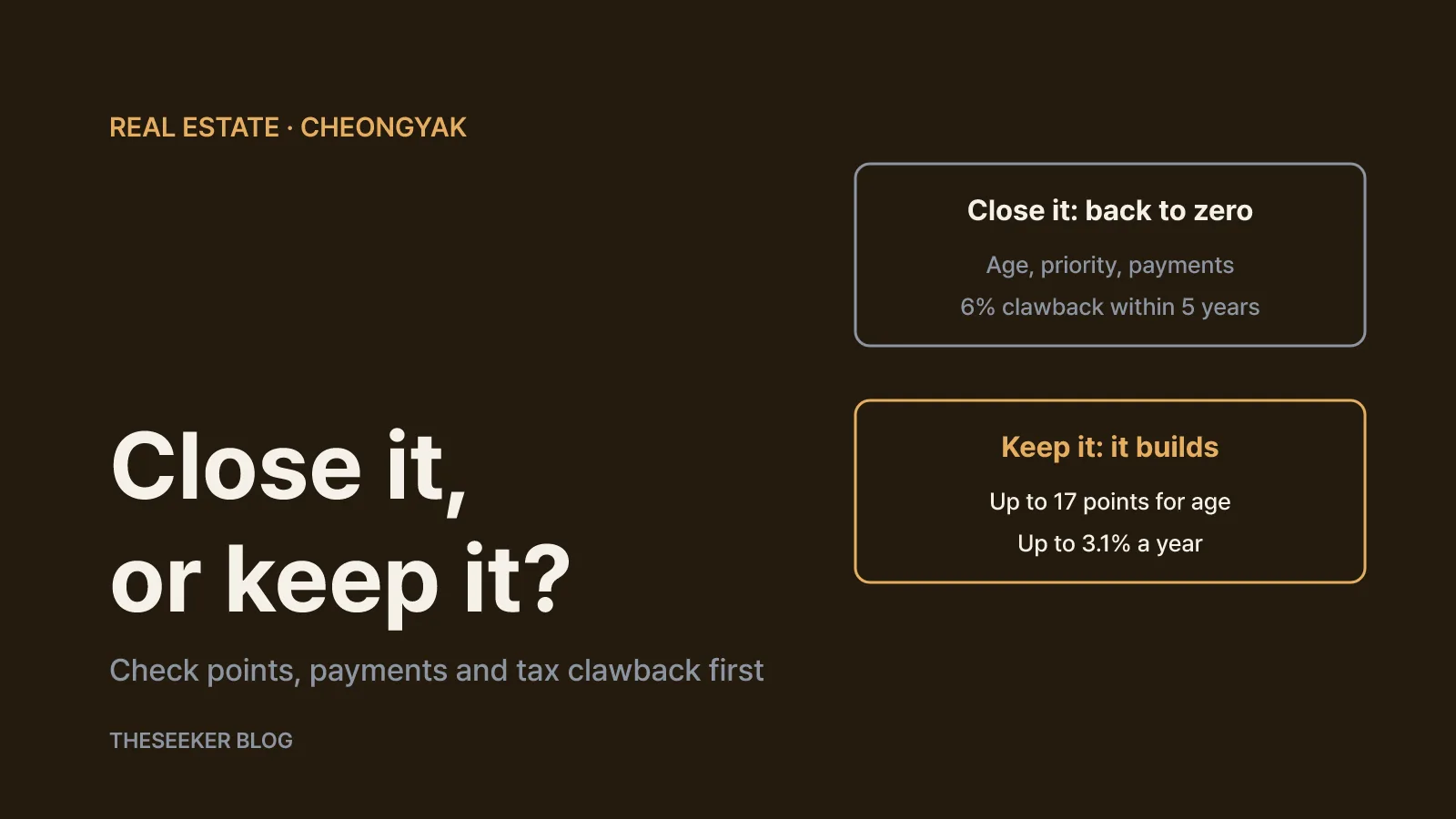
The combined account (주택청약종합저축) merges all three functions. It can be used for National Housing and private housing alike, and every subscription account opened since September 1, 2015 is this product. KB Kookmin Bank's priority requirements page treats the Youth Housing Dream account as part of the combined account family under the same rules. The government briefing puts the combined account's interest rate at 2.3–3.1% a year depending on how long you have held it, with 3.1% applying from two years of membership.
Eligible housing and first-priority rules by account
Account type affects not only whether you can apply but whether you count as first priority. KB Kookmin Bank's requirements table makes the differences clear:
- Subscription savings: in the Seoul metropolitan area you need one year of membership and at least 12 monthly payments; outside the capital region, six months and six payments; in overheated speculation zones, two years and 24 payments. In shrinking markets one month is enough. Because the count of on-time payments matters, paying on the agreed date each month is part of your record.
- Subscription deposits: one year in the capital region, six months elsewhere and two years in overheated zones, plus a deposit large enough for the unit size you want.
- Subscription installments: similar time requirements, but the recognised total of your monthly payments must meet the regional deposit threshold for private homes of 85 m² or less.
- Combined account: for National Housing it is judged like subscription savings, by time and number of payments; for private housing it is judged like a deposit, by time and balance against the regional threshold.
Provincial governors can stretch the one-year and six-month periods to 24 and 12 months when a market overheats, so the recruitment notice for a specific project is always the final word.
The private housing deposit thresholds, based on the applicant's registered address on the notice date, are listed by KB as follows (in Korean won). For units of 85 m² or less: 3 million in Seoul and Busan, 2.5 million in other metropolitan cities and 2 million in other cities and counties. Up to 102 m²: 6 million, 4 million and 3 million. Up to 135 m²: 10 million, 7 million and 4 million. Any size: 15 million, 10 million and 5 million. A deposit sized for 85 m² units will not give you first priority for larger ones.
Second priority is simpler: any account holder who is not first priority qualifies, regardless of time or balance. KB notes, however, that second priority for private housing is open only to deposit, installment and combined account holders, while second priority for National Housing is open only to subscription savings and combined account holders. An account that has already been used for a winning application cannot be reused, whether or not a contract was signed. In practice, someone holding only subscription savings cannot join a private project even at second priority.
Three ways to check which account you hold
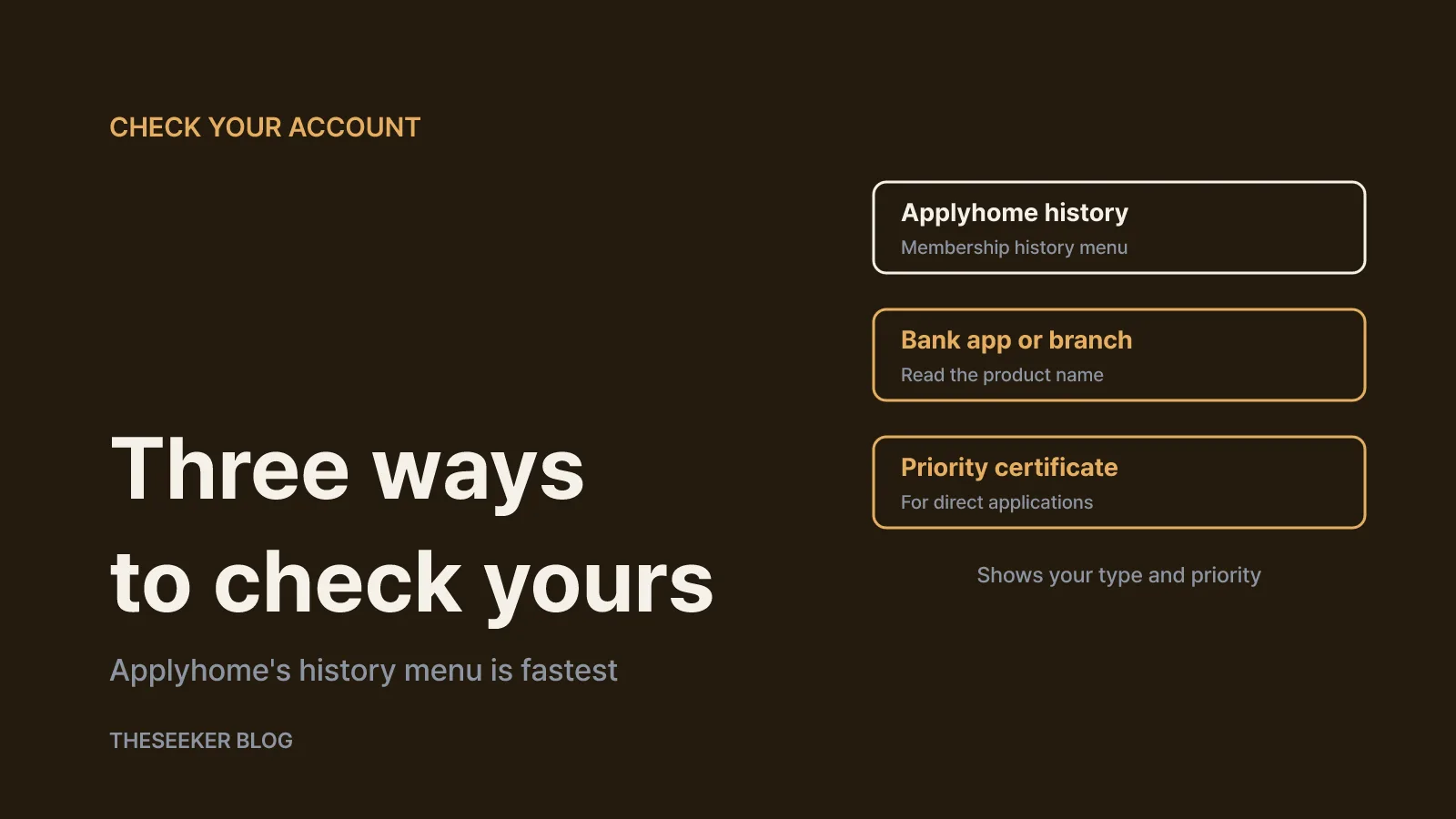
After many years it is easy to forget the exact product name. Any of these methods will tell you.
1. Applyhome membership history. Log in to the Korea Real Estate Board's Applyhome site with a certificate in your own name and open the subscription account membership history menu (청약자격확인 → 청약통장 → 가입내역). It shows the account you hold and your current priority. Applyhome itself points account holders to this lookup when they want their present priority rather than one tied to a particular project.
2. Your bank's app, online banking or branch. The product name in your account list will read subscription savings, subscription deposit, subscription installment or the combined account. Some banks, including KB Kookmin, offer an online priority lookup that requires a certificate in your name. If you prefer a branch, ask for the product type together with your recognised payment amount and count.
3. A priority (membership) certificate. Applyhome issues certificates using data from your bank. They are needed when you apply directly to a developer such as LH, SH or a private builder; if you apply through Applyhome or a bank counter you do not need one. Applyhome lists general supply, special supply, other rental housing and membership confirmation versions, and the membership version, used to prove membership length for private housing point scoring, is available even for second-priority accounts. Issuance hours depend on the bank: Industrial, Kookmin, NongHyup, Woori, Hana, Shinhan and several others run 0:00–24:00 on business days, while SC First, Citi and Jeonbuk run 9:00–17:30.
Two quick clues also help. Any account opened on or after September 1, 2015 is the combined account. If you made one lump-sum payment and left it, a subscription deposit is the likely answer; regular monthly payments point to savings, installments or the combined account. Treat these as hints and confirm with one of the methods above.
What changes when you convert to the combined account
Older accounts only open one category of housing, which used to leave holders stuck if their plans changed. The conversion program lets you switch to the combined account while keeping your existing record. According to the government briefing, the program has run since October 2024, and on September 23, 2026 the land ministry extended the deadline from September 30, 2026 to September 30, 2027.
Your record is recognised in two ways after conversion:
- Housing types your old account already covered keep your full membership period and payment history. A subscription savings holder who converts keeps that history for National Housing.
- Housing types newly opened by conversion count only from the conversion date. The same holder starts building time and balance for private housing from scratch.
Interest is also changing. Until now, converted accounts earned interest based on time in the combined account, so the 3.1% top rate arrived only two years after conversion. The ministry said it plans to recognise the earlier membership period when setting the rate, so converted holders can receive the top rate immediately. Ask your bank when that improvement takes effect before you apply.
You can apply at a branch or through the mobile app of the bank that holds your old account. Holders of deposits and installments may also choose any of the nine Housing and Urban Fund trustee banks: Kyongnam, Kookmin, IBK Industrial, NongHyup, Busan, Shinhan, Woori, Hana and iM Bank.
A checklist before you convert
Conversion is a planning decision rather than an automatic upgrade. Work through these steps:
- Confirm your type and record on Applyhome. For subscription savings the key number is your payment count; for deposits it is your balance.
- Decide which housing you will target. If you only want public sale or public rental homes, your old subscription savings record already works there. If private apartments are in the picture, conversion is the only route, and your private housing record starts on the conversion date.
- Match unit size to deposit. Compare the size you want with the threshold for your registered region.
- Check the rate and the bank. Ask when the earlier membership period will count toward interest, and which trustee bank you will use if you hold a deposit or installment account.
- Note the deadline. Applications close on September 30, 2027. Branches tend to be busy close to deadlines, so leave room if you have an application coming up.
When you visit the bank, bring a short list of questions: the exact product name, your recognised payment count and amount, how your National Housing and private housing records will appear after conversion, and when the interest change applies. Then compare the answers with the recruitment notice for the project you want, because that notice is the final authority on priority and eligibility.
Sources
Frequently asked questions
Is subscription savings the same as the combined housing subscription account?
No. Subscription savings (청약저축) is a legacy product for National Housing only. The combined Housing Subscription Comprehensive Savings account works for both National Housing and private housing, and accounts were unified into it from September 1, 2015.
Can I still open a subscription deposit or installment account?
Since the September 1, 2015 unification, new subscription accounts are the combined account, including the Youth Housing Dream version. Existing deposit, installment and savings holders can keep their accounts or convert by September 30, 2027.
What is the fastest way to see which account type I have?
Log in to Applyhome with a certificate in your name and open the subscription account membership history menu. It shows your account and current priority. Your bank app's product name is another quick check.
Will I lose my membership period if I convert subscription savings?
No. Your existing period and payment history still count for National Housing, which your old account covered. For private housing, which conversion newly opens, time and payments count from the conversion date.
Can I move a deposit or installment account to another bank when converting?
Yes. Deposit and installment holders can convert at their current bank or at any of the nine Housing and Urban Fund trustee banks: Kyongnam, Kookmin, IBK Industrial, NongHyup, Busan, Shinhan, Woori, Hana and iM Bank.
blog.theseeker.io/en/posts/housing-subscription-account-types-korea
Olivia Hartman
Olivia covers home buying, leases, mortgages and housing taxes, following official notices and legal guidance to explain where the rules and steps change.
Read our editorial standards