Korea Basic Pension Asset Test: Homes, Savings and Cars
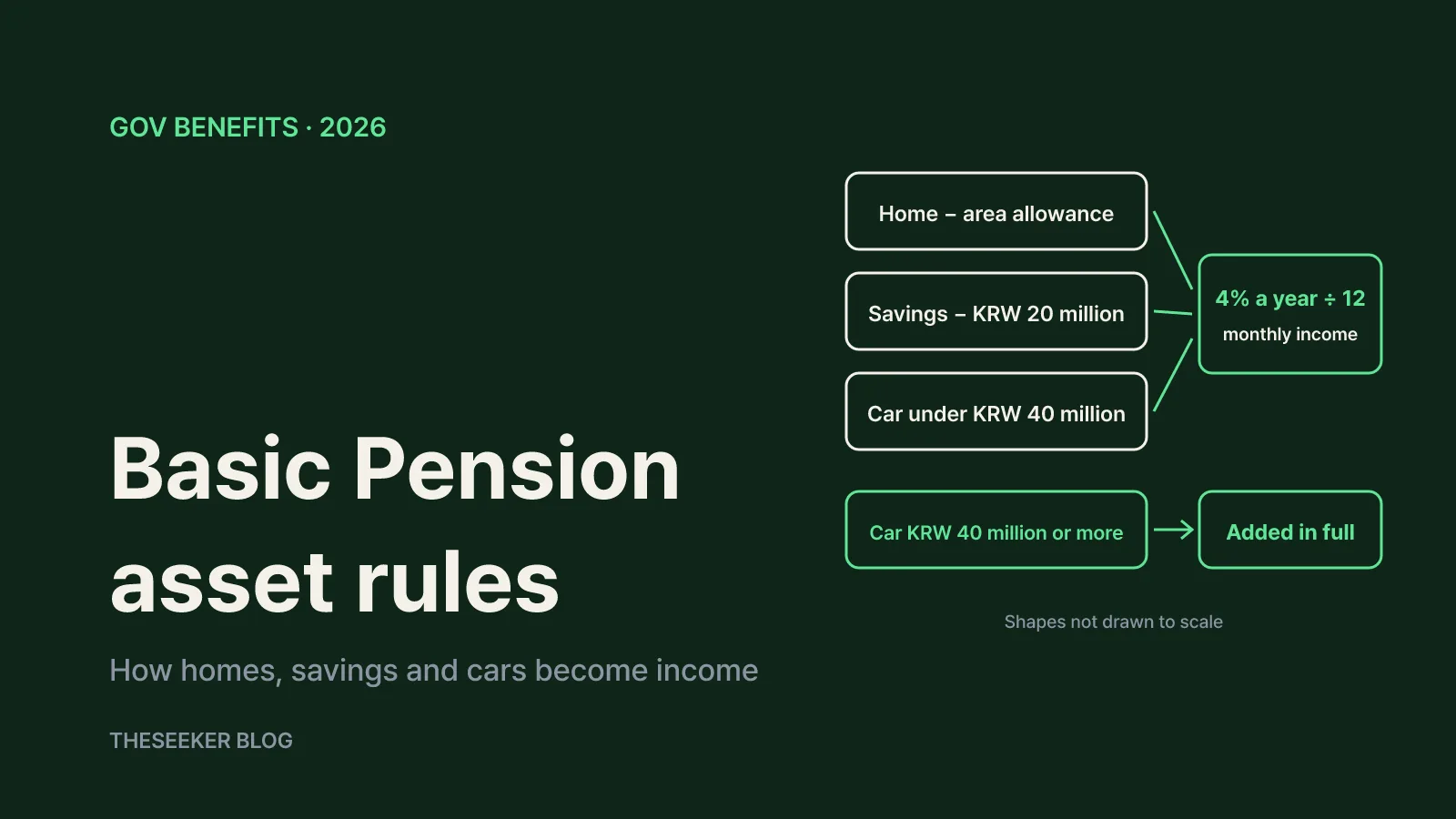
Korea's Basic Pension converts property into monthly income: subtract a regional home allowance and KRW 20 million of savings, apply 4% a year, divide by 12. Cars worth KRW 40 million or more count in full. Formula and three worked examples for 2026.
 Nathan Brooks
In this post
- The recognized income formula: turning assets into monthly income
- Homes and lease deposits: the regional basic property allowance
- Savings and insurance: the KRW 20 million deduction and debts
- Cars and memberships: the KRW 40 million line
- Three worked examples
- Before you apply: gifted assets and paperwork
- Sources
- Frequently asked questions
As of October 2026, Korea's Basic Pension (기초연금) is paid to people aged 65 or older whose household recognized income (소득인정액) is at or below a yearly threshold. For 2026 that threshold is KRW 2.47 million a month for a single older person and KRW 3.952 million a month for a married couple, according to the Ministry of Health and Welfare. Owning a home, savings or a car does not disqualify you on its own. Instead, the government subtracts set allowances from your assets and treats 4% a year of what remains, divided by 12, as if it were monthly income. The big exception is a car valued at KRW 40 million or more, along with membership rights such as golf memberships: their full value is added to monthly recognized income. This guide walks through the formula, how each asset type is treated, and three worked examples.
The recognized income formula: turning assets into monthly income
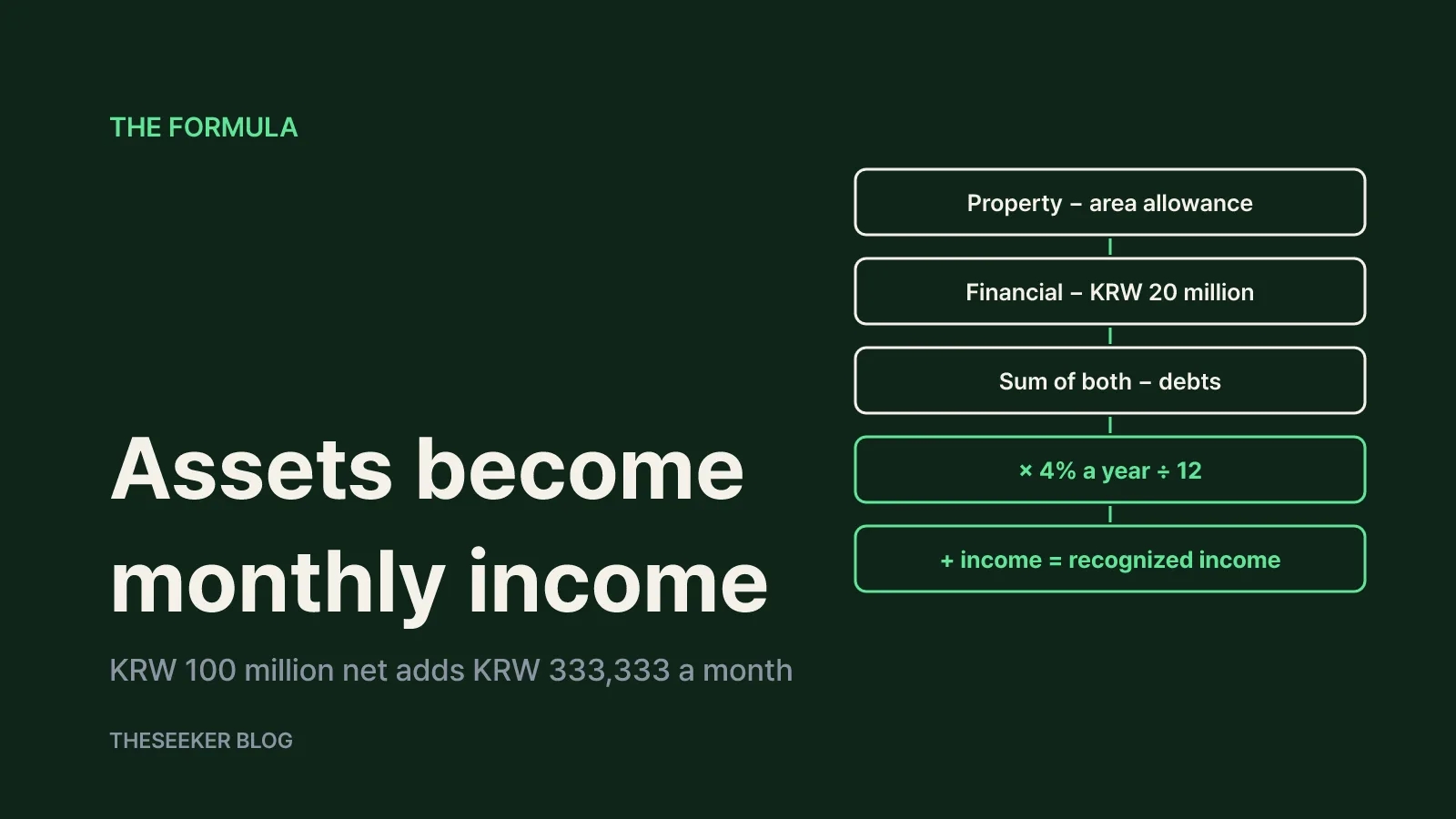
The Government24 Basic Pension page sets out the formula in three parts:
- Recognized income = monthly assessed income + monthly income from assets
- Monthly assessed income = 0.7 × (earned income − KRW 1.16 million) + other income (business income, property income, public transfer income such as public pensions, and imputed rent-free housing income)
- Monthly income from assets = [{(general property − basic property allowance) + (financial assets − KRW 20 million) − debts} × conversion rate ÷ 12] + value of luxury cars and membership rights
The conversion rate is fixed at 4/100, or 4% a year, by Article 4(2) of the Enforcement Rule of the Basic Pension Act. A useful rule of thumb follows: every KRW 100 million of net counted assets adds KRW 333,333 a month to your recognized income (100 million × 4% ÷ 12).
The same article fixes the order of operations, and it matters. General property minus its allowance cannot go below zero, and financial assets minus KRW 20 million cannot go below zero. Those two results are added, debts are subtracted, and a negative total becomes zero. In practice this means an unused home allowance does not spill over to shelter your savings, but debts reduce the combined figure, so a mortgage can offset savings even if your home value sits under the allowance.
Homes and lease deposits: the regional basic property allowance
Under Article 3 of the Enforcement Decree, general property includes land, buildings and homes, lease deposits on homes, shops and buildings (including jeonse deposits), apartment occupancy rights, rights to acquire a building once completed, aircraft and ships, cars and membership rights. Many renters overlook the fact that a large jeonse deposit is counted just like an owned home. Clan property and village common property used for shared purposes are excluded.
From general property you subtract a basic property allowance that depends on where you live. Government24 lists KRW 135 million for large cities, KRW 85 million for small and medium-sized cities, and KRW 72.5 million for rural areas. A single person living in Seoul, for example, deducts KRW 135 million before any home value is converted. The local community service center or the National Pension Service branch can confirm which category your address falls into.
Asset values follow the valuation method in Article 3 of the Enforcement Rule, which can differ from market prices. For a self-check, start from official figures such as the published housing price and confirm the number during your consultation.
To see where the line sits, assume a single person in Seoul with no other income, no car and no financial assets above KRW 20 million. The ceiling on net counted assets is 2.47 million × 12 ÷ 4% = KRW 741 million. Add back the KRW 135 million allowance and the break-even general property value is KRW 876 million. Any pension or wage income lowers that ceiling, so treat it as an illustration of the structure rather than a target.
Savings and insurance: the KRW 20 million deduction and debts
The Enforcement Decree defines financial assets as financial assets under the Real Name Financial Transactions Act plus insurance products under the Insurance Business Act. That means deposits and installment savings, and potentially insurance policies with a surrender value, all count. You subtract KRW 20 million, treated as the minimum cash needed for daily living; the formula applies a single KRW 20 million deduction to the household.
Accepted debts are listed in Article 4 of the Enforcement Rule: loans, overdue amounts and unpaid credit card balances, plus a set share of any lease deposit you hold as a landlord, calculated with reference to the published housing price. Because debts are taken off the combined net figure, keep documentation of outstanding loan balances ready when you apply.
Cars and memberships: the KRW 40 million line
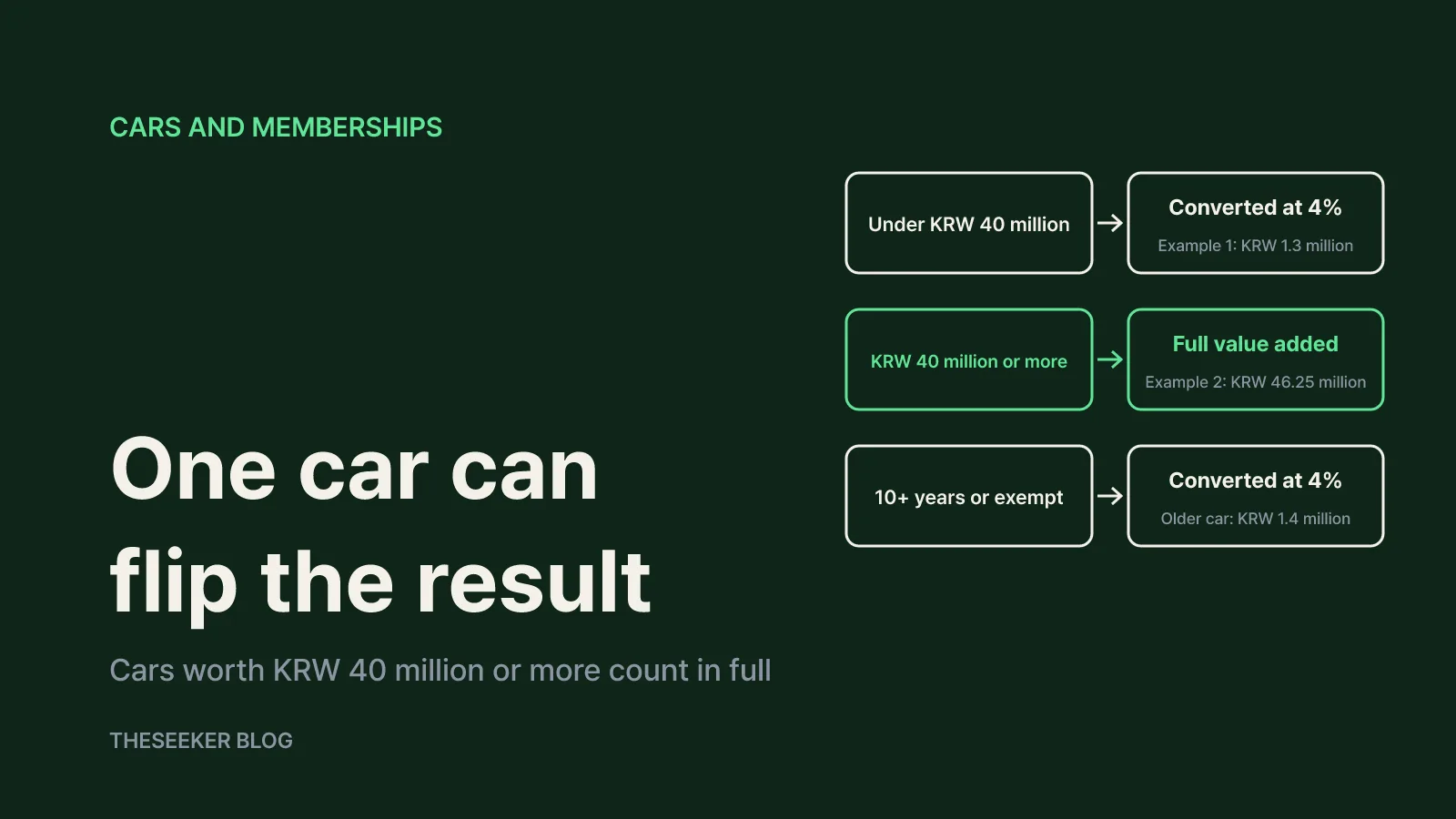
A car is normally general property, so it shares the regional allowance and is converted at 4%. However, a Ministry of Health and Welfare interpretation confirms that for a car valued at KRW 40 million or more, the 4% rate is not applied and 100% of the value is added to recognized income. One such car alone pushes monthly recognized income to tens of millions of won, which effectively rules out the pension. Membership rights are handled the same way under Article 4 of the Enforcement Rule.
The ministry lists exceptions that fall back to the ordinary 4% treatment: cars 10 years old or older, cars that cannot be scrapped, sold or driven because of seizure, cars shown to be used for making a living, cars with an official certificate of loss, and illegally registered cars recorded with a suspension order. Separately, the Enforcement Decree excludes from assets certain cars owned by registered persons with disabilities or by veterans with a disability rating, where they meet the ministry's notified criteria.
Three worked examples
These households are hypothetical and show how the formula works; real decisions use officially verified values.
Example 1: single person in Seoul (large-city allowance)
- Home KRW 300 million, car worth KRW 15 million, savings KRW 50 million, no debt, National Pension KRW 600,000 a month
- General property: (300 million + 15 million) − 135 million = KRW 180 million
- Financial assets: 50 million − 20 million = KRW 30 million
- Asset income: 210 million × 4% ÷ 12 = KRW 700,000 a month
- Recognized income: 600,000 + 700,000 = KRW 1.3 million a month, under the KRW 2.47 million threshold.
Example 2: the same person with a three-year-old car worth KRW 45 million
- The car leaves general property and its full value is added.
- General property: 300 million − 135 million = KRW 165 million; financial assets KRW 30 million
- Asset income: 195 million × 4% ÷ 12 = KRW 650,000, plus KRW 45 million for the car
- Recognized income: 600,000 + 650,000 + 45 million = KRW 46.25 million a month, far above the threshold.
- If the same car were 10 years old or older, general property would be 345 million − 135 million = KRW 210 million; adding KRW 30 million of financial assets gives 240 million × 4% ÷ 12 = KRW 800,000, and recognized income would be KRW 1.4 million a month.
Example 3: married couple in a provincial city (small/medium-city allowance)
- Home KRW 200 million, savings KRW 30 million, mortgage KRW 35 million, husband's wages KRW 2 million a month, combined National Pension KRW 800,000 a month
- Assessed wages: (2 million − 1.16 million) × 0.7 = KRW 588,000
- Asset income: {(200 million − 85 million) + (30 million − 20 million) − 35 million} × 4% ÷ 12 = 90 million × 4% ÷ 12 = KRW 300,000
- Recognized income: 588,000 + 800,000 + 300,000 = KRW 1.688 million a month, under the couple threshold of KRW 3.952 million.
Qualifying is not the same as receiving the full amount. In 2026 the maximum is KRW 349,700 a month for a single person and KRW 559,520 for a couple, and payments can be reduced depending on National Pension contribution history and benefit level, household type and recognized income (Government24).
Before you apply: gifted assets and paperwork
Article 3(1)3 of the Enforcement Decree also counts assets given away or sold since July 1, 2011, unless you can prove the proceeds were spent on yourself or your spouse, for example buying other assets, repaying debts or paying medical bills. Transferring a home to a child just before applying does not automatically remove it from the calculation, so keep receipts and transaction records.
You can apply from one month before the month of your 65th birthday at any community service center, any National Pension Service branch, or online through Bokjiro. Government24 lists the documents as ID, the social welfare service application form, an income and asset declaration, consent forms for financial information from you and your spouse, and a copy of your bankbook. Recipients of civil service, private school teacher, military or special post office pensions and their spouses are generally excluded. If your result is close to the line, call the Health and Welfare Call Center at 129 to confirm with your actual records.
Sources
Frequently asked questions
Does owning a home disqualify me from Korea's Basic Pension?
No. A home is general property. After subtracting the regional allowance (KRW 135 million in large cities, KRW 85 million in small and medium-sized cities, KRW 72.5 million in rural areas), 4% a year of the remainder divided by 12 is counted as monthly income. You qualify if total recognized income stays at or below the threshold.
How much savings is ignored in the asset test?
KRW 20 million of financial assets is deducted. Anything above that is combined with net general property, debts are subtracted, and 4% a year divided by 12 is counted as monthly income. Insurance products can also count as financial assets.
How is a car counted?
A car valued under KRW 40 million is general property converted at 4% a year. At KRW 40 million or more, its full value is added to monthly recognized income, unless an exception applies, such as the car being 10 years old or older, used for making a living, or undrivable because of seizure.
Do loans reduce recognized income?
Yes. Accepted debts such as loans, overdue amounts and unpaid card balances are subtracted from the combined net general and financial assets before the 4% conversion.
Can I give assets to my children to qualify?
Assets gifted or sold since July 1, 2011 can still be counted unless you prove the money was spent on yourself or your spouse, for example on other assets, debt repayment or medical costs.
blog.theseeker.io/en/posts/korea-basic-pension-asset-test-recognized-income
Nathan Brooks
Nathan covers eligibility, application steps and deadlines for public support programs, working from government notices and starting with who qualifies.
Read our editorial standards