When Do Korean Support Payments Expire? Deadlines and Shops
In Korea, a support payment's expiry date is set by the program, not by whether you got it on a card or as local currency. Here is what ended, what is still running and how to check balances and eligible shops.
 Nathan Brooks
In this post
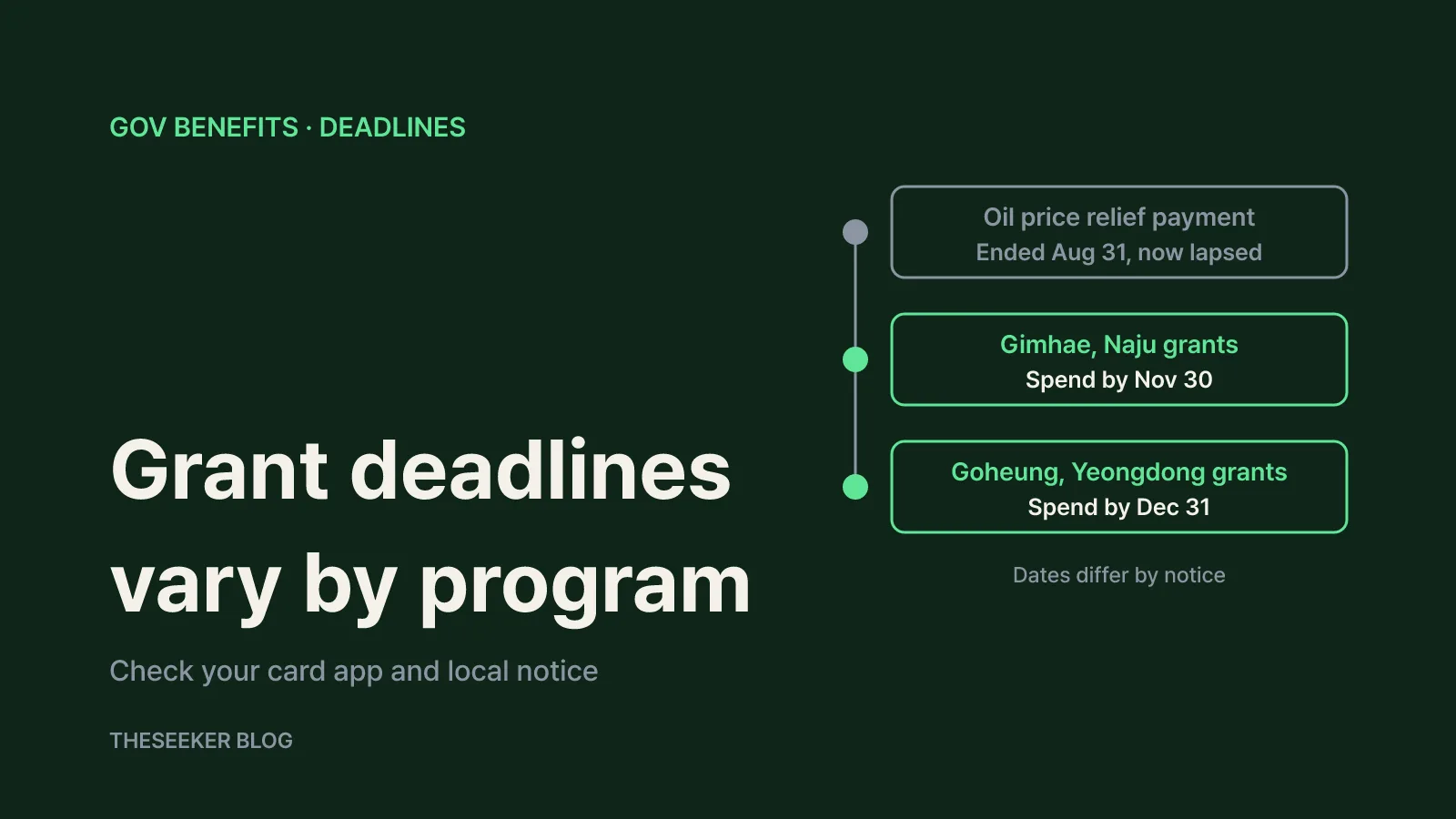
As of October 2026, the short answer is this: in Korea, the deadline for spending a government support payment is set by the program that paid it, not by the payment method. The nationwide High Oil Price Relief Payment (고유가 피해지원금) paid out earlier this year stopped working at midnight at the end of Monday, Aug 31, 2026, whether you received it on a credit card, a check card, a prepaid card or as local currency, and any unused balance disappeared automatically (Ministry of the Interior and Safety). If you are still spending a grant today, it is most likely a local relief grant paid by your city or county, and those carry their own deadlines. Cases reported in September included Gimhae and Naju with a Nov 30 deadline and Goheung and Yeongdong with a Dec 31 deadline (Segye Ilbo). This guide explains how to tell which program your money came from, where to check the balance and the deadline, and how the rules on eligible shops worked.
The program, not the card, decides the deadline
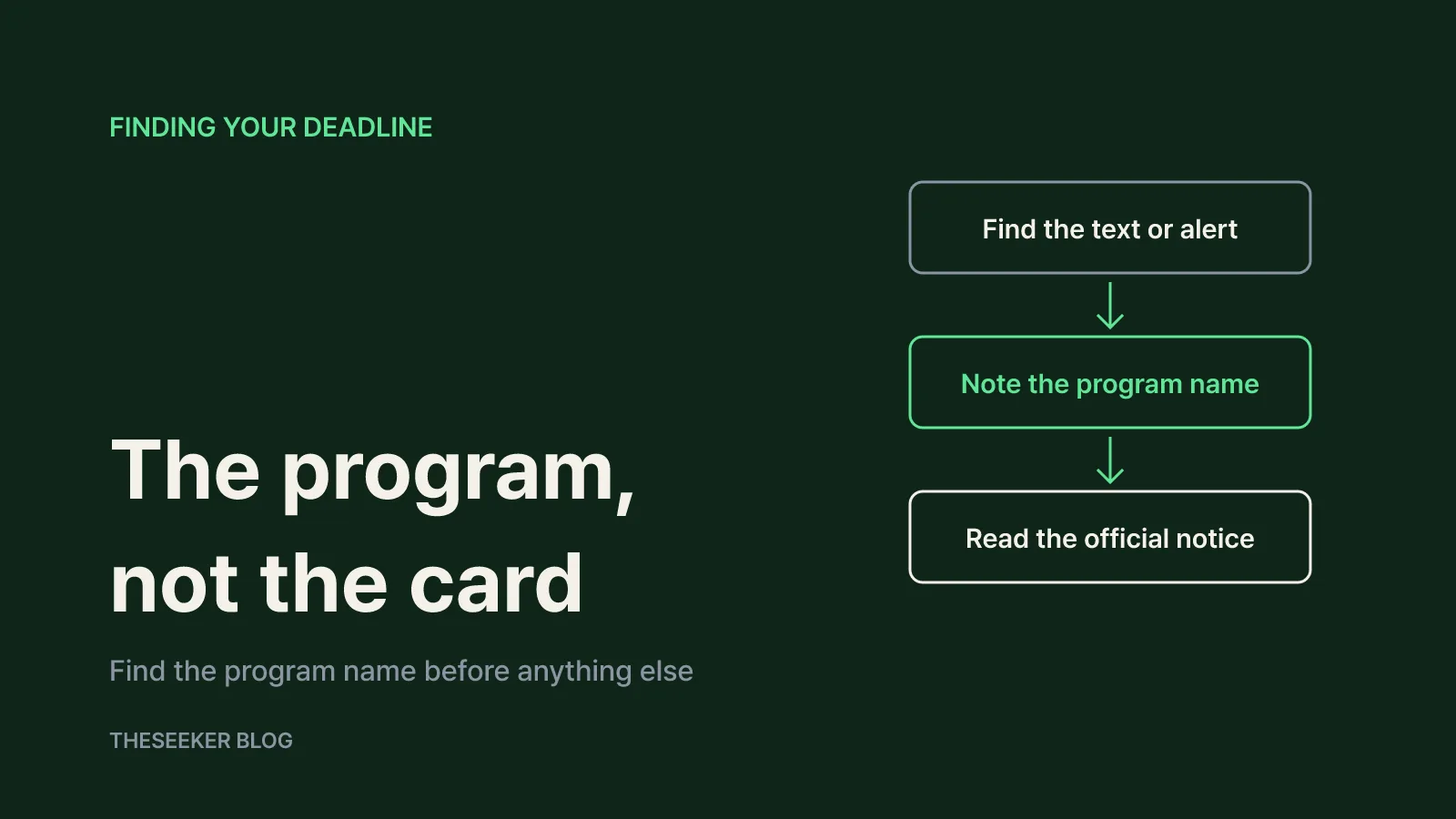
Most people remember a grant as "money on my card" or "credit in my local currency app." That is a natural shortcut, but it hides the detail that matters. The same credit card can hold a national grant and a local grant with different end dates, and a local currency app can show your own top-up balance next to a grant balance that follows different rules. So the first step is always to find the name of the program in the text message or app notification you received when the money arrived.
The High Oil Price Relief Payment is the clearest example. The Ministry of the Interior and Safety (MOIS) program page lists the spending deadline as Aug 31, 2026 and states that it applied equally to the first and second payment rounds (MOIS program overview). The program paid between KRW 100,000 and KRW 600,000 per person depending on income group and region. A week before the deadline, on Aug 24, MOIS issued a reminder that use would end at 24:00 on Aug 31 and that unused balances would lapse automatically. The same notice reported that, as of 8 a.m. on Aug 18, KRW 3.4542 trillion of the KRW 3.5492 trillion loaded onto credit and check cards had already been spent, or 97.3%. When we checked in October 2026, the MOIS program page showed no extension. If that balance no longer appears on your card or app, it has expired as scheduled.
Local relief grants work differently. Each city or county publishes its own notice covering who qualifies, how much is paid, when to apply and when the money must be spent. According to Segye Ilbo's Sept 16 roundup, Hampyeong County paid KRW 500,000 per resident on a prepaid card usable at its local currency merchants until the end of the year. Goheung County (KRW 300,000) and Yeongdong County (KRW 300,000) set Dec 31 deadlines, while Gimhae (KRW 100,000) and Naju (KRW 200,000) set Nov 30. Several of these grants also covered marriage migrants and permanent residents registered in the area, which is worth checking if you are a foreign resident. Treat the dates in news reports as a starting point and confirm them in the latest notice on your local government's website.
How to check a balance loaded onto a credit or check card
Card-based payments are convenient because you do not have to choose anything at the till, but the remaining balance is easy to lose track of. Under the second round of the High Oil Price Relief Payment, money requested on a card was loaded the day after the application and confirmed by text message (MOIS second-round notice). The grant was kept separate from card reward points, and when you paid with that card at an eligible shop, the grant was used before your regular card credit. MOIS said balances would be shown by text or app notification, but noted that whether and how alerts are sent varies by card company.
That leaves three places to look:
- Your card company's app or website. Look for the grant's loading and spending history. Because the grant is separate from reward points, do not rely on the points balance.
- Payment alerts. After paying at an eligible shop, check whether the alert shows the amount deducted from the grant and what remains. If no alert arrives, review the notification settings in the card app.
- The card company's customer center or automated phone line. Card call centers and ARS lines were official application channels, so they are a reasonable place to ask about a balance too.
One trap is worth knowing. The grant is deducted first only at eligible shops. If you pay at a restricted business or outside your permitted area, the payment may still go through but be charged to your regular card account. If your statement shows a charge while you still had grant money left, check whether that shop met the rules.
Watch out for phishing texts as well. MOIS said the government, card companies and local currency operators would not send any grant-related text messages containing URL links. Delete any message urging you to tap a link to "extend" a balance, and check only through an official app you installed yourself or the number printed on your card.
If you received local currency or a prepaid card
For mobile or card-type Local Love Gift Certificates (지역사랑상품권, Korea's city- and county-level local currency), the main place to check is the local currency app or website you used to apply. Under the oil price program, these were requested through your local government's app and paid the next day. The app may show your own purchased or topped-up balance alongside the grant, so open the transaction history and check the grant's deadline separately. Do not assume your own balance and the grant follow the same expiry rules.
Prepaid cards and paper certificates were collected in person at the local community service center. For a prepaid card, look on the card or the leaflet that came with it for a customer service number and expiry date. For paper certificates, check the validity period and area printed on them. If you have lost the leaflet, call your city or county call center or visit the community center and give the name of the grant.
Some local governments pay on a prepaid card but restrict spending to local currency merchants. Hampyeong's grant is one such case. A shop that takes ordinary card payments will not necessarily accept the grant, which is why the payment method and the list of eligible shops need to be checked separately.
For national programs, the government's Kookmin Biseo (National Secretary) alert service can help. MOIS used it to send subscribers personalized details such as the amount, application window, deadline and permitted area. You can sign up through the Naver app, KakaoTalk, Toss or the service website (www.ips.go.kr). Local grants may not be announced through it, so also watch for city or county text alerts and website notices.
Where you can spend it: area and shop rules
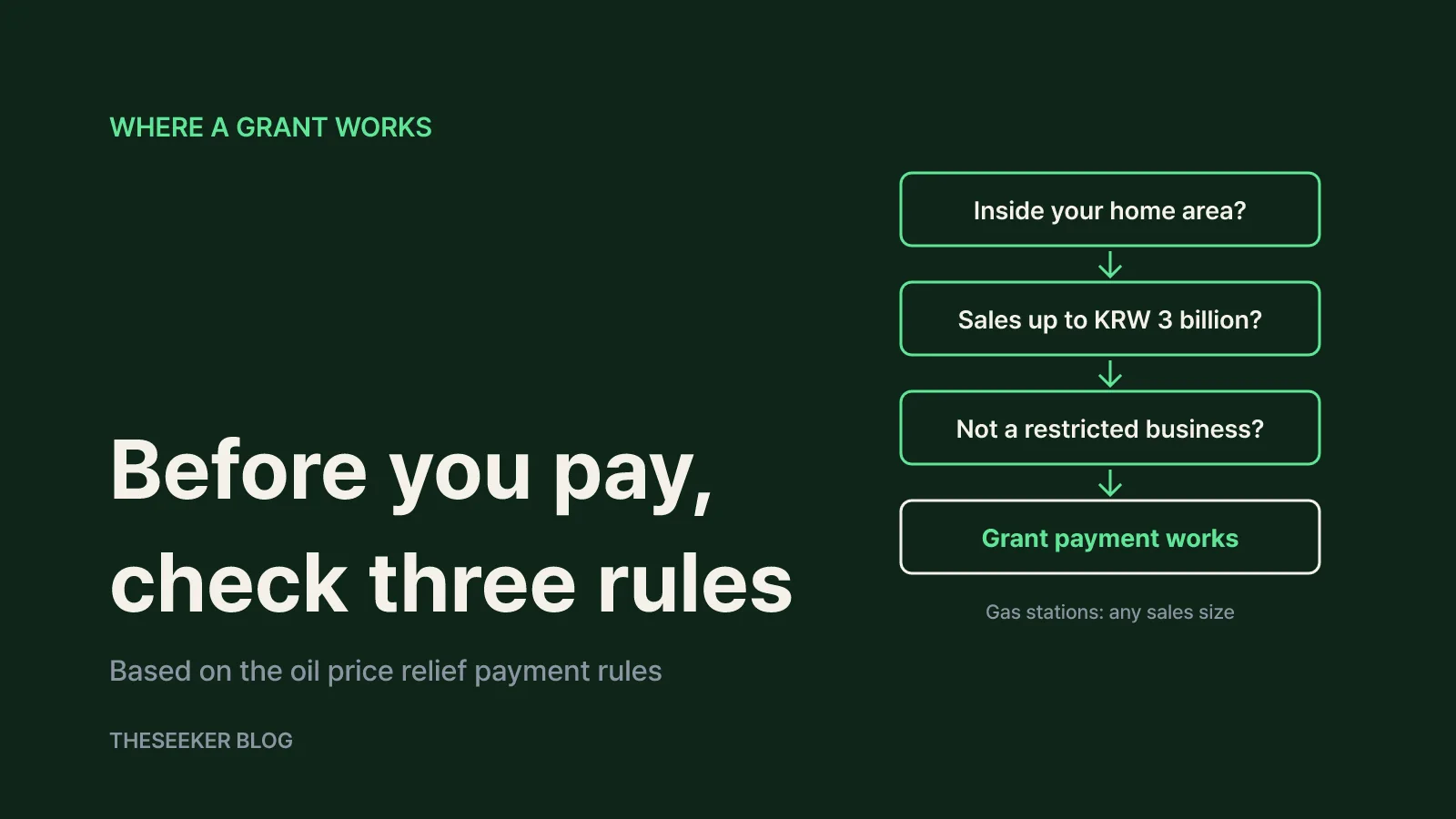
The second most common question is where a grant actually works. For the High Oil Price Relief Payment, three tests applied (MOIS second-round notice).
- Area. You could spend it only within your registered home area. Residents of a special or metropolitan city, including Sejong and Jeju, could use it anywhere in that city, while residents of a province were limited to their own city or county. A resident of Jung-gu in Seoul could spend it across Seoul, but a resident of Cheongju could use it only in Cheongju.
- Shop size. With local currency, eligible shops were merchants in your area with annual sales of KRW 3 billion or less. With credit, check or prepaid cards, it was small businesses with annual sales of KRW 3 billion or less, excluding certain sectors. Gas stations were accepted regardless of sales.
- Restricted sectors. Online shopping malls, entertainment and gambling businesses, and businesses whose goods are easily converted to cash were among the main exclusions, broadly in line with standard local currency rules.
There were also exceptions based on how you pay. Kiosks that process payments through an online payment gateway (PG) could not accept the grant, but the same shop's own card terminal could. Delivery apps worked only with the in-person "pay on delivery" option, while people paid in local currency could also pay inside public delivery apps. If a kiosk declines your grant, asking to pay at the counter is the first fix to try.
Local grants may copy these rules or set their own. Most reported cases limited spending to local currency merchants, but sector exceptions and sales thresholds should be confirmed in each notice. Be careful if you have moved. Each local government uses its own residency reference date, and people who registered after that date may not qualify even if they live there now. A grant you already hold may also be tied to the merchants of the area that paid it.
A checklist before your balance expires
If you still have a grant to spend, run through this list one or two weeks before the deadline:
- Write down the program name and exact deadline. Notices often specify a time, such as 24:00 on the final day.
- Pick your balance channel. Card app, alerts or customer center for card-based grants; the local currency app for mobile or card-type certificates; the leaflet or local call center for prepaid cards and paper certificates.
- Find eligible shops early. Use the merchant search on your card company's site, your local government's site or the local currency app so you are not dealing with declined payments in the final week.
- Use up small leftovers. Because the card-based oil price grant was spent before regular credit, a purchase larger than the remaining balance used up the grant first and charged the rest to your card. Whether a local currency app lets you combine grant and personal balances depends on the app.
- Do not count on an extension. The oil price grant lapsed on schedule. Until an official notice says otherwise, plan around the original date.
For questions about national programs, the Government Call Center (110) and program hotlines, such as 1670-2626 for the oil price grant, were available. For local grants, your city or county call center and community service center will have the most accurate answer.
Sources
Frequently asked questions
Can I still spend my High Oil Price Relief Payment?
No. Both rounds of the payment had to be spent by 24:00 on Aug 31, 2026, and unused balances lapsed automatically. As of October 2026, the MOIS program page showed no extension. If you still see a balance, it may be a local grant or your own top-up, so check the program name in your transaction history.
Is grant money on my card the same as reward points?
No. MOIS said grant money loaded onto credit and check cards was kept separate from reward points and was used before regular card credit at eligible shops. Check the grant history in your card app or your payment alerts rather than your points balance.
Where do I find the deadline for a local relief grant?
Check the grant notice on your city, county or district website. Deadlines differ: September reports put Gimhae and Naju at Nov 30 and Goheung and Yeongdong at Dec 31. If you cannot find the notice, call the local government or ask at your community service center.
Why does a kiosk decline my grant?
Under the oil price program, kiosks and table-ordering systems that use an online payment gateway could not accept the grant. The same shop's own card terminal could, so ask to pay at the counter. For local grants, check the shop rules in the notice.
I got a text with a link saying my grant deadline was extended. What should I do?
Do not open it. MOIS said the government, card companies and local currency operators do not send grant-related texts with URL links. Delete the message and check your balance or deadline through an official app you installed yourself or an official customer center.
blog.theseeker.io/en/posts/korea-support-payment-expiry-usage-shops-check
Nathan Brooks
Nathan covers eligibility, application steps and deadlines for public support programs, working from government notices and starting with who qualifies.
Read our editorial standards