Japan's Dual Pricing: Restaurants, Hotels and What to Check
Most of Japan's dual pricing is based on where you live, not your nationality. Here is what is confirmed at Himeji Castle, Kyoto buses and restaurants, and why lodging taxes matter more for hotels.
 Daniel Foster
In this post
- What dual pricing means in Japan
- Public attractions: residence, not passport
- Restaurants: a stated discount is not the same as a hidden menu
- Hotels: lodging taxes, not foreigner rates, are the real cost change
- Where the government stands
- A pre-trip and on-the-ground checklist
- Sources
- Frequently asked questions
As of October 2026, most of what gets reported as "dual pricing" in Japan is not a surcharge for foreigners as such. It is a higher rate for anyone who does not live locally, with residents getting a discount. Public sites such as Himeji Castle publish both prices openly, and a few restaurants advertise a "Japan resident discount." For accommodation, the change most travelers will actually notice is not a foreigner rate but higher lodging taxes and a bigger departure tax that apply to everyone. So the useful question before a trip is not "will I be charged more as a foreigner?" but "which price applies to me, and where is it published?"
The topic went viral after reports that Japan was "charging tourists more for meals and hotels" during the weak-yen travel boom. Those reports blur together three different things: municipal fees set by local ordinance, private businesses that disclose a resident discount, and menus that quietly list different prices by language. This guide sticks to cases confirmed in published reporting and does not generalize them to other cities or businesses.
What dual pricing means in Japan
Dual pricing (nijū kakaku) means charging different customer groups different prices for the same thing. In Japan the debate covers three distinct models:
- Residence-based public fees. Local residents keep the old price while everyone else pays more, including Japanese visitors from other cities.
- Disclosed private discounts. A restaurant or theme park states a rule, such as a lower price for people who live in Japan.
- Undisclosed differences. For example, an English menu that lists higher prices than the Japanese menu, with no stated reason.
The first two can be checked in advance. The third is where complaints concentrate. Seoul Economic Daily notes that local governments split fares by residence rather than nationality precisely to avoid discrimination claims, and that language-based menu pricing is more contentious because its basis is not disclosed.
The pressure behind all this is volume. The same report cites 3,692,200 foreign arrivals in April 2026 alone. The Guardian reports that Japan received more than 42 million overseas visitors in 2025 and has raised its target to 60 million by 2030, alongside rising maintenance costs at historic sites and congestion in Kyoto and Tokyo.
Public attractions: residence, not passport
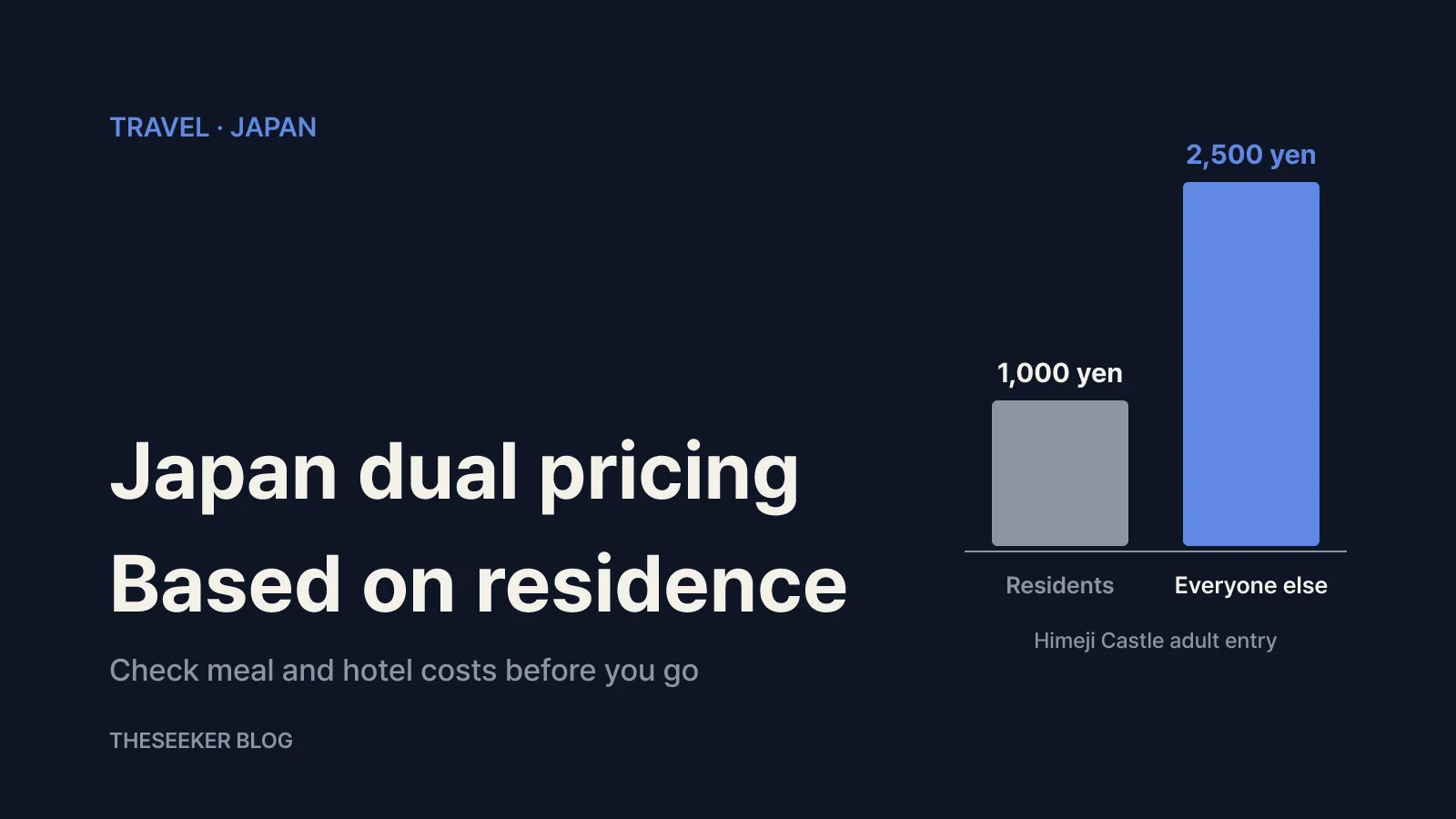
Himeji Castle is the best-known example. According to TV Asahi, from March 1, 2026 adults who live in Himeji pay 1,000 yen while all other adults pay 2,500 yen. Visitors under 18 enter free regardless of residence, and residents prove eligibility with ID such as a My Number card.
The city's mayor had floated a much higher fee aimed specifically at foreign visitors, but that idea was dropped: staff would struggle to tell who counts as a foreign tourist, and checking at the ticket window would cause queues. Castle management told the Guardian it sees the system as "a flat 2,500 yen with a discount for city residents who show ID." In the first month, admissions fell 17% while ticket revenue more than doubled.
Other examples reported in 2026:
- Kagoshima City has set resident prices 100 to 500 yen lower at 14 facilities, including the zoo, since October 2025.
- Kitakyushu City applied the same approach at four facilities, including Kokura Castle, from April 2026.
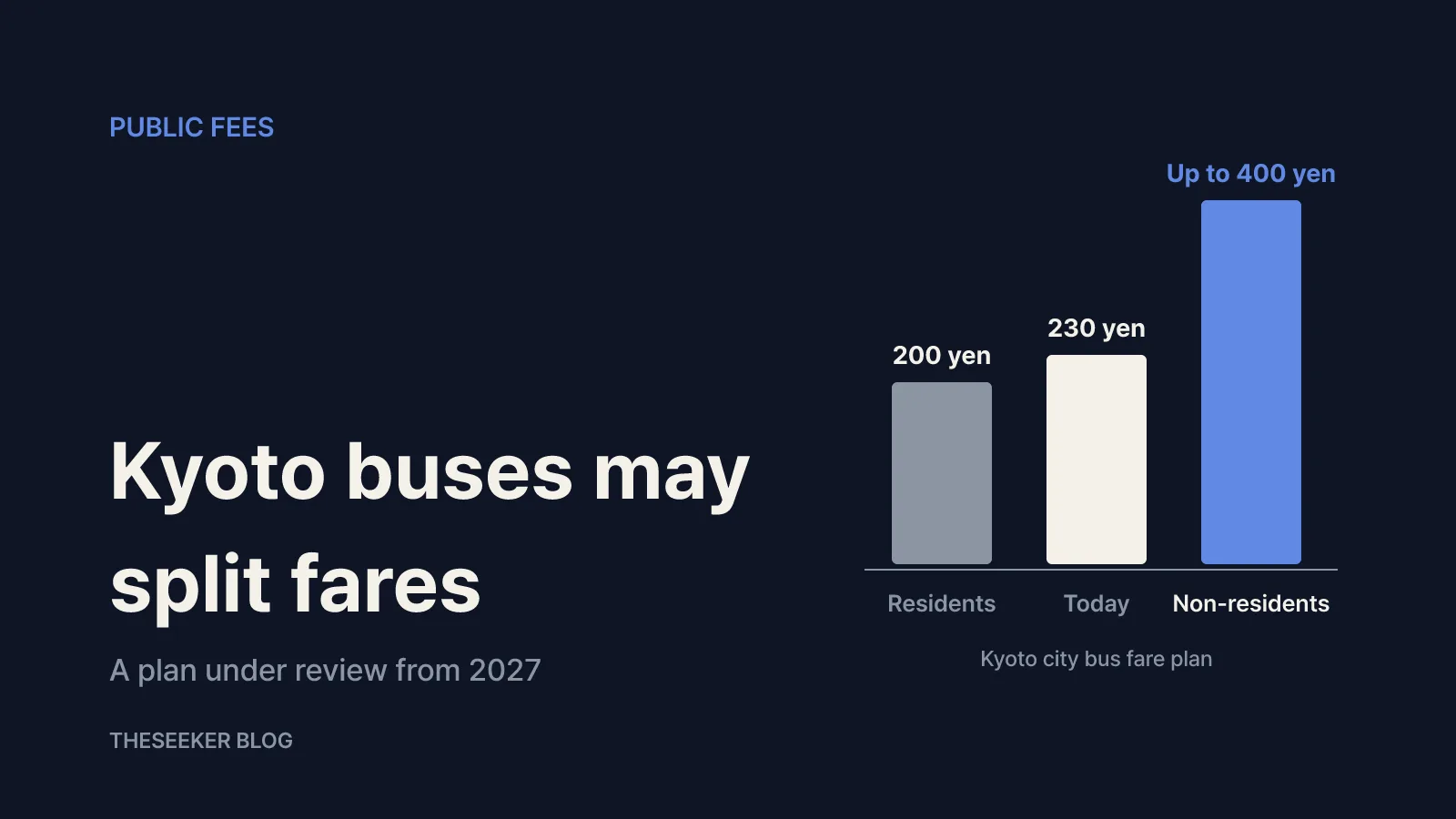
- Kyoto city buses may split fares from 2027: 200 yen for residents and up to 400 yen for non-residents, versus 230 yen today. That would be Japan's first dual-priced public transit.
- Junglia Okinawa, a nature theme park, sells one-day tickets at 6,930 yen for people living in Japan and 8,800 yen for everyone else.
The Guardian also reports that the Agency for Cultural Affairs has decided to introduce higher admission prices for overseas tourists at state-run museums and galleries. Because public fees are posted on official websites, the simplest fix is to check the facility's price page shortly before you go and budget at the non-resident rate.
Restaurants: a stated discount is not the same as a hidden menu
Restaurant cases split into two groups. TV Asahi profiled a seafood buffet in Shibuya, Tokyo, that opened in 2024 with a "domestic resident discount": prices start at 5,478 yen for people living in Japan and 6,578 yen for overseas tourists. The owner said guests who don't speak Japanese need more staff time to explain ingredients and how to eat them, which raises labor costs.
The Japanese-language booking site shows both the regular price and the resident discount, while the foreign-language site shows no discounted price. Walk-in foreign residents of Japan, and tourists who speak Japanese, also receive the discount. The rule is disclosed, but what you see depends on which booking page you use.
The controversial cases are the ones without a stated rule. Seoul Economic Daily describes a Kyoto sushi restaurant where an English menu priced three pieces of tuna sushi at 1,980 yen including tax. When the diners asked for the Japanese menu, it arrived only after a long delay, and it included items from 500 yen and a set at 5,214 yen, lower than the English menu. The video spread widely and drew accusations of secretly overcharging foreigners.
One restaurant does not define dining in Japan. But the practical response is clear: if there are menus in several languages, compare prices for the same dish, and ask before ordering if they differ. Checking prices posted on map apps or booking sites against the menu in front of you also helps.
Hotels: lodging taxes, not foreigner rates, are the real cost change
You will see claims that Japanese hotels charge foreigners more. In the sources reviewed for this guide, the confirmed change on the accommodation side is higher lodging taxes charged to every guest, Japanese or not.
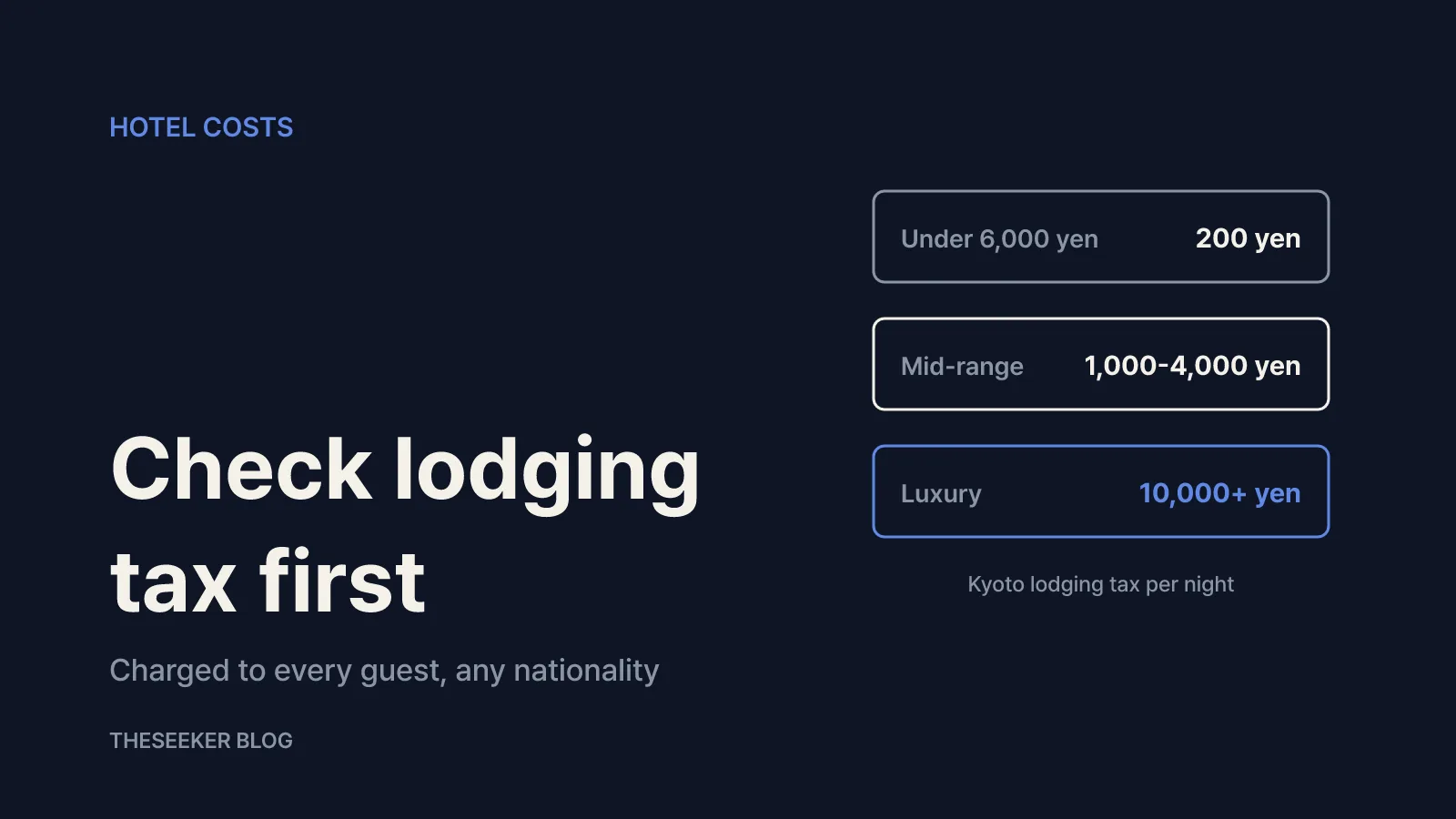
According to Euronews, Kyoto overhauled its lodging tax on March 1, 2026: 200 yen per night for stays under 6,000 yen, 1,000 to 4,000 yen for mid-range stays, and 10,000 yen or more at luxury hotels. From April 1, Hokkaido charges 100, 200 or 500 yen per person per night depending on the room rate, and Sapporo adds another 200 or 500 yen. Hiroshima charges 200 yen for stays of 6,000 yen or more.
Lodging tax is sometimes collected separately at check-in rather than included in your online payment. Even if a booking says "taxes included," confirm whether local lodging tax is extra. On a multi-city itinerary, each city's rule is different.
Two more costs rose in 2026. Japan's departure tax tripled from 1,000 yen to 3,000 yen per person from July, for everyone aged two and over leaving by air or sea; it is usually built into your airfare. And from October 1 the 7-day ordinary Japan Rail Pass for adults rose by 3,000 yen to 53,000 yen.
Where the government stands
In March 2026 the Japan Tourism Agency said it would convene an expert panel to draft dual-pricing guidelines, and its commissioner stressed that operators setting different rates should explain the basis to customers.
By October, the message was more hands-off. Per Seoul Economic Daily, the agency's commissioner told foreign correspondents that the government would not comment on rates set for foreign tourists, and that introducing or raising tourism and lodging taxes, or charging overseas visitors more than residents, is up to each operator. In other words, there is no national rule that bans or mandates dual pricing, so expect prices to keep varying by city and venue.
A pre-trip and on-the-ground checklist
Before you go
- Check the official price page of each attraction for separate "resident" and "general" prices, and budget at the general rate.
- Read your hotel confirmation for lodging tax, and whether it is paid at check-in. Re-check Kyoto, Hokkaido, Sapporo and Hiroshima, which changed rules in 2026.
- Confirm the departure tax appears in your airfare's tax breakdown.
- If you plan to buy a Japan Rail Pass, compare the new price with individual tickets for your actual route.
At restaurants
- If menus come in several languages, compare prices for the same item; a translation app's camera mode works on Japanese menus.
- If a resident discount is posted, check whether its conditions apply to you.
- If a price gap isn't explained, ask before ordering, and feel free to walk away.
- Match your receipt against the menu when you pay.
Dual pricing in Japan is still evolving. Checking three things yourself, the official price list, your booking confirmation and the menu, avoids most surprise charges.
Sources
- 'Fine for others to pay more': can Japan attract more overseas tourists while charging them extra? (The Guardian, 2026-07-01)
- Japan Won't Intervene in Dual Pricing for Foreign Tourists (Seoul Economic Daily, 2026-10-13)
- Different Prices by Language: Japan Restaurant Sparks Tourist Overcharging Row (Seoul Economic Daily, 2026-07-15)
- Travelling to Japan in 2026? Here are the new taxes and price hikes you need to know about (Euronews, 2026-04-15)
- 外国人観光客の二重価格 日本で導入加速 トラブルも 世界に学ぶ成功の秘訣 (テレ朝news, 2026-01-26)
Frequently asked questions
Does Japan charge foreigners more than Japanese people?
As of October 2026, confirmed public-sector cases are mostly based on residence, not nationality. Himeji Castle charges 1,000 yen to city residents and 2,500 yen to everyone else, including Japanese visitors from other cities. Some private restaurants offer a discount for people living in Japan.
Do Japanese hotels charge foreign guests higher rates?
In the sources reviewed, the confirmed change is higher lodging taxes charged to all guests. Kyoto's tax, revised on March 1, 2026, ranges from 200 yen to 10,000 yen or more per night depending on the room rate. Check whether it is included in your booking or collected at check-in.
What should I do if the English menu shows higher prices?
Compare the same item on the Japanese menu and ask about the difference before ordering. A disclosed rule such as a resident discount is different from an unexplained gap; if the answer doesn't satisfy you, you don't have to order.
Is the Japanese government regulating dual pricing?
The Japan Tourism Agency announced an expert panel on guidelines in March 2026, but in October said pricing for foreign tourists is up to each operator. Rules therefore vary by city and venue.
How much is Japan's departure tax now?
From July 2026 it is 3,000 yen per person, up from 1,000 yen, for travelers aged two and over leaving by air or sea. It is normally included in the ticket price.
blog.theseeker.io/en/posts/japan-dual-pricing-tourists-restaurants-hotels-checklist
Daniel Foster
Daniel covers trip planning, booking and on-the-ground tips, checking fast-changing details such as entry rules and fares against official sources and noting when they were checked.
Read our editorial standards