Busan Ferry Terminal: Getting There, Parking and Check-In
How to reach Busan Port International Passenger Terminal from Busan Station, what parking costs, and the step-by-step check-in and departure process for ferries to Japan.
 Daniel Foster
In this post
- Where the terminal is and how to get there by public transport
- Parking at the terminal and how discounts work
- Check-in steps for a ferry to Japan
- What to prepare for customs and security
- Documents to have ready before arriving in Japan
- Day-before and departure-day checklist
- Sources
- Frequently asked questions
As of October 2026, the official guidance from Busan Port Authority and Busan Port Security Corporation boils down to this: Busan Port International Passenger Terminal (206 Chungjang-daero, Dong-gu, Busan) is a short walk from Busan Station, and if you are taking a ferry to Japan you should be at the terminal two hours before departure. Check in at your ferry company's counter in the third-floor departure hall, then go through the departure gate, customs and security screening, and Korean emigration control before boarding. If you drive, know the daily parking rate and the same-day ferry ticket discount before you go.
Schedules, fares and cancellations for routes to Fukuoka, Tsushima, Osaka and elsewhere vary by operator and change often. This guide covers the terminal procedures that apply to every passenger; for timetables, use the operator list published by Busan Port Authority and each company's own site.
Where the terminal is and how to get there by public transport
The terminal's main line is +82-51-400-1200 (night: +82-51-400-1230). Do not confuse it with the Coastal Passenger Terminal, which handles domestic routes such as Jeju, or the Yeongdo cruise terminal. When you search in a map app, use the full name "Busan Port International Passenger Terminal".
The Busan Port Authority directions page lists these main routes:
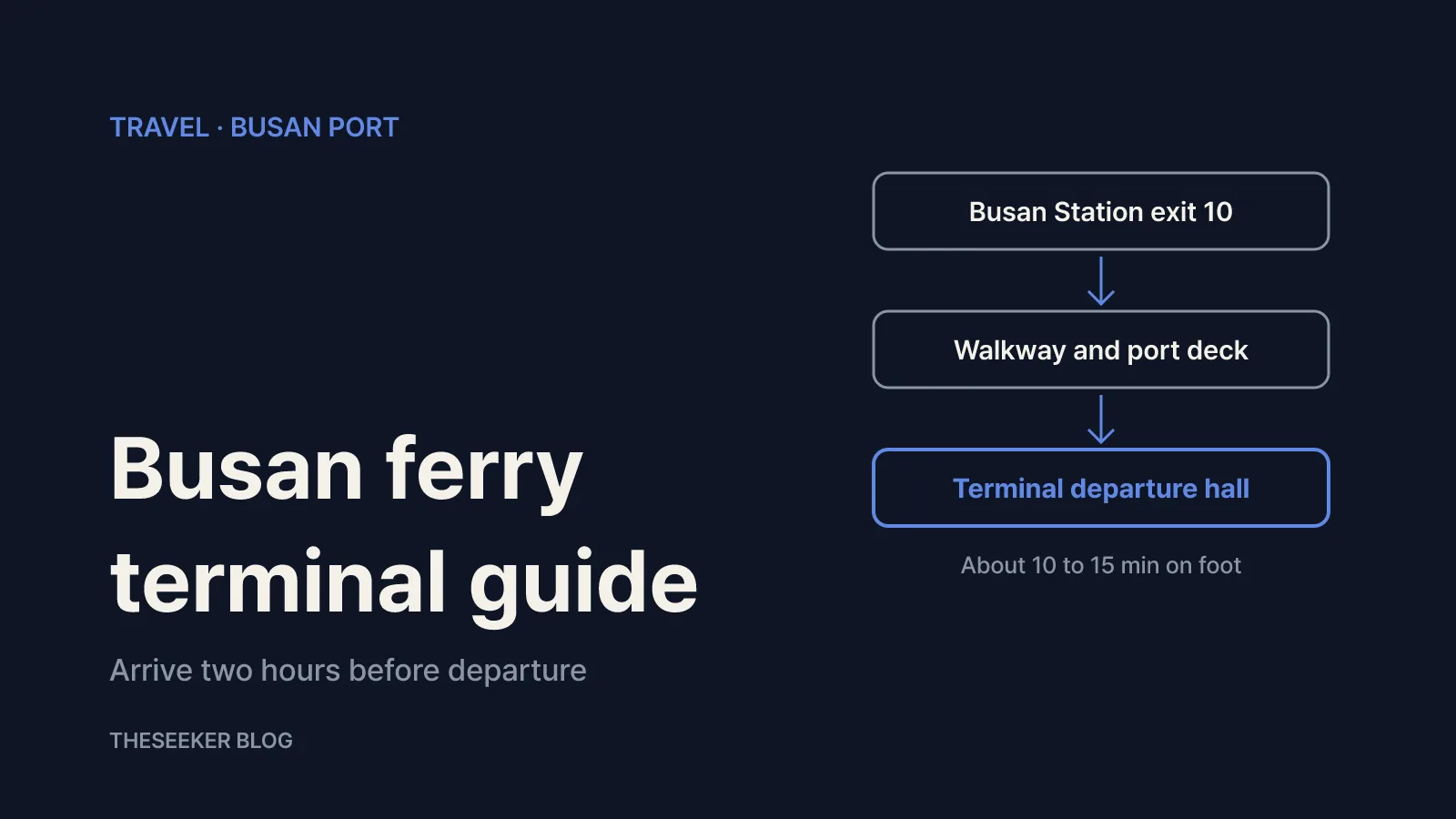
- On foot from Busan Station (rail): exit 10 of the station building, then the moving walkway and the Busan Port pedestrian deck to the terminal, about 10 to 15 minutes
- Subway Line 1, Busan Station: exit 6, through station building exit 10, then the walkway and deck, about 20 minutes
- Subway Line 1, Choryang Station: exit 6, past the underpass intersection and across Chungjang-daero, about 20 minutes
- From Gimhae Airport by public transport: Busan-Gimhae Light Rail from Airport Station, change to Line 2 at Sasang, change to Line 1 at Seomyeon, then Busan Station exit 6 and the deck, about 70 minutes
- From Gimhae Airport by car: about 30 minutes
If you are pulling a suitcase, the deck route from exit 10 of Busan Station is the simplest option. The moving walkways cut down on stairs and the path is hard to miss. Arriving by KTX and heading straight to the port? Add the walking time to your train's arrival and check that you still reach the terminal two hours before sailing.
City buses 5-1, 1004, 42 and 172 also stop at the terminal. According to the official page, the standard card fare is KRW 1,550 on routes 5-1, 42 and 172 and KRW 2,100 on route 1004, which comes from Gimhae via Seomyeon and Busan Station and turns around at the terminal. Weekday intervals range from 12 to 33 minutes depending on the route, so a real-time bus app is worth using if your sailing time is fixed.
Parking at the terminal and how discounts work

The official parking fee page sets these rates for passenger cars:
← Swipe to see more
| Duration | Car | Large vehicle (bus, 25+ seats) |
|---|---|---|
| First 10 minutes | Free | Free |
| 11 to 30 minutes | KRW 1,000 | KRW 2,000 |
| After 30 minutes | KRW 500 per 10 min | KRW 1,000 per 10 min |
| Daily rate | KRW 10,000 | KRW 20,000 |
The key rule: parking for 3 hours 30 minutes or longer triggers the daily rate. A quick drop-off is billed by time, but if you leave the car while you travel to Japan, budget for the daily rate across your trip. For multi-day parking, call the parking office (+82-51-400-1252) before you go to confirm how longer stays are settled.
Discounts depend on where you park and who you are. Using the outdoor lot (E) alone gives 20% off (trucks excluded). Holders of a same-day ferry ticket get 20% off in the indoor lots (A/B) or 30% off outdoors, and "same day" means the ticket must carry the date you drive out. In practice, keep your return ferry ticket so you can show it when you collect the car.
Vehicles registered to national merit recipients or disabled drivers, cars under 1,000cc, eco-friendly vehicles and multi-child households can get 50% indoors or 60% outdoors, with Korean documentation. Discounts do not stack; only the highest single rate applies, and corporate or commercial vehicles are excluded. If you could not show proof at the exit, you can submit documents within seven days for a refund of the discount. EV drivers using the terminal's charging facilities park free for up to one hour.
Check-in steps for a ferry to Japan
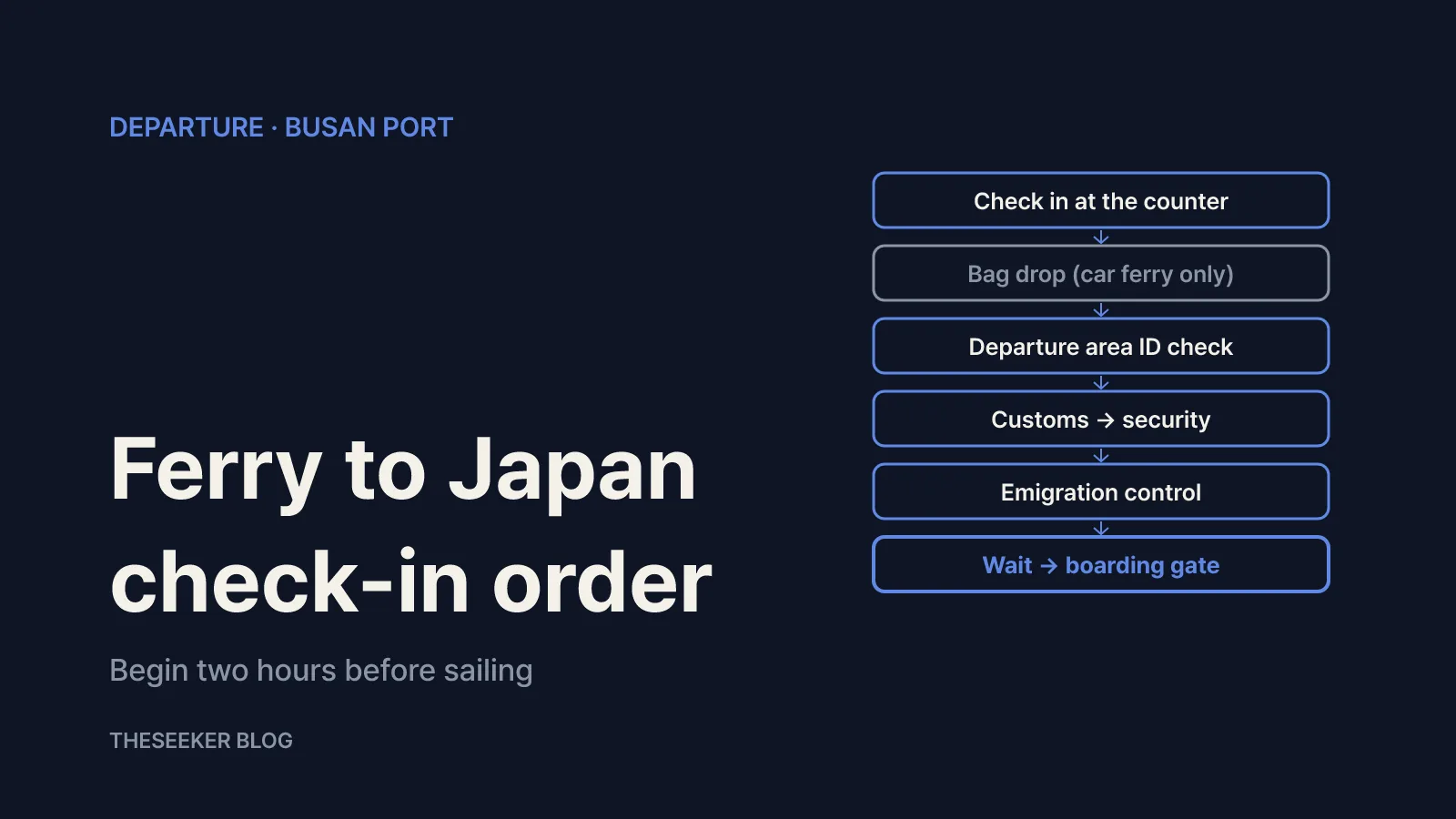
The Busan Port Authority departure procedure asks passengers to arrive two hours before departure because of terminal congestion. You pass through a departure gate, screening and emigration control just as at an airport, so turning up shortly before sailing, as you might at a bus station, is risky. The sequence is:
- Arrive two hours before departure and go up to the third-floor departure hall. Korea Ferry, Star Line, Pukwan Ferry, Panstar Line Dot Com and Dae-A Express Shipping all have ticket counters there.
- Check in at your operator's counter by showing your passport. You receive a boarding pass with your cabin number along with your passport.
- Drop checked baggage (car ferry passengers only) at the baggage counter within the posted time, showing your boarding pass and passport, and keep the baggage receipt. If you are on a high-speed ferry, this step does not apply, so pack on the assumption that your bags stay with you.
- Enter the departure area by showing your passport and boarding pass for an identity check.
- Go through customs and security screening.
- Clear emigration by handing your passport and boarding pass to the officer, who returns your passport after the check.
- Wait to board in the lounge or duty-free area until your sailing is announced.
- Board through your operator's gate when instructed.
Gates differ by company. According to the operator list, Pukwan Ferry uses car ferry gate 1, Korea Ferry and Panstar use car ferry gates 2 and 3, and Star Line and Dae-A Express use the high-speed ferry gate. Follow your boarding pass and the announcements on the day.
The operator list also describes Korea Ferry's New Camellia on the Busan-Fukuoka route, Panstar's Busan-Osaka car ferry and Busan-Tsushima route, and Dae-A Express Shipping's Busan-Tsushima service. Sailing days and times shift with the season and the weather, so recheck the operator's notices the evening before and on the morning of departure.
What to prepare for customs and security
The departure guidance flags two customs points. First, valuables worth KRW 450,000 or more should be declared when you leave Korea, so they are not taxed as new purchases when you return and so you have a record for insurance claims if they are stolen. That matters mainly for Korean residents carrying cameras, laptops or designer bags. Second, if the total cash and currency you carry is equivalent to USD 10,000, you must declare it to customs.
Busan Port Security Corporation describes screening in four steps: an identity check with your passport and boarding pass at the entrance, customs declaration for any items that need it, putting carry-on items in trays on the X-ray belt, and walking through the metal detector. Depending on what the equipment shows, officers may do a pat-down or open your bag. Note the order: customs comes before security screening, so if you have something to declare, go to the customs desk before joining the screening line.
To move through faster, keep laptops, power banks and liquids where you can reach them, and put metal items from your pockets into your bag ahead of time. The security corporation's site has a separate page on items restricted on board, which is worth checking if you are carrying camping gear or tools.
Documents to have ready before arriving in Japan
Busan Port Authority advises filling in the Japanese arrival card provided on board before the ship docks, so you can hand it in at immigration after disembarking. Bring a pen and note your accommodation's name, address and phone number in advance.
You also need a customs declaration. Japan Customs requires every passenger entering Japan to submit a Declaration of Accompanied Articles and Unaccompanied Articles and recommends doing it electronically through Visit Japan Web. The paper form is still accepted and can be printed on A4 in advance, with English (C-5360-B) and Korean (C-5360-C) versions available. Japan Customs says its electronic declaration gates are installed at seven international airports, so at a seaport follow the on-site instructions for how your QR code is used. Registering in Visit Japan Web ahead of time and knowing the paper form is an option covers you either way.
Day-before and departure-day checklist
The day before:
- Passport validity, and the physical passport itself
- Booking confirmation and operator notices about weather cancellations or time changes
- Your Japanese accommodation details and a pen
- A list of valuables and whether you will declare them
- If driving, your parking duration, expected daily charges and discount paperwork
On the day:
- Work backwards so you reach the terminal two hours before departure
- Collect your boarding pass at the third-floor operator counter
- On a car ferry, drop bags within the baggage window
- Declare items at customs before security screening
- Recheck your gate after emigration
- Keep your return ticket for the parking discount
The terminal's direct link to Busan Station makes it easy to reach. The process, however, is the same as at an airport, so arriving late on the assumption that boarding a boat is quick can cause problems. Sticking to the two-hour rule takes most of the stress out of departure.
Sources
Frequently asked questions
How early should I arrive at Busan Port International Passenger Terminal?
Busan Port Authority asks passengers to arrive two hours before departure, and check-in at operator counters also begins two hours before sailing.
Can I walk from Busan Station to the ferry terminal?
Yes. Leave through exit 10 of the Busan Station building and follow the moving walkway and the Busan Port pedestrian deck. The official estimate is about 10 to 15 minutes.
Can I leave my car at the terminal while I travel to Japan?
Cars parked for 3 hours 30 minutes or longer are charged the daily rate of KRW 10,000. Call the parking office at +82-51-400-1252 to confirm multi-day settlement. A ferry ticket dated the day you drive out gives 20% off indoors or 30% off outdoors.
Can high-speed ferry passengers check their bags?
Busan Port Authority says baggage check is for car ferry passengers only. Ask your high-speed ferry operator about its baggage rules.
Do I need to declare anything to Korean customs when leaving?
Valuables worth KRW 450,000 or more should be declared on departure so they are not taxed on return, and currency equivalent to USD 10,000 must be declared. Declare before security screening.
blog.theseeker.io/en/posts/busan-port-international-passenger-terminal-guide
Daniel Foster
Daniel covers trip planning, booking and on-the-ground tips, checking fast-changing details such as entry rules and fares against official sources and noting when they were checked.
Read our editorial standards