Lost or Found Something in Japan? Koban Reports and Recovery
Lost a wallet or phone in Japan? Ask the facility first, or file a Lost Property Report at a koban. Found cash? Hand it in within 24 hours or 7 days. Here is the official process, step by step.
 Daniel Foster
In this post
- First, decide where you lost it: a facility or the street
- How to file a Lost Property Report at a koban
- Lost it on a train, subway, taxi or at the airport
- After your item is found: pickup, proxies and shipping
- Found cash or a wallet? The 24-hour and 7-day rules
- Useful Japanese phrases and a pre-trip checklist
- Sources
- Frequently asked questions
As of October 2026, the official guidance from Japan's National Police Agency and the Tokyo Metropolitan Police Department boils down to one rule: if you lost something inside a managed facility such as a station, store or hotel, contact that facility first; if you lost it on the street or have no idea where, file a Lost Property Report at the nearest koban (police box) or police station. If a credit card, bank card or phone is missing, call the issuer or carrier to suspend it before anything else. And if you are the one who found something, hand it to the facility within 24 hours or to the police within 7 days to keep your rights as a finder.
Japan has a reputation for returning lost wallets, and viral travel videos about finding large sums of cash have made the question more common. The system works well, but it is built around Japanese residents, which is why visitors often get stuck on phone numbers, office hours and pickup after they have flown home. I put this guide together from the National Police Agency's lost property site, the Tokyo Metropolitan Police Department (TMPD), GO TOKYO and the Japan National Tourism Organization (JNTO). Phone numbers and hours change, so double-check them before you travel.
First, decide where you lost it: a facility or the street
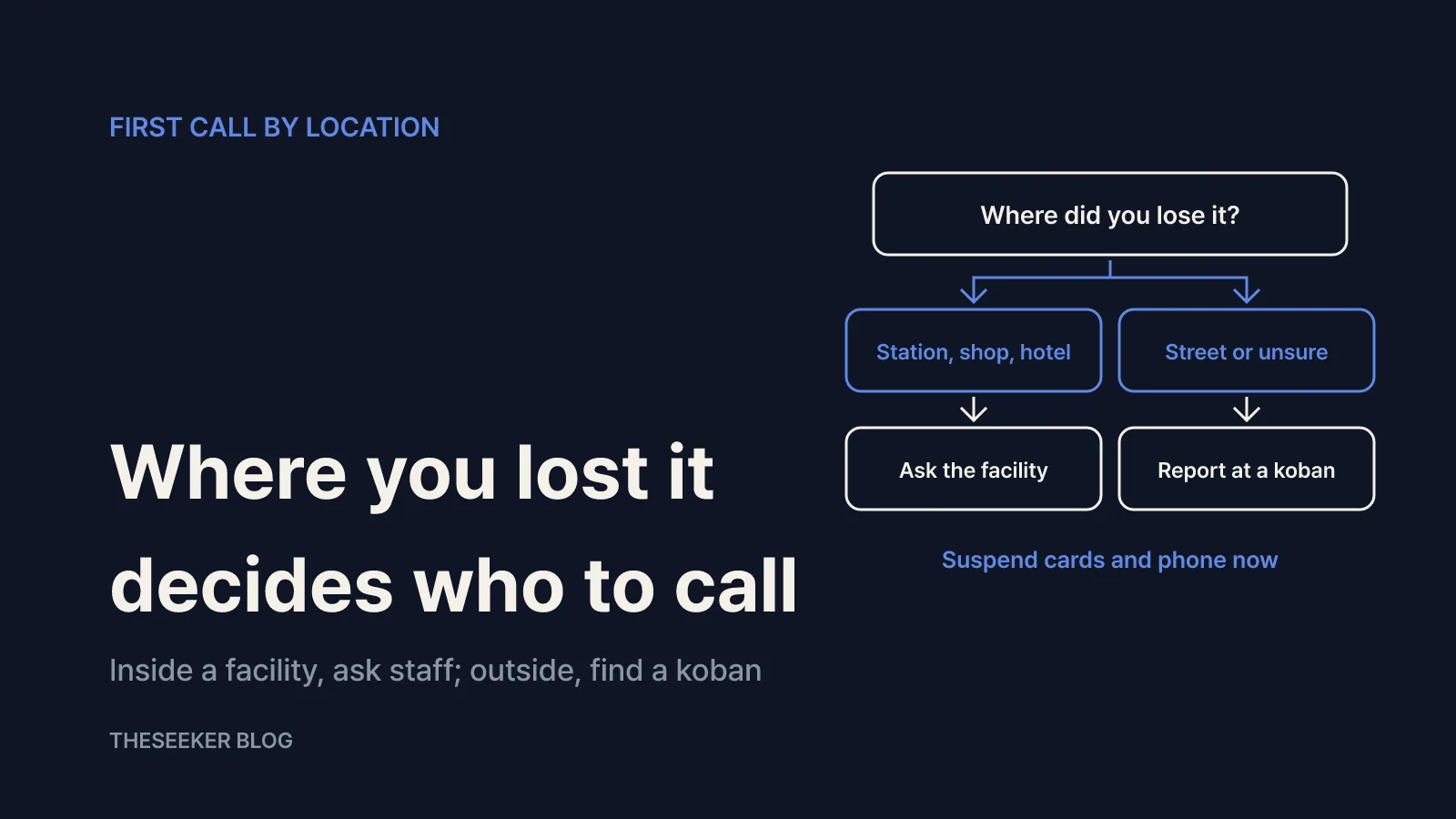
The police split every case into two paths. If you think you lost the item inside a facility with a manager, such as a train station or department store, the National Police Agency tells you to ask the facility first. Facilities hold found items for a while before passing them to the police, so on the same day your best chance is usually the station office, the store's service counter or the hotel front desk.
If you lost it on the street, or you genuinely do not know where, go straight to a police station or koban. Koban are the small police posts found in most neighborhoods; GO TOKYO describes them as the place to drop in for directions, lost-and-found inquiries and traffic incidents. If you cannot find one, ask a passer-by or your hotel.
Whatever the location, deal with payment cards and phones immediately. The police guidance puts this step first: contact the card issuer or mobile carrier and suspend the account or line. Keep your bank's international lost-card number somewhere other than your wallet.
A lost passport adds one step. TMPD advises you to contact your embassy or consulate first to find out whether you need a police certificate for the replacement. JNTO also notes that a police report may be required for passport reissue or a travel insurance claim, and suggests visiting the nearest koban or asking your hotel front desk for help.
How to file a Lost Property Report at a koban
A Lost Property Report records the date, time, place and description of what you lost. Two things surprise many travelers. According to the National Police Agency, the report is not proof that you lost something, and the police do not search or investigate based on it. Instead, items handed in are matched against registered reports, and you are contacted only when a match turns up. The more specific your description, the better your odds.
You can get the form at any koban or police station. In Tokyo you can also download it from the TMPD website and fill it out in advance, but TMPD states it must be submitted in person; reports sent by email or other means are not accepted. Items lost outside Japan, for example on the plane before arrival, are not handled by Japanese police.
Prepare these details before you go:
- Time window: from when you last saw the item to when you noticed it was gone.
- Location: area and street, or the train line, direction, transfer station and the stations where you boarded and got off.
- Items: list from largest to smallest, such as the bag, then the wallet, then its contents.
- Description: brand, color, material, damage, and the maker's name or serial number for electronics.
- Contact details: phone and email you can actually be reached on.
Contact details matter more than visitors expect. TMPD asks for a Japanese phone number and says that, as a rule, it does not make international calls. The National Police Agency asks visitors to give a valid email address and phone number for after they leave Japan, plus the details of anyone in Japan who could contact the police or collect the item for them. Ask for your report number and photograph it.
Lost it on a train, subway, taxi or at the airport
Transit operators run their own lost-and-found desks, so knowing which company you rode with is half the battle. GO TOKYO lists these Tokyo contacts:
← Swipe to see more
| Where | Contact |
|---|---|
| JR East | Lost & Found Telephone Inquiry Center, 050-2016-1603 |
| Tokyo Metro | Lost & Found Center, 0570-033-777, or online inquiry form |
| Toei Transportation | 03-3816-5711 |
| Tokyo taxis | Find the operator in the Tokyo Taxi Center's radio base list and call it directly |
| Haneda Airport (domestic, and international before outbound passport control) | 03-5757-8111 |
| Narita Airport Terminal 1 | 0476-32-2105 |
If you are not sure which operator it was, GO TOKYO points to Lost Item Cloud Find, a chat service that searches several transport operators and facilities at once, including JR lines, private railways, airports and taxi companies. TMPD also reminds visitors that railway and bus companies, airlines and shops may keep items for a few days, so contact them as well as the police. Outside Tokyo the same logic applies, with local operators and the prefectural police in their place.
After your item is found: pickup, proxies and shipping
Items handed to the police are kept for 3 months from the day they are reported, according to the National Police Agency. Umbrellas, clothing and similar items may be sold or disposed of if no owner turns up within 2 weeks of the public notice. While you wait, you can check the police online database; TMPD's version is Japanese-only and searchable by item type and date.
In Tokyo, pickup at a police station or the TMPD Lost and Found Center is 8:30 a.m. to 4:30 p.m., Monday to Friday, excluding national holidays and December 29 to January 3. Bring:
- A valid ID (your passport)
- Your Lost Property Report, if you have not already filed one
- The notification letter and the item's reference number
- For a phone, the SIM card number or the device serial number
Already home? You have two options. A proxy can collect it with a letter of authorization, their own valid ID and a copy of yours. Or you can request shipping at your own cost: the National Police Agency accepts payment in Japanese yen only, and TMPD ships only to an address in Japan. For Tokyo losses, that usually means a friend or agent in Japan.
If the finder asks for a reward, you must pay 5% to 20% of the item's value plus storage costs. Police are not involved in the amount or payment; you settle it directly with the finder.
Found cash or a wallet? The 24-hour and 7-day rules
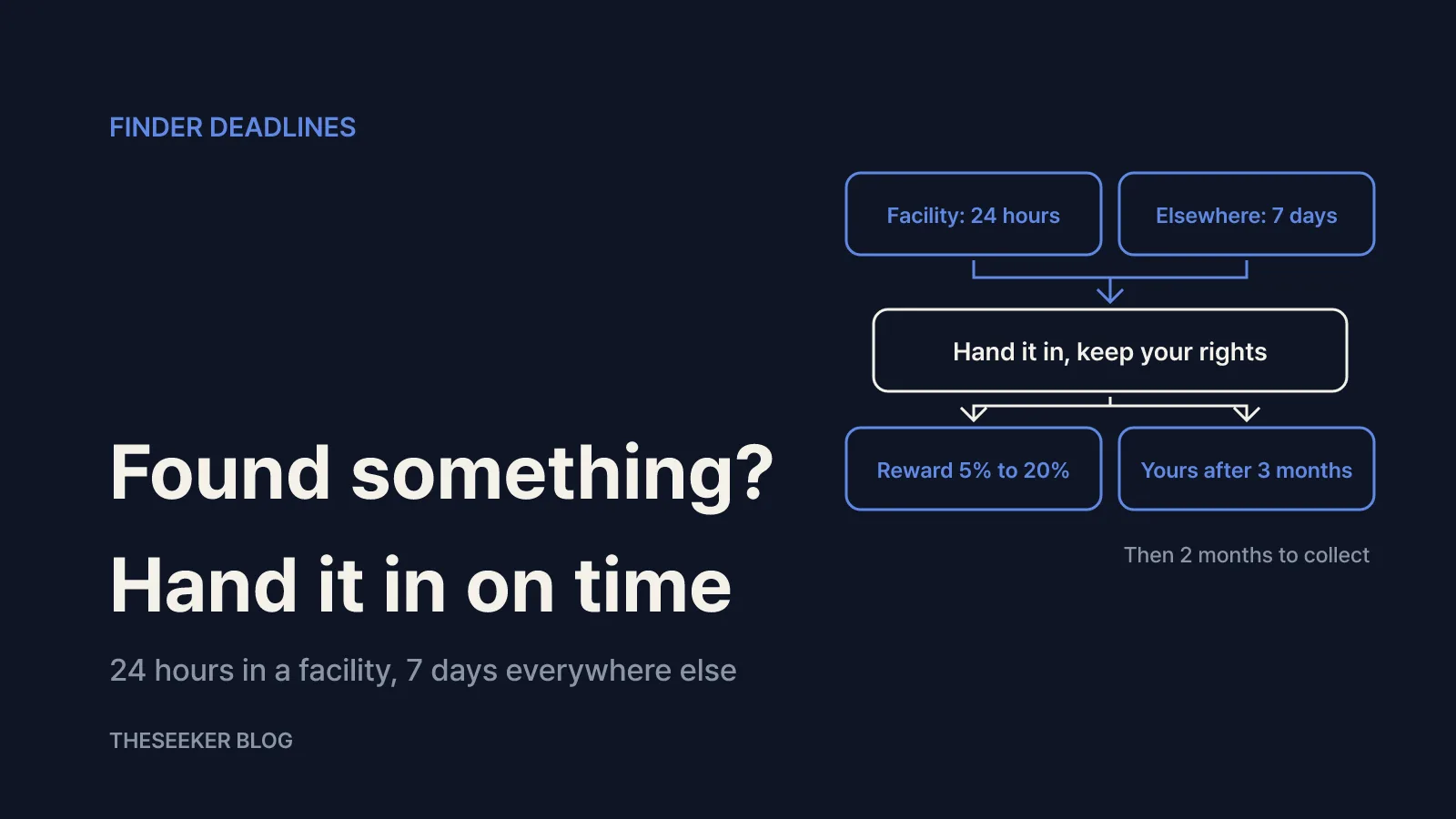
If you find something, the National Police Agency sets two deadlines: within 24 hours to the facility manager if you found it inside a managed facility, and within 7 days to a police station or koban if you found it elsewhere. Miss them and you lose the finder's rights. Do not pack found cash in your luggage and fly home with it.
Handing it in on time gives you three rights:
- A reward of 5% to 20% of the value when the owner is found, or 2.5% to 10% when it was found inside a managed facility.
- Ownership if the police do not notify you of a return to the owner within 3 months. You then have 2 months to collect it before ownership passes to the prefecture. You cannot acquire credit cards, IDs, phones or other items containing personal information.
- Expenses for reporting and storing the item.
You can claim or waive each right. Claiming a reward means your name and address are shared with the owner, and claims expire 1 month after the item is returned. You will receive a copy of the Receipt of Found Property; keep it, because you need it to collect the item if it becomes yours. Visitors who want to keep their rights should leave an email or phone number valid after departure. On a short trip, handing the item straight to staff is usually the cleanest choice.
Useful Japanese phrases and a pre-trip checklist
Many koban can manage some English, but a few phrases saved on your phone speed things up:
← Swipe to see more
| Situation | Japanese | Romaji |
|---|---|---|
| Where is the koban? | 交番はどこですか | Koban wa doko desu ka |
| I lost something | 落とし物をしました | Otoshimono o shimashita |
| I lost my wallet | 財布をなくしました | Saifu o nakushimashita |
| I want to file a lost item report | 遺失届を出したいです | Ishitsu todoke o dashitai desu |
| I found this | これを拾いました | Kore o hiroimashita |
| Does anyone speak English? | 英語ができる人はいますか | Eigo ga dekiru hito wa imasu ka |
For language help, JNTO lists 110 for emergencies, TMPD's English helpline at 03-3501-0110, and the 24-hour Japan Visitor Hotline at 050-3816-2787, which supports English, Chinese, Korean and Japanese. The TMPD Lost and Found Center is 0570-550-142.
Before you fly, save your card issuers' lost-card numbers, store a passport copy separately, note your phone's serial number, keep taxi receipts (they show the company name), and check whether your travel insurance needs a police report for a claim. The sequence to remember: suspend cards and phone, ask the facility, file at a koban, watch the database, then collect in person or by proxy. Finders only need two numbers: 24 hours in a facility, 7 days everywhere else.
Sources
Frequently asked questions
Can I get my lost item back after I leave Japan?
Often, yes. Police keep found items for 3 months, and a proxy with a letter of authorization can collect it, or you can request shipping at your own cost. TMPD ships only to addresses in Japan, so a contact in Japan helps.
Will the police search for my lost wallet?
No. The National Police Agency says reports are not used to search or investigate; found items are matched against reports and you are contacted if there is a match. A detailed description is what makes the difference.
What happens if I find money in Japan?
Hand it to the facility within 24 hours if found inside a managed facility, or to a koban or police station within 7 days. If the owner is found you can claim 5% to 20% (2.5% to 10% inside a facility), and if not, you may acquire ownership after 3 months.
Do I have to pay the finder a reward?
If the finder requests it, the owner must pay 5% to 20% of the item's value plus storage costs. The police do not set the amount; you agree it with the finder directly. Claims expire 1 month after the item is returned.
What if I don't know which train company I lost it with?
Try Lost Item Cloud Find, the chat service listed by GO TOKYO that searches JR, private railways, airports and taxi operators at once. If that fails, file a report at a koban or call the TMPD Lost and Found Center on 0570-550-142.
blog.theseeker.io/en/posts/japan-lost-and-found-koban-guide
Daniel Foster
Daniel covers trip planning, booking and on-the-ground tips, checking fast-changing details such as entry rules and fares against official sources and noting when they were checked.
Read our editorial standards