How to Choose a Small Town in Japan to Visit
Before falling for a photo of rural Japan, compare how you get from the airport to your bed, whether local transit works without a car, and where a solo traveler can actually stay. Takamatsu and Amakusa show the difference.
 Daniel Foster
In this post
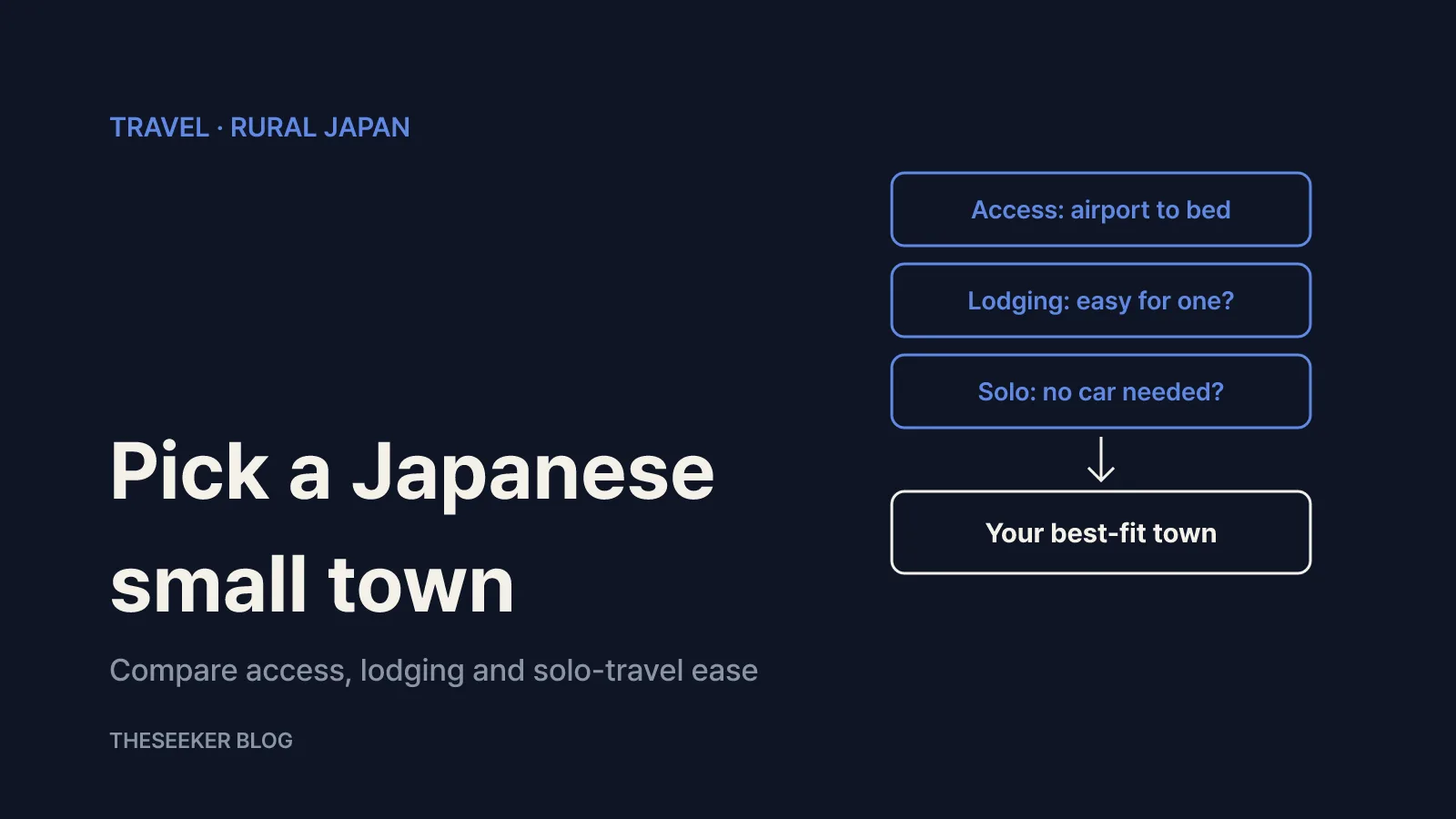
The best way to choose a small town in Japan is to check three things before the scenery: can you get from the airport to your lodging by public transport in one leg, does a day of sightseeing work without a car, and is there somewhere easy for one person to stay near a station or bus terminal. As of October 2026, official tourism and airport pages show a clear split. A place like Takamatsu, backed by an airport limousine bus and frequent trains, is easy to plan even on a first solo trip. A seaside area like Amakusa in Kumamoto, more than two hours by bus from the nearest airport, rewards you only if you build in time and check timetables carefully.
This guide is about off-the-beaten-path Japan rather than Tokyo, Osaka or Fukuoka. Travel videos featuring Yamaguchi, Takamatsu, Amakusa and high-altitude mountain villages are popular right now, and it is tempting to pick a destination from a single beautiful clip. The problems usually appear on arrival day: the last bus has gone, or your inn is an hour from the station. Flight schedules and fares change often, so the numbers below are only those published on the official pages I checked.
Filter your shortlist with four criteria
Write down two or three towns you are curious about, then run each one through the same four questions. Doing this before you book separates the mood of a video from the real effort involved.
- Access: Which airport is closest, which routes appear on its official list, and how long does public transport take from the airport to the town center? If there is no direct international flight, check whether a domestic flight or a train from a major hub gets you there.
- Local transit: From your base station or bus terminal, how often do trains or buses run to the places you want to see? If a route has only a handful of departures, a rental car may be close to mandatory.
- Lodging options: Are there business hotels near the station that suit one person, or is the area mostly ryokan and family-run inns? The type of lodging changes how you are charged and when you need to arrive.
- Solo-travel ease: Combine the first three. Can you still reach your bed if your flight lands late? Can you find dinner? Does the day work without driving?
These criteria feed into each other. Good airport access does not help much if local buses are rare, and needing a car adds a permit, insurance and parking to your checklist. For a first trip to rural Japan, a town that scores reasonably on all four usually beats one that is spectacular on a single measure.
Access: can you get from the airport to your bed in one leg?
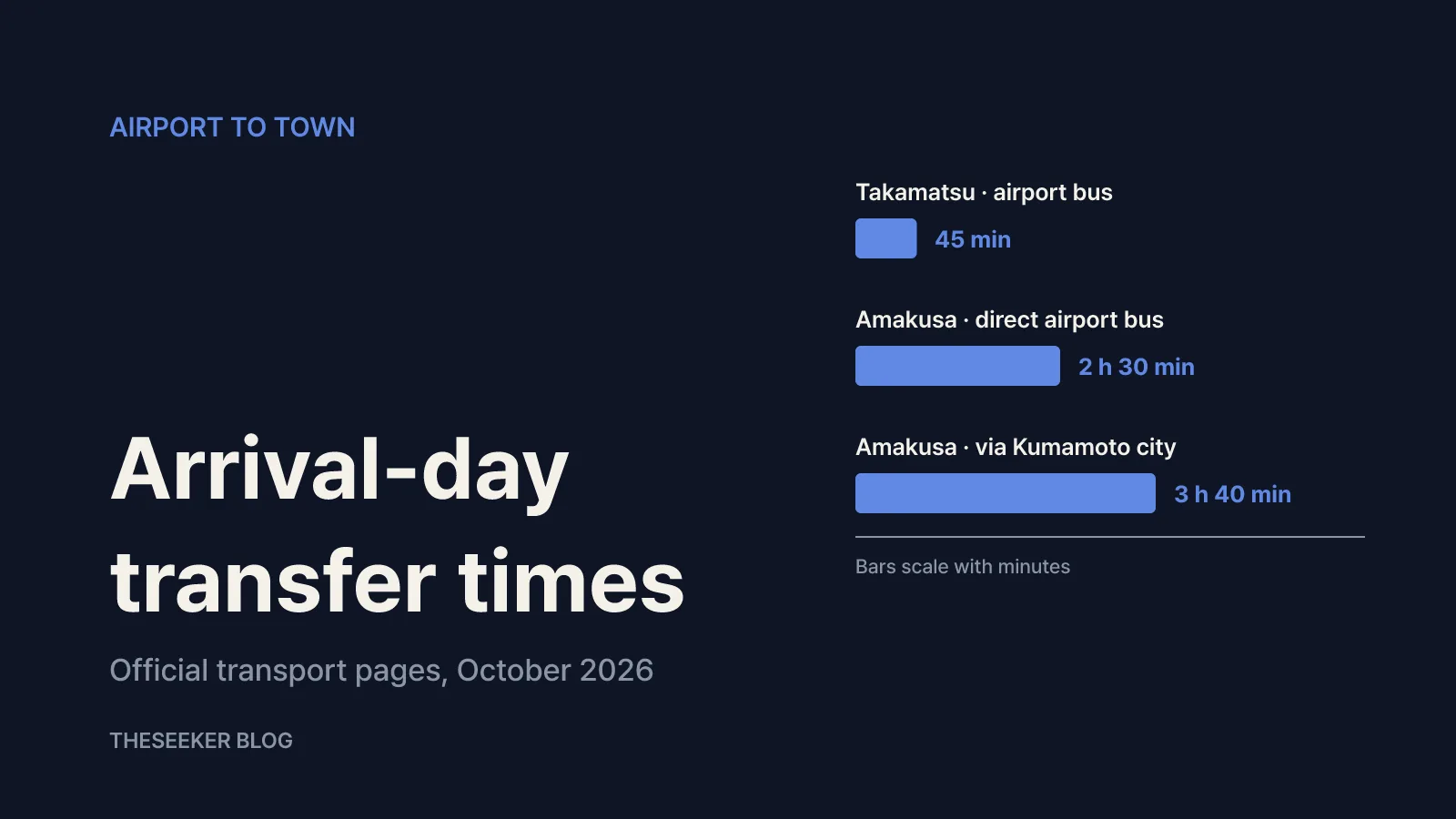
The number that matters most is not flight time but the transfer from the airport to the town center. Two towns that look equally remote on a map can differ by hours on arrival day.
Takamatsu, on Shikoku, is one of the easier small cities to reach. According to the Kagawa Prefecture Tourism Association's access page, Takamatsu Airport has international flights from Seoul, Shanghai, Taipei and Hong Kong, plus domestic flights from Tokyo (Haneda and Narita) and Okinawa. The flight from Tokyo takes about 1 hour 20 minutes. From the airport, a limousine bus reaches Takamatsu Station in about 45 minutes, and some buses run directly to stations near other sights. If you are already traveling by rail, take the shinkansen to Okayama and change to a rapid train: Takamatsu Station is about one hour away, and rapid trains run every 30 minutes. The same page lists ferries to Seto Inland Sea islands such as Naoshima, which makes Takamatsu a natural base for island day trips.
Amakusa, a coastal area in Kumamoto Prefecture, takes noticeably longer. The Aso Kumamoto Airport access page lists a direct bus called "Amapo" that reaches Maejima in about 1 hour 50 minutes (2,400 yen) and Hondo Bus Center, Amakusa's main hub, in about 2 hours 30 minutes (3,000 yen). Going via central Kumamoto with the airport limousine bus and the Amakusa-go bus takes about 3 hours 40 minutes to Hondo, with a transfer discount ticket of 3,500 yen. The airport notes that these times are estimates that vary with road conditions and transfers. If your flight does not line up with the direct bus, you may lose an extra hour or more, so compare the bus timetable with flight times before you buy a ticket.
Rural buses also work differently from city buses. JNTO's bus guide explains that outside the main cities many buses charge by distance. You board through the center door, take a numbered ticket, and when you get off you match your number to the fare on the screen at the front, then drop the exact amount into the box next to the driver. IC cards such as Suica may not work on these routes, so carry coins and small notes. Long-distance highway buses need a ticket before boarding, and JNTO suggests arriving at the terminal at least 30 minutes before departure. The Japan Rail Pass covers JR-operated local bus routes but not highway buses.
Decide early whether you need a rental car
Once you have a candidate, test whether the trip works without a car. List three to five places you want to visit and look up the bus or train timetable from your base to each. If round trips fit comfortably into a day, public transport is enough. If a single outing uses up the whole day because departures are sparse, consider renting. JNTO's rental car guide itself notes that Hokkaido and the Okinawa islands are much easier to explore by car.
The paperwork is strict. According to the same guide, you must obtain an International Driving Permit before you leave home, issued by your country's authority, usually the national automobile association, under the 1949 Geneva Convention on Road Traffic. Japan accepts only the paper booklet version; card and smartphone permits are not valid. The permit is valid for up to one year from issue and no more than one year from your arrival in Japan. Arrival is proven by the entry stamp in your passport, and automated immigration gates may not stamp it. If you plan to rent, use a staffed gate, or ask at the immigration office for a stamp if you have already gone through an automated gate. Drivers with licenses from Switzerland, Germany, France, Belgium, Monaco or Taiwan follow a different route: they carry their original license with an official Japanese translation instead.
Then consider the driving itself. Traffic keeps left. Main roads usually have English signs for major destinations, but rural roads may not. In snowy areas you need winter tires or chains. Prices vary by company; JNTO's average example for a sub-compact (1,000 to 1,300cc) is 5,000 to 11,100 yen per 24 hours, with fuel extra, and it urges every renter to take out insurance because coverage differs by company. As a solo traveler you carry that cost alone, so if only one day needs a car, renting just for that day from your base town is worth comparing.
If driving is not for you, rural Japan is still open. Stay in a base town with good transit and mix in local tours or taxis for the mountain and coastal spots that buses barely reach.
Lodging: separate your base hotel from the ryokan night
Small-town lodging splits roughly into hotels near the station and ryokan or family-run inns in hot spring areas and villages. Solo travelers should understand how each one charges.
The Japan Tourism Agency's ryokan Q&A explains that ryokan commonly charge per person, and the standard rate includes dinner and breakfast. Some now charge per room like a hotel; in that case a two-person room costs the same whether one or two people stay, which raises the cost for a solo guest. More ryokan also offer breakfast-only or room-only plans, and the agency suggests contacting the inn directly to ask what is available.
Read the booking terms as well. The same Q&A notes that cancellation fees rise as the date approaches and that a no-show is typically charged 100 percent. Payment timing varies too: some inns take payment only at checkout, some only in advance, and some accept either.
A simple pattern works well for one person:
- First and last nights near the airport bus stop or station, which protects you from late arrivals and early departures.
- One middle night at a ryokan or village inn. With a dinner-included plan you need to arrive in time for the meal, so check the bus arrival against check-in time.
- Room-only plans only after confirming on a map that a restaurant or convenience store near the inn stays open in the evening.
Rate solo-travel difficulty in three levels
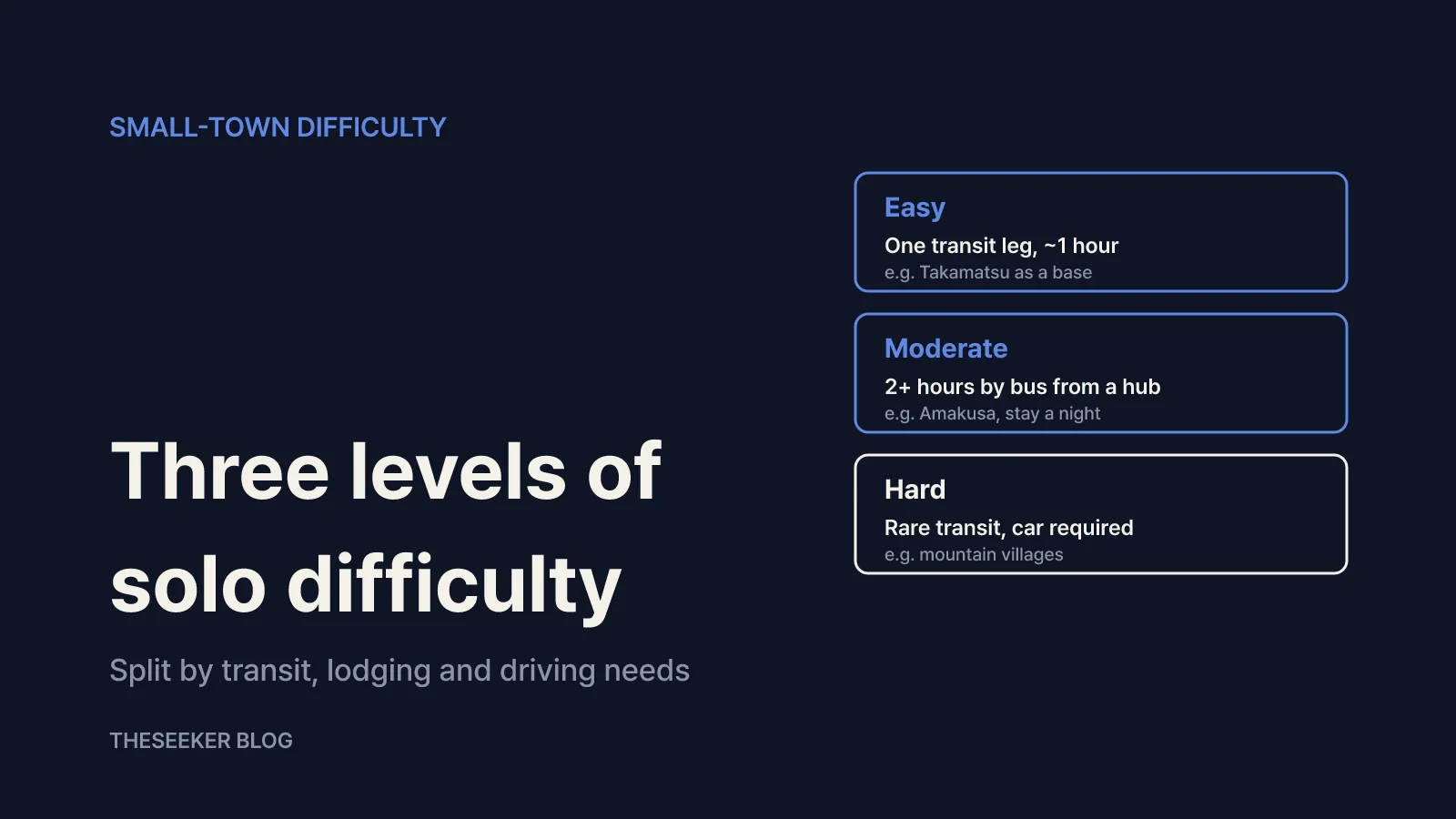
Put the criteria together and most small towns fall into one of three levels. The examples below are based on the official transport pages cited above.
Easy: one public-transport leg of about an hour from an airport or shinkansen station. There is plenty of lodging around the base station and trains run often enough that a missed connection is not a disaster. Takamatsu fits: about 45 minutes by limousine bus from the airport, or about an hour by rapid train from Okayama with departures every 30 minutes. For a first solo trip, use a town like this as your base and visit nearby islands or villages as day trips.
Moderate: two or more hours by bus from the nearest hub. Lodging choices shrink, and missing a bus leaves few alternatives. Amakusa is an example, at about 2 hours 30 minutes to Hondo on the direct airport bus or about 3 hours 40 minutes via central Kumamoto. Some videos show it as a day trip, but alone you will have a far more relaxed time with at least one night there.
Hard: mountain villages and remote islands with rare or no public transport. A rental car and driving confidence are effectively required, and winter adds road conditions to the list. Videos of high-altitude villages draw big audiences, but these places are best saved until you have a valid permit, driving experience and a reliable way to call for help.
You can rate any other town, Yamaguchi included, the same way: write down the nearest airport, the transfer time to the center, the bus frequency to your must-see spots and the type of lodging, and the level becomes obvious.
A pre-trip checklist
Work through these steps in order. If a town fails an early step, swap it out rather than forcing the plan.
- Airport and routes: Check the nearest airport's official route list, then confirm actual days and times with the airline.
- Airport to town: Use the airport or regional tourism association's official access page for transfer times and match bus times to your arrival.
- Local transit: Look up timetables for three to five places you want to see and decide whether you need a car.
- Driving prep: If you need a car, get a paper-booklet International Driving Permit before departure and use a staffed immigration gate for your entry stamp.
- Lodging: Split base hotels and ryokan nights, and confirm single-occupancy booking, meal plans, cancellation rules and payment timing.
- Payment: Carry coins and small notes for distance-based buses that may not take IC cards.
- Recheck: The figures here were checked in October 2026. Bus timetables are revised, so look at the official pages again just before you go.
Following this order keeps the charm of small-town Japan while filtering out the classic arrival-day problems.
Sources
Frequently asked questions
Which small towns in Japan are easiest for a first solo trip?
Look for towns reachable in one public-transport leg of about an hour from an airport or shinkansen station, with plenty of lodging near the station. Takamatsu works well: about 45 minutes by limousine bus from its airport, or about an hour by rapid train from Okayama.
Can I travel rural Japan without a car?
Yes, if buses or trains from your base town let you complete round trips within a day. In mountain or island areas where one outing takes the whole day because of sparse departures, mix in a rental car, local tours or taxis.
Can I get an International Driving Permit after arriving in Japan?
No. JNTO says you must obtain it before departure from your own country, and Japan accepts only the paper booklet version under the 1949 Geneva Convention. It is valid for up to one year from issue and from your arrival date.
Is a ryokan more expensive if I travel alone?
It depends on the pricing model. Per-person rates change little, but at ryokan that charge per room a two-person room costs the same for one guest. Ask about single occupancy and meal plans before booking.
Can I visit Amakusa as a day trip?
It is possible but the travel time is long: about 2 hours 30 minutes from Aso Kumamoto Airport to Hondo Bus Center by direct bus, or about 3 hours 40 minutes via central Kumamoto. Staying at least one night gives you a far more relaxed visit.
blog.theseeker.io/en/posts/how-to-choose-japan-small-town-access-lodging-solo
Daniel Foster
Daniel covers trip planning, booking and on-the-ground tips, checking fast-changing details such as entry rules and fares against official sources and noting when they were checked.
Read our editorial standards