Used EV Checklist: Battery Health, Warranty and Mileage
A used electric car needs checks a petrol car does not: a measured battery state of health, the warranty that is actually left, mileage records that agree, and, in South Korea, subsidy rules that travel with the car.
 Ryan Mitchell
In this post
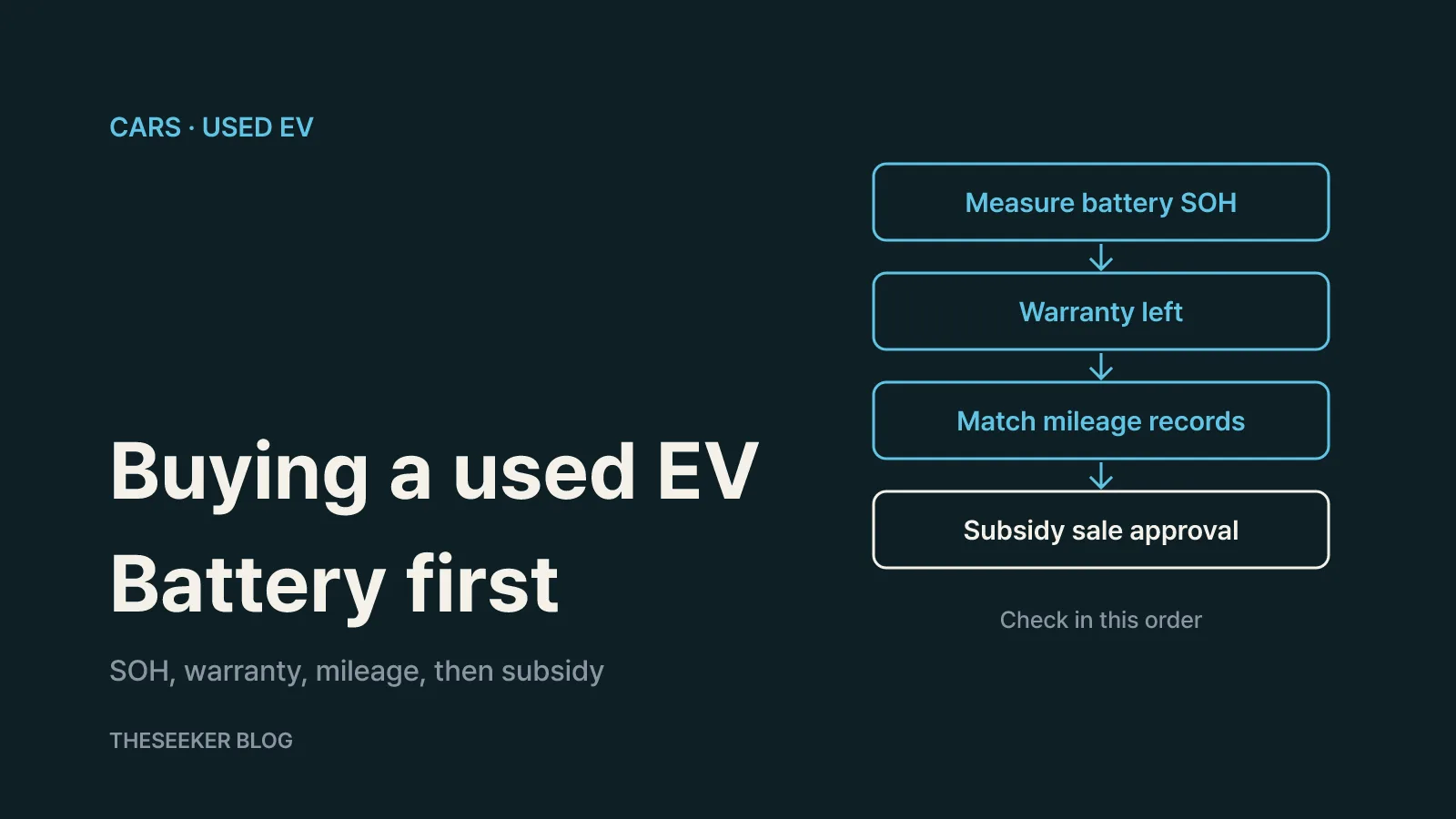
As of October 2026, buying a used electric car well comes down to four checks on top of a normal used-car inspection. Get the battery's state of health (SOH) as a measured number rather than a verbal promise. Work out how much of the battery and EV-component warranty is left, counted from the original sale date, and whether any perks were reserved for the first owner. Line up the odometer reading against service and inspection records. And if you are buying in South Korea, check whether the car received a purchase subsidy, because a mandatory operating period and possible clawback rules come with it. This guide walks through each check in order, using manufacturer and government publications as the reference points.
An electric car removes many of the familiar inspection items, such as oil leaks or a worn gearbox, but it concentrates value in one expensive component: the high-voltage battery. A clean body and low mileage do not tell you much if you have not verified the battery and the paperwork behind its warranty.
Get battery health as a measured number
State of health describes how much energy the battery can store today compared with when it was new. Every lithium-ion pack loses capacity gradually, but not at the same rate. The U.S. Department of Energy's Alternative Fuels Data Center cites national laboratory modeling suggesting that today's batteries may last 12 to 15 years in moderate climates and 8 to 12 years in extreme climates. It lists climate, driving and charging patterns, cell chemistry and design, and the vehicle's thermal management system as factors. In practice, two cars of the same model, year and mileage can have noticeably different batteries.
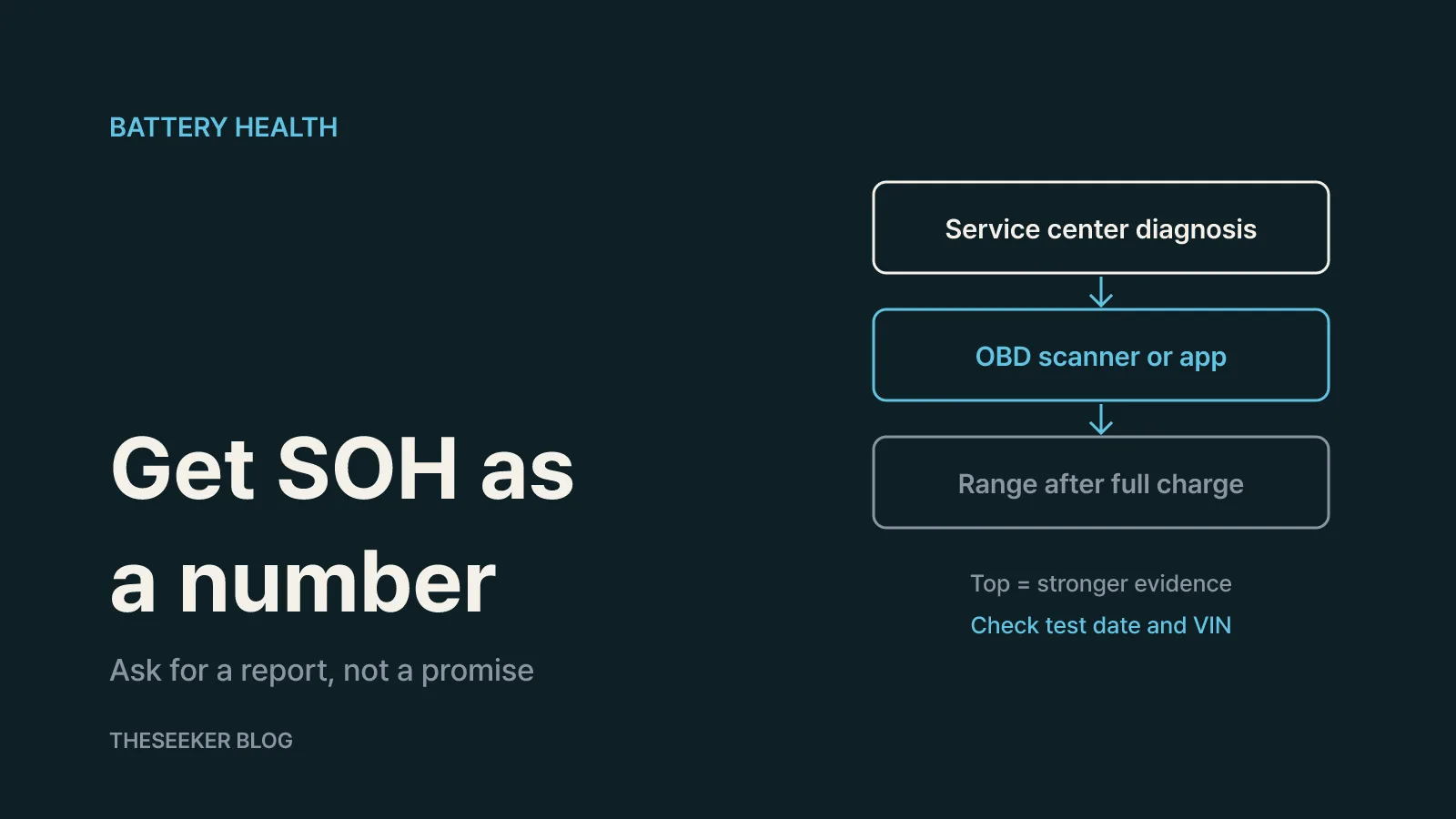
That is why the seller's word is not enough. There are three ways to check, in rough order of reliability:
- A manufacturer service center diagnosis. Dealer tools read the battery management system directly. Ask the service center in advance what the check covers, what it costs and how to book it. In a private sale, agree before paying a deposit that the car will go in for this check.
- An OBD scanner or app. These read battery data through the diagnostic port. They are convenient, but support varies by model and the way each tool calculates health can differ, so treat the result as supporting evidence rather than a final verdict.
- Displayed range after a full charge. This is the easiest test and the least precise. Temperature, climate control and recent driving style all move the estimate, so never judge the battery on this number alone.
Whatever report you receive, confirm that it shows the date of the test and the vehicle identification number (VIN). A screenshot without a matching VIN could come from any car. If the pack or modules have been replaced or repaired, ask when, and how the warranty applies to the replacement parts.
On the test drive, watch whether the state of charge drops unusually fast for the distance covered, whether any high-voltage warning lights appear, and whether the charging port and its cover are clean and undamaged. If you can, plug into a nearby DC fast charger and confirm that a session starts normally.
Separate the warranty that is left from first-owner perks
The most common mistake with used EV warranties is hearing that the battery warranty is long and never calculating what remains. Hyundai's Korean SUV warranty table is a useful worked example because it spells the structure out clearly:
- Coverage runs from the new-car sale date and ends at the time or distance limit, whichever comes first.
- For the IONIQ 5, EV-specific components are covered for 10 years or 160,000 km, and the high-voltage battery has a special warranty of 10 years or 200,000 km.
- EV-specific components are listed as the high-voltage battery, drive motor, reduction gear, inverter, ICCU (LDC plus on-board charger) and VCU.
- For the KONA Electric launch model, a lifetime high-voltage battery warranty applied only to the first individual owner; models released after January 6, 2020 carry a 10-year or 200,000 km special battery warranty.
- Hyundai defines the first owner as the customer who bought the car new and owned it at first registration. Only individuals qualify; sole proprietors, corporations, leasing and rental customers are excluded.
Read from a second buyer's position, this gives two rules. Time-and-distance coverage counts from the original sale, so you inherit whatever time and distance remain. First-owner perks are tied to the original owner, so it is safest not to count on them after a change of ownership. If a listing advertises a lifetime battery warranty, confirm whether that promise applies only to the current owner.
Do the arithmetic yourself. For example, if a car with 10-year or 160,000 km coverage was sold new four years ago and has covered 90,000 km, there are six years or 70,000 km left, and coverage ends at whichever limit arrives first. High-mileage drivers may run out of distance long before time. The sale date can differ from the registration date, so confirm the warranty start date with the manufacturer using the VIN. Hyundai's page links to a vehicle warranty lookup, and its customer center number is listed as 080-600-6000.
Questions worth asking the manufacturer:
- Does the battery warranty cover only outright failure, or is there also a capacity-loss threshold, and if so, what is it?
- Does any extended warranty the previous owner bought transfer to you?
- Could accident repairs or non-authorized servicing affect coverage?
Hyundai also lets owners switch body and general-parts coverage between 2 years or 80,000 km, 3 years or 60,000 km, and 4 years or 40,000 km, and states that used cars can change too. Other brands, especially imports, structure their warranties differently, so read that brand's warranty booklet the same way. Terms also differ by country, so check the manufacturer's documents for the market where the car was sold. The AFDC advises checking model-specific battery life and warranty details with the dealer and notes that replacing a battery outside warranty may be a significant expense.
Cross-check mileage and charging history
Mileage still matters on an EV: it reflects battery use and wear on the drive unit, suspension and tires. Do not rely on the dashboard figure alone. Lay out every dated record you can find, such as inspection reports, service invoices and any pre-sale condition report, and check that the odometer readings rise over time. If a later record shows fewer kilometers than an earlier one, ask for a documented explanation such as an instrument cluster replacement.
Charging history is the check that petrol cars do not need. The AFDC lists charging patterns among the factors that affect battery life, but the share of DC fast charging is often not recorded anywhere. Ask the seller where and how the car was usually charged, at home or work on AC, or mostly at public fast chargers, and review the charging log in the manufacturer's app if one exists. Heavy fast charging alone does not make a car a bad buy; interpret it alongside the measured SOH.
Check the usage history too. Former rental, lease or company cars can accumulate distance quickly, and under Hyundai's definition they never qualified for first-owner perks in the first place. Because the battery pack sits under the floor, look for flood or accident history and for scrapes or dents underneath. Asking for the car to be put on a lift so you can see the underside of the battery casing is a reasonable request.
In South Korea, check the subsidy operating period
This section applies to cars that received a Korean purchase subsidy. According to the Seoul Metropolitan Government's sale approval guide, subsidized electric and hydrogen vehicles have a statutory operating period of 8 years from first registration, and a transfer of ownership within 2 years of first registration requires sale approval. The obligation passes to the buyer, so a used-car purchaser inherits the remaining period.
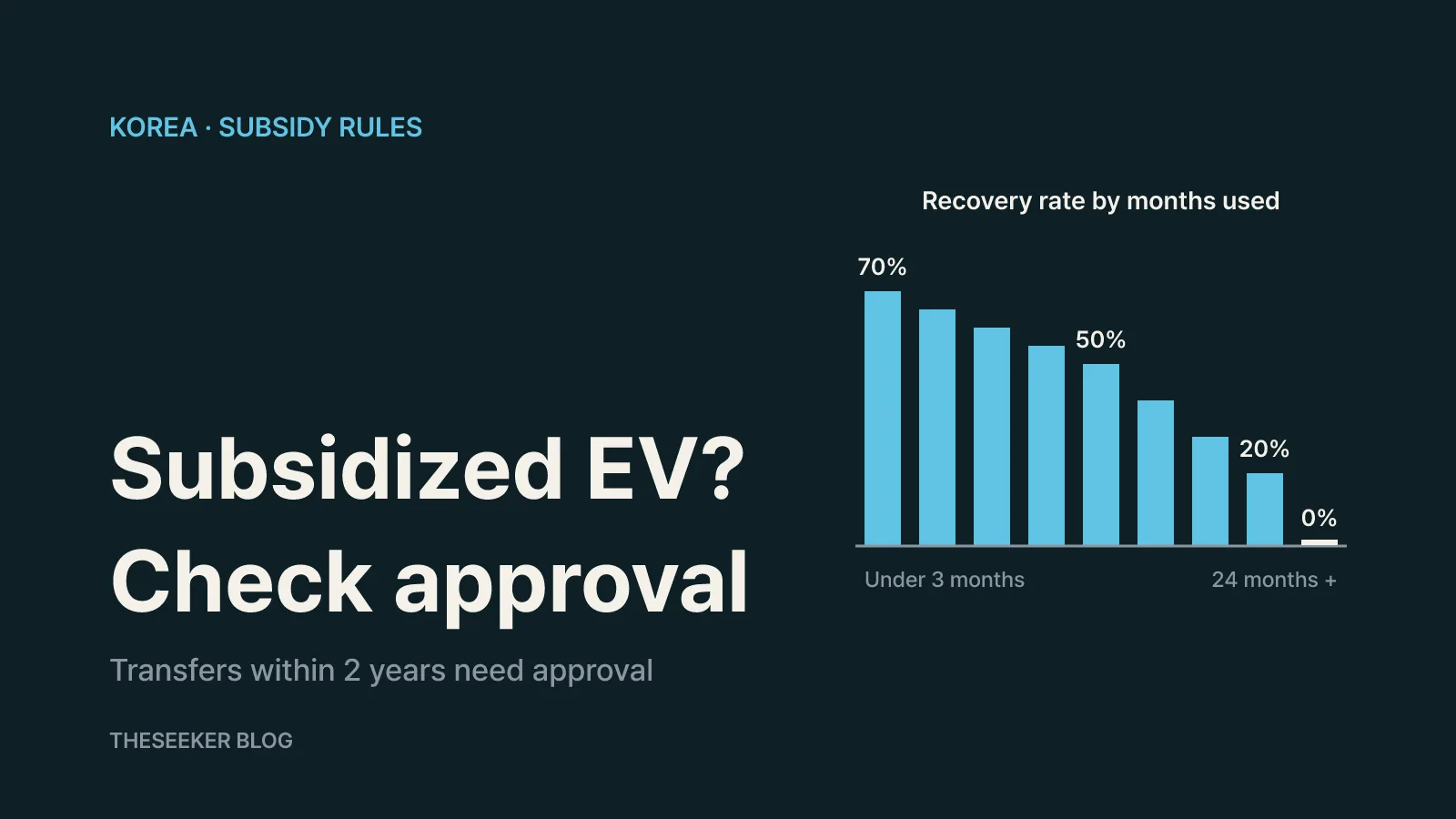
When a car subsidized by Seoul is sold to someone registered in another local government area, Seoul recovers part of its subsidy according to how long the car was used (moving without a change of ownership is excluded). Seoul publishes these recovery rates:
← Swipe to see more
| Period of use | Recovery rate |
|---|---|
| Under 3 months | 70% |
| 3 to under 6 months | 65% |
| 6 to under 9 months | 60% |
| 9 to under 12 months | 55% |
| 12 to under 15 months | 50% |
| 15 to under 18 months | 40% |
| 18 to under 21 months | 30% |
| 21 to under 24 months | 20% |
| 24 months or more | 0% |
Electric trucks have a separate rule: if one is sold within 2 years of registration after less than 20,000 km of use, 30% of the total subsidy is recovered even for a sale within Seoul.
The process runs in four steps. The seller applies on Seoul's website, the city reviews the subsidy and any recovery, an approval letter is sent by email, and the parties take that letter to the vehicle registration office to transfer ownership. The application must include a consent form for the operating period, and that form has a signature field for the buyer. In other words, the buyer is part of the paperwork, and it is wise not to hand over money before approval is in place.
You can check subsidy status with the VIN. Seoul notes that subsidy payments appear in the special remarks of the vehicle registration record, and that the national zero-emission vehicle portal at ev.or.kr can confirm by VIN whether a subsidy was paid, for applications from February 2019 onward. Rules and rates can differ between local governments, so follow the guidance of the authority that paid the subsidy, and write into the contract who pays any recovery amount. Because the operating period transfers with the car, check the remaining period again whenever you later sell or dispose of it.
A final order of checks before you sign
The list looks long, but in order it usually takes a day or two.
- Get the VIN first and use it to check subsidy status and registration remarks.
- Query the manufacturer for the sale date, remaining time and distance, any first-owner-only perks, and whether extended coverage transfers.
- Obtain an SOH report showing the test date and VIN, or book a service center diagnosis.
- Line up the records: mileage from inspections, servicing and condition reports in date order, plus usage, flood and accident history.
- Test drive and test charge: watch the state-of-charge drop, warning lights, the charging port and whether a charging session actually starts.
- Put it in the contract: the SOH figure and test date, who handles sale approval, who pays any subsidy recovery, and what the manufacturer confirmed about warranty transfer.
Working through these six steps lets you compare listings at similar prices on the same footing: battery condition, remaining warranty and paperwork risk. Anything you cannot confirm with a number or a document is either a reason to negotiate or a reason to look at another car.
Sources
Frequently asked questions
What battery state of health is good enough for a used EV?
There is no single official threshold that applies to every model. Weigh the measured SOH against whether the manufacturer's battery warranty includes a capacity-loss threshold, how much coverage remains and how much range you need each day. Compare cars using reports that show the test date and VIN.
Does the battery warranty transfer to a second owner?
In Hyundai's published Korean warranty table, coverage runs from the new-car sale date until the time or distance limit, whichever comes first, so a second owner inherits what remains. Perks reserved for the first individual owner, such as a lifetime battery warranty, should not be counted on after a change of ownership. Confirm the details with the manufacturer using the VIN.
Can I buy a subsidized EV in Korea that is less than two years old?
Yes, but under Seoul's rules a transfer within 2 years of first registration requires sale approval. The seller applies, the buyer signs the operating-period consent form, and a sale to someone in another local government area triggers a recovery rate based on time in use. Check the rules of the authority that paid the subsidy and record in the contract who pays any recovery.
Should I avoid a used EV that was fast-charged a lot?
Charging patterns are one of several factors that affect battery life. Rather than ruling a car out on fast-charging history alone, look at the measured SOH, the mileage and the remaining warranty together.
blog.theseeker.io/en/posts/used-ev-battery-soh-warranty-mileage-checklist
Ryan Mitchell
Ryan covers buying, insuring and maintaining a car, checking terms against manufacturer and agency publications so the options are easy to compare.
Read our editorial standards