How to Track Mortgage Rate Trends in Korea with COFIX
A practical guide to reading Korea's COFIX index, the Korea Federation of Banks household loan rate disclosures and the Bank of Korea base rate to see where mortgage rates are heading.
 Olivia Hartman
In this post
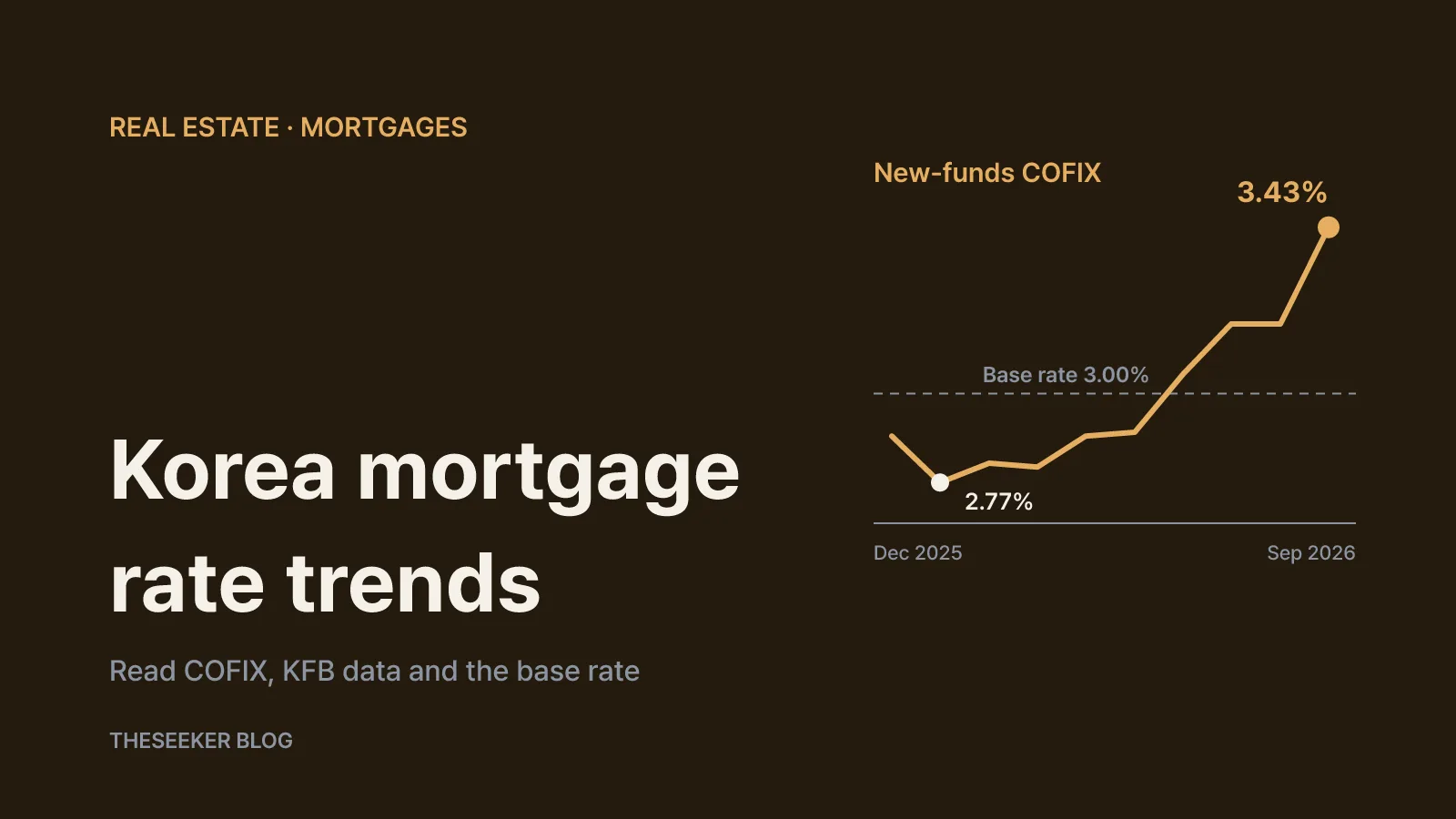
As of October 2026, the quickest way to tell whether Korean mortgage rates are rising or falling is to check three public sources in order. Start with the COFIX figures published by the Korea Federation of Banks (KFB), the benchmark most variable-rate mortgages in Korea are priced from. Then look at the KFB consumer portal's household loan rate comparison, which shows what each bank actually charged on new mortgages last month. Finally, check the Bank of Korea base rate history for the policy backdrop. Right now the direction is up: COFIX on new funds for September 2026, announced on October 15, was 3.43%, up 0.25 percentage points from 3.18% in August, and the Bank of Korea raised its base rate from 2.75% to 3.00% on August 27, 2026. None of these numbers is your personal loan rate, though. Here is how to read each one and connect it to your own loan.
The three disclosures that show the trend
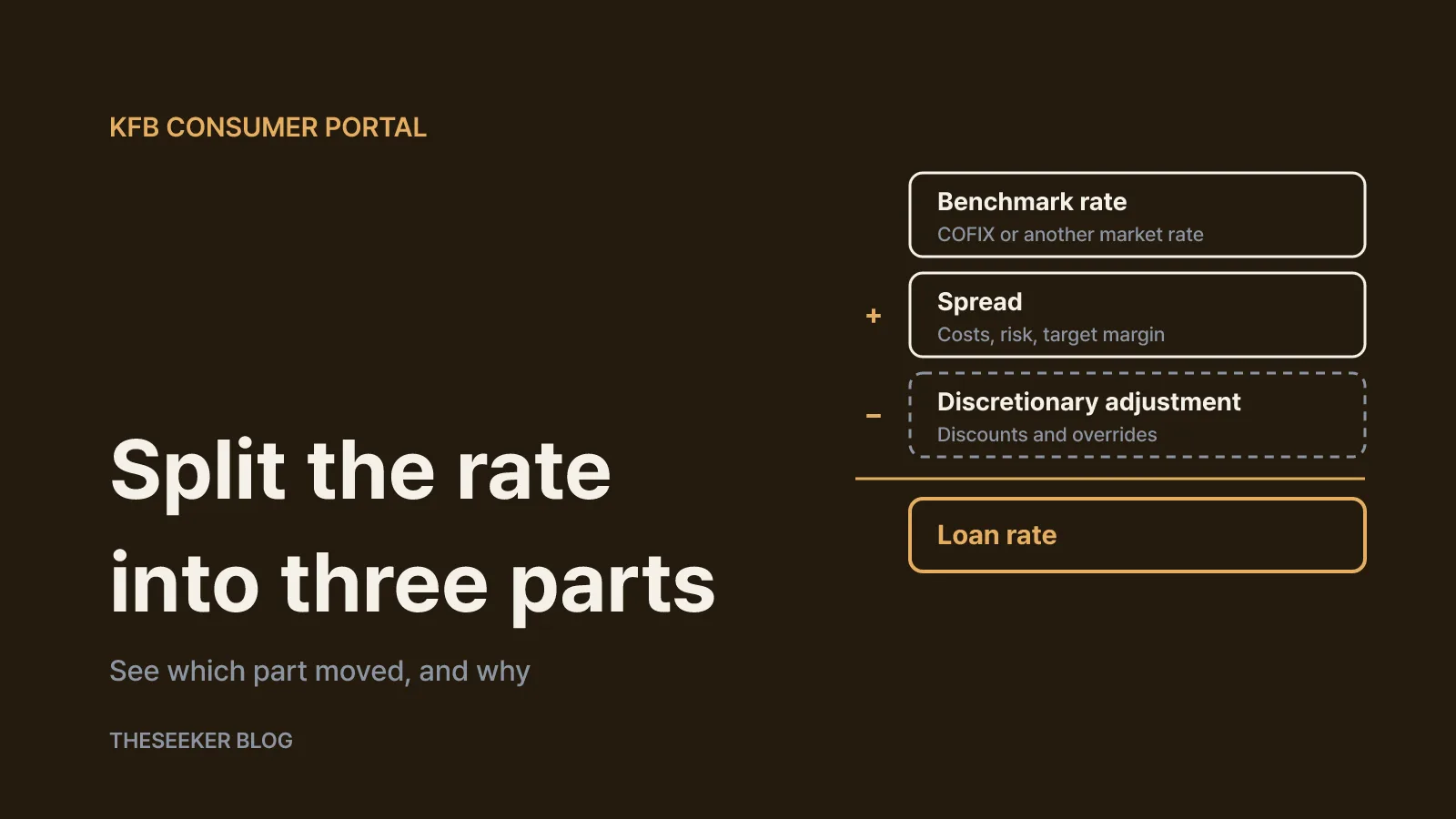
The KFB consumer portal breaks a Korean bank loan rate into three parts: a benchmark rate, a spread added by the bank (covering operating costs, statutory costs, a risk premium and a target margin), and a discretionary adjustment that branch or head-office managers can apply, usually as a discount. In formula form it is benchmark + spread − discretionary adjustment. Since July 2019 the portal has shown the discretionary adjustment as a separate column.
← Swipe to see more
| Source | Publisher | Frequency | What it tells you |
|---|---|---|---|
| COFIX | Korea Federation of Banks | Monthly (Short-Term COFIX weekly) | Movement in the benchmark used by most variable-rate mortgages |
| Household loan rate comparison | KFB consumer portal | Monthly, covering last month's new loans | Actual rates by bank, split into benchmark, spread and adjustment |
| Base rate | Bank of Korea | At each monetary policy meeting | The overall direction of deposit and bond yields |
Each source sits at a different layer. COFIX is the banks' cost of funding, so it behaves like the wholesale cost of a mortgage. The portal shows the retail result after each bank adds its spread. The base rate is the policy rate behind both, and it is never added directly to your mortgage. Watching only one of them can mislead you: COFIX can climb while the base rate holds, and a bank can absorb part of a COFIX increase by widening its discount.
How COFIX works and which version to watch
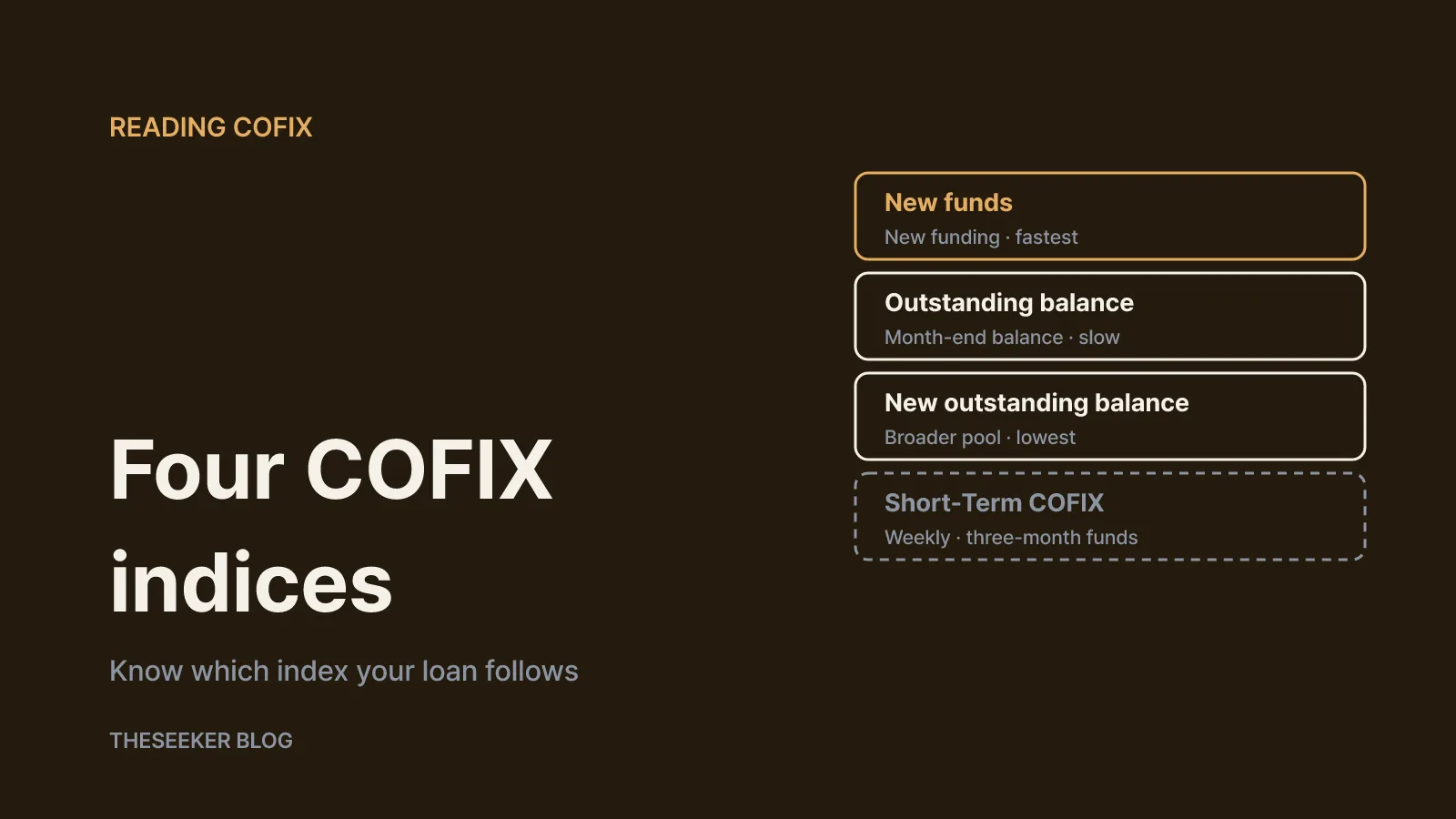
According to the KFB's explanation of COFIX, the Cost of Funds Index is a weighted average of funding costs reported by eight banks: Nonghyup, Shinhan, Woori, Standard Chartered Korea, Hana, Industrial Bank of Korea, Kookmin and Citibank Korea. The funding products include time deposits, installment savings, certificates of deposit, repurchase agreements, cover notes and bank bonds (excluding subordinated and convertible bonds). Four versions are published:
- COFIX on Monthly Acquired New Funds (often called new-funds COFIX): the weighted average rate on money raised during the month. It reacts fastest to market changes.
- COFIX on Outstanding Balance: the weighted average rate on all funding outstanding at month-end. Because older funding is mixed in, it moves slowly.
- New COFIX on Outstanding Balance: a broader balance-based index that also counts inter-bank deposits, non-resident deposits, borrowings from the Bank of Korea and the government, subordinated and convertible bonds, and demand deposits used to fund loans. Cheap demand deposits pull it down, and in the 2026 tables it was consistently the lowest of the three monthly indices.
- Short-Term COFIX: a weekly index based only on newly raised funds with three-month maturities.
COFIX is released at 3:00 p.m. Korea time on the announcement date. In the 2026 tables, monthly figures generally appear around the 15th, although the July figure came out on August 18. Short-Term COFIX is published weekly.
Two habits prevent most misreadings. First, separate the announcement date from the reference month: the October 15 release is the September number. Second, only compare like with like. A gap between new-funds COFIX and New COFIX on Outstanding Balance is normal because they measure different pools of money. When new-funds COFIX pulls well above the balance-based index, recent funding is more expensive than the historical average, which suggests the balance-based indices may keep drifting up.
What the 2026 COFIX figures show
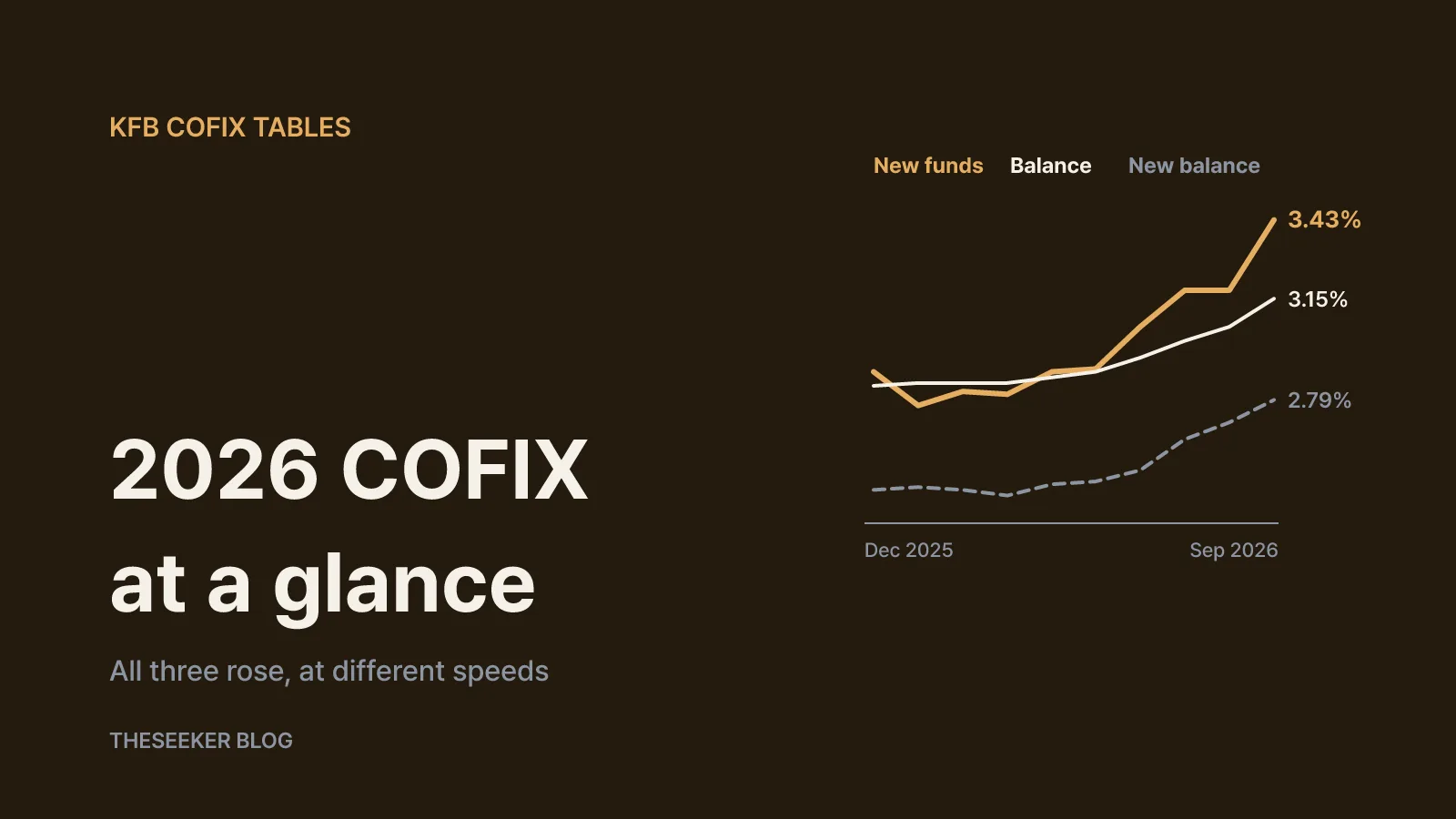
Here are the monthly figures from the KFB tables, December 2025 through September 2026 (annual %):
← Swipe to see more
| Reference month | Announced | New funds | Outstanding balance | New outstanding balance |
|---|---|---|---|---|
| Dec 2025 | Jan 15, 2026 | 2.89 | 2.84 | 2.47 |
| Jan 2026 | Feb 19, 2026 | 2.77 | 2.85 | 2.48 |
| Feb 2026 | Mar 16, 2026 | 2.82 | 2.85 | 2.47 |
| Mar 2026 | Apr 15, 2026 | 2.81 | 2.85 | 2.45 |
| Apr 2026 | May 15, 2026 | 2.89 | 2.87 | 2.49 |
| May 2026 | Jun 15, 2026 | 2.90 | 2.89 | 2.50 |
| Jun 2026 | Jul 15, 2026 | 3.05 | 2.94 | 2.54 |
| Jul 2026 | Aug 18, 2026 | 3.18 | 3.00 | 2.65 |
| Aug 2026 | Sep 15, 2026 | 3.18 | 3.05 | 2.71 |
| Sep 2026 | Oct 15, 2026 | 3.43 | 3.15 | 2.79 |
New-funds COFIX bottomed at 2.77% for January and has climbed since April: 2.89%, 2.90%, 3.05%, 3.18%, 3.18% and then 3.43%. The 0.25-point jump for September is the largest monthly move in this window. The balance-based index rose from 2.84% to 3.15% and the new balance-based index from 2.47% to 2.79%. Same direction, different speeds, which is exactly why you need to know which version your loan follows.
For an earlier signal, the weekly Short-Term COFIX was 3.16% for September 19–25, 3.32% for September 26–October 2 and 3.43% for October 3–9. It is not a mortgage benchmark, but it hints at where bank funding costs are going before the next monthly release.
Reading the KFB household loan rate comparison
If COFIX is the wholesale cost, the KFB consumer portal comparison is the retail price. The page is in Korean; the menu path is 금리/수수료 비교공시 (rate and fee disclosures) → 대출금리비교 (loan rates) → 가계대출금리 (household loans) → 은행별 비교공시 (by bank). Nineteen banks are listed, from the major commercial banks to regional banks and the internet banks K Bank, Kakao Bank and Toss Bank.
- Choose the disclosure month. Figures cover household loans newly made in the previous month.
- Under loan type, pick 분할상환방식 주택담보대출 (amortizing mortgage, limited to maturities of 10 years or more) or 일시상환방식 주택담보대출 (bullet-repayment mortgage).
- Under detail, pick the option that splits the rate into benchmark, spread and discretionary adjustment.
- Results are shown as an average and, since August 2022, across nine credit score bands from credit bureau scores, starting at 1,000 points in 50-point steps. Rates are weighted by loan amount, and a dash means the bank made no loans in that band.
To see a trend, hold the bank, loan type and score band fixed and change only the month. Then ask which column moved. A higher benchmark points to market funding costs such as COFIX; a higher spread means the bank repriced risk or strategy; a smaller discretionary adjustment means discounts were trimmed. The portal notes that its bands use credit bureau scores rather than each bank's internal grades, and the figures are last month's averages, so treat them as a shortlist tool rather than a quote.
How the Bank of Korea base rate feeds through
The base rate history shows a cut to 2.50% on May 29, 2025, then two hikes: 2.75% on July 16, 2026 and 3.00% on August 27, 2026. In its August 27, 2026 policy statement, the Monetary Policy Board said inflation was expected to stay above target for a considerable period, flagged rising housing prices in the Seoul metropolitan area and faster household debt growth, and said it would decide the timing and pace of further increases while monitoring conditions.
The transmission is indirect. A base rate change moves deposit and bank bond rates, which flow into COFIX, which then reaches variable-rate loans. In 2026, new-funds COFIX started rising with the April figure, before the first hike, and accelerated afterward. COFIX reflects rates banks have already paid, so it never moves on the exact day of a policy decision. Meeting dates and statements are listed on the Bank of Korea website.
Applying the numbers to your own mortgage
- Find the benchmark name in your loan agreement. It may be new-funds COFIX, New COFIX on Outstanding Balance or another market rate. Fixed and hybrid loans are unaffected by COFIX during the fixed period.
- Check the reset interval and next reset date. A variable rate is recalculated only when the agreed interval comes round, so a COFIX rise today changes nothing until then.
- Compare the index at your last reset with the latest figure. The difference approximates your benchmark change. Spreads usually stay as agreed, but missing a preferential-rate condition can push the rate up.
- Run a quick estimate. On a ₩300 million balance, a 0.25-point rise adds roughly ₩750,000 a year, about ₩62,500 a month; amortization makes the real figure smaller.
- Shortlist banks before refinancing. Use the portal to find two or three banks with low averages and spreads in your score band, then compare limits, term, repayment method and early repayment fees in person.
A monthly routine is enough: check COFIX around the 15th, log the portal figures for the same settings, and read the opening paragraph of the Bank of Korea statement in meeting months.
Sources
Frequently asked questions
When is COFIX announced?
Monthly COFIX figures are released by the Korea Federation of Banks once a month at 3:00 p.m. Korea time. In 2026 they mostly came out around the 15th, though the July figure was published on August 18. Short-Term COFIX is released weekly. Remember that each release covers the previous month.
Is new-funds COFIX or New COFIX on Outstanding Balance better for a mortgage?
Neither is always better. New-funds COFIX tracks market moves quickly in both directions, while the balance-based index moves slowly because it covers a broader, older pool of funding. Banks may set different spreads for each, so compare the final rate and reset interval.
Does my Korean mortgage rate change as soon as COFIX rises?
No. A variable-rate loan is repriced only on its agreed reset date, using the benchmark at that time. Fixed and hybrid loans are not affected during their fixed period. Check your loan agreement for the benchmark type and next reset date.
Why is my quoted rate different from the KFB portal average?
The portal shows last month's amount-weighted averages for new loans, grouped by credit bureau scores rather than the bank's internal grades. Your own rate also depends on collateral, income, preferential-rate conditions and the benchmark on the day you apply.
If the Bank of Korea raises rates by 0.25 points, does COFIX rise by the same amount?
There is no fixed link. COFIX is a weighted average of rates banks actually paid on deposits and bonds, so timing and size differ. In 2026, new-funds COFIX began rising with the April figure, before the July hike, and rose 0.25 points in September alone.
blog.theseeker.io/en/posts/korea-mortgage-rate-trend-cofix-kfb-disclosure
Olivia Hartman
Olivia covers home buying, leases, mortgages and housing taxes, following official notices and legal guidance to explain where the rules and steps change.
Read our editorial standards