Should You Cancel Your Korean Housing Subscription Account?
Closing a Korean housing subscription account resets your enrollment period and payment record, and can trigger a tax clawback if you claimed the deduction within five years. Here is what to check first.
 Olivia Hartman
In this post
- What you lose when you close the account
- If you claimed the tax deduction, calculate the clawback first
- What you keep by holding on: points, interest and access
- Why so many people are closing accounts now
- Five questions to answer before closing
- Alternatives to closing and how to close safely
- Sources
- Frequently asked questions
As of October 2026, the short answer is this: if there is any realistic chance you will apply for new housing in Korea in the next few years, and you do not urgently need the money, keeping your housing subscription account usually costs you less than closing it. Cancelling the account resets your enrollment period and your record of recognized monthly payments to zero. If you claimed the year-end income tax deduction for it, closing within five years of opening can also mean paying part of that tax benefit back. On the other hand, if you already own a home and have no plans to apply, or you face an urgent cash need with no alternative, closing it can be a reasonable decision. This guide walks through what you lose, what the tax rules say, what you keep by holding on, and the questions worth answering before you visit the bank.
The account in question is the Housing Subscription Savings account (주택청약종합저축, often called a cheongyak account). It is the entry ticket to Korea's new-apartment allocation system, covering both public housing and privately built units.
What you lose when you close the account
You cannot make a partial withdrawal. Article 13 of the Rules on Housing Supply states that principal and interest are paid out in a single lump sum when the account is terminated. In other words, the only way to get your money out is to close the account. The same article says no interest is paid if you close within one month of opening.
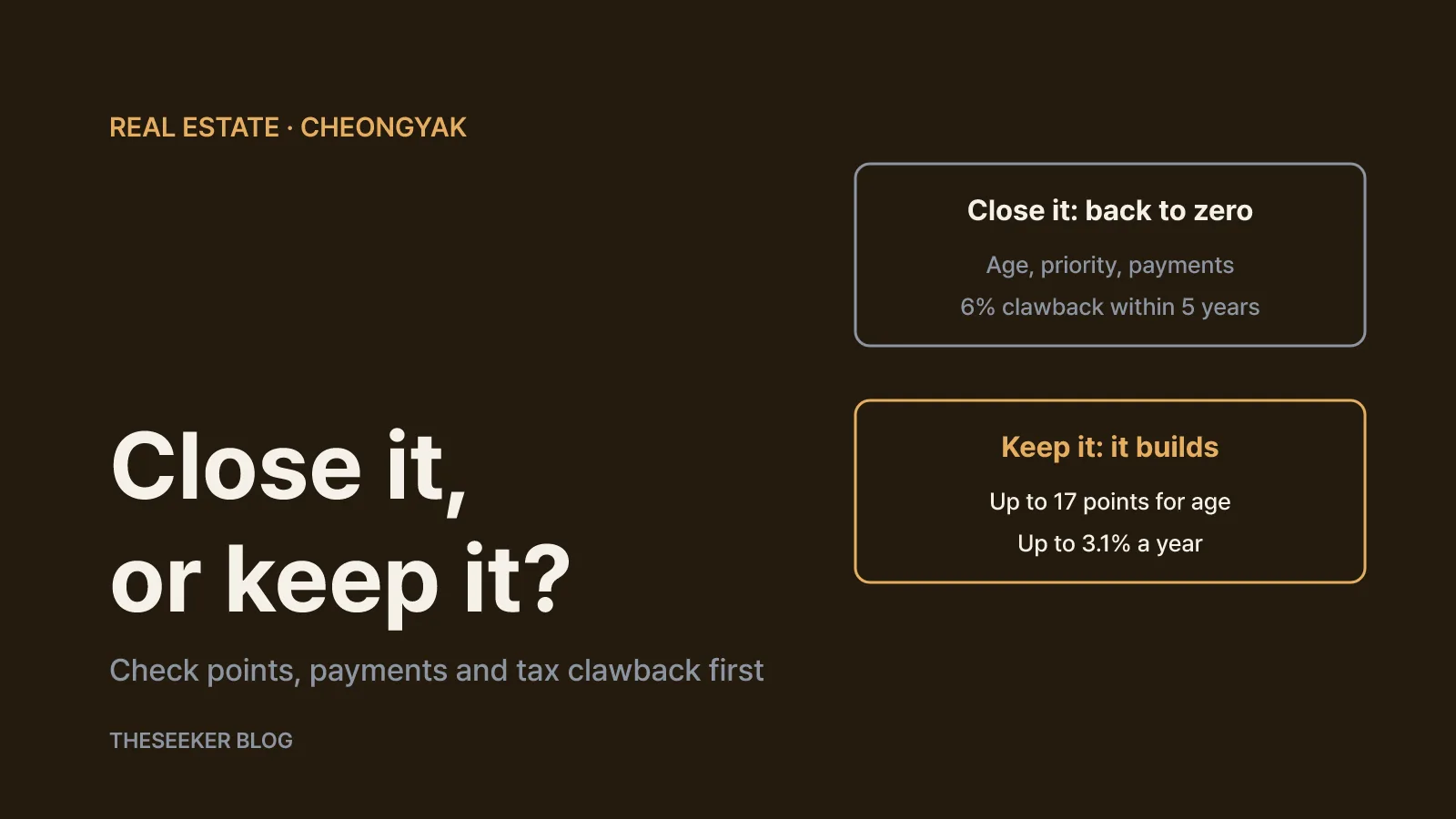
The first thing that disappears is your enrollment period. In the points system used for private apartments, the account's age is worth up to 17 points, and you need 15 years or more for the maximum. The period is counted from your original opening date even if you change the account type, deposit amount or holder name, but a newly opened account starts counting from its own opening date. According to the Korea Housing & Urban Guarantee Corporation (HUG) points table, an account held 10 to 11 years earns 12 points, while one under six months earns 1. Closing a decade-old account and reopening it means dropping from 12 points to 1 on that line.
The second loss is first-priority eligibility. NH NongHyup Bank's product terms list the first-priority requirements for public housing: in the Seoul metropolitan area, 12 months since opening and at least 12 monthly payments; in speculation-overheated or subscription-overheated zones, 24 months and 24 payments; outside the capital region, six months and six payments. For private housing you also need a minimum balance that depends on where you live and the unit size. In Seoul and Busan, the threshold for units up to 85 square meters of exclusive area is 3 million won. Closing the account means rebuilding all of this from scratch.
The third loss matters most for public housing: your recognized payment count and amount. Public units are frequently allocated by how many payments you have made and how much has been recognized, and the same bank terms cap the recognized amount at 250,000 won per payment. A long, steady record is your competitive edge in public housing, and cancelling wipes it out.
If you claimed the tax deduction, calculate the clawback first
Many salaried workers claim this account at year-end tax settlement. Under Article 87 of the Restriction of Special Taxation Act, a household head (or the head's spouse) with total salary of 70 million won or less and no home during the tax year can deduct 40% of contributions, on up to 3 million won a year. That works out to a maximum deduction of 1.2 million won from earned income, and it applies to contributions made through December 31, 2028. You have to submit a homelessness confirmation to your bank by the end of February following the first year you claim, and the National Tax Service FAQ notes that one submission is enough. You do not have to refile every year.
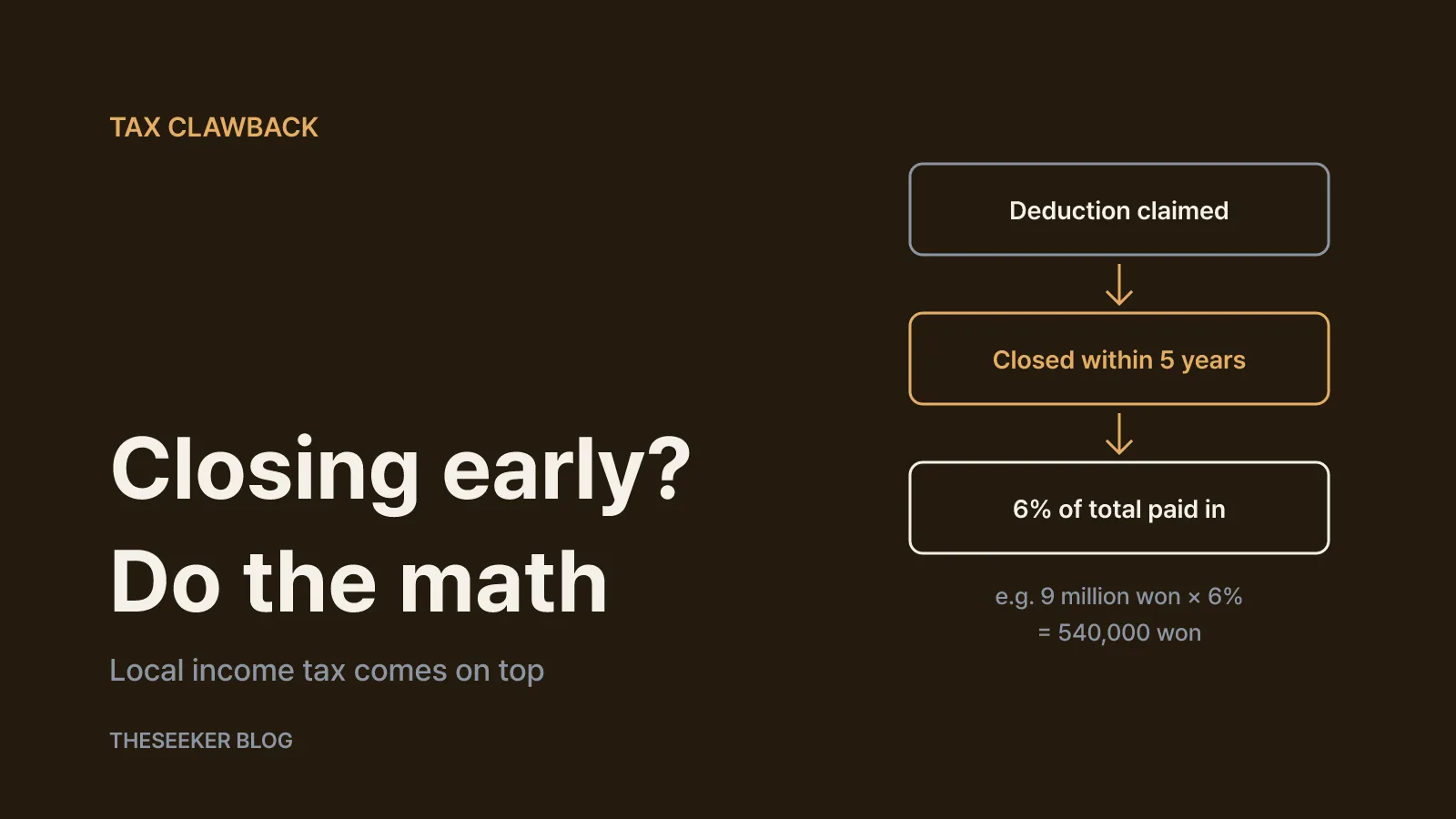
Timing is the catch. Paragraph 7 of the same article says that if someone who received the deduction closes the account within five years of opening it, the bank withholds 6% of the cumulative contributions made since the deduction began (counting up to 3 million won per year). Local income tax comes on top. If you can prove the tax you actually saved was smaller, only that actual amount is recovered.
Here is a worked example. Suppose you registered for the deduction and paid in 3 million won a year for three years. The cumulative total is 9 million won, so the base clawback is 540,000 won, plus local income tax, deducted from your payout.
The NTS lists exceptions: the saver's death or emigration; winning a unit of national housing size; or, within six months before closing, a natural disaster, retirement, business closure, an injury or illness requiring three or more months of hospitalization or care, or the bank's suspension or bankruptcy. Switching into the youth-preferred version of the account is also exempt. Winning a unit larger than national housing size (85 square meters) triggers the clawback regardless of how long you have held the account.
One more detail: if you close mid-year without a qualifying reason, none of that year's contributions are deductible. Closing in October through December means losing the current year's deduction as well.
What you keep by holding on: points, interest and access
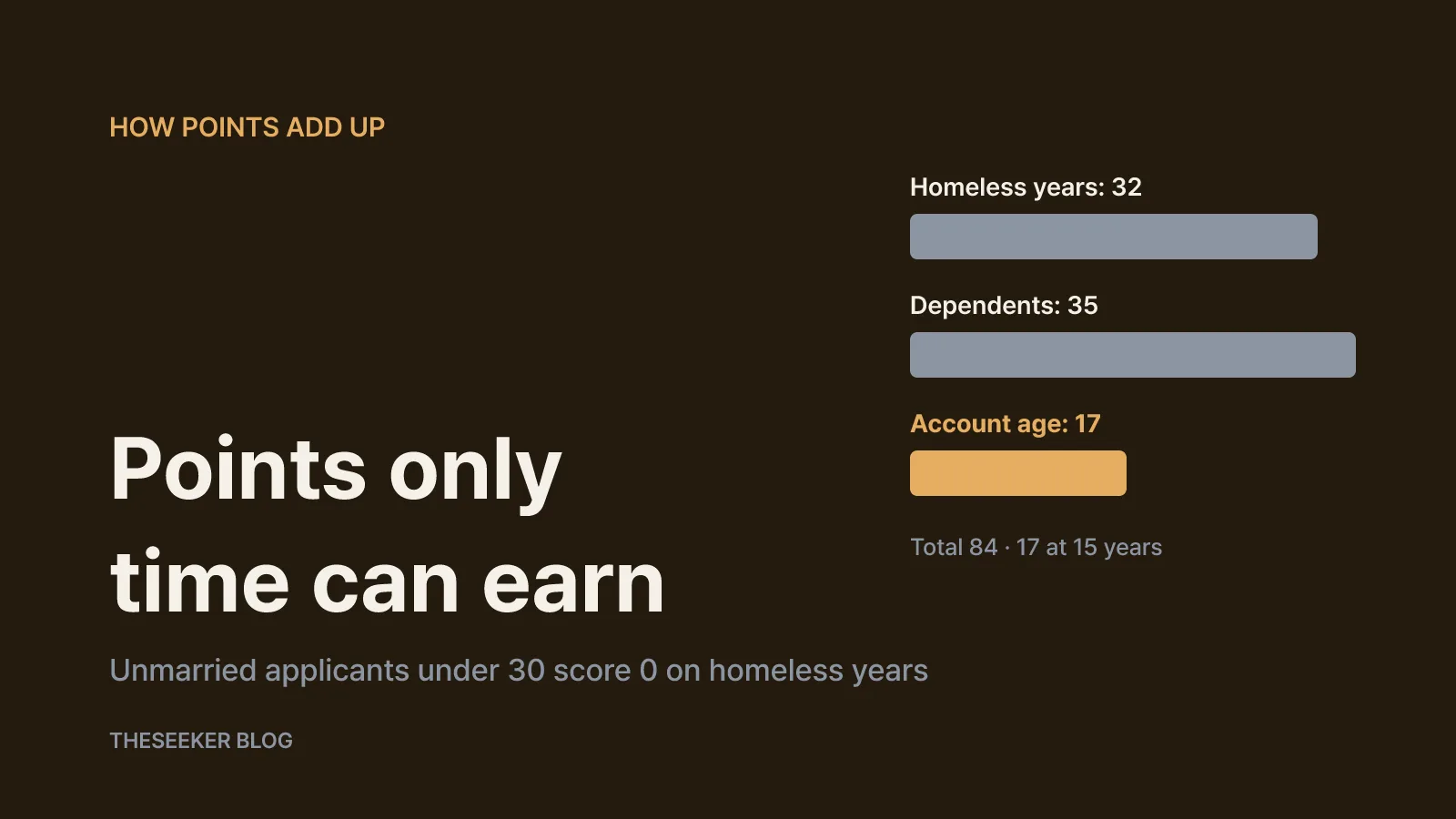
The biggest benefit of keeping the account is points that only time can earn. Per HUG's guide, the system awards up to 32 points for years without a home, 35 for dependents and 17 for account age, for a total of 84. Homeless years start counting at age 30, or at marriage registration if earlier, and unmarried applicants under 30 score zero on that line. For someone in their twenties, account age is effectively the only category they can build right now, at roughly one point per year until it reaches 17 at 15 years. You cannot buy those points back later.
Low points do not mean no chance. Under HUG's guide, private units of 85 square meters or less are allocated 40% by points and 60% by lottery, though exceptions in some areas can raise the points share to 100%. Larger units default to lottery. Many special-supply categories, such as those for newlyweds and first-time buyers, also generally require a subscription account. Without one, you cannot enter the lottery or the special supply at all.
Interest also counts. Asia Times Korea reported that the account pays 2.3% to 3.1% a year depending on how long you have held it, with the 3.1% top rate after two years. Interest is calculated at closing using the rate set by the Ministry of Land, Infrastructure and Transport for the holding period. That may look modest next to promotional deposits or other investments, but judging the account on interest alone undervalues the eligibility and tax benefits that come with it.
Why so many people are closing accounts now
The trend is real. The same report, citing Korea Real Estate Board data, put total subscription account holders at 25,740,524 at the end of August 2026, down 632,745 from 26,373,269 a year earlier and more than 1.09 million below August 2024. Analysts point to rising sale prices that make the down payment, interim payments and balance harder to fund even after winning.
The government has reportedly extended the deadline for converting older account types (subscription savings, deposits and installment accounts) into the integrated account until September 30, 2027. It also plans to count the old account's age toward the interest rate, so holders of two years or more would get the 3.1% top rate right after converting, with the revised notice expected to apply from October. Bank pages may still show the earlier September 30, 2026 deadline, as NH's terms do, so confirm the current date with your bank.
Conversion has nuances. According to NH's terms, converting from the old subscription savings account keeps your public-housing payment count and amount, but your private-housing enrollment period is not carried over; only the deposited amount is recognized. Converting from an old subscription deposit or installment account keeps both the period and the amount for private housing. If you hold one of these legacy accounts, compare conversion with closing before you decide.
Five questions to answer before closing
- Could you apply for housing in the next five to ten years? Marriage, children or a job move can open special-supply eligibility. If the possibility exists, account age is an asset you cannot recover.
- Have you claimed the deduction, and has the account passed five years? If not, calculate the clawback: 6% of cumulative contributions since the deduction began, plus local tax.
- Do you truly need this money now? For living costs or debt repayment, closing may be necessary. For another investment, put the expected return side by side with the points and eligibility you would give up.
- Do you own, or will you soon own, a home? Ownership removes your homeless-years points and the deduction. Rules also vary by area; first-priority private applications in overheated zones restrict households with two or more homes.
- Is it a legacy savings, deposit or installment account? Look at conversion first.
Alternatives to closing and how to close safely
If closing is not essential, you can simply pause contributions and keep the account open. Account age for points is measured from the original opening date, so it keeps growing. Public-housing priority and payment counts, however, depend on actual payments, and late or prepaid installments can delay their recognition date. If public housing is your goal, smaller but regular payments help.
If you need cash urgently, ask your bank whether any option lets you keep the account open. Because partial withdrawals are not allowed, that answer can change your decision.
If you do close, follow the order. Check the expected payout and any clawback in your banking app or at a branch. For special reasons such as retirement, business closure or long hospitalization, close within six months of the event with documents to avoid the clawback; death and emigration carry no such window. Confirm that no application or allocation is in progress. You can always open a new account later, but your enrollment period and payment count will start again from zero.
Sources
Frequently asked questions
Can I withdraw part of the money from a Korean housing subscription account?
No. Article 13 of the Rules on Housing Supply says principal and interest are paid in a single lump sum at termination, so getting money out means closing the account.
How much tax is clawed back if I close after claiming the deduction?
If you close within five years of opening, the bank withholds 6% of cumulative contributions made since the deduction began, counting up to 3 million won per year, plus local income tax. If you prove your actual tax saving was lower, only that amount is recovered.
Does pausing payments reset my enrollment period?
No. For the points system, enrollment is counted from the original opening date while the account stays open. Public-housing priority and payment counts depend on actual payments, though, so regular contributions still matter if you want public housing.
If I close and reopen later, is my old record restored?
No. A new account counts its enrollment period from the new opening date, and first-priority requirements and payment counts must be rebuilt from the start.
Should I close an old subscription deposit or installment account?
Compare conversion first. The conversion deadline was reportedly extended to September 30, 2027, and converting from a deposit or installment account keeps both the enrollment period and the deposited amount for private housing. Confirm the current deadline with your bank.
blog.theseeker.io/en/posts/korea-housing-subscription-account-cancel-checklist
Olivia Hartman
Olivia covers home buying, leases, mortgages and housing taxes, following official notices and legal guidance to explain where the rules and steps change.
Read our editorial standards