Newlywed Money Management: Accounts, Bills, Emergency Fund
A practical order for combining finances after marriage: full disclosure, choosing how much to merge, a fair way to split expenses, an account structure and an emergency fund target.
 Ethan Caldwell

In this post
As of October 2026, the order that holds up best for newlywed money management is: (1) disclose everything, (2) decide how much of your money to combine, (3) agree on a number-based rule for splitting shared expenses, (4) build the account structure and automatic transfers, and (5) set an emergency fund target and decide where to keep it. Couples who start by opening a joint account or picking investments often skip the agreement that makes those tools work, and end up having the same argument every month. This guide focuses on budgeting and savings structure rather than on any particular product or return.
A useful reference point is a case reviewed by South Korea's Financial Supervisory Service (FSS). A couple three months into marriage were managing income and spending separately, had many automatic payments and different paydays, and could not decide whether to merge accounts or only pool living costs. The FSS advised them to set shared financial goals first, separate regular income from irregular income, split their money into purpose-based accounts and manage goals on a three-to-five-year horizon. The steps below follow the same logic.
Start with full financial disclosure
You cannot choose a system for combining finances after marriage until both of you can see the whole picture. A loan or a card balance that surfaces later damages trust no matter which account setup you picked. Make the first money conversation about what exists, not about who will manage it.
Each partner fills in the same sheet:
- Income: take-home pay, bonuses and other irregular income, side income
- Assets: checking and savings balances, deposits, investment accounts, retirement accounts
- Debts: balance, interest rate and monthly payment for every loan, plus credit card balances and installment plans
- Fixed costs: insurance, phone, subscriptions, regular support for parents
- Irregular costs: holidays, gifts, weddings and funerals, insurance renewals, vacations
In the FSS case, the advice only became concrete once the couple's savings, their combined credit card debt and their housing deposit loan were all on the table. Agree in advance that disclosure is about aligning your starting line, not judging past choices.
Then name three shared goals with a deadline and an amount, such as paying down a housing loan, saving for a home or preparing for a baby. Those goals become the yardstick for every later decision.
Three ways to combine finances after marriage

There is no single correct answer to whether married couples should combine finances. The right model depends on your income gap, spending habits and the size of your goals.
Fully combined. All income flows into one shared system, and each partner receives a set personal allowance. It is the easiest way to see cash flow and control the savings rate, but one person often ends up doing all the admin, and personal spending can start to feel monitored.
Partly combined. Only shared costs, such as housing, groceries, utilities and joint savings, go into a shared account; the rest stays individual. Many dual-income couples start here because it protects autonomy while still funding joint goals. The weak point is the contribution rule: without one, "who paid more" becomes a recurring fight.
Fully separate. Each partner pays specific bills and manages everything else alone. It requires the least change, but, as in the FSS case, spending can drift and shared goals get postponed. The FSS suggested that couple move to four purpose-based accounts: one for pay, one for annual expenses, one for living costs and one for personal allowances.
If you are unsure, run a partly combined setup for about six months, then decide whether to widen it. Merging everything on day one forces every difference in spending habits to collide at once.
How to split household expenses fairly

With a partly combined or separate model, you need a rule for how much each person puts into the shared pot. Three common options:
- Equal amounts (50/50): simple, and a good fit when incomes are similar.
- Proportional to take-home pay: the higher earner contributes more, so the lower earner is not left with almost nothing for themselves.
- By category: one partner covers rent, the other covers groceries and utilities. Easy to run, but the effective split shifts quietly whenever a bill changes.
Here is a simple illustration using hypothetical figures in any currency. One partner takes home 3,000 a month, the other 2,000, and shared costs are 2,500. The income ratio is 60:40. A proportional split means contributions of 1,500 and 1,000, leaving each person 1,500 and 1,000, which keeps the same 60:40 balance. A 50/50 split means 1,250 each, leaving 1,750 and 750. The lower earner's personal money is cut much more deeply for the same shared bills.
Whichever rule you choose, agree on when you will recalculate it: a raise, a job change, parental leave or a gap in work for either partner. The FSS case also separated money by rhythm: monthly pay covered savings and essential spending, while irregular annual income such as bonuses went toward extra loan principal. Deciding in advance what irregular money is for stops a bonus month from quietly raising your spending baseline.
Set up accounts and automatic transfers
Once the split is agreed, build a structure that moves money without anyone having to remember. The FSS case budget put savings first and then divided the rest into fixed costs, variable costs, personal allowances and a monthly set-aside for irregular annual costs. Pay yourselves first, then live on what remains.
A starter structure for newlyweds:
- Individual pay accounts: where salaries land, with automatic transfers scheduled for the day after payday.
- Shared living-costs account: groceries, household supplies, utilities. Link only one or two payment methods so spending stays visible.
- Annual expenses account: holidays, anniversaries, gifts and vacations, saved in twelve monthly slices.
- Personal allowance accounts: money each person spends without explanation. Protecting this space reduces scrutiny of the shared account.
- Shared emergency fund: only for genuinely unexpected events such as job loss, illness or urgent repairs.
- Shared goal savings: loan prepayments, a home fund and other dated goals.
If your paydays differ, schedule shared transfers for the day after the later payday so the shared account is never briefly empty. The U.S. Consumer Financial Protection Bureau's emergency fund guide calls automatic transfers one of the easiest ways to save consistently, while recommending balance alerts so a transfer does not trigger overdraft fees. Check balances a few days before each payment date for the first couple of months.
Size your emergency fund and choose where to keep it
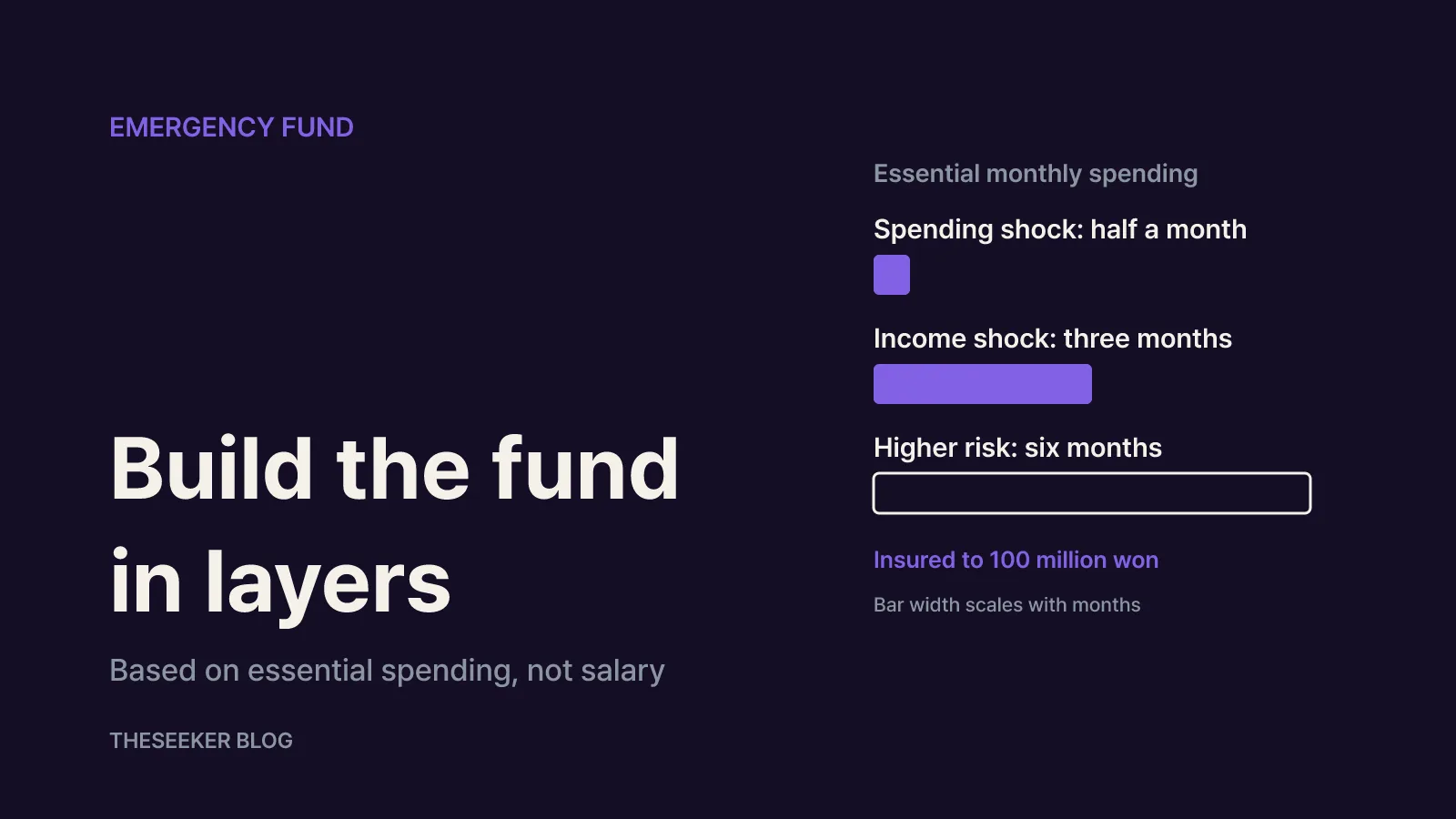
Base the target on essential monthly spending, not on salary: housing, food, utilities, insurance and loan payments that continue even if income stops. Keep holiday and vacation money in the annual expenses account, not in the emergency fund.
Vanguard's emergency fund guide splits the target into two layers. For spending shocks, such as a car repair, aim for at least half a month of expenses. For income shocks, such as a job loss, build toward three to six months of expenses over time. Fill the half-month layer quickly, then grow toward three months and finally six.
Where a couple lands in that range depends on risk:
- Two stable jobs with similar pay: three months is a reasonable starting target.
- A planned move to one income, a freelance or self-employed partner, or large loan payments: aim closer to six months.
- A baby or parental leave on the horizon: calculate the income gap for that period and add it as a separate goal. In the FSS case, a reserve target of 20 million won was designed to cover childbirth costs and the shortfall during leave.
The fund should be safe, separate from everyday spending and quickly accessible. In South Korea, deposit protection has covered up to 100 million won per person, per financial institution, principal and interest combined since September 1, 2025, according to the Financial Services Commission. Accounts at the same institution are added together toward that limit; deposits at different institutions are covered separately. Because the limit is per person, deposits held in each spouse's own name are counted separately. The same Q&A states that investment products such as funds, and cash management accounts (CMAs) at securities firms, are not covered. If you live elsewhere, check your own deposit insurer's rules before choosing an account.
Also agree on when the fund can be used. The CFPB suggests setting your own definition of an emergency, using the fund without guilt when one happens, and then rebuilding it. For couples, one rule is often enough: tell each other before any withdrawal above an agreed amount.
Review monthly and renegotiate at life changes
Set a short monthly money check-in:
- Confirm every automatic transfer ran as planned.
- If shared spending ran over, narrow the cause to one or two categories.
- Look ahead at next month's irregular costs.
- Record progress on the emergency fund and shared goals in numbers.
Leave personal allowance spending out of the review. Transparency for shared money and privacy for personal money is what keeps both partners committed to the system.
Agree in advance on the moments that trigger a full renegotiation: a significant income change, a move or home purchase that changes fixed costs, or the arrival of a child and a temporary drop in one income. At those points, refill the disclosure sheet, then adjust the contribution ratio, the account amounts and the number of months in your emergency target together. One month over budget is not a failure; decide whether the budget was unrealistic or the expense was a one-off, and fix next month's numbers.
Sources
Frequently asked questions
Should married couples combine finances completely?
Not necessarily. Fully combined, partly combined and fully separate models can all work. Pick the one that fits your income gap, habits and shared goals. If you are unsure, start by pooling only shared costs and joint savings, then decide after a few months whether to merge more.
Is splitting expenses 50/50 fair if we earn different amounts?
When incomes are similar, 50/50 is fine. When the gap is large, splitting in proportion to take-home pay leaves both partners a fair share of personal money. For example, take-home pay of 3,000 and 2,000 gives a 60:40 split. Agree on when you will recalculate.
How big should a couple's emergency fund be?
Start with at least half a month of essential expenses for surprise bills, then build toward three to six months of expenses for a loss of income. Aim nearer six months if one income is irregular, a move to one income is planned or loan payments are large.
Where should we keep our emergency fund?
Keep it in a separate, easily accessible deposit account. In South Korea, deposits are protected up to 100 million won per person per institution, while funds and securities-firm CMAs are not covered. Elsewhere, check your own deposit insurer's rules.
What should we do with bonuses and other irregular income?
Avoid letting it raise your monthly spending baseline. Decide in advance where it goes, such as extra loan principal, the emergency fund or a dated savings goal, as the FSS recommended in its newlywed case.
blog.theseeker.io/en/posts/newlywed-money-management-combining-accounts-emergency-fund
Ethan Caldwell
Ethan covers the basics of managing money, from saving and credit to taxes, checking rates and terms against official guidance from banks and government agencies.
Read our editorial standards