Do Warehouse Day Jobs Count for Unemployment Pay in Korea?
Yes, day shifts at fulfillment centers such as Coupang's can qualify you for Korea's job-seeker allowance. Here is how the 180-workday test, the one-third rule and the application steps work for day laborers.
 Nathan Brooks
In this post
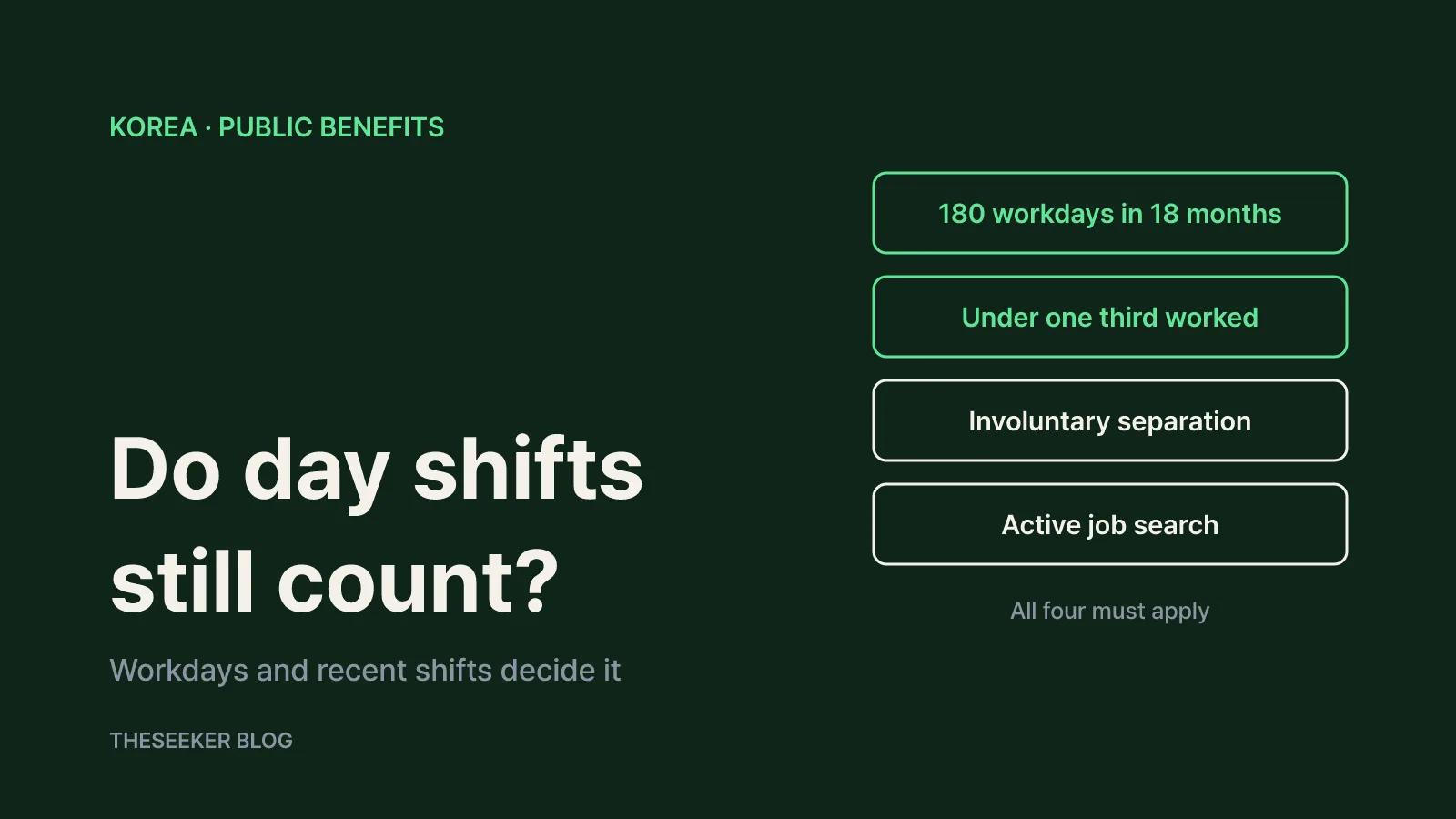
As of October 2026, the short answer is yes: if you have only ever worked day shifts at a fulfillment center such as Coupang's, you can still qualify for Korea's job-seeker allowance (구직급여, the main unemployment benefit under Employment Insurance). Day laborers are assessed under special rules, though. You need at least 180 insured workdays within the 18 months before you left your last job, and when you apply, your recent workdays must be below one third of a defined window so that you count as unemployed. This guide follows Article 40 of the Employment Insurance Act and the Work24 Employment Insurance page for day laborers, and it is written for anyone in Korea, including foreign residents covered by Employment Insurance, who wants to check eligibility before visiting a job center.
Who counts as a day laborer under Korean law
Korean law defines a day laborer as someone hired for less than one month (Easylaw, Ministry of Government Legislation). If you book individual shifts through an app and are paid per day, you almost certainly fall into this group. If, instead, you signed a contract for several months at the same warehouse, you are treated as a regular (fixed-term) employee, and the standard rules apply rather than the day-laborer rules. So the first thing to establish is how your last employer reported you to Employment Insurance.
According to Work24, a 2004 amendment made Employment Insurance mandatory for all day laborers. Even for a single shift, the employer must file a work-history report (근로내용확인신고), and those reported days become the raw data for your benefit claim. Large logistics employers do not have a separate regime; their day workers are judged under the same statutory test as everyone else.
Article 40 lists six conditions. The last two apply only to people who were day laborers at the time of their final separation:
- At least 180 days of insured unit period in the base period (normally the 18 months before separation)
- Willing and able to work but not employed
- The reason for leaving is not one that disqualifies you
- Actively looking for work
- (Day laborers) Workdays from the first day of the month before your application month through the application date are fewer than one third of the total days in that window; construction day laborers may instead show no work at all for 14 consecutive days before applying
- (Day laborers) If you left another job for a disqualifying reason during the base period, at least 90 of your insured days must be as a day laborer
The 180-day test counts workdays, not months
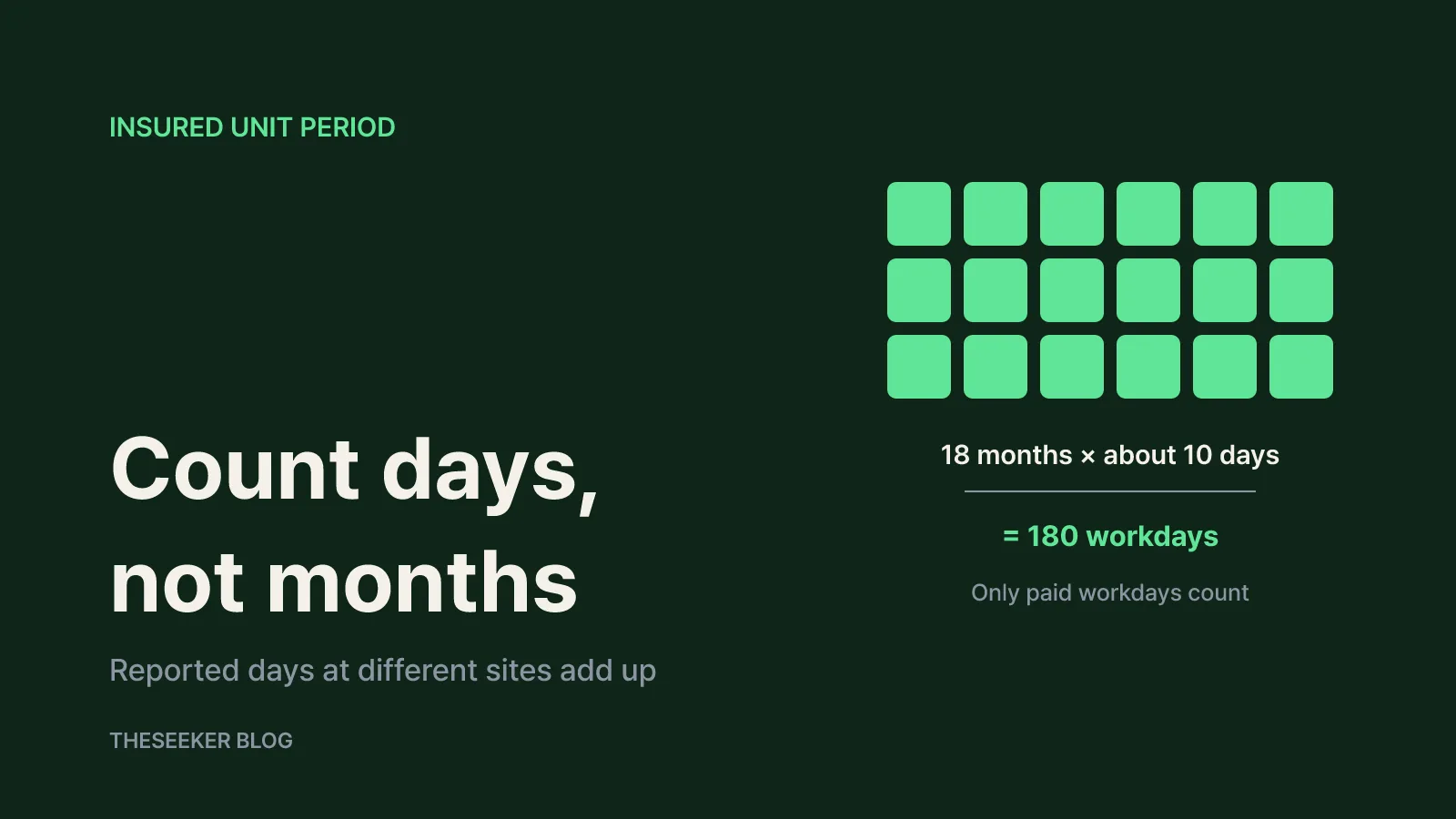
Many Korean searches ask whether "six months" of work is enough. For day laborers that shortcut is misleading. The insured unit period is the sum of days on which wages were paid (Easylaw). Salaried staff also earn credit for paid weekly rest days, so a five-day week fills 180 days in roughly six to seven months. A day laborer only earns credit for the days actually worked and paid.
That makes the math concrete: to reach 180 days within 18 months you need to have worked about 10 days a month on average. Someone who picks up two or three shifts a week may fall short even after a full 18 months. On the other hand, days at different warehouses or other employers are added together as long as each one was reported, so you do not need 180 days at a single site.
A few adjustments matter. Days that already supported a previous unemployment claim are not counted again. If illness, injury or a similar reason kept you from being paid for 30 or more consecutive days, the base period is extended by those days, up to three years. People who worked under 15 hours a week and no more than two days a week can, if they meet the conditions, use a 24-month base period instead. Because these exceptions depend on your records, bring documentation and ask the job center to confirm.
The one-third rule decides whether you are unemployed
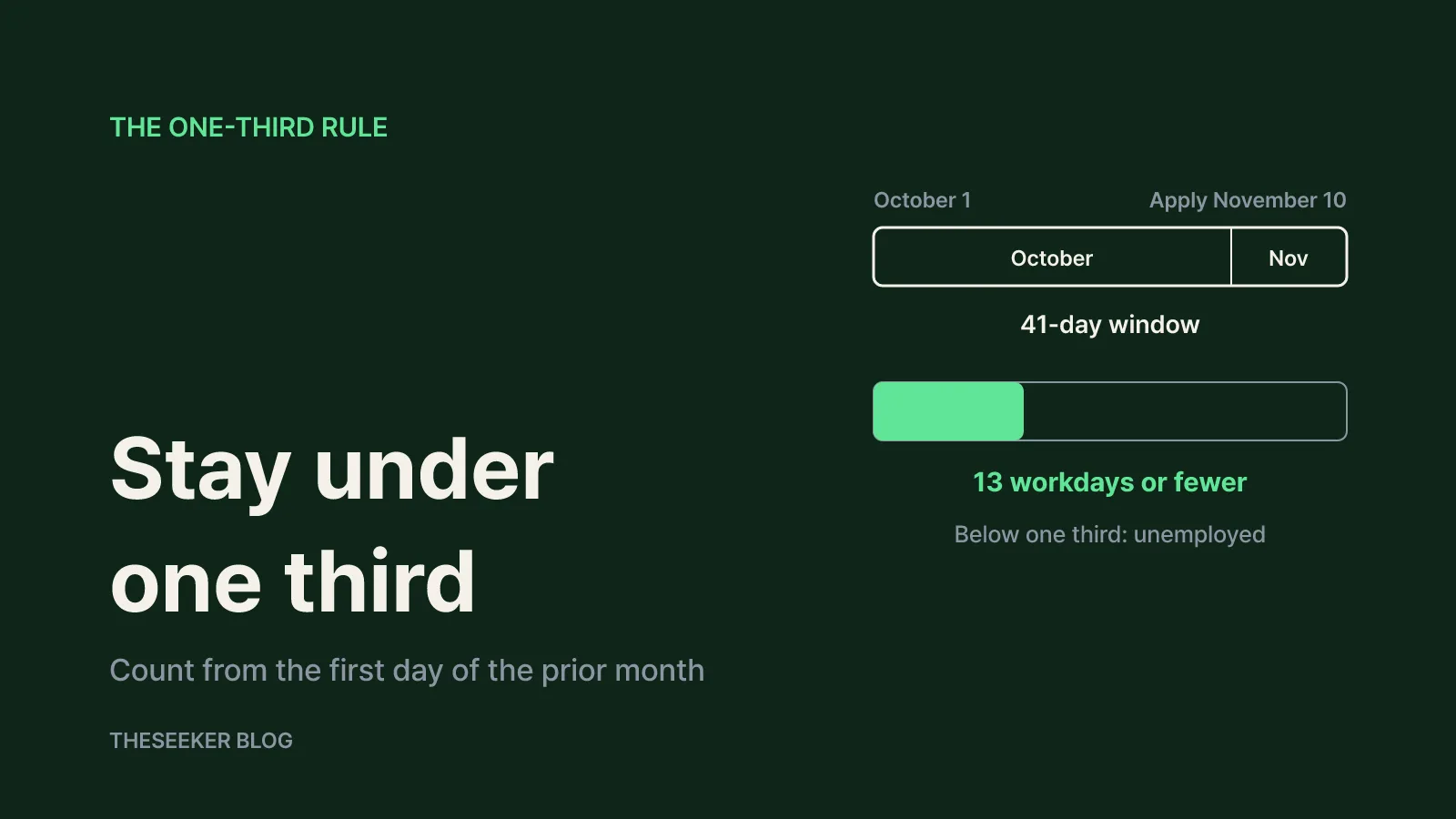
Day laborers often stop and restart work, so the law checks whether you are genuinely out of work at the moment you apply. The window runs from the first day of the month before your application month to the application date itself, and your workdays in that window must be fewer than one third of its total days.
Suppose you apply on November 10. The window is October 1 to November 10, which is 41 days. One third of 41 is about 13.7, so you must have worked 13 days or fewer in that period. If you worked 14 or more shifts in October, waiting a few days may not help; the window only resets when the calendar month changes. The flip side is useful: a handful of shifts right before applying does not automatically disqualify you, as long as you stay under the ratio.
Construction day laborers have an alternative. Someone classified in the construction industry at separation qualifies if there were no workdays for 14 consecutive days before applying, even if the one-third ratio is exceeded. Warehouse work is generally not construction, so plan around the one-third rule.
Quitting, misconduct and the 90-day rule
Because a day contract ends on its own, day laborers are less likely than salaried staff to be blocked for "quitting voluntarily". Work24 still states that people who left by choice, for example to change jobs or start a business, or who were dismissed for serious misconduct such as a criminal conviction, embezzlement or prolonged unauthorized absence, cannot receive the benefit (Work24).
A common scenario is quitting a salaried job and then supporting yourself with warehouse shifts. Paragraph 6 of Article 40 says that if a person who was a day laborer at final separation had left another job for a disqualifying reason during the base period, they must have worked at least 90 days as a day laborer in that period. In other words, an earlier resignation does not close the door if you then logged 90 or more day-labor days and meet everything else.
Some resignations are treated as justified. Examples in the enforcement rules include unpaid wages for two months or more within the year before leaving, workplace harassment, a relocation that makes the round-trip commute three hours or more, and the end of a fixed-term contract (Easylaw).
How much you can receive and for how long
The daily benefit is 60% of your average wage before separation. For day laborers, the average wage is total pay for the three months before the final month, divided by the calendar days in those three months, looking at the four months before separation and dropping the last one. Because the divisor is calendar days, irregular work can produce a lower average than your shift rate suggests.
Daily caps apply. According to a Ministry of Employment and Labor 1350 helpline answer, the ceiling for people who left on or after January 1, 2026 is 68,100 won per day. The floor is 80% of the minimum wage multiplied by your contractual daily hours at the last workplace, which for 2026 separations is 66,048 won on an eight-hour basis (MOEL 1350). Shorter scheduled hours mean a lower floor.
The number of payable days depends on age at separation and total insured period. For separations on or after October 1, 2019, people under 50 receive 120 days with under one year of coverage, 150 days for one to three years, 180 for three to five, 210 for five to ten and 240 for ten or more. People aged 50 or over and people with disabilities receive 120, 180, 210, 240 and 270 days respectively.
Checking your record and applying
The most frequent snag is that an employer's work-history report has not yet appeared in your record. Work24 lists that employer filing as the first step of the process, so prepare in this order:
- Log in to Work24 and compare your insured history and daily work records with your actual shifts. Ask the employer to file any missing months.
- Count your workdays in the last 18 months and check the one-third ratio for your planned application date.
- Register as a job seeker on Work24 and complete the online orientation for claimants.
- Bring ID to the job center for your registered address and submit the eligibility application. Work24 says a decision is normally issued within two weeks.
- Once approved, attend unemployment certification every one to four weeks and report job-search activity. The first certification includes a seven-day waiting period.
Missing a scheduled certification does not just delay payment; Work24 notes it reduces your remaining benefit days. Applying or interviewing counts as job search, but phone inquiries alone or repeated applications to the same employer do not. If you take even one shift while claiming, report it, because worked days are not paid and unreported work can be treated as fraud. If you find a job and stay employed for 12 months or more within your benefit period, you may receive part of the remaining amount as an early re-employment allowance.
Work24 also offers an eligibility simulator and a day-laborer benefit calculator. For anything unclear, call the ministry helpline at 1350 or ask your local job center, bringing shift records and wage deposit history.
Sources
Frequently asked questions
Can I get unemployment benefits in Korea if I only did day shifts at a Coupang warehouse?
Yes, if your reported workdays add up to at least 180 in the 18 months before separation, your workdays from the first day of the previous month through the application date are below one third of that window, and you also meet the involuntary-separation and job-search conditions.
Is six months of work enough for a day laborer?
Not necessarily. The insured unit period counts paid workdays, so a day laborer needs 180 actual workdays, roughly 10 days a month on average across 18 months.
I worked a few shifts right before applying. Am I still eligible?
You can be, as long as your workdays from the first day of the month before your application month through the application date are fewer than one third of that window. Applying on November 10, for example, means 13 workdays or fewer out of 41.
I quit a salaried job and then worked day shifts. Does the resignation block me?
If you were a day laborer at final separation, an earlier disqualifying resignation in the base period is overcome when you worked at least 90 days as a day laborer in that period and meet the other conditions.
My Employment Insurance record is missing some shifts. What should I do?
The employer's work-history report may not have been filed or processed yet. Check your record on Work24 and ask the employer to file the missing days before you apply.
blog.theseeker.io/en/posts/day-laborer-unemployment-benefit-korea-warehouse
Nathan Brooks
Nathan covers eligibility, application steps and deadlines for public support programs, working from government notices and starting with who qualifies.
Read our editorial standards