How to Request a Mortgage Rate Cut in Korea
Korean borrowers can ask their bank to lower the rate on an existing mortgage after their credit improves. Here is who qualifies, how to apply, the 10-business-day decision rule and what each rejection reason means.
 Ethan Caldwell
In this post
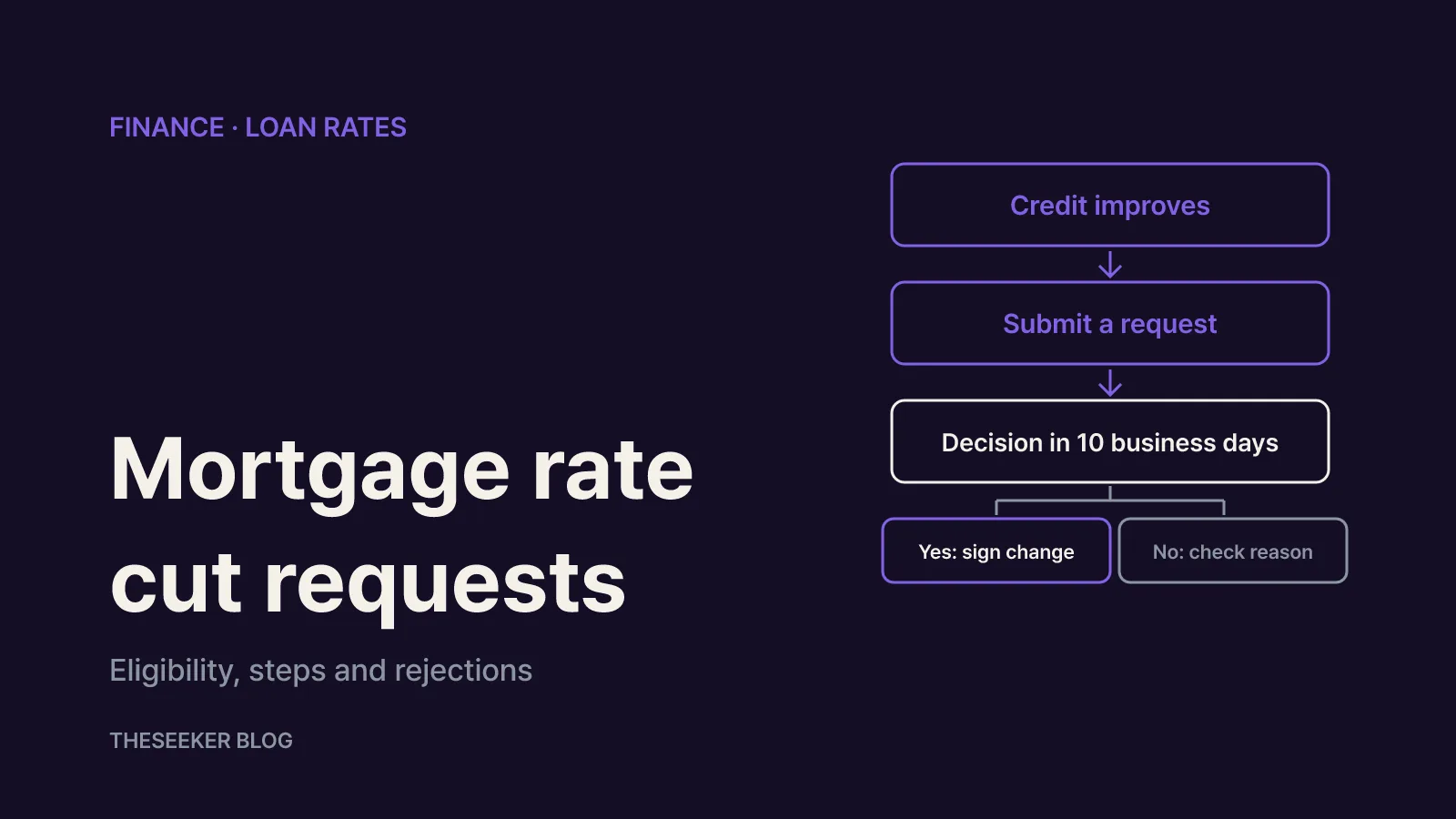
As of October 2026, anyone with a mortgage from a Korean bank can ask that bank to lower the interest rate if their credit standing has improved since the loan was made, for example through a new job, a promotion, higher income, lower debt or a better personal credit score. This is a statutory right known in Korean as geumni inha yogu-gwon (금리인하요구권), usually translated as the right to request an interest rate reduction. The bank must tell you whether it accepts the request, and why, within 10 business days of receiving it (Enforcement Decree of the Banking Act, Article 18-4).
The catch for homeowners is that collateral, not your personal credit, drives most of a mortgage's pricing. Korea's Financial Services Commission (FSC) has said that the rejection reason "internal credit grade did not rise enough to allow a rate cut" occurs mainly with mortgages and guaranteed loans, where credit has a limited effect on the rate (FSC press release, February 2023). So a request is worth making, but it pays to check eligibility and prepare evidence first. This guide covers bank loans in Korea, based on the decree and public material from the FSC and the Financial Supervisory Service (FSS). Each bank applies its own internal rules, so your loan's product disclosure and the bank's notice remain the final word.
What the right covers and whether mortgages qualify
The right comes from Article 30-2 of the Banking Act, and banks must tell borrowers about it when a loan is signed. In its November 2021 reform plan, the FSC summarized two conditions. First, the loan must be priced using the borrower's credit standing. Second, that credit standing must have improved after the loan was taken out.
The same document states that every loan is in scope except those where the borrower's credit does not affect the rate. The FSC also listed two examples of poor guidance by lenders: telling customers that partially secured loans or loans secured by assets other than housing were excluded, and telling them they could not apply within three months of signing. It added that a borrower whose credit has improved may apply regardless of how many times or when they apply.
In practice, a mortgage is not excluded simply because it is a mortgage. The test is not whether the rate is fixed or variable, but whether your credit was part of how the rate was set. If the rate is determined without reference to the borrower's credit, as can be the case with government-backed policy loans that use a published rate table, expect a "not an eligible product" answer. Asking the lender before you apply saves time.
The FSS consumer guide adds a realistic caveat: even after a marked improvement, the lender's internal policy and its credit scoring system (CSS) may not produce a lower rate, and internal rules can limit how the right is exercised. Think of it as a right to have your rate recalculated, not a guarantee of a cut.
Eligibility: what kind of change counts

For individual borrowers, the decree lists employment, promotion, an increase in assets and a higher personal credit score as examples of improved credit. A 2021 industry standard for household loans groups qualifying changes into three buckets:
- Higher income or assets: a new job, promotion, job change or professional qualification that raised income, or growth in assets and a reduction in debt
- Better credit score: a rise in the score issued by a credit bureau
- Other: any other change the borrower considers an improvement, plus criteria the bank sets itself, such as preferred-customer status
For a typical homeowner, the useful questions are: has my salary gone up, have I paid off a personal loan, card loan or installment plan, and has my credit score risen through on-time payments? What matters is the change since the loan was approved. Circumstances that were already priced in at the time rarely count as new grounds.
The 2023 FSC measures asked banks to disclose, as far as possible, the factors they actually use when approving requests. Examples given include deposit activity, any history of late payments, and use of other services such as having your salary paid into the bank. Banks were also asked to contact borrowers whose internal grade or bureau score had risen at least once every six months, so a reminder message from your bank is a useful signal.
How to apply: app, branch and documents
According to the FSS, you apply at a branch or through internet or mobile banking and submit documents showing the improvement; the lender then reviews the request. In most Korean banking apps the option sits inside the loan details or loan management menu, although names and locations differ by bank.
A practical sequence:
- Check your loan agreement and product disclosure for how the rate is built (base rate, spread and any discounts) and whether rate cut requests apply.
- Write one sentence describing what has changed since the loan was made, such as "promoted, annual income higher" or "paid off a personal loan".
- Gather documents tied directly to that change, such as proof of employment and income, or confirmation that a debt was repaid. Use the bank's own document list.
- Submit the request in the app or at a branch and note the date.
- Respond quickly if the bank asks for more paperwork. Under the decree, the period from the bank's request for additional material until you supply it does not count toward the 10-business-day limit.
Applying online is convenient, but evidence matters. FSC data for 2020 showed an acceptance rate for bank household loans of 76% for in-person requests versus 27% for non-face-to-face requests, with many online applications lacking the required documents.
Decision timing and when the new rate applies
The bank must notify you of its decision and the reason within 10 business days, by phone, letter, text message, email, fax or a similar method. The clock runs on business days, not calendar days, and pauses while the bank waits for extra documents.
Acceptance does not change your rate automatically. Since the 2021 reforms, the lower rate takes effect when you sign the rate change agreement. After an approval, confirm that you have completed that step and that the new rate shows in your loan details.
The FSC notes that refusing or delaying a request without a legitimate reason counts as an unfair business practice under the Financial Consumer Protection Act and can lead to fines. If the deadline passes without a reply, contact the bank and cite your application date.
If your request is rejected
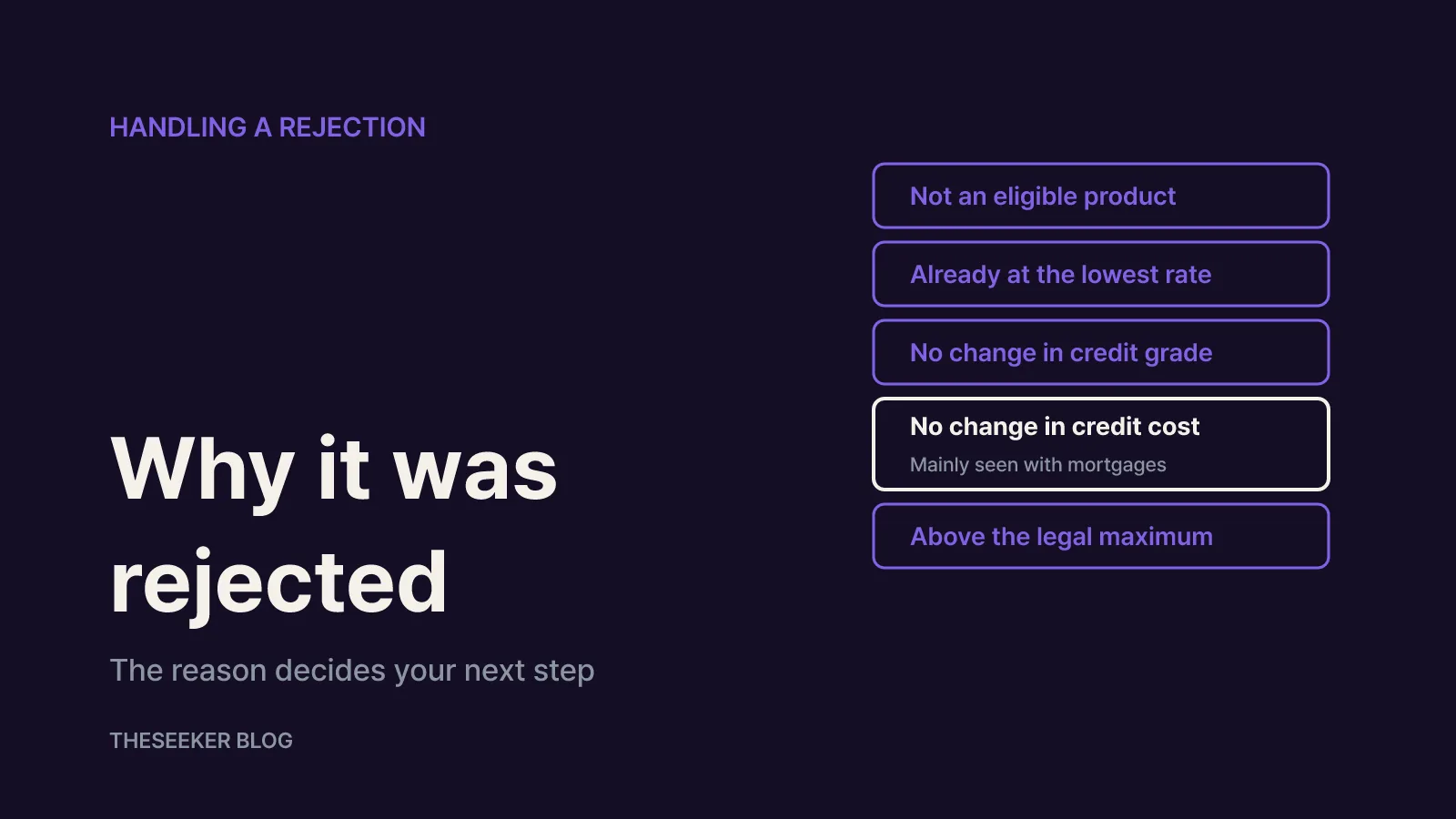
Start with the stated reason. Since 2023, banks have been expected to split the old catch-all "minor credit improvement" into more specific categories, giving five types in total:
- Not an eligible product: the rate is set without reference to the borrower's credit
- Already at the lowest rate: you already receive the best rate, for example at the top grade
- No change in credit grade: the bank's internal grade did not move
- No change in credit cost: your internal grade did not rise enough to justify a cut
- Above the legal maximum: even after the improvement, the recalculated rate would exceed the legal interest cap
For mortgage holders, the fourth reason deserves attention. The FSC says it arises mainly with mortgages and guaranteed loans, where credit has limited influence on pricing. It usually means your improvement was real but not large enough to shift a collateral-driven rate.
What to do next depends on the reason:
- Not an eligible product: reapplying for the same loan is unlikely to help. Lowering your cost would mean comparing other options such as refinancing, including any early repayment fee.
- Already at the lowest rate: there is no further room on credit grounds.
- No change in grade or credit cost: ask for the information used in your credit assessment. Under the 2023 measures, banks provide this on request, and Article 36-2 of the Credit Information Act lets individuals ask for an explanation of their credit evaluation. If the data was out of date or wrong, you can ask for it to be corrected or deleted, or for the evaluation to be recalculated.
Timing a second attempt also matters. Under the 2023 disclosure rules, a new request for the same product within one month of a decision is counted as a duplicate unless the outcome differs. That is not a ban, but reapplying with nothing new will usually produce the same result. Wait until you have fresh evidence, such as a new income statement or further debt reduction.
To compare banks, industry associations publish half-yearly results. Since 2023, bank disclosures break household loans into credit, secured and mortgage loans, showing acceptance rates, interest savings, the average rate reduction and the share of online applications. The FSC advises looking at savings and rate reductions alongside acceptance rates, because heavy online volume can push acceptance rates down for reasons unrelated to pricing.
If you believe the refusal lacked a legitimate reason, ask the bank's consumer protection team for a detailed explanation first, then consider filing a complaint with the FSS.
A final checklist before you apply
- Does your loan's rate depend on your credit, according to the product disclosure?
- Can you state in one sentence what has changed since the loan was approved?
- Do you have documents that prove that change?
- Have you recorded the application date and counted 10 business days?
- If approved, have you signed the rate change agreement?
- If rejected, do you know the reason category and the data used to assess you?
A rate cut request costs nothing to file and simply asks the bank to price your loan again with up-to-date information. Mortgage outcomes tend to be more conservative than for unsecured loans, but a well-documented request and a clear understanding of any rejection will tell you whether to wait, correct your credit data or look at other options.
Sources
Frequently asked questions
Can I request a rate cut on a fixed-rate mortgage in Korea?
The FSC's test is whether the borrower's credit affects the loan's pricing, not whether the rate is fixed or variable. If credit plays no part in setting the rate, expect a 'not an eligible product' response, so check your product disclosure or ask the bank first.
Do I have to wait a certain time after taking out the loan?
The FSC criticized lenders that told borrowers they could not apply within three months of signing, and stated that borrowers with improved credit can apply regardless of timing. Conditions already reflected when the loan was approved, however, rarely count as new grounds.
How long does the bank have to respond?
The bank must give its decision and the reason within 10 business days of receiving the request. Time spent waiting for additional documents you were asked to supply is excluded.
When does the lower rate start?
Under the 2021 reforms, the reduced rate applies from the point you sign the rate change agreement. After approval, complete that step and confirm the new rate in your loan details.
Can I reapply immediately after a rejection?
Nothing prohibits it, but disclosure rules count a request for the same product within one month of a decision as a duplicate. Check the rejection reason and reapply once you have new evidence, such as higher income or reduced debt.
blog.theseeker.io/en/posts/korea-mortgage-rate-cut-request-guide
Ethan Caldwell
Ethan covers the basics of managing money, from saving and credit to taxes, checking rates and terms against official guidance from banks and government agencies.
Read our editorial standards