How to Compare Savings and Parking Account Rates in Korea
Korea's regulators publish official rate comparisons: FSS Finlife for term deposits and installment savings, and the bank and savings bank association portals for parking accounts. Here is the filter order and how to read base rates, top rates and after-tax interest.
 Ethan Caldwell
In this post
- Which official site covers which product
- Filtering term deposits on Finlife, step by step
- Installment savings: separate by contribution type first
- Parking accounts: check the balance that earns the top rate
- Reading pre-tax and after-tax interest
- Final checks: deposit insurance and early withdrawal
- Sources
- Frequently asked questions
As of October 2026, the most reliable way to compare savings rates in South Korea is to use the official disclosure sites rather than ranking articles. For term deposits (jeonggi yegeum) and installment savings (jeokgeum), use Finlife, the product comparison site run by the Financial Supervisory Service (FSS). For parking accounts, which are high-interest demand deposits you can withdraw from at any time, use the Korea Federation of Banks consumer portal for commercial banks and the Korea Federation of Savings Banks portal for savings banks. The workflow is the same everywhere: enter your amount and term, filter by institution type, eligibility and sign-up channel, then open the product details to check bonus conditions and balance limits before comparing after-tax interest.
All three sites are in Korean only. This guide translates the menu labels and filters you will see, so you can work through them with a browser translation tool if needed. The menus described here were checked on each site in October 2026.
Which official site covers which product
Start by deciding what kind of money you are placing. A KB Think guide produced in cooperation with the FSS splits Korean savings products into three groups: term deposits for a lump sum held to a fixed date, installment savings for regular monthly contributions, and demand deposits (ipchulgeum jayu yegeum) for money you move in and out freely. A parking account is simply a demand deposit that pays a higher rate than an ordinary checking account.
← Swipe to see more
| Product | Where to compare | Key filters |
|---|---|---|
| Term deposit | Finlife › 저축 (Savings) › 정기예금 | Amount, term, sector, interest method |
| Installment savings | Finlife › 저축 › 적금 | Monthly amount, term, contribution type |
| Bank parking account | KFB consumer portal › demand deposits | Bank, interest payout, sign-up channel |
| Savings bank parking account | KFSB portal › 입출금자유예금 | Top-rate band, interest payout, channel |
Finlife's savings menu also lists demand deposits and tax-advantaged products, and its notice section links to the association disclosures. For parking accounts, though, the association portals are more useful because they show the balance that qualifies for the top rate.
Filtering term deposits on Finlife, step by step
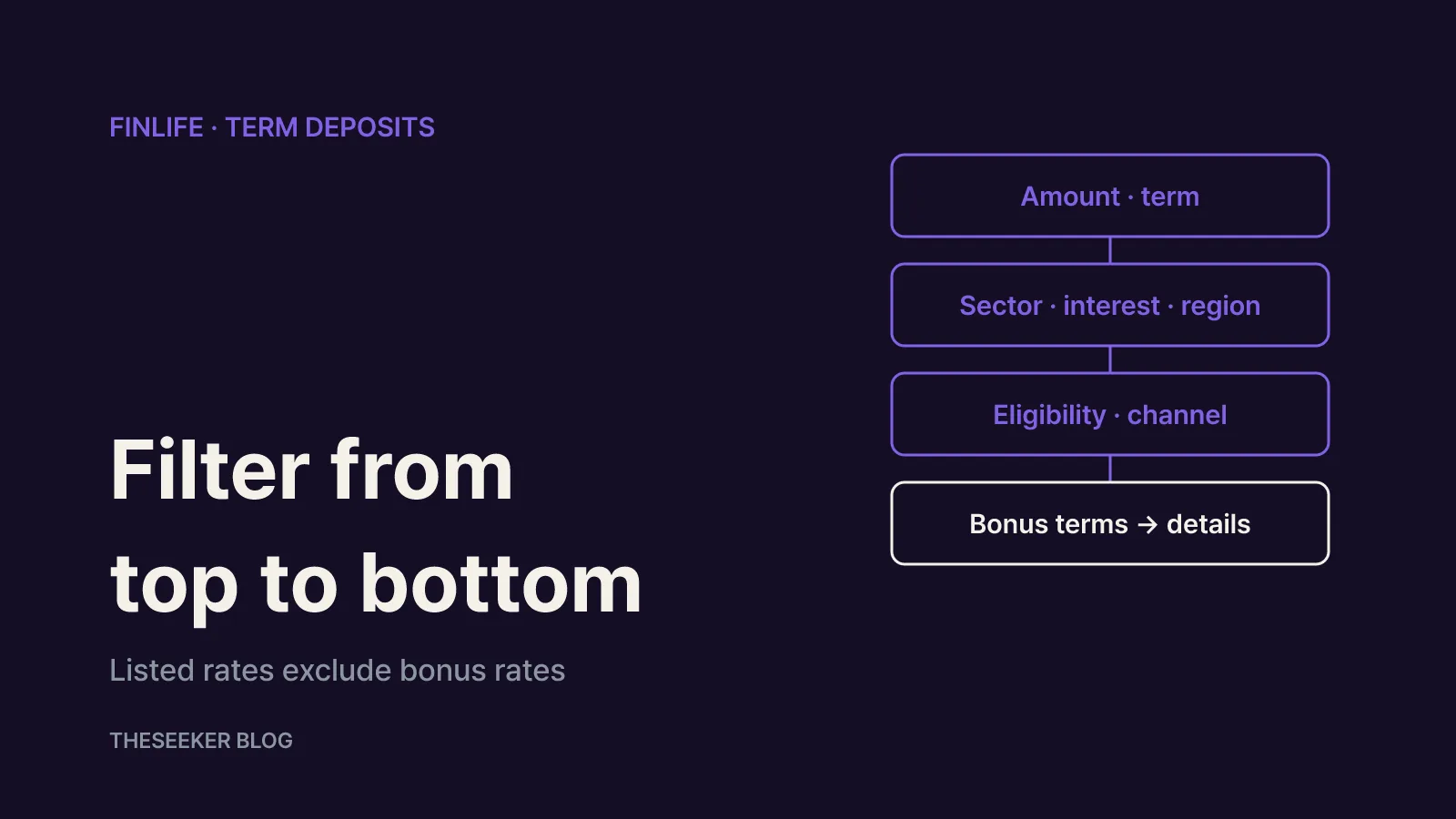
On the term deposit page, fill in the filters from top to bottom:
- Deposit amount (저축 금액): up to 1 billion won. Enter the amount you will actually deposit so the after-tax interest column matches your situation.
- Planned term (저축 예정기간): 1, 3, 6, 12, 24 or 36 months. Pick a term that ends before you need the money to avoid early withdrawal.
- Sector (금융권역): all, banks, savings banks, or credit unions (신협조합). Choosing credit unions shows products offered by individual unions.
- Interest method (이자계산방식): simple or compound. Some products appear twice, once for each method, so selecting one keeps the list clean.
- Region (지역): 17 provinces and metropolitan cities from Seoul to Jeju, useful for regionally focused institutions.
- Eligibility (가입대상): unrestricted (제한없음) for the general public, low-income only (서민전용), or partially restricted (일부제한) for specific groups. The site asks you to check the detailed requirements for the last two.
- Sign-up channel (가입방법): branch, internet, smartphone, agent, phone banking or other. Keep only internet and smartphone if you cannot visit a branch.
- Bonus conditions (우대조건): filters such as online sign-up, rollover, primary bank relationship, first-time customer, age, and other product use.
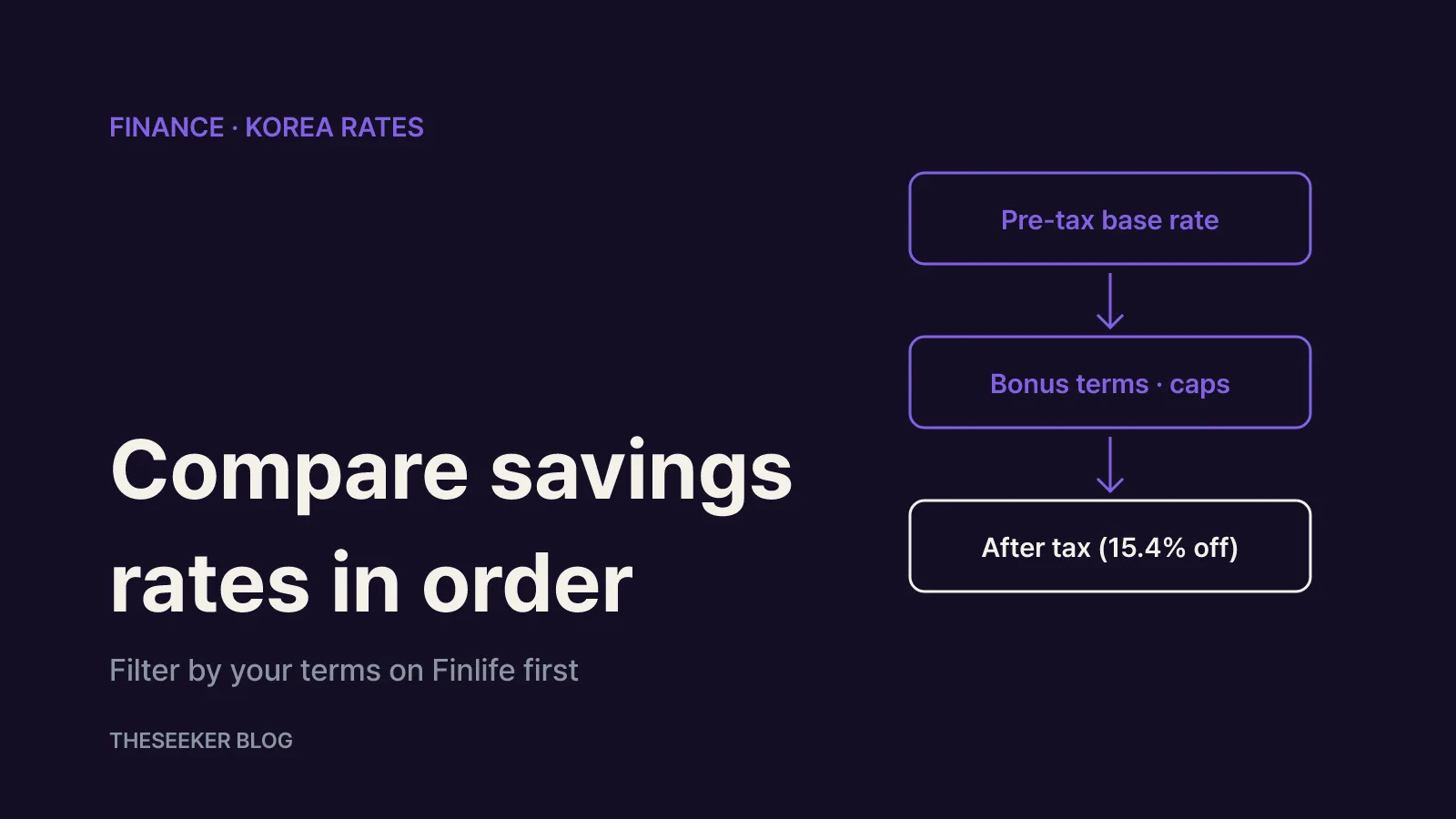
The results table shows the pre-tax rate, after-tax rate, an after-tax interest example, the maximum bonus rate, eligibility and interest method. The key detail: the pre-tax rate in the list is the base rate without bonus conditions. Finlife notes that a higher rate may apply if you meet the bonus conditions listed under product details. Shortlist two or three products with the compare checkbox and read each product's bonus conditions and post-maturity rate.
Installment savings: separate by contribution type first
The installment savings page works the same way with two differences. You enter a monthly amount (up to 10 million won) and the site calculates the total, and the results include a contribution type column:
- Fixed installment (정액적립식): the same amount every month, suited to a steady salary.
- Flexible installment (자유적립식): any amount at any time within the term, suited to irregular income.
Do not rank the two types together. Finlife does not calculate after-tax interest for flexible plans because contributions vary. Also remember that each monthly payment only earns interest for the months left until maturity, so an installment plan earns less interest than a term deposit of the same total at the same headline rate. The after-tax interest example column reflects this and is a better guide than the rate itself.
Parking accounts: check the balance that earns the top rate
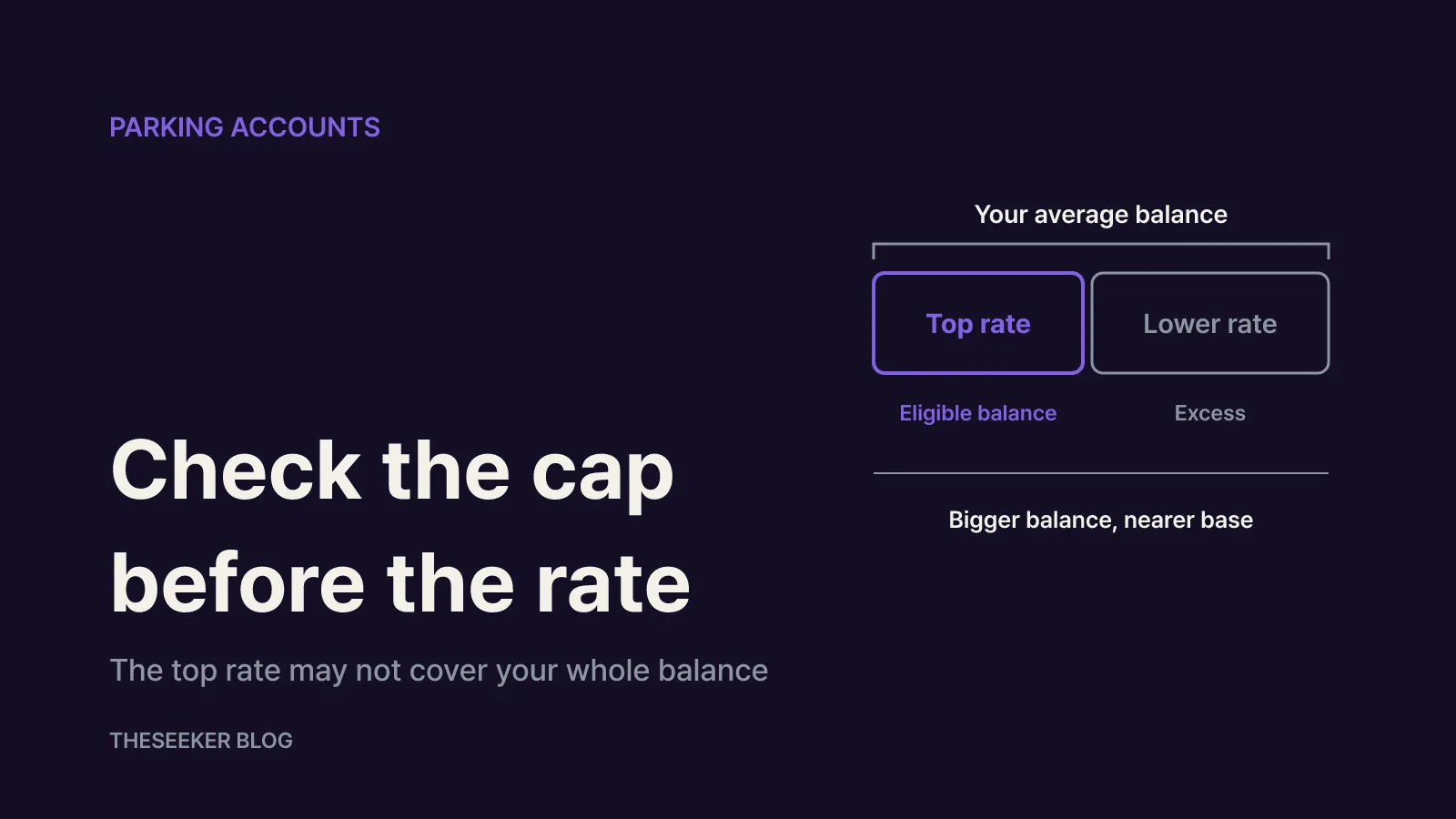
The most common mistake with parking accounts is assuming the headline rate applies to the whole balance. The savings bank federation's demand deposit page splits results into three columns:
- Base rate (기본금리): the lowest rate the product can pay.
- Top rate including bonuses (최고금리): the highest rate available when bonus and other requirements are met.
- Balance eligible for the top rate (최고금리 적용 가능 금액): the amount the top rate actually applies to.
You can filter by top-rate band (under 1%, 1% or more, up to 4% or more), interest payout frequency (on demand, monthly, quarterly, semi-annual, annual) and sign-up channel. The federation says the top rate depends on bonus conditions and the amount, so it should be confirmed with the savings bank.
In practice, decide your average balance first. If the eligible balance is smaller than that, assume the excess earns a lower rate. The larger your balance relative to the cap, the closer your effective rate moves toward the base rate. Check payout frequency too, because it changes when interest is added back to principal.
For commercial bank parking accounts, the KFB portal lets you filter by bank, payout method and channel. According to KB Think, those results are pre-tax and may differ from live rates, so confirm with the bank before opening an account.
Reading pre-tax and after-tax interest
Every rate on Finlife is an annual rate. A 6-month product shows its rate annualized, so you earn roughly half that percentage over the 6 months.
The after-tax rate deducts Korea's 15.4% withholding tax on interest income (14% income tax plus 1.4% local income tax). Using an assumed rate for illustration: 10 million won in a 12-month simple-interest deposit at 3.00% earns 300,000 won before tax. Withholding of 15.4% takes 46,200 won, leaving 253,800 won. The after-tax rate is 3.00% × 0.846, about 2.54%. Keep the same deposit for 6 months and pre-tax interest is about 150,000 won.
The after-tax figures on screen are illustrative: Finlife rounds down to the won and assumes monthly compounding for compound products, and it advises confirming the exact amount with the institution. Use the numbers to compare products, not as a final payout.
Rates can also lag. Finlife states that terms change frequently and may be disclosed late, and the savings bank federation gives a similar warning. Narrow your shortlist on the comparison site, then check that day's rate in the institution's app.
Final checks: deposit insurance and early withdrawal
Higher rates often come from savings banks and mutual credit cooperatives, so check deposit protection. According to the Financial Services Commission Q&A, Korea raised its deposit protection limit to 100 million won from September 1, 2025. Banks and savings banks are covered by the Korea Deposit Insurance Corporation, while regional agricultural and fisheries cooperatives, credit unions, Saemaul Geumgo and forestry cooperatives are covered by their central federations, all at 100 million won.
The limit applies per person, per institution, combining principal and interest. Multiple accounts at one institution are added together: in the FSC's example, deposits of 30, 40 and 50 million won at one bank total 120 million won, of which 100 million won is protected. Deposits at different institutions are protected separately, up to 100 million won each. Protected interest uses the lower of the contracted rate and a rate set by the insurer or federation. Funds, performance-based products, securities firm CMAs and subordinated bonds are not protected, which is a key difference between a CMA and a bank parking account.
Finally, check early withdrawal terms. Ending a term deposit or installment plan early means a lower rate. The savings bank portal shows a representative early-withdrawal rate for a 12-month product closed after 6 months, so add it to your comparison if you might need the money early. Product details also list the post-maturity rate, which applies if you leave funds in place after maturity, so set a reminder for the maturity date.
The full sequence: define the purpose and term, pick the right site for the product, filter by amount, term, sector, eligibility and channel, read the bonus conditions and balance caps, compare after-tax and early-withdrawal figures, confirm you are within the protection limit, and recheck the live rate before applying.
Sources
Frequently asked questions
Does the rate in Finlife's results list include bonus rates?
No. The pre-tax rate in the list is the base rate without bonus conditions. Check the maximum bonus rate column and the bonus conditions in the product details to see whether you qualify for more.
Can I compare parking account rates on Finlife?
Finlife's savings menu includes demand deposits, but parking accounts depend heavily on balance caps. The Korea Federation of Banks portal (commercial banks) and the Korea Federation of Savings Banks portal (savings banks) are more useful, and the savings bank portal shows the balance eligible for the top rate.
Will a 6-month deposit pay the full rate shown?
No. Finlife shows annualized rates, so a 6-month product pays roughly half the stated percentage in pre-tax interest. The after-tax interest example column shows an amount that reflects the term.
How is the after-tax rate calculated in Korea?
It deducts the 15.4% withholding tax on interest income, made up of 14% income tax and 1.4% local income tax. A 3.00% pre-tax rate becomes about 2.54% after tax. On-screen amounts are illustrative, so confirm the exact payout with the institution.
Are savings bank deposits protected up to 100 million won?
Yes. Since September 1, 2025, deposits at banks, savings banks and mutual credit cooperatives are protected up to 100 million won per person per institution, including principal and interest. Accounts at the same institution are combined, and securities firm CMAs and funds are not covered.
blog.theseeker.io/en/posts/korea-savings-parking-account-rate-comparison-finlife
Ethan Caldwell
Ethan covers the basics of managing money, from saving and credit to taxes, checking rates and terms against official guidance from banks and government agencies.
Read our editorial standards