How Long Does a Job Change Take? Timeline and When to Resign
A job change is the sum of four stages, and only one of them has a legal ceiling. Here is how to plan backwards from your start date and pick a safe moment to resign, using South Korea's notice rules as the worked example.
 Hannah Price
In this post
- The four stages that make up your job change timeline
- Build your schedule backwards from your start date
- When does a resignation take effect? The legal baseline in Korea
- How to decide when to resign while you are still employed
- What to check when your job search drags on
- A week-by-week job change checklist
- Sources
- Frequently asked questions
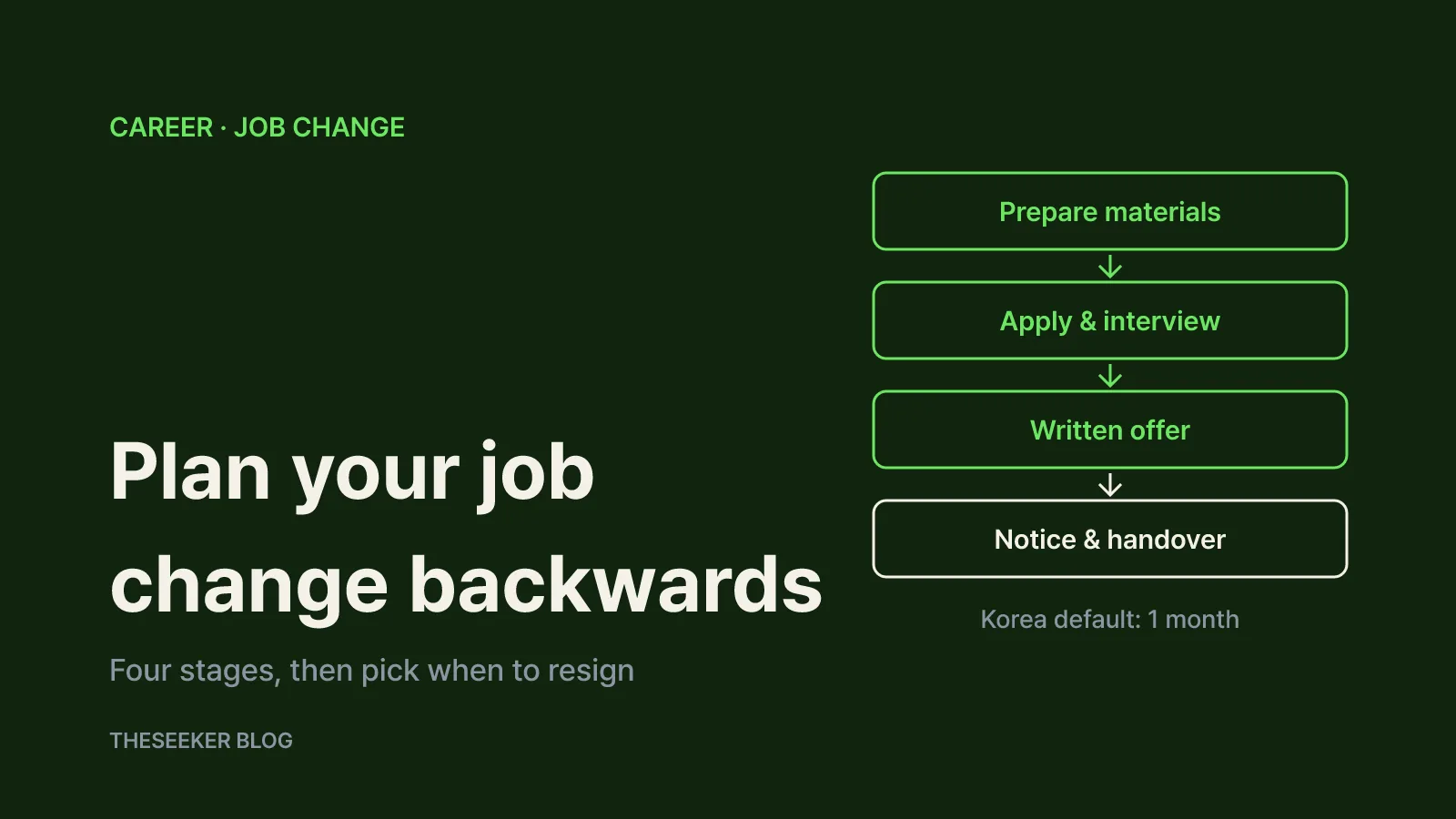
As of October 2026, there is no single answer to "how long does it take to find a new job?" A job change is the sum of four stages: preparing your materials, applying and interviewing, negotiating and receiving a written offer, and giving notice and handing over your work. The first stage is yours to control, the middle two depend on the hiring company, and the last one is shaped by your contract and the law. This guide uses South Korea's rules as the worked example: if you are on an open-ended contract and your employer never accepts your resignation, Article 660 of the Korean Civil Act says termination takes effect one month after notice is received, or after the next full pay period if you are paid by period, such as a monthly salary. The safest order is simple: plan backwards from your new start date, and resign only after the offer is confirmed in writing.
If you work somewhere else, the structure of this plan still applies, but the notice rules do not. Check your own employment contract and local labor law for the notice period that binds you.
The four stages that make up your job change timeline
Breaking the process into stages turns a vague worry ("when will I be able to leave?") into a set of smaller, answerable questions.
Stage 1: Preparing your materials. Updating your resume, rewriting project descriptions around outcomes, and pulling together a portfolio or work samples. This stage is fully in your hands. If you are still employed, be honest about how many evening and weekend hours you can really spend on it. Rewriting past work so it shows results usually takes longer than people expect.
Stage 2: Applying and interviewing. Finding openings, submitting applications, waiting for screening decisions and attending one or more interview rounds. This stage runs on the employer's calendar. Recruiters often separate time to hire, measured from a candidate's application to offer acceptance, from time to fill, measured from the moment a job goes live to acceptance (RecruitmentTrends by Pinpoint). Neither measure includes the weeks you spend preparing beforehand or the notice period afterwards, so a company's hiring speed alone will underestimate your total timeline.
Stage 3: Negotiation and a written offer. Agreeing on salary, title and start date, then receiving those terms in writing. Reference checks or pre-employment health checks can stretch this stage. Until it ends, the move is not confirmed.
Stage 4: Notice and handover. Telling your current employer, transferring your responsibilities and wrapping up leave and final pay. Because this stage is governed by your contract and the law, it gets its own section below.
Build your schedule backwards from your start date
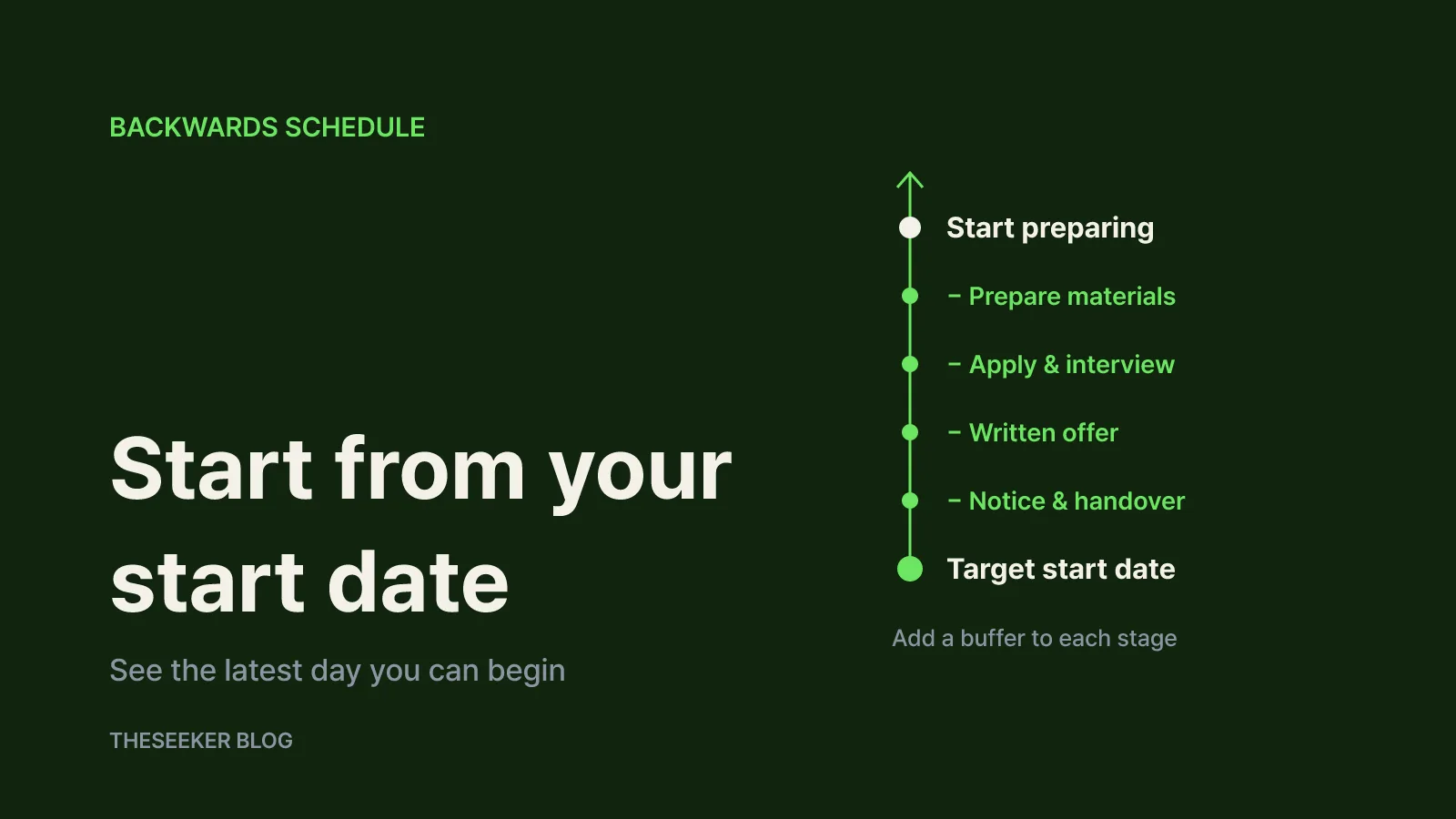
Planning forward from today makes every delayed interview ripple through the whole plan. Planning backwards from a target start date tells you the latest point by which each step has to be finished.
- Pick a target start window. If there is a project deadline or performance review you want to complete first, set the window after it.
- Subtract Stage 4. Look for a notice clause in your employment contract and company rules. If there is none, use the legal default that applies when your employer does not accept your resignation, then add time for a proper handover.
- Subtract Stage 3. Leave generous room for negotiation and paperwork. Rushing does not shorten it.
- Subtract Stage 2. Check how many rounds each posting lists and allow waiting time between them. If you are applying to several companies at once, plan around the slowest one.
- Subtract Stage 1. The date you land on is when you need to start preparing. If it has already passed, either push your target start date back or compress your preparation.
Always add a buffer. Interviews get rescheduled, final decisions slip and successors get assigned late. Without slack, any delay turns directly into a clash between your last day and your first day.
When does a resignation take effect? The legal baseline in Korea
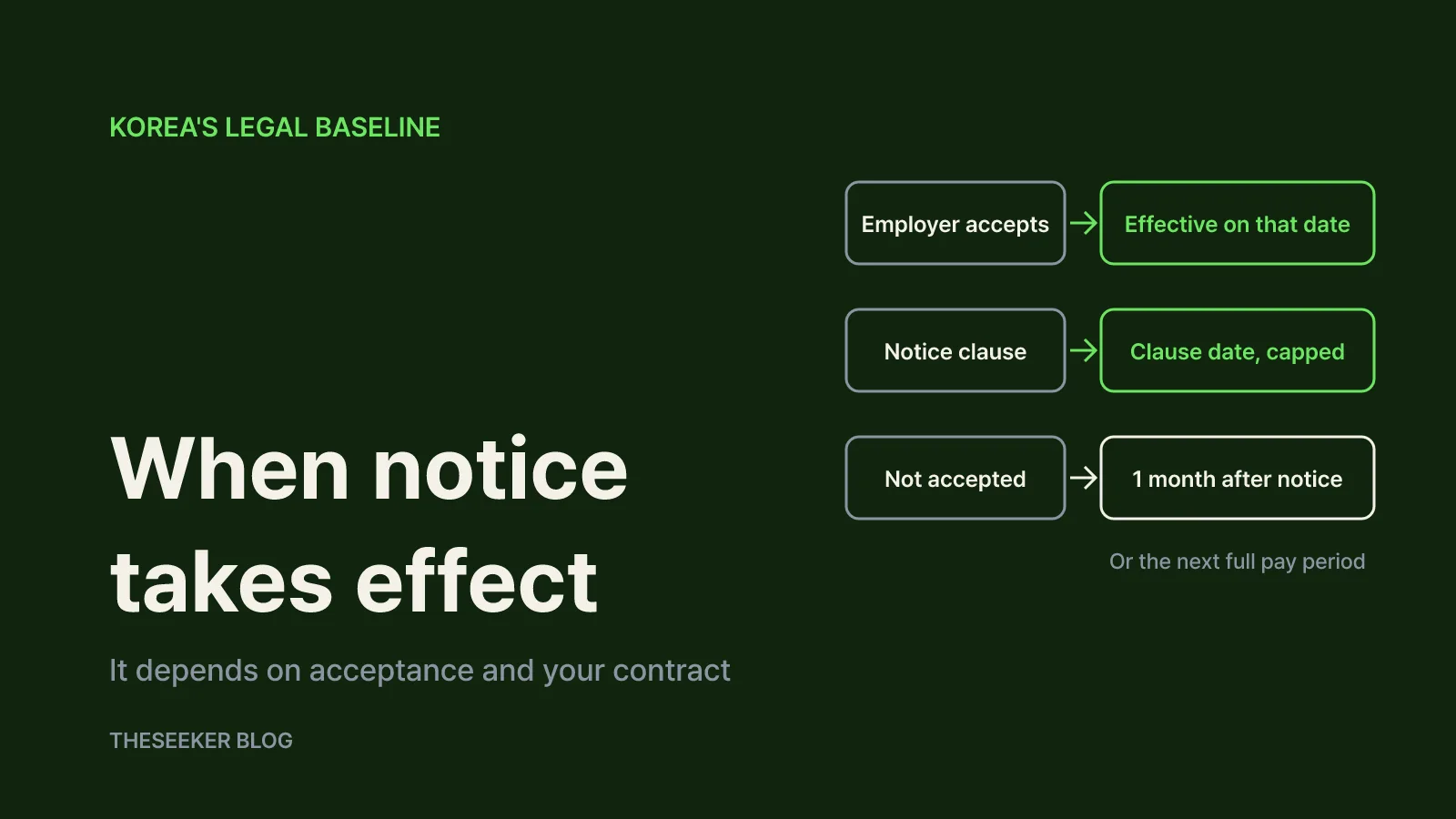
To choose a resignation date, you need to know when you actually stop being an employee. A Ministry of Employment and Labor Q&A response notes that the Labor Standards Act has no provision on when an employee's resignation takes effect, and lays out these cases:
- Your employer accepts the resignation. It takes effect on the date of acceptance. If you agree a leaving date with your employer, plan around that date.
- Your contract or company rules include a notice clause (for example, "submit your resignation 30 days before leaving"). The resignation can take effect at that point, but according to the ministry, such a clause cannot exceed the period set in Civil Act Article 660: one month, or the next full pay period.
- Your employer does not accept it and there is no special clause. Article 660 applies. With no fixed contract term, either party may give notice at any time, and termination takes effect one month after the other party receives it. Where pay is set by period, it takes effect once the pay period following the one in which notice was received has passed. For a monthly salary, that can mean the rest of the current pay month plus the whole next one, which may be longer than a simple "one month later." Check your payslip or company rules to see exactly when your pay period starts and ends.
- You are on a fixed-term contract. You are generally expected to serve out the term. The ministry cites Civil Act Article 661: either party may terminate for an unavoidable reason, but if that reason arose through one party's fault, that party must compensate the other.
One point matters a great deal for scheduling: the same response states that your employment contract remains in force during the notice period. Failing to show up can count as unauthorized absence, may expose you to a damages claim for breach of contract, and can lower your average wage. Do not set a start date on the assumption that you can stop working the day after you hand in your letter. For advice on a specific case, the ministry points to the Korea Legal Aid Corporation (dial 132 in Korea).
How to decide when to resign while you are still employed
With the legal baseline in mind, work through these checks in order.
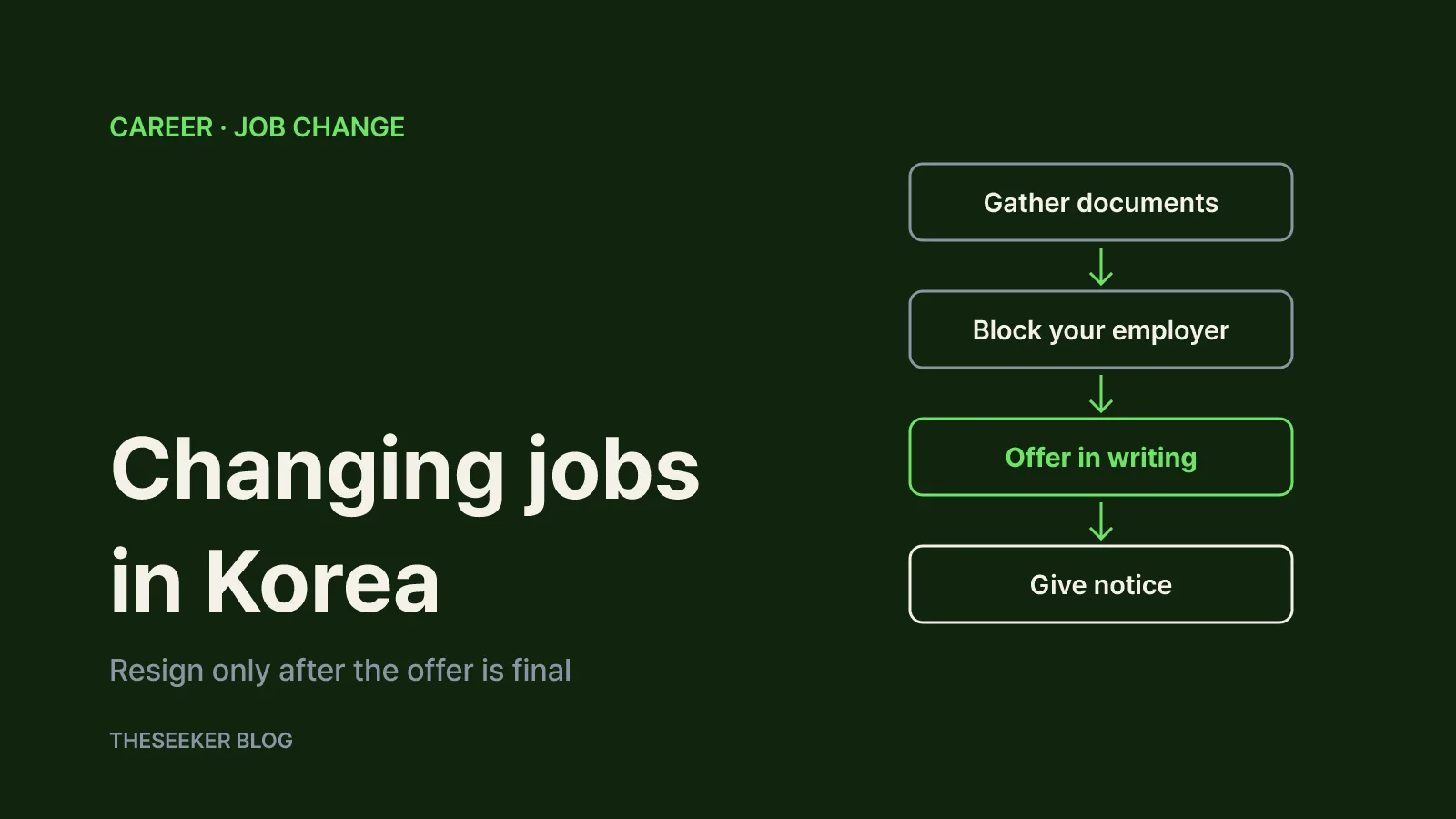
Get the offer in writing first. A verbal yes or a promise that paperwork is "on its way" is not enough. If negotiations fall apart after you have resigned, you have nowhere to go back to. Wait until you hold a document showing salary, title, working conditions and start date.
Make sure your start date does not overlap with your legal leaving date. If your employer does not accept your resignation right away, the effective date can be weeks away. When you propose a start date to the new company, choose one that still works if your current employer refuses to agree an earlier exit. Raise the start date during negotiation, not after.
Read the resignation clauses before you plan. Your contract and company rules may set a notice deadline, a form or an approval process. Missing these can squeeze your handover or create avoidable friction.
Prepare your handover quietly in advance. A list of responsibilities, the status of open work, key contacts and file locations will make the notice period shorter and cleaner. Keep it at the level of ordinary housekeeping so it does not signal your plans early.
Check leave and final pay. Find out how unused leave is handled and when severance and your final salary are paid, so there is no gap in your cash flow between jobs.
What to check when your job search drags on
When the plan slips, identify which stage is stuck rather than simply waiting.
- Stuck in Stage 1: compare your resume line by line against the requirements in the postings you want.
- Few responses in Stage 2: revisit how well your target roles fit, and tailor emphasis by role instead of sending one resume everywhere.
- Stalling after interviews: write down every question you are asked and practice explaining your work as situation, action and result.
- Offers falling apart in Stage 3: prepare the reasoning behind your salary expectations and decide in advance which terms you can flex on.
A long search makes "should I quit and search full-time?" tempting. Quitting frees up time but creates an income gap and a career gap you will need to explain. Unless searching while employed is truly impossible, work out how many months of expenses you can cover before you decide.
A week-by-week job change checklist
- Kickoff week: confirm your target start window, your contract's resignation clauses and your pay period, then fix the length of Stage 4.
- Preparation weeks: rewrite your experience project by project and narrow your target roles to two or three families.
- Application weeks: track each company, its stages and expected decision dates in one table.
- Interview weeks: log questions and answers after each round and plan leave for interviews if you are still employed.
- Negotiation week: get terms and start date in writing and confirm the start date falls after your effective leaving date.
- Notice week: tell your direct manager first, then submit your resignation through the company process and keep a record of the agreed leaving date.
- Handover weeks: pass on your task list and files, confirm leave and final pay, and keep working normally until your last day.
In the end, a job change timeline is the part you control plus the part others and the law control. Pull the first part forward and give the second part plenty of slack, and you can avoid both an unplanned gap and an awkward overlap between jobs.
Sources
Frequently asked questions
How long should I plan for a job change?
There is no universal number. Split the process into preparation, applications and interviews, negotiation, and notice and handover, then work backwards from your target start date. Add a buffer to every stage that depends on the hiring company.
In Korea, what happens if my employer will not accept my resignation?
On an open-ended contract, Civil Act Article 660 says termination takes effect one month after notice is received, or after the next full pay period if you are paid by period such as monthly. Your contract stays in force until then, so you are still expected to work.
Does a 30-day notice clause in my Korean contract apply?
According to the Ministry of Employment and Labor, a notice clause can set when the resignation takes effect, but it cannot exceed the Article 660 period of one month or the next full pay period.
Should I resign as soon as I hear I got the job?
Wait until you have the offer in writing, including salary, title and start date. Resigning on a verbal offer leaves you with no fallback if negotiations fail.
What if I work outside South Korea?
The four-stage, backwards-planning method still works, but your notice period comes from your own contract and local labor law, so check those before setting a start date.
blog.theseeker.io/en/posts/job-change-timeline-when-to-resign
Hannah Price
Hannah covers job searching, the workplace and preparing for professional exams, confirming dates and requirements against notices from the bodies that run them.
Read our editorial standards