How to Prepare for a Job Change in Korea While Employed
A step-by-step plan for job hunting in Korea without tipping off your current employer: the documents Korean companies ask for, resume privacy settings on job sites, and when to hand in your notice.
 Hannah Price
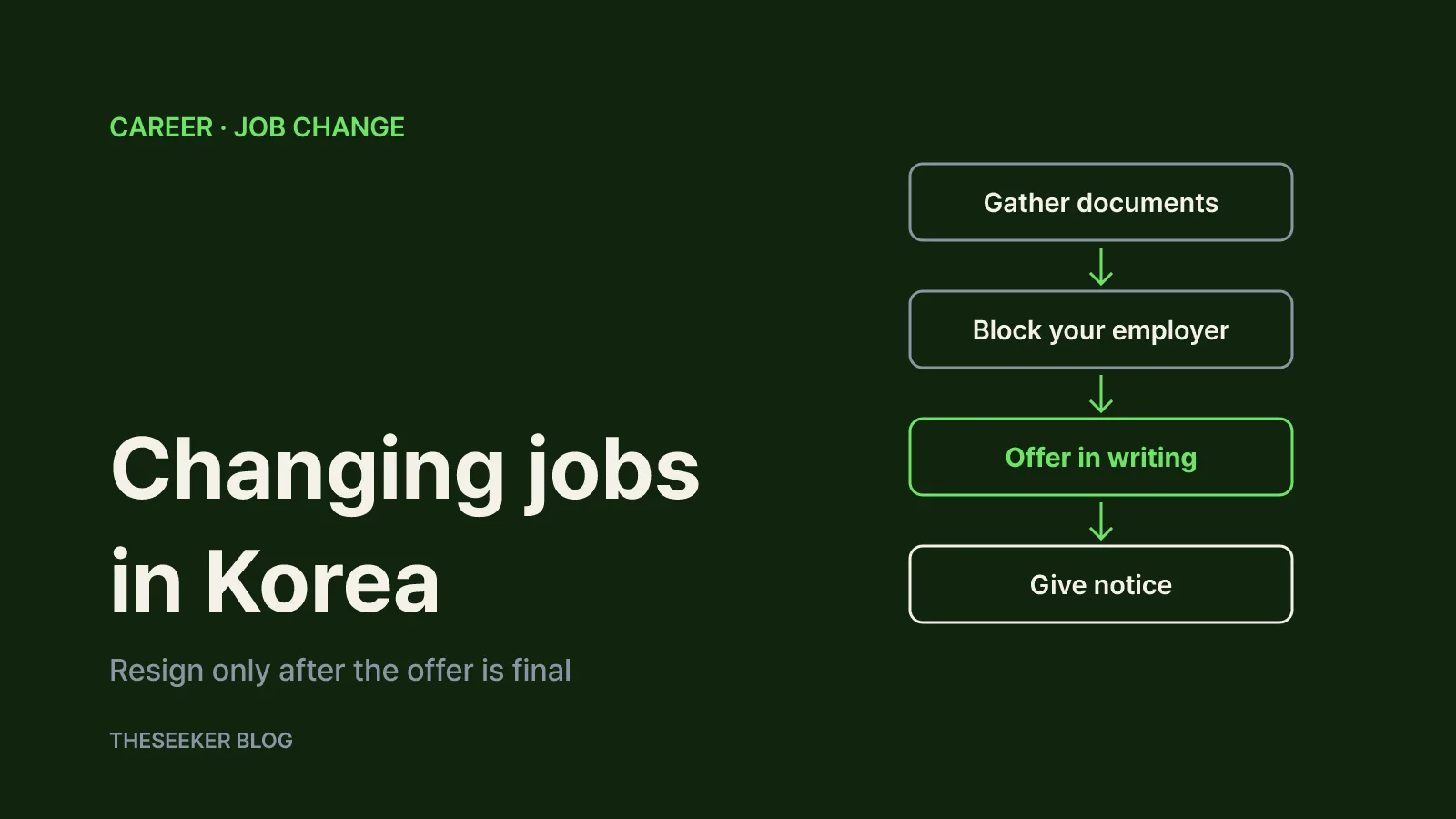
In this post
- A seven-step order for job hunting while employed
- Documents Korean employers commonly request
- Using Korean job sites without alerting your employer
- If your current employer finds out
- When to give notice and when your resignation takes effect
- Final checklist before you resign
- Sources
- Frequently asked questions
As of October 2026, the safest way to change jobs in Korea while you are still employed is to follow a fixed order: clarify your goal, record your experience, set job-site privacy, apply and interview, get the offer in writing, then resign and hand over your work. Tell your current employer only after the new company has confirmed your pay, title and start date in writing. If you resign and your employer neither accepts the resignation nor has a contractual rule on the end date, Korea's Civil Act (Article 660) says the resignation takes effect one month after the employer receives your notice, so plan your start date backwards from that point.
This guide is written for anyone working under a Korean employment contract, including foreign professionals and returning Koreans who are less familiar with local hiring customs. I checked the statutes and official guidance linked below rather than relying on forum advice, and the focus here is the whole process rather than how to word a resume.
A seven-step order for job hunting while employed
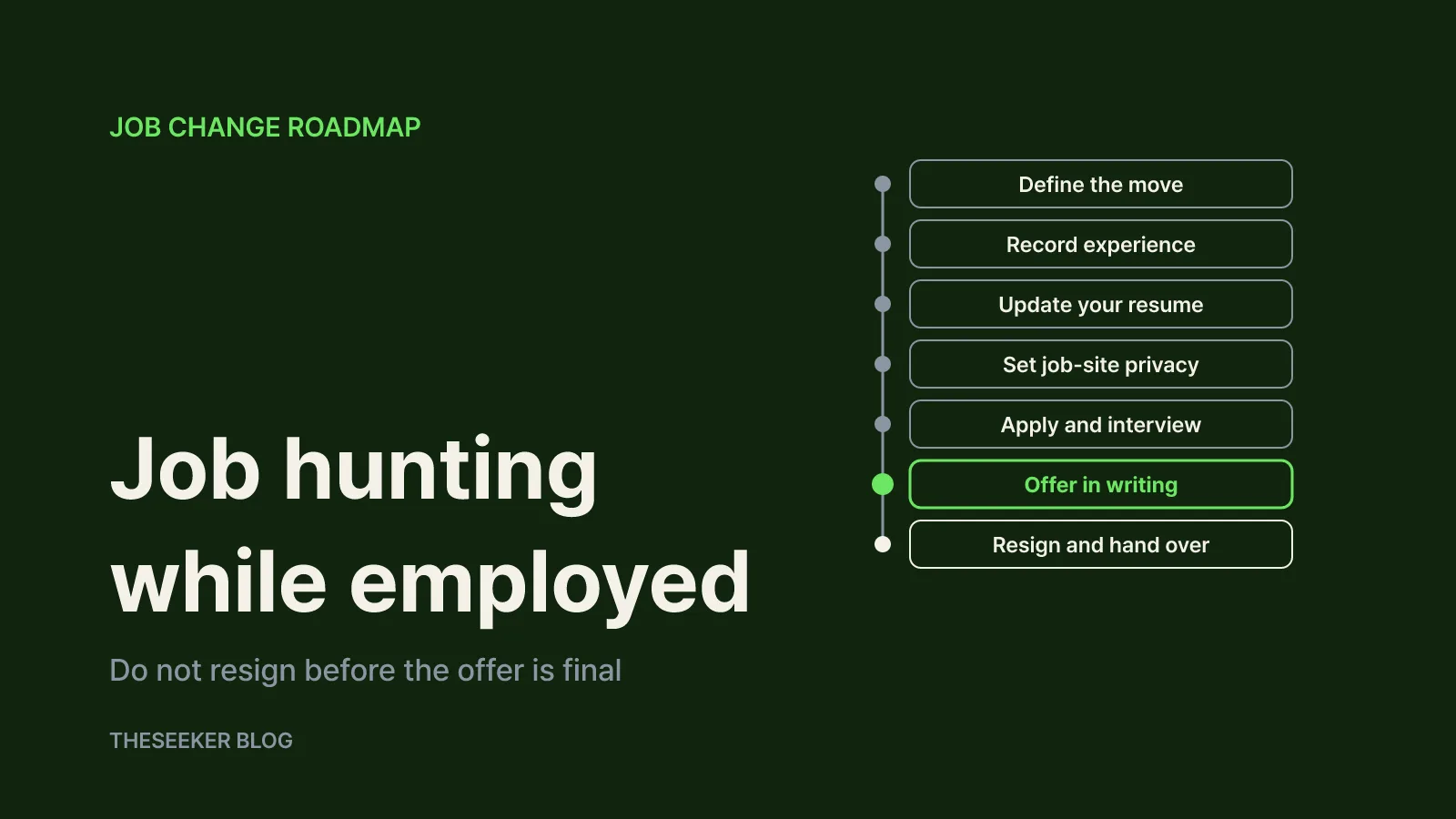
Breaking the process into stages keeps your search from colliding with your current workload.
- Define the move. Write one sentence on why you want to leave, then split your conditions into must-haves (role, salary, work arrangement, location) and negotiables. This lets you decline poor fits quickly.
- Record your experience. List projects, your role and outcomes while they are fresh. Do not copy internal files or client data to personal storage; describe only what you contributed at a level that is safe to share.
- Update your resume and career description. Korean employers often ask for a separate career description (gyeongnyeok gisulseo) alongside the resume. Keep a master version and tailor copies per role.
- Set up job sites before posting anything. Configure visibility and company blocking first, as explained below.
- Apply and interview. Use annual or half-day leave for interviews, and never use your work phone, desk or company email for recruiting conversations.
- Confirm the offer. Get salary, title, start date and any probation terms in writing, such as an offer email or a draft employment contract. A verbal promise is not enough to resign on.
- Resign and wrap up. Inform your employer, agree on a handover plan and a final day, and collect the documents you will need after leaving.
The rule that matters most: do not start step 7 until step 6 is finished. A final-round pass is not a confirmed offer while the start date or package is still being negotiated. If the new employer wants you sooner than your notice period allows, explain when your resignation legally takes effect and how long the handover will take, and ask to adjust the date.
Documents Korean employers commonly request
It helps to group paperwork by when you will be asked for it.
At the application stage you usually submit a resume, a cover letter (jagi sogaeseo), a career description and a portfolio. Use the company's own form if it has one. Korea's Fair Hiring Procedure Act, Article 4-3, bars employers from requiring applicants to state, or collecting as evidence, information unnecessary for the job: physical traits such as appearance, height and weight; birthplace, marital status and assets; and the education, occupation and assets of parents, children and siblings (National Law Information Center). If a form asks for these, it is reasonable to question how they relate to the role.
When your experience is verified, before or just after an offer, you may be asked for proof of employment history:
- Certificate of employment (gyeongnyeok jeungmyeongseo). Under Article 39 of the Labor Standards Act, an employer must promptly issue a truthful certificate covering the period of employment, type of work, position and wages when a worker requests one, even after the worker has left, and the certificate may contain only the items the worker asks for. Breaching this duty can lead to an administrative fine of up to 5 million won (Easy-to-Find Practical Law). In practice, you can ask for a certificate that shows only your dates and duties if you would rather not disclose your previous salary.
- Health insurance eligibility history (jagyeok deuksil hwaginseo). This record from the National Health Insurance Service shows when you gained and lost coverage, so it is often used as supporting evidence of where and when you worked. You can issue it yourself through the NHIS online civil service center by selecting the certificate, checking the history, and printing it or sending it by fax (NHIS guide). Because it does not go through your current HR team, it is convenient to prepare while employed.
- Earned income withholding receipt (wonchen jingsu yeongsujeung). Some employers request it to confirm your previous pay. Ask the recruiter which alternatives they accept and by when.
After you accept, the onboarding list depends on the company. Prepare what the offer email lists rather than collecting every possible certificate in advance. Beyond that, make sure your personal email works and that your digital ID login for government sites is active, since many certificates require it.
Using Korean job sites without alerting your employer
Korean job platforms are also talent databases that HR teams search. If your resume is open to offers, your current employer's recruiters could see it. Check settings in this order: visibility, company blocking, then which contact details are shown.
On Saramin, one of the largest Korean job sites, the official help page says the resume viewing restriction is available only when your resume is set to receive offers (the 'actively looking' or 'open to good positions' settings). Companies you block cannot search for or view your resume, and you can block by company name or by industry (Saramin help). Details worth knowing:
- Your current employer is blocked automatically if it appears in your work history, but only when you selected it from the autocomplete list. If you typed the company name manually, add the block yourself.
- A 'one-shot block' option also blocks other entries registered under the same business registration number, which covers the same company listed under a different name.
- A company that viewed your resume before you set the block may still contact you, so set restrictions before making your resume visible.
- On desktop the path is My Home, then Received Offers, then Resume View Status, then the register-blocked-companies option.
Other Korean sites and headhunting platforms offer similar controls under different names, so read each site's help pages first. Remember that companies you apply to directly receive the documents you submit, whatever your visibility setting. Once you have accepted an offer, switch your resume to private.
If your current employer finds out
Most leaks come from habits, not settings. Avoid company laptops, email and messengers for anything related to your search; assume activity on company networks can be logged. Do not overhaul your professional profiles all at once, and do not tell colleagues before your offer is final. Keep your performance steady, because your last months shape any reference check.
If you are found out, a short, honest acknowledgment usually works better than denial: say nothing is final if that is true, and commit to your current responsibilities. Retaliation is a different matter. Article 40 of the Labor Standards Act prohibits anyone from creating or using secret codes or lists, or communicating, in order to obstruct a worker's employment (Easy-to-Find Practical Law). And according to court rulings summarized by the Ministry of Government Legislation, if an employer tells you to resign or be dismissed and you submit a resignation only because of that pressure, the termination should be treated as a dismissal in substance (Easy-to-Find Practical Law). In that situation, keep dated notes and contact your regional labor office or a legal aid service.
When to give notice and when your resignation takes effect
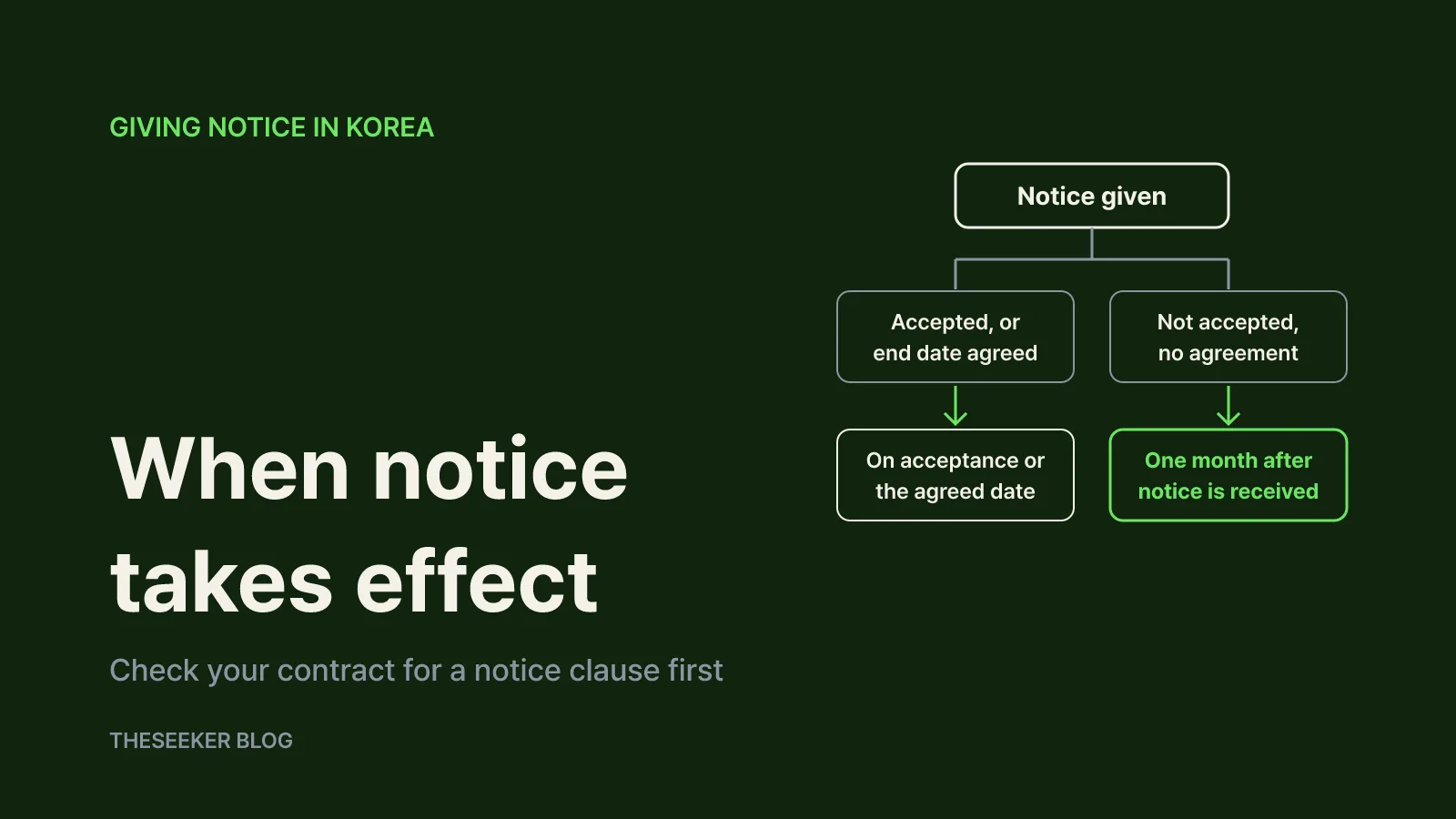
Give notice right after the new offer is confirmed in writing. Earlier, and a collapsed offer leaves you in an awkward spot; later, and your handover is squeezed.
For employment without a fixed term, the government's practical-law service explains that you may give notice at any time, and the resignation takes effect as follows (Easy-to-Find Practical Law):
← Swipe to see more
| Situation | When the resignation takes effect |
|---|---|
| Employer accepts it, or a collective agreement, work rules or contract set the end date | When accepted, or on the agreed date |
| Employer does not accept it and there is no such agreement | One month after the employer receives notice |
| Wages are set per fixed period and paid regularly | After one pay period following the period in which notice was received |
Three practical points follow. First, read your work rules and contract for any notice clause before choosing a last day. Second, deliver notice in a way that leaves a record, such as a dated resignation letter or email, after telling your manager in person, because the date your employer receives notice starts the clock. Third, set your new start date after the latest plausible effective date, and keep working and handing over until then, since the employment relationship continues in the meantime.
Before you leave, confirm who issues certificates of employment and how to request one. You can request it after leaving, but it is easier while you still have direct contacts.
Final checklist before you resign
- Offer terms (pay, title, start date, conditions) received in writing.
- Work rules and contract checked for notice clauses.
- Start date set after your likely effective resignation date plus handover time.
- Job-site visibility and company blocks reviewed, with a plan to go private after accepting.
- Know how to request a certificate of employment and issue your NHIS eligibility history.
- No job-search traces left on company devices or accounts.
- Draft handover document ready.
Following this order keeps the uncertain period short and leaves a good impression at both the company you are leaving and the one you are joining.
Sources
Frequently asked questions
When should I tell my employer in Korea that I am leaving?
After the new company confirms your pay, title and start date in writing. If your employer does not accept the resignation and there is no agreed end date, it takes effect one month after they receive notice, so plan your start date around that and your handover.
Can I ask for a certificate of employment that leaves out my salary?
Yes. Article 39 of the Labor Standards Act says the certificate may contain only the items the worker requests, so you can ask for your employment dates and duties only. You cannot ask for details that are untrue.
Will my current company see my resume on Korean job sites?
It can if your resume is open to offers. Saramin lets you block specific companies when your resume is visible, and blocks your current employer automatically if you chose it from the autocomplete list. Set blocks before making your resume visible.
What if my employer refuses to accept my resignation?
For open-ended employment with no agreed end date, the resignation takes effect one month after the employer receives notice, or after one pay period following the notice period if wages are paid per fixed period. Keep working and complete the handover until then.
How can I prove past employment if my old company is hard to reach?
Your NHIS health insurance eligibility history, which you can issue yourself online, shows when you gained and lost workplace coverage. Ask the recruiter whether they accept it as a substitute.
blog.theseeker.io/en/posts/job-change-preparation-documents-korea
Hannah Price
Hannah covers job searching, the workplace and preparing for professional exams, confirming dates and requirements against notices from the bodies that run them.
Read our editorial standards