EV Efficiency (km/kWh) Explained: Range and Charging Cost
EV efficiency in km/kWh tells you how far a car travels on one kilowatt-hour. Learn the two formulas for range and monthly charging cost, why official and real-world figures differ, and how to compare cars fairly.
 Ryan Mitchell
In this post
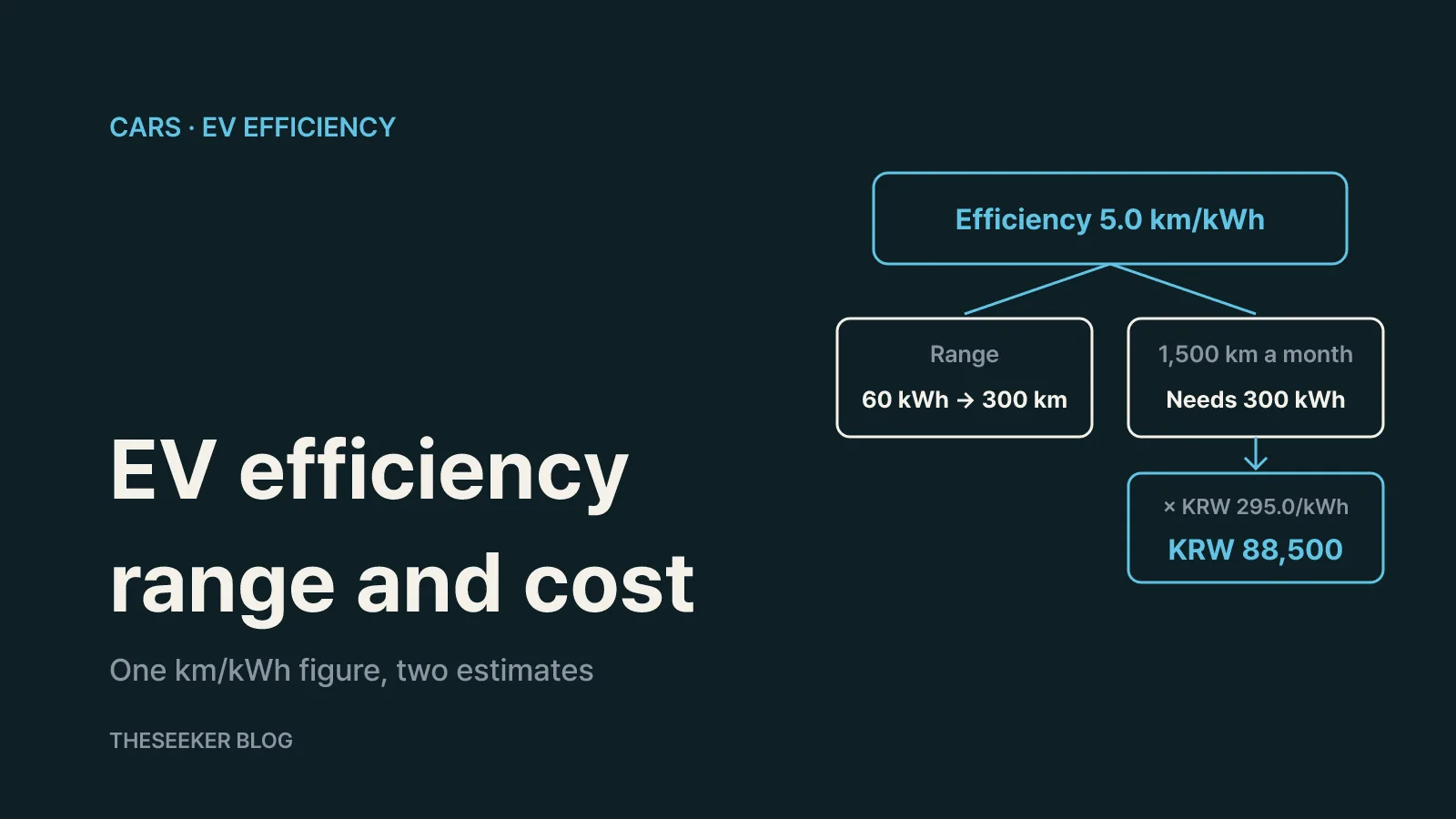
As of October 2026, the short answer is this: EV efficiency in km/kWh is the distance an electric car travels on one kilowatt-hour of electricity, so a higher number is better. Two formulas do most of the work. Range is usable battery capacity (kWh) × efficiency (km/kWh), and monthly charging cost is monthly distance ÷ efficiency × price per kWh. A car rated at 5.0 km/kWh with 60 kWh of usable battery has a theoretical range of 300 km. Drive it 1,500 km in a month and you need 300 kWh; at South Korea's public slow-charging rate of KRW 295.0 per kWh, in force since August 1, 2026, that month costs KRW 88,500.
This guide does not rank specific models. Instead it shows how to turn an efficiency figure into range and cost numbers you can check yourself, how the figure relates to the US label units you may see in reviews, and which conditions to line up before comparing two cars.
What EV efficiency means and how the units convert
Efficiency is the electric equivalent of fuel economy. Where a gasoline car is rated in distance per unit of fuel, an EV in Korea and many other markets is rated in kilometres per kilowatt-hour. The Korea Energy Agency defines an electric car's energy efficiency as the combined figure under the national labelling regulation and expresses it in km/kWh (Korea Energy Agency). The same page lists the minimum efficiency a passenger EV must reach to qualify as an eco-friendly vehicle: 5.0 km/kWh for micro, light and small cars, 4.2 km/kWh for mid-size cars and 3.4 km/kWh for large cars. These are qualifying thresholds, not class averages, but they make useful reference points, so the examples below use all three.
The inverse of efficiency is consumption. Divide 1,000 by the km/kWh figure and you get watt-hours per kilometre: 5.0 km/kWh is 200 Wh/km, 4.2 km/kWh is about 238 Wh/km and 3.4 km/kWh is about 294 Wh/km. US window stickers express consumption as kWh per 100 miles. Because 100 miles is about 160.9 km, you can convert with 160.9 ÷ km/kWh: 5.0 km/kWh is roughly 32.2 kWh/100 mi, 4.2 km/kWh roughly 38.3 kWh/100 mi and 3.4 km/kWh roughly 47.3 kWh/100 mi.
US labels also show MPGe. The US Environmental Protection Agency explains that a gallon of gasoline holds the energy equivalent of 33.7 kWh, so an EV that uses 33.7 kWh to drive 100 miles is rated at 100 MPGe (US EPA). On that basis, 5.0 km/kWh works out to about 105 MPGe. MPGe is handy for comparing an EV with a gasoline car, but for running costs the consumption figure is more direct.
The official US fuel economy site makes the same point: kWh per 100 miles relates directly to the electricity used, and therefore to cost, while distance-per-fuel metrics can exaggerate or hide real savings (fueleconomy.gov). You can see this with km/kWh. Over 1,500 km, a 3.4 km/kWh car needs about 441.2 kWh, a 4.2 km/kWh car about 357.1 kWh and a 5.0 km/kWh car exactly 300 kWh. Both steps are an improvement of 0.8 km/kWh, yet the first saves about 84.0 kWh and the second about 57.1 kWh. When you compare costs, convert to kWh first instead of subtracting efficiency figures.
Why official and real-world efficiency differ
Official figures come from standardised laboratory procedures. According to the EPA, vehicles are tested over five cycles: city, highway, aggressive high-speed driving, a hot test at 95°F with air conditioning and a cold test at 20°F with heating and defrost. For EV range, the car is driven on a dynamometer over repeated city or highway cycles until the battery is depleted. Those lab results are then adjusted for real-world factors such as climate control, cold weather and hard driving. The most common method multiplies the results by 0.7, then weights city range at 55% and highway range at 45%. In the EPA's own example, a 200-mile highway lab result becomes 140 miles on the label.
Charging losses are the second difference. The EPA states that its MPGe values include them, assuming Level 2 AC charging and counting losses in the charging cable and the on-board charger. That moves the measurement from the car to the wall outlet, closer to what owners actually pay for. A dashboard efficiency readout, by contrast, may be calculated from energy drawn from the battery, which can make it look better than an efficiency figure based on the kWh you paid for at the charger. Check your owner's manual to see which basis your car uses.
On the road, more variables apply. The fueleconomy.gov label notes list driving style, maintenance, air conditioning and accessory use, weather, road conditions and vehicle load. For EVs, cabin heating in winter, battery temperature management and aerodynamic drag at steady motorway speeds tend to have the largest effect. Treat the official figure as a like-for-like comparison tool and keep your own record for budgeting.
The most reliable way to measure your real efficiency is to divide the distance driven over a period by the total kWh billed by chargers over the same period. If you drove 1,500 km and your charging receipts add up to 300 kWh, your real efficiency is 5.0 km/kWh, charging losses included. Keeping separate figures for each season makes later estimates far more realistic.
How to estimate range from battery size and efficiency
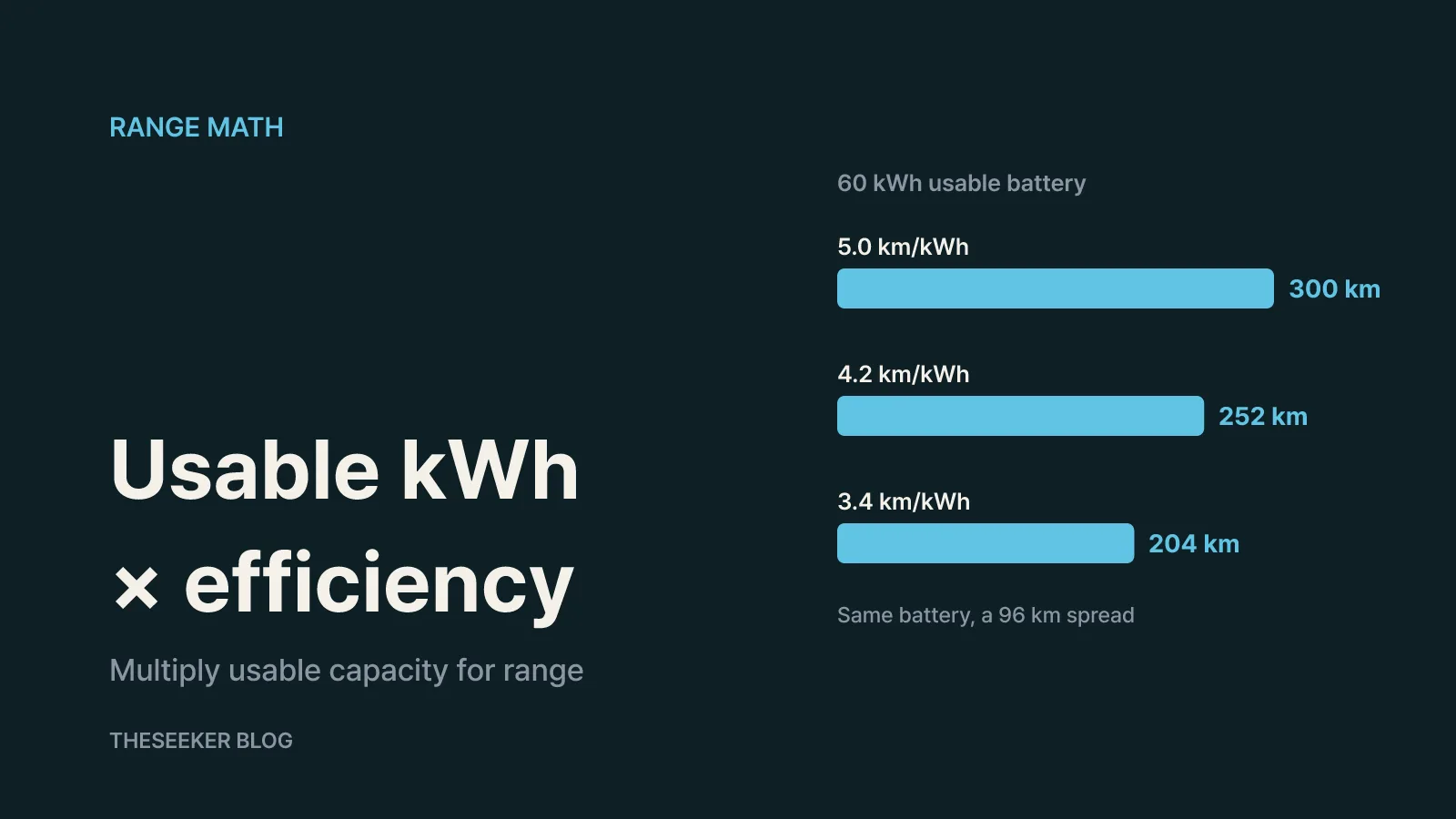
Range is usable capacity multiplied by efficiency. The key word is usable: some batteries keep part of their capacity in reserve to protect longevity, and spec sheets do not always say whether they list gross or usable capacity. Confirm which one you are looking at before you calculate.
With 60 kWh of usable capacity, 5.0 km/kWh gives 300 km, 4.2 km/kWh gives 252 km and 3.4 km/kWh gives 204 km. The same battery yields a 96 km spread purely because of efficiency. A bigger battery adds range but also weight, which can lower efficiency, so always look at the two numbers together.
Few drivers use the full 0 to 100% window day to day. If you normally charge between 10% and 80%, you are using 70% of the pack: 60 kWh × 0.7 = 42 kWh, which at 5.0 km/kWh means about 210 km of comfortable driving per charge. That practical figure is more useful for planning commutes and long trips than the headline range.
The same formula estimates remaining distance: state of charge × usable capacity × recent efficiency. Use recent data when conditions change. If that 60 kWh car drops to 4.0 km/kWh in winter, recalculate full-charge range as 240 km. The range estimate on the dashboard is also based on recent efficiency, which is why it moves when the weather or your driving changes.
How to calculate monthly charging cost
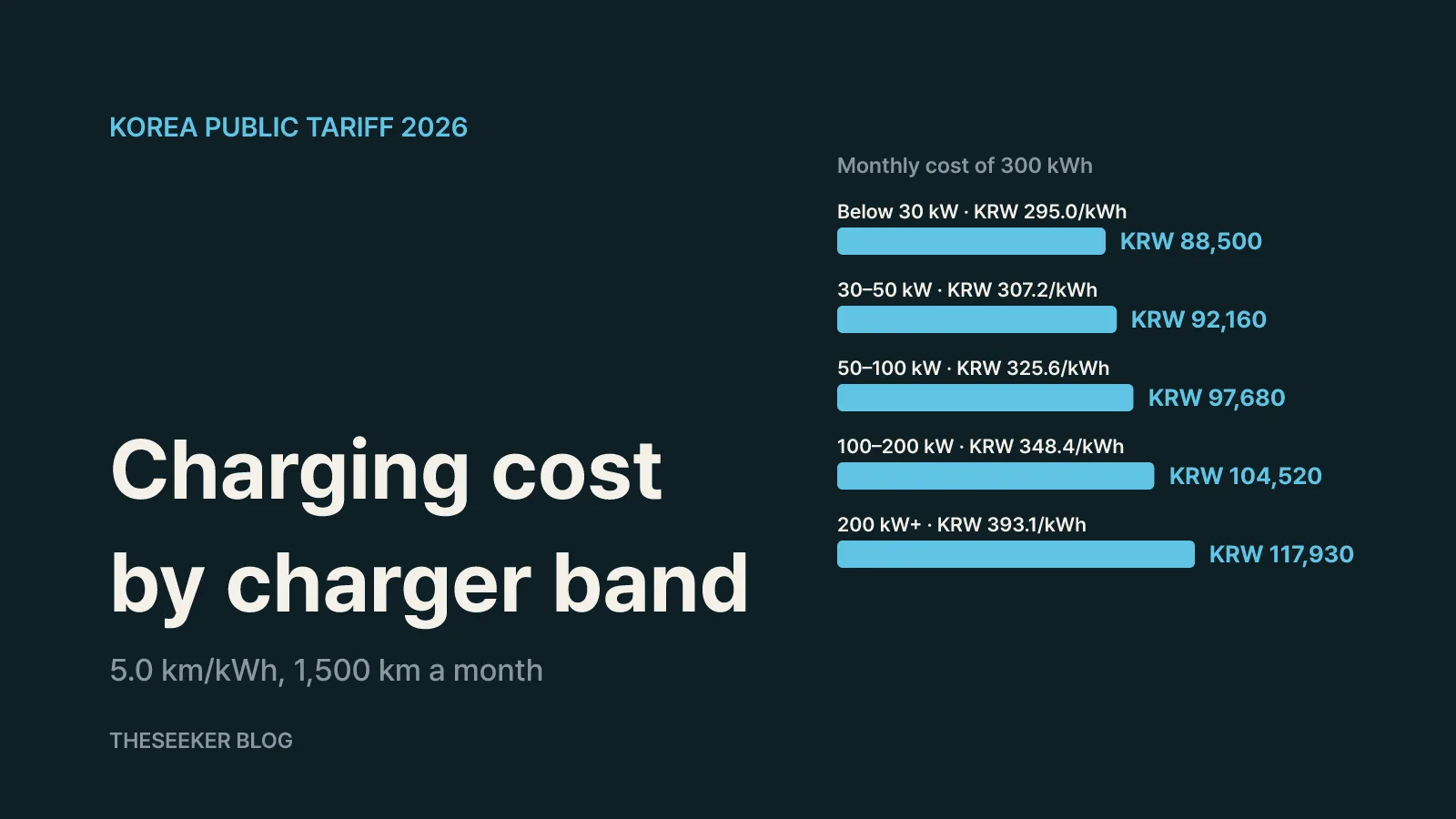
Monthly cost is monthly distance ÷ efficiency × price per kWh. The first part gives the kWh you need; multiply by the price you actually pay. In US terms, the equivalent shortcut is kWh/100 mi × price per kWh = cost per 100 miles. The EPA label example uses an illustrative 12 cents per kWh, so a car at 32.2 kWh/100 mi would cost about $3.86 per 100 miles at that price. Use your own tariff for real budgeting.
For a concrete example with official prices, South Korea's Ministry of Climate, Energy and Environment split its public charging tariff from two bands (KRW 324.4 below 100 kW and KRW 347.2 at 100 kW and above) into five bands from August 1, 2026 (Ministry of Climate, Energy and Environment). Slow chargers below 30 kW, about 90% of all chargers, fell by KRW 29.4 per kWh (about 9.1%), while ultra-fast chargers of 200 kW and above, about 2.3% of chargers, rose by KRW 45.9 (about 13.2%). The full table is published on the government briefing site (Korea.kr). Assuming 1,500 km at 5.0 km/kWh (300 kWh), all charged in one band:
← Swipe to see more
| Charger output | KRW per kWh | Cost of 300 kWh |
|---|---|---|
| Below 30 kW | 295.0 | KRW 88,500 |
| 30 to under 50 kW | 307.2 | KRW 92,160 |
| 50 to under 100 kW | 325.6 | KRW 97,680 |
| 100 to under 200 kW | 348.4 | KRW 104,520 |
| 200 kW and above | 393.1 | KRW 117,930 |
The gap between slow and ultra-fast charging for the same energy is KRW 29,430 a month, so split your estimate by charging habit. If 240 kWh comes from slow charging below 30 kW and 60 kWh from ultra-fast charging at 200 kW and above, the bill is 240 × 295.0 + 60 × 393.1 = KRW 70,800 + KRW 23,586 = KRW 94,386.
These rates apply to chargers run by the ministry and to partner private chargers when paying with the ministry's membership card. Private operators' own prices, apartment chargers and home charging follow their own tariffs, so use the price on your receipt or app. Per 100 km at KRW 295.0, 5.0 km/kWh costs KRW 5,900, 4.2 km/kWh about KRW 7,024 and 3.4 km/kWh about KRW 8,676. Using your real, receipt-based efficiency includes charging losses; a dashboard figure may understate the cost.
A checklist for comparing electric cars by efficiency
Line up the conditions before you compare the numbers:
- Compare like with like. Official combined against official combined, real-world logs against logs from similar conditions. Trims and wheel options can carry separate ratings, so check the exact version you plan to buy.
- Multiply capacity by efficiency for range. Two cars with similar range can get there differently, one with a large battery and lower efficiency, the other with a smaller battery and higher efficiency. The more efficient car usually costs less to charge.
- Price it with your own tariff. Decide which charger bands and payment methods you will mostly use, then split your monthly distance accordingly.
- Allow for winter and motorway driving. Run a second estimate with a lower efficiency figure and check that your regular trips still fit comfortably.
- Read the test conditions in comparison videos. Temperature, average speed, passengers, tyres and climate settings all change results. Do not rank cars tested under different conditions.
Write down your assumptions next to the result, for example 5.0 km/kWh, 1,500 km a month and KRW 295.0 per kWh, so you can redo the maths quickly when prices or your routine change.
Sources
Frequently asked questions
Is a higher km/kWh figure better?
Yes. km/kWh is distance per unit of energy, so higher means more distance from the same electricity. Consumption figures such as Wh/km or kWh/100 mi work the other way: lower is better. Divide 1,000 by km/kWh to get Wh/km.
How do I convert km/kWh to kWh/100 miles?
Divide about 160.9, the number of kilometres in 100 miles, by the km/kWh figure. For example, 5.0 km/kWh is roughly 32.2 kWh/100 mi. To get MPGe, divide 3,370 by the kWh/100 mi figure, based on the EPA's 33.7 kWh per gallon equivalence.
How do I calculate an EV's range?
Multiply usable battery capacity in kWh by efficiency in km/kWh. A 60 kWh usable battery at 5.0 km/kWh gives 300 km. If you normally use only 10% to 80% of the battery, multiply by 0.7 for a practical figure.
What is the formula for monthly EV charging cost?
Monthly distance divided by efficiency, multiplied by your price per kWh. At 1,500 km and 5.0 km/kWh you need 300 kWh; at Korea's public slow-charging rate of KRW 295.0 that is KRW 88,500, and at the 200 kW-plus rate of KRW 393.1 it is KRW 117,930.
Why does my real-world efficiency differ from the official rating?
Official ratings come from lab tests with standard adjustments, such as the EPA's common 0.7 factor. On the road, temperature, heating and cooling, speed, load and road conditions all change consumption, with winter heating and motorway speeds usually having the biggest effect.
blog.theseeker.io/en/posts/ev-efficiency-km-per-kwh-range-charging-cost
Ryan Mitchell
Ryan covers buying, insuring and maintaining a car, checking terms against manufacturer and agency publications so the options are easy to compare.
Read our editorial standards