Youth Leap Account vs Youth Future Savings: Key Differences
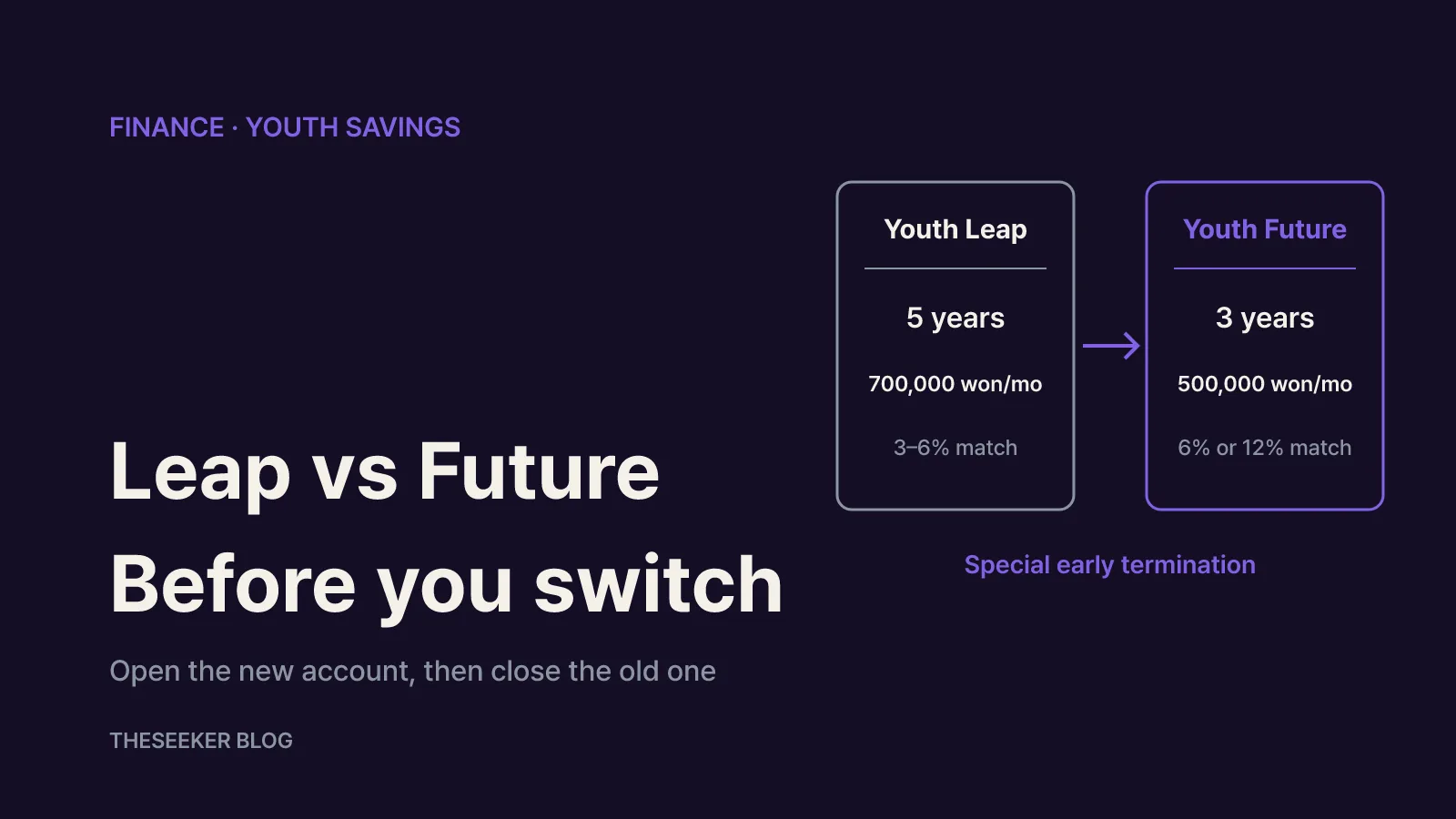
Korea's Youth Leap Account (5 years, up to 700,000 won a month) and Youth Future Savings (3 years, up to 500,000 won) differ in term, matching and eligibility. Here is how they compare and how switching works.
 Ethan Caldwell
In this post
As of October 2026, the short answer is this: Korea's Youth Leap Account (청년도약계좌) is a five-year savings plan that accepts up to 700,000 won a month and adds a government contribution of 3–6% of deposits depending on income, while the newer Youth Future Savings (청년미래적금) runs for three years, caps deposits at 500,000 won a month and matches 6% (general track) or 12% (preferential track). New enrollment in the Youth Leap Account closed in December 2025. Because you cannot hold both, existing Leap Account holders can only move by using a special early termination during an official switching window. The second-round application period ran from October 7 to 16, 2026; applicants who pass screening must finish the switch while accounts can be opened from November 16 to 27.
Everything below is drawn from the Financial Services Commission's September 30 pre-application notice, its September 16 second-round announcement and its June 15 launch guide. These programs are only open to people who meet Korean age, income and tax-record conditions, so treat this as a guide to Korean policy rather than a general savings comparison. Bank-specific bonus rates and exact dates can change, so check the Korean Inclusive Finance Agency's program page and your bank app before you act.
Youth Leap Account vs Youth Future Savings at a glance
The FSC published a side-by-side comparison table in its second-round release. The key rows look like this:
← Swipe to see more
| Feature | Youth Future Savings | Youth Leap Account |
|---|---|---|
| Term | 3 years (36 months) | 5 years |
| Monthly deposit | 1,000 to 500,000 won, flexible | Up to 700,000 won |
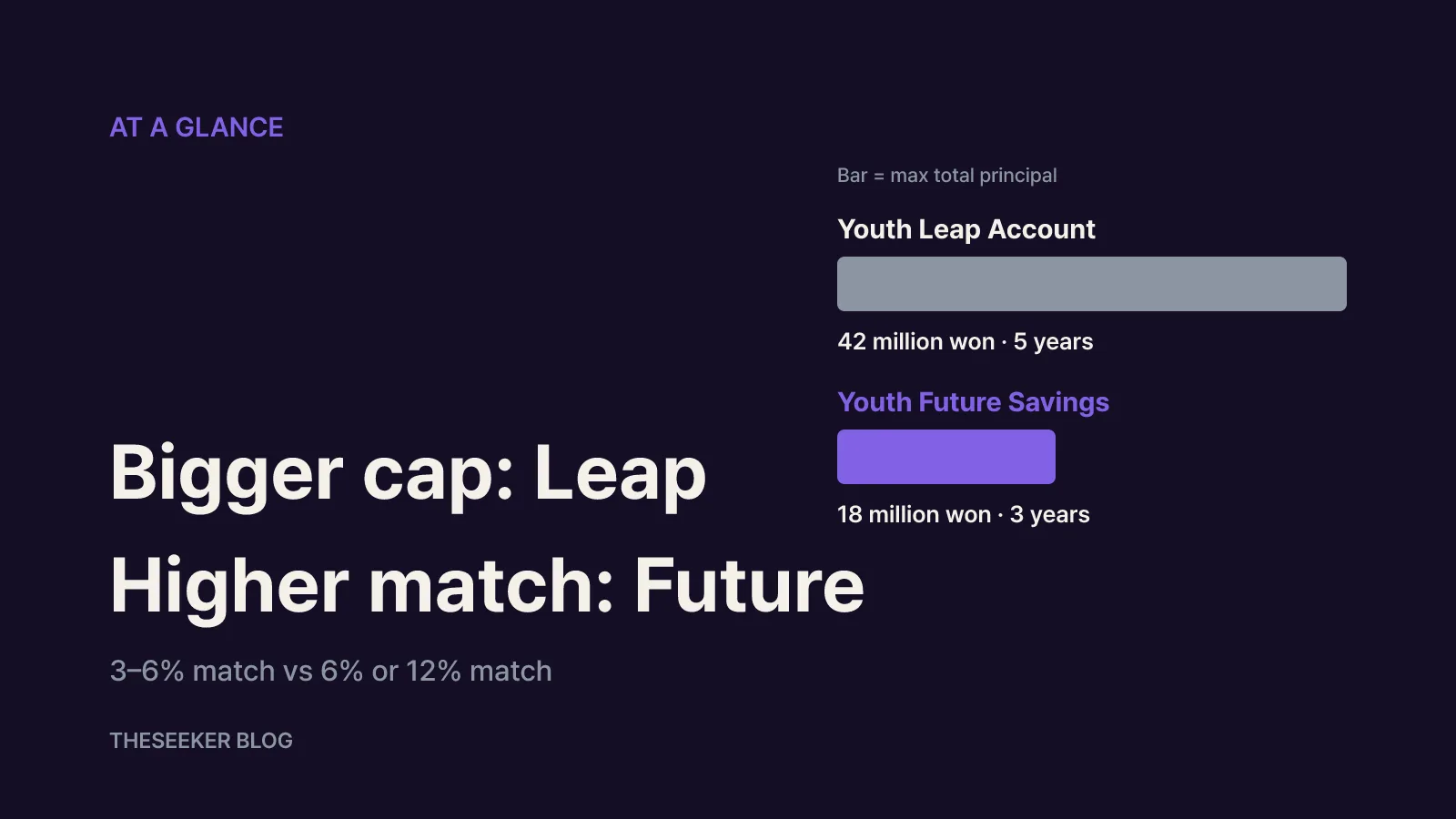
| Maximum total principal | 18 million won | 42 million won |
| Interest rate | Fixed for 3 years: 5% base plus up to 2–3% bank bonus | Fixed for 3 years, then variable for 2 |
| Government matching | 6% general, 12% preferential | 3–6% by income band |
| Interest income tax | Exempt | Exempt |
| FSC maximum equivalent yield (simple) | About 14.4% general, about 19.4% preferential | About 9.2% |
| New enrollment | Twice-yearly rounds (June and October 2026) | Closed December 2025 |
The most practical difference is time. Youth Future Savings locks your money up for three years instead of five, but the monthly ceiling is 200,000 won lower. That is why the maximum principal you can build differs so sharply: 18 million won versus 42 million won. On the other hand, the matching rate per won deposited is designed to be higher in Youth Future Savings.
The "maximum equivalent yield" is the FSC's conversion of matching plus the tax exemption into the rate a regular taxable installment savings account would need to pay. The Youth Future Savings figures assume a bank rate of 7–8%, so if you cannot meet a bank's bonus conditions, the real effect will be lower. In the FSC's own worked example at a 7% rate, a general-track saver who deposits the full 18 million won receives 1.08 million won in matching and 2.02 million won in interest for a maturity payout of 21.10 million won; a preferential-track saver receives 2.16 million won in matching and 2.11 million won in interest for 22.27 million won.
So the useful question is not which product is better in the abstract but which conditions apply to you. If you save more than 500,000 won a month, the deposit cap matters most. If you work at a small or medium-sized company or have a low income, the matching rate matters most.
Who qualifies for Youth Future Savings
Applicants must be aged 19 to 34. Up to six years of completed military service are subtracted from your age. In the second round, eligibility was set by the account-opening dates, covering people born between November 17, 1991 and November 27, 2007.
Two income tests must both be met. First, your 2025 total salary must be 75 million won or less (or 63 million won of comprehensive income), or you must be a small business owner with annual sales of 300 million won or less. Second, your household income must be at or below 200% of the national median. Anyone who was subject to comprehensive taxation on financial income in any of the previous three years is excluded. People whose only income is certain tax-exempt payments, such as parental leave benefits or conscript pay, can still apply.
Within the program, benefits split three ways:
- Tax exemption only: total salary above 60 million won up to 75 million won (comprehensive income above 48 million won up to 63 million won). No government matching.
- General track, 6% matching: total salary of 60 million won or less (48 million won comprehensive income), or small business sales of 300 million won or less, with household income at or below 200% of the median.
- Preferential track, 12% matching: employees of small or medium-sized companies earning 36 million won or less (26 million won comprehensive income) or small business owners with sales of 100 million won or less, with household income at or below 150% of the median; plus new hires at such companies who meet the general-track income test.
Dual-income couples living as a two-person household get looser household thresholds: 250% for the general track and 200% for the preferential track. Preferential-track employees also carry an ongoing condition. According to the launch guide, you must work at a qualifying company for a total of at least 29 months up to one month before maturity, with no more than two job changes. Miss that and the account can be converted to the general track at maturity.
A proposed 2027 budget would open the program to all young adults and raise preferential matching from 12% to 15%, or 25% for those working at small firms outside the capital region. The FSC says existing members would receive the higher preferential rate retroactively if the National Assembly approves it, but this is not yet final, so do not count on it in your planning.
How switching works and the second-round deadlines
The two products cannot be held together, and someone who keeps a Youth Leap Account to its five-year maturity is not eligible for Youth Future Savings. To let existing holders move without losing benefits, the government created a special early termination of the Leap Account for the purpose of joining Youth Future Savings. Switching was first limited to the June–August 2026 launch round, but after continued requests the FSC reopened it for the second round. In an FSC survey of 1,245 Leap Account holders, 54% said they intended to switch.
The order of steps is fixed:
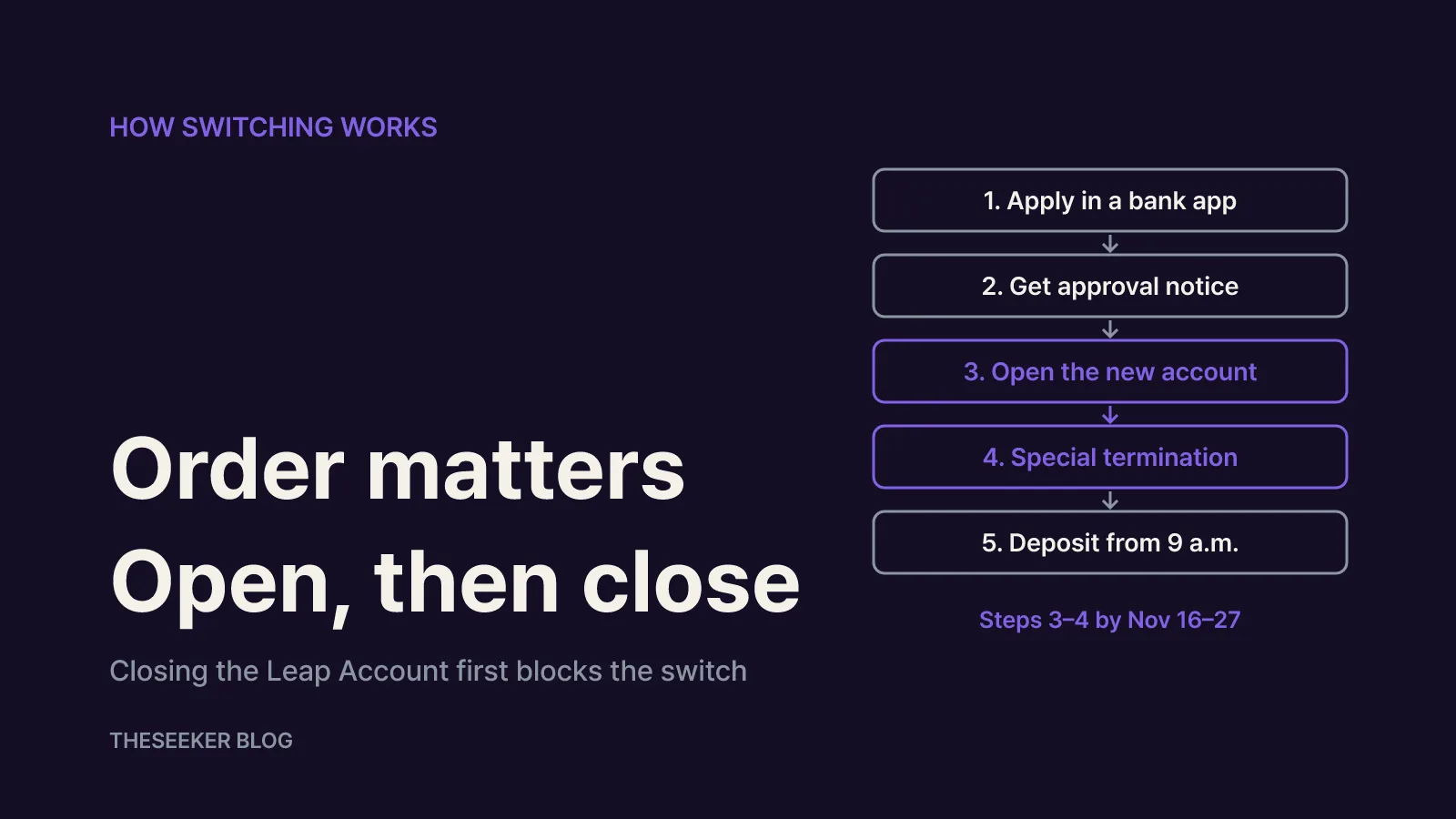
- Apply for Youth Future Savings in a participating bank's app.
- Pass screening and receive an approval notice.
- Open the Youth Future Savings account. Deposits are blocked at this stage.
- In the app of the bank holding your Leap Account, request the special early termination for joining Youth Future Savings. It is processed automatically.
- Start depositing into Youth Future Savings from 9 a.m. on the next business day.
For the second round, the September 30 notice sets screening from October 19 to November 13. Preliminary results are due October 30 to November 2 (provisional), with an appeal window from November 2 to 5 (provisional) if the result differs from the type you selected. Final results arrive November 12–13, and accounts can only be opened from November 16 to 27, excluding weekends.
The critical rule is that the special termination must also be completed within that account-opening window. If you open the new account but do not close the Leap Account, you cannot deposit into Youth Future Savings. Your Leap Account stays as it is, but the suspended Youth Future Savings account must be closed. You can reapply only two months after closing it, and on re-enrollment your matching rate is multiplied by (36 months minus prior enrollment months) divided by 36, with the suspended period counted as enrollment time.
Whether a third round will allow switching has not been announced. The FSC has only said the third round will follow once the 2027 budget is settled and the screening system is updated.
Five checks before you switch
A special early termination preserves the government contributions and the interest tax exemption on what you already deposited in the Leap Account, so you do not lose money on the exit. That does not make switching right for everyone.
1. Do not close the Leap Account first. If you cancel it before opening the Youth Future Savings account, it becomes an ordinary cancellation and the switch is no longer possible. The order is always new account first, then special termination.
2. Plan for the payout. You cannot move the Leap Account refund into Youth Future Savings as a lump sum. The new account is built month by month, up to 500,000 won at a time, so the payout needs its own plan.
3. Check your monthly savings level. If you were putting more than 500,000 won a month into the Leap Account, the amount that earns matching and tax relief shrinks after the switch. Decide where the excess will go.
4. Compare maturity dates. Switching starts a fresh three-year term. If your Leap Account is already close to maturity, your money could end up locked away for longer. Line up both dates against big plans such as a wedding or a rental deposit.
5. Confirm your track and whether you can keep it. Above 60 million won in salary, Youth Future Savings offers no matching, only the tax exemption. If you expect the preferential track, make sure you can meet the 29-month employment rule given any job-change plans, and use the appeal window if the preliminary result surprises you.
Bank bonus rates also differ: the base rate is 5% everywhere, but bonuses run up to 2–3% with different conditions. Compare them on the Korea Federation of Banks consumer portal and choose a bank based only on the conditions you can realistically meet.
What to do now, depending on your situation
If you applied in the second round, watch for the preliminary result around October 30, then complete both the account opening and the special termination between November 16 and 27. Do the termination on the same day you open the account rather than waiting for the last day.
If you missed the second-round application, this switching window has passed. Keep your Leap Account open and watch whether the third-round notice allows switching. Closing the Leap Account early would forfeit the special-termination route.
If you never had a Leap Account, switching does not apply. You can simply consider Youth Future Savings when the next round opens, and eligibility may widen if the 2027 budget passes. Questions can go to the Korean Inclusive Finance Agency youth finance call center (1397, option 3), and switching instructions are sent to eligible holders by KakaoTalk notification.
Sources
Frequently asked questions
Can I hold a Youth Leap Account and Youth Future Savings at the same time?
No. Duplicate enrollment is not allowed, and someone who keeps a Youth Leap Account to its five-year maturity also cannot join Youth Future Savings. The only route is switching through the special early termination.
Will I lose the government contributions from my Youth Leap Account if I switch?
Not if you use the special early termination for joining Youth Future Savings. Contributions on your past deposits and the interest tax exemption are kept. An ordinary cancellation before opening the new account forfeits that route.
Can I deposit my Youth Leap Account payout into Youth Future Savings in one go?
No. Lump-sum transfers of the refund are not supported. Youth Future Savings accepts 1,000 to 500,000 won a month over three years, so you rebuild the balance from scratch.
What happens if I open the new account but miss the special termination?
You cannot deposit into Youth Future Savings, and your Leap Account remains open. The suspended new account must be closed; you can reapply two months later, and your matching rate is reduced by an adjustment ratio on re-enrollment.
Will there be another chance to switch after the second round?
As of October 2026, the FSC has not said whether the third round will allow switching. It plans to run that round after the 2027 budget is approved and the rules are updated, so keep your Leap Account open while you wait.
blog.theseeker.io/en/posts/youth-leap-account-vs-youth-future-savings-switching
Ethan Caldwell
Ethan covers the basics of managing money, from saving and credit to taxes, checking rates and terms against official guidance from banks and government agencies.
Read our editorial standards