How to Verify a Korean Certification: National vs Private
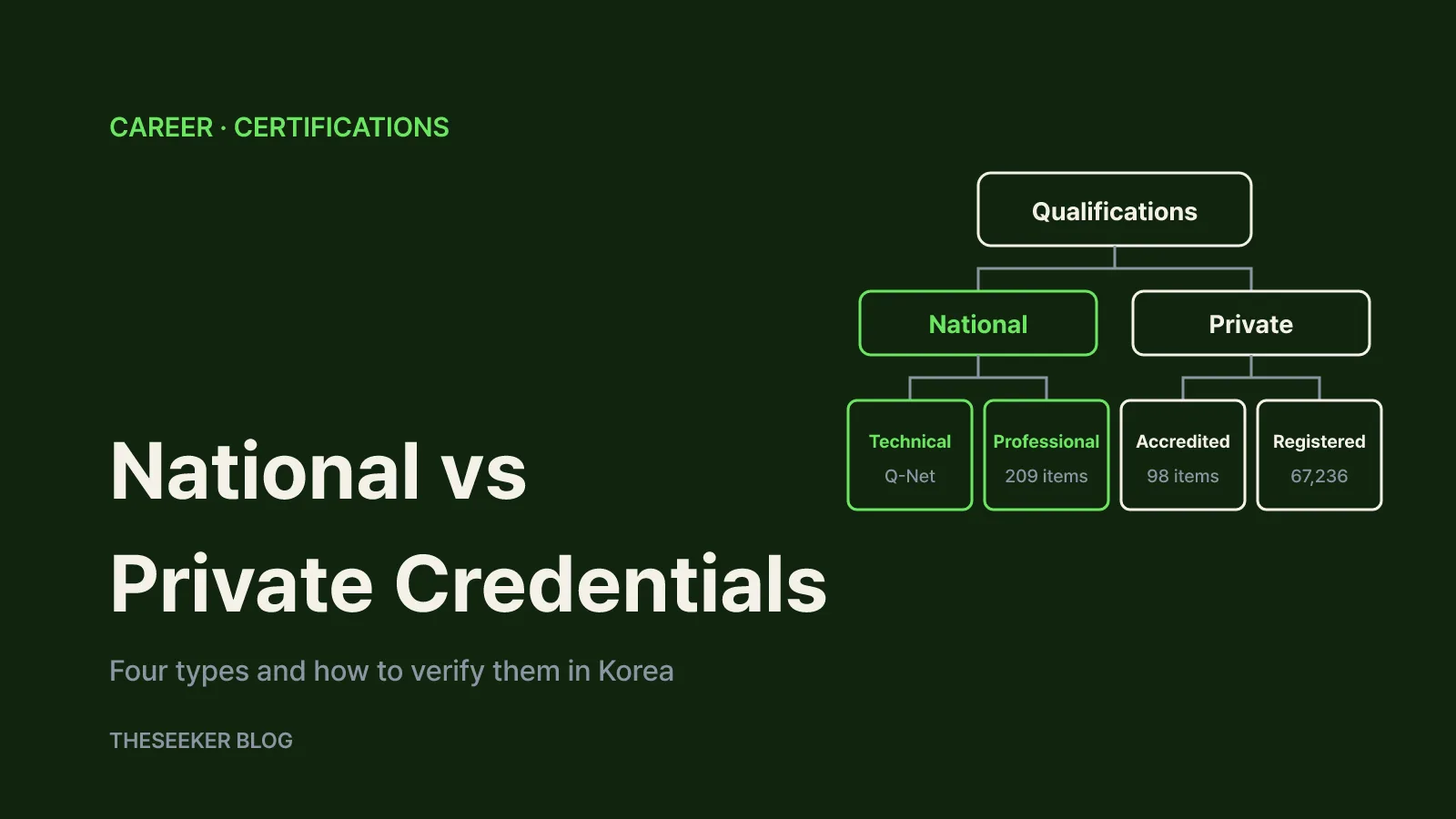
Korea sorts credentials into national technical, national professional, accredited private and registered private qualifications. Here is what each means legally and how to check one on Q-Net and pqi.or.kr.
 Hannah Price
In this post
- The legal split: who creates the credential
- National technical vs national professional qualifications
- Registered vs accredited private qualifications
- How to verify a Korean credential step by step
- What employers can and cannot rely on
- Red flags before paying for a private course
- Sources
- Frequently asked questions
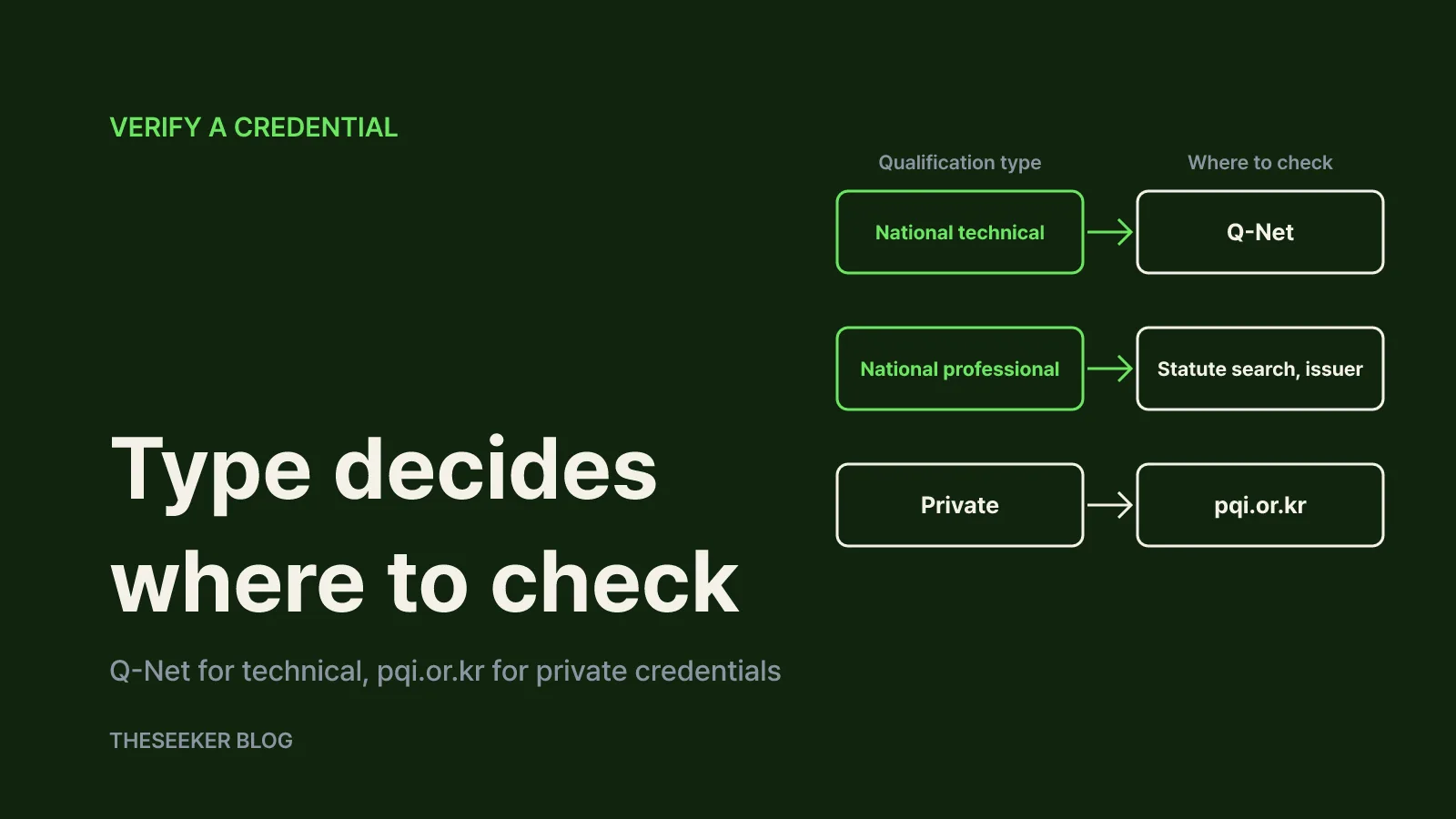
As of October 2026, every Korean credential falls into one of two top-level categories defined by the Framework Act on Qualifications (자격기본법): national qualifications, which the state creates and runs under statute, and private qualifications, which any non-state body (a corporation, an association or an individual) creates and runs. National qualifications split into national technical qualifications, governed by the National Technical Qualifications Act and the Professional Engineers Act, and national professional qualifications created by individual laws such as the Medical Service Act. Private qualifications split into registered private qualifications and a much smaller group of state-accredited private qualifications. You can check which type a certificate belongs to on two public sites: the Private Qualification Information Service at pqi.or.kr, run by the Korea Research Institute for Vocational Education and Training (KRIVET), and Q-Net at q-net.or.kr, run by HRD Korea.
This guide is written for people who need to read a Korean certificate accurately: recruiters screening a candidate, international students or workers planning to sit a Korean exam, and Korean applicants preparing an English résumé. It does not recommend particular certificates. Instead it explains the legal categories and the lookup steps, with figures taken directly from the official statistics pages and dated accordingly.
← Swipe to see more
| Type | Legal basis | Who runs it | Examples | Where to check |
|---|---|---|---|---|
| National technical | National Technical Qualifications Act, Professional Engineers Act | The state | Engineer Information Processing, Civil Engineer, Hairdresser, Vocational Counselor | Q-Net |
| National professional | Individual statutes such as the Medical Service Act | The responsible ministry or its agency | Lawyer, Doctor, Architect, Licensed Real Estate Agent | pqi.or.kr statute search, then the administering body |
| Accredited private | Article 19 of the Framework Act | A corporation, accredited by a minister | Items on the accredited list | pqi.or.kr |
| Registered private | Article 17 of the Framework Act | Corporations, associations or individuals | Items on the registered list | pqi.or.kr |
The legal split: who creates the credential
The first test is simply who created the qualification. Article 2 of the Framework Act on Qualifications defines a national qualification as one "newly established, managed and operated by the State pursuant to statutes," and a private qualification as one established and operated by anyone other than the State. A name that includes "Korea" or "national," or a certificate that looks official, tells you nothing on its own.
The Act also sets out where each type may exist. Article 11 lists fields suited to national qualifications, including those directly tied to life, health and safety, public-interest areas such as defence, policing, education and key industries, and fields where demand is too small for a private body to run a scheme. Article 17 does the reverse for private qualifications, barring them from fields directly connected to life, health, safety and national defence, or to activities other laws prohibit. That is why licensed professions exist only as national qualifications.
Names are protected too. Under Article 14, a private operator may not use the same name as a national qualification, and nobody who has not obtained a national qualification may use its title. When two credentials sound alike, compare the exact name and issuing body character by character.
National technical vs national professional qualifications
The national qualification overview on pqi.or.kr divides national qualifications into those created by individual laws and the national technical qualifications created under the National Technical Qualifications Act and the Professional Engineers Act.
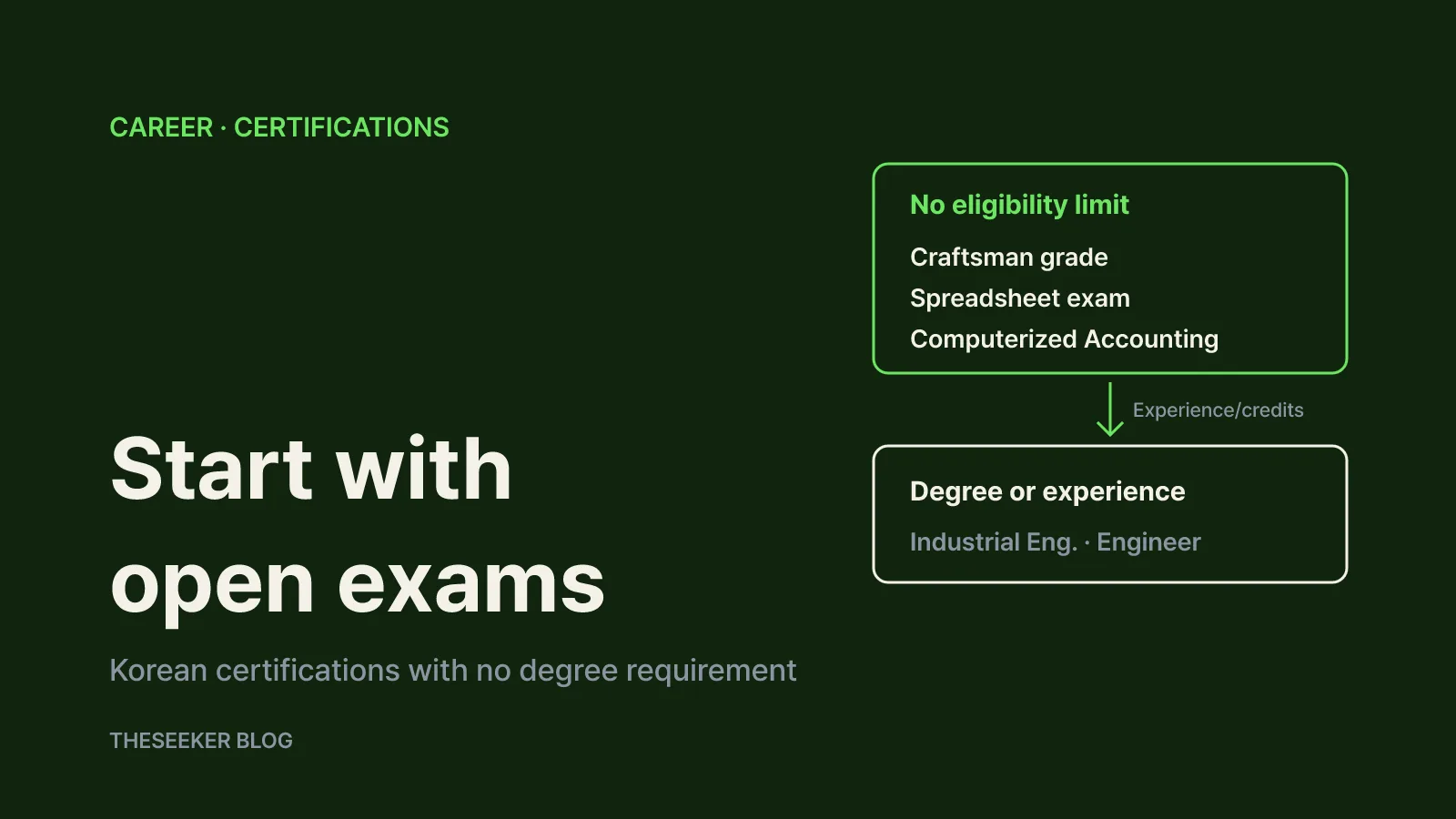
National technical qualifications cover industrial skills and some service occupations. The technical and craft track is graded as Professional Engineer (기술사), Master Craftsman (기능장), Engineer (기사), Industrial Engineer (산업기사) and Craftsman (기능사). Service-sector items include Vocational Counselor, Computerized Accounting Operator and Convention Planner. Exam schedules, item details and holder lookups sit on Q-Net.
National professional qualifications rest on the law that regulates each occupation: the Medical Service Act for doctors, the Attorney-at-Law Act for lawyers, the Licensed Real Estate Agents Act, the Framework Act on Juveniles for youth counselors, and so on. Because each ministry or its agency administers its own scheme, the issuing body differs from one qualification to the next. Q-Net runs exams for some of them, and its professional exam menu links to separate pages for items such as licensed real estate agent, tax accountant, first-grade social worker and administrative agent.
For scale, pqi.or.kr counted 209 national qualifications created by individual laws across 30 ministries as of October 2024. Split by grade or field, that becomes roughly 600 items, and the count excludes national technical qualifications. The Ministry of Health and Welfare has the most with 40, followed by the Ministry of Land, Infrastructure and Transport with 25 and the Ministry of Oceans and Fisheries with 21.
One common confusion: Koreans sometimes call any state credential "nationally accredited." Legally, national technical and national professional qualifications never go through accreditation, because they are national from the start. Accreditation applies only to private qualifications.
Registered vs accredited private qualifications
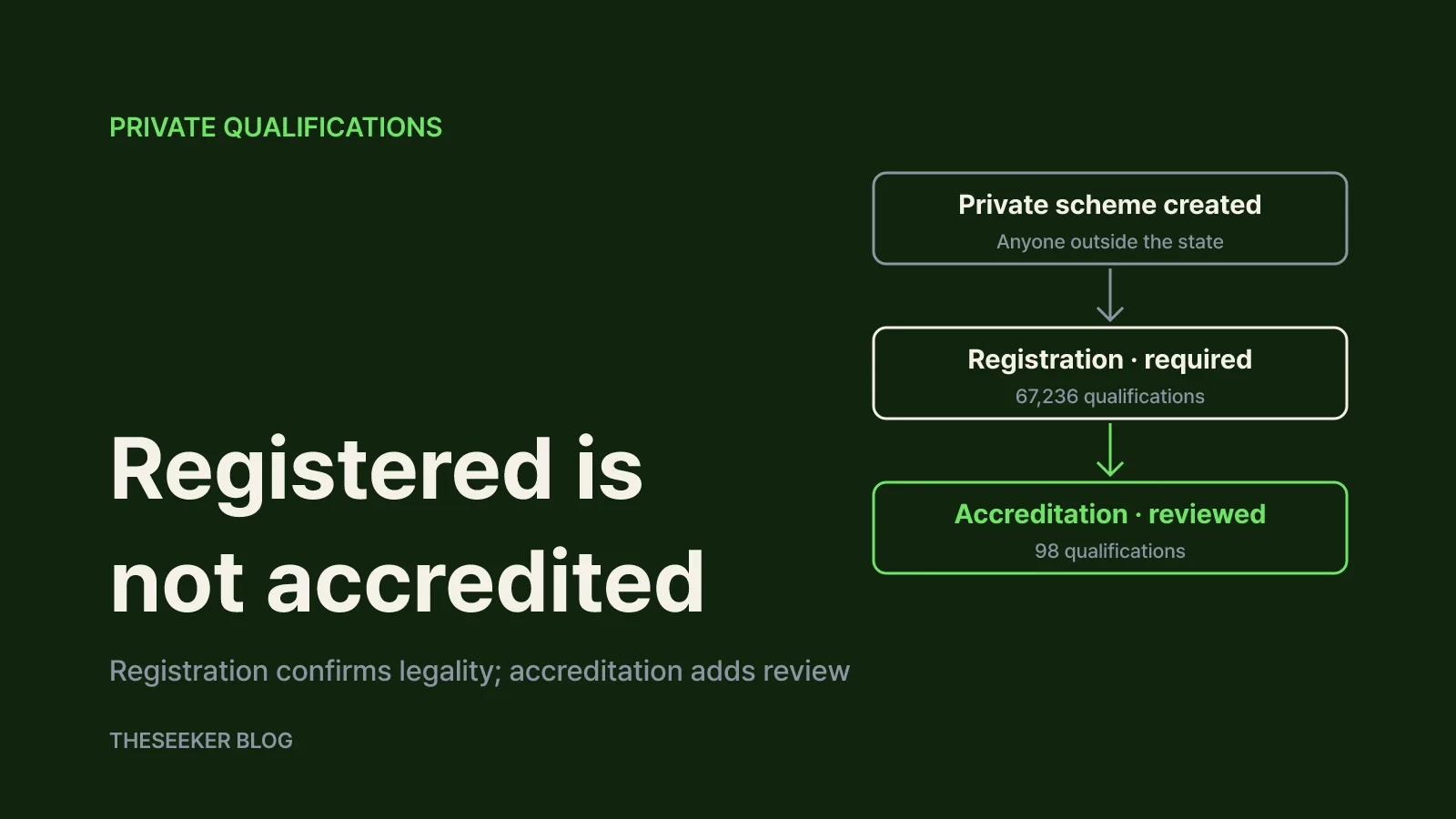
Anyone outside the state may create a private qualification, but it must be registered. Article 17(2) of the Framework Act requires operators to register with the responsible minister, and Article 39 makes running an unregistered scheme punishable by up to three years' imprisonment or a fine of up to 30 million won.
Under the registration system, KRIVET handles applications on the government's behalf. It checks the operator against disqualification grounds, asks the relevant ministry whether the field is prohibited and whether the name can be used, then records the qualification in the register and issues a certificate of registration. The key point is that registration confirms legality, not quality. It does not mean the state has reviewed the exam's difficulty or the training behind it.
Accredited private qualifications are registered ones that passed a further review. According to the accreditation page, a candidate must have run for at least one year with at least three rounds of testing, be operated by a corporation, and be registered, after which the Qualification Policy Council reviews it. Where a related national qualification exists, the testing standard, subjects and eligibility must match it or be comparable. Accreditation lasts up to five years as set by the minister, can be extended once for up to five more years, and can be renewed before it expires (Article 20).
The gap in numbers is large. As of 2 October 2026, the registered private qualification statistics list 67,236 qualifications from 18,656 operators (6,601 corporations and 12,055 individuals or other groups). Since 2008, 89,836 have been registered in total and 22,589 abolished. By contrast, the accredited list held 98 qualifications from 61 operators as of 1 May 2026. The two dates differ, so a precise ratio is not meaningful, but the vast majority of private qualifications are not accredited.
Timing matters as well. Article 21(2) says a private qualification obtained before accreditation generally does not carry accredited status, with limited exceptions for exams or training approved by the minister. Check the accreditation number and the date the holder qualified.
How to verify a Korean credential step by step
Both sites are mainly in Korean, so the menu names below include the Korean labels you will see.
- Collect the details on the certificate or advert. Note the exact name, grade, issuing body and registration or accreditation number. Article 33 requires any advertisement for a qualification to show its type, its registration or accreditation number and its operator, so a legitimate advert should carry these.
- National technical: use Q-Net. Find the item under 자격정보 > 국가자격 종목별 상세정보. Holders can look up their own record under 자격증·확인서 > 자격취득조회, and a certificate you have received can be checked under 자격증 진위확인 (certificate authenticity check).
- National professional: find the statute and administering body. On pqi.or.kr, use 자격정보 > 국가자격 > 개별법 국가자격 검색 to identify the governing law and the body that runs the exam, then follow that body's verification process.
- Private: search pqi.or.kr. Under 자격정보 > 민간자격 > 민간자격 검색(등록/공인), search the qualification name and confirm whether it is registered or accredited and which operator manages it. Make sure the operator matches the one named on the certificate.
- Check whether it still exists. Use 등록폐지자격 검색 (abolished qualification search) and the public notices board. Under Article 18-4, cancellations, suspensions and abolitions must be announced within 20 days.
If nothing comes up, try different spacing or grade wording, then ask the operator for its registration number. Under Article 34, national and accredited operators must keep systematic records of holders, so an accredited operator can be asked to confirm that a person qualified.
What employers can and cannot rely on
Article 30 of the Act allows the state and local governments to favour holders of national or accredited qualifications when granting licences or benefits, and allows employers to favour them in hiring, promotion and transfers. Registered private qualifications are not mentioned. That does not make them worthless, but it marks the boundary of the statutory preference.
Article 23(3) adds that accredited holders receive treatment equal to holders of the corresponding national qualification "as prescribed by other statutes." In other words, accreditation is not an automatic equivalence everywhere; recognition depends on the specific law or the employer's own rules.
Practical points for both sides of a hiring decision:
- Read the posting closely. "Relevant certificates preferred" is broad, while a requirement such as "national technical qualification at Engineer grade or above" is specific and will usually exclude other types.
- Ask before submitting an unlisted private credential. Give the HR team the accreditation status and number so they can decide quickly.
- Licensed roles need the national credential. If a law makes a qualification a condition of doing the job, a private credential cannot stand in for it.
- Label credentials precisely on an English résumé. Use terms such as "national technical qualification," "accredited private qualification" or "registered private qualification," and list the grade, issuer and date.
Red flags before paying for a private course
Private qualifications are often sold together with a training course, so check a few things before paying.
- "Nationally accredited" claims. Articles 22(2) and 33(2) prohibit presenting an unaccredited qualification as accredited on a certificate or in an advert. Confirm that the same item and operator appear in the accredited search.
- "Government registered" wording. A registration number shows the scheme completed registration; it is not a quality endorsement.
- Operator mismatch. The training company and the qualification operator can be different entities. Make sure the body issuing the certificate matches the search result.
- Abolition history. Registrations are abolished every year; in 2025 alone, 2,721 were abolished. Once an operator drops a qualification, reissue or verification may become difficult.
- Cost breakdown. Get the course fee, exam fee, certificate fee and refund terms in writing before you sign.
- Where to raise problems. pqi.or.kr has a consumer damage consultation board under its participation menu.
Before choosing any Korean certificate, answer two questions: which of the four types it belongs to, and whether the employer or authority you care about recognises that type. Those two checks save the most time and money.
Sources
Frequently asked questions
Is a "nationally accredited" certificate the same as a national qualification in Korea?
No. National qualifications are created by the state under statute. An accredited private qualification is created by a private corporation and later accredited by a minister under Article 19 of the Framework Act on Qualifications. There were 98 accredited private qualifications as of 1 May 2026.
How can I check whether a Korean private qualification is registered?
Search the qualification name on pqi.or.kr under 자격정보 > 민간자격 > 민간자격 검색(등록/공인). The result shows whether it is registered or accredited and which operator runs it. Use the abolished qualification search for schemes that no longer exist.
Can an employer verify a Korean national technical qualification?
Yes. Q-Net offers a certificate authenticity check (자격증 진위확인) and confirmation documents under its 자격증·확인서 menu. For national professional qualifications, contact the body that administers that exam.
Do registered private qualifications have any legal standing?
They are lawful credentials, and running an unregistered scheme is an offence. However, the statutory preference in Article 30 for hiring and licensing covers only national and accredited qualifications, so recognition of a registered credential depends on the employer.
blog.theseeker.io/en/posts/national-vs-private-certification-korea-verify
Hannah Price
Hannah covers job searching, the workplace and preparing for professional exams, confirming dates and requirements against notices from the bodies that run them.
Read our editorial standards