EV Battery Types: LFP vs NMC vs LMR Compared
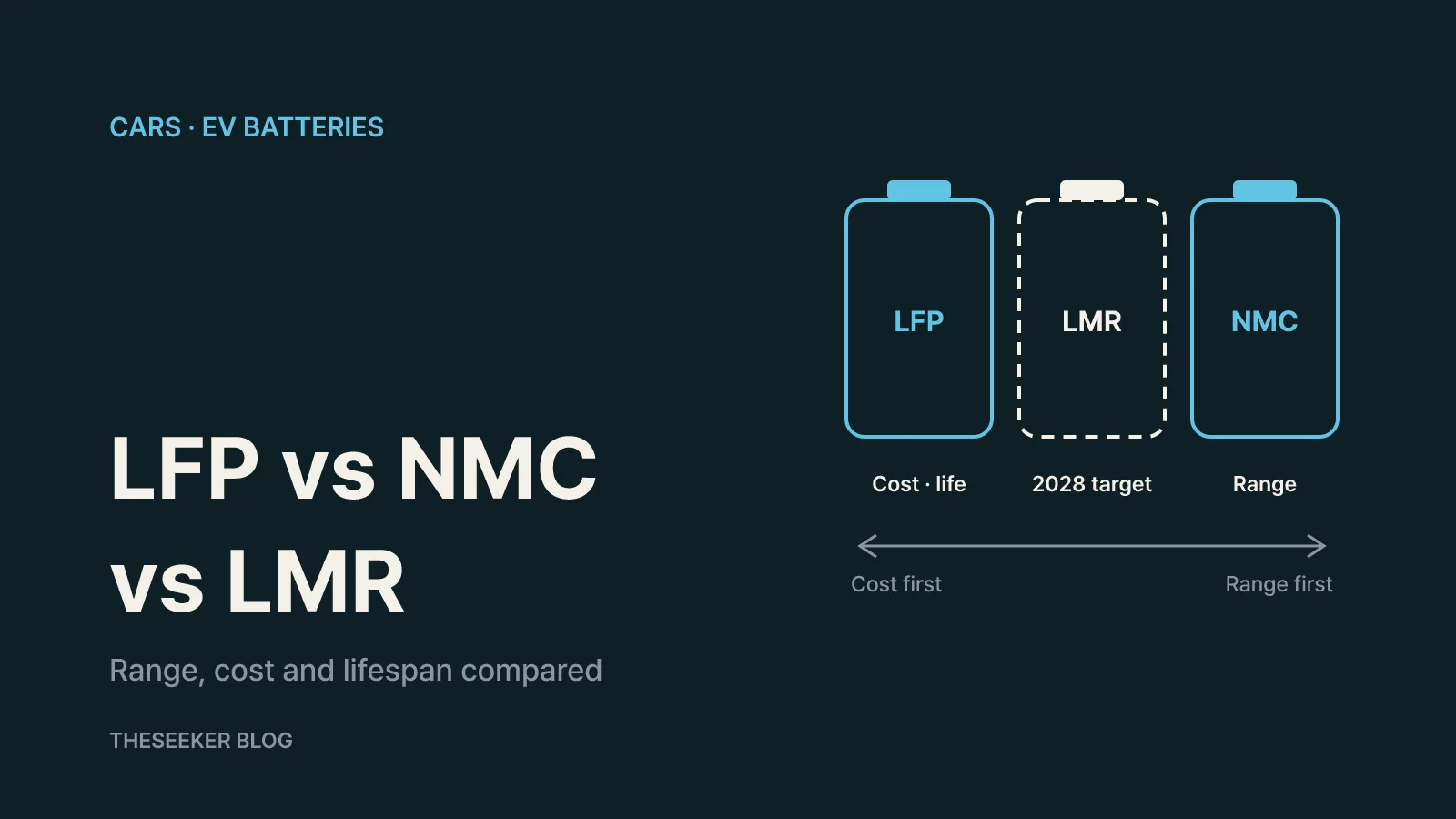
LFP trades range for lower cost and durability, NMC packs more energy for longer range, and LMR aims to sit in between. Here is how to compare them and find out which one a car actually uses.
 Ryan Mitchell
In this post
As of October 2026, the short answer is this. LFP (lithium iron phosphate) batteries cost less and are known for durability, but they store less energy for their size and weight. NMC (nickel manganese cobalt) batteries, especially high-nickel versions, store more energy and make long range easier, at a higher material cost. LMR (lithium manganese-rich) is a next-generation chemistry that aims to combine near-LFP cost with more energy than LFP, but based on the official announcements I checked, it is not yet in production vehicles. If you are buying an EV now, the certified range, cold-weather range and battery warranty of the specific car matter more than the chemistry label alone.
LMR has been getting a lot of attention lately, with headlines suggesting it will make electric cars dramatically cheaper. The direction is plausible, but the timeline and savings are manufacturer targets. Below, I break down how the three chemistries differ on range, cost, lifespan and charging habits, then show how to confirm which battery a car uses before you sign.
LFP, NMC and LMR are cathode chemistries
The letters on an EV spec sheet describe the cathode, the electrode whose metal mix largely sets a lithium-ion cell's energy, cost and stability. They do not tell you the cell format (prismatic, pouch or cylindrical) or who made the cell. Two NMC packs can also perform quite differently depending on the exact metal ratio, cell design and pack engineering, so the label is a starting point rather than a verdict.
The Pacific Northwest National Laboratory, part of the U.S. Department of Energy network, notes that lithium-ion covers a wide range of chemistries and singles out NMC and LFP as two of the most commonly used, from electric vehicles to grid storage (PNNL). In practice, these two families dominate today's EVs.
- NMC (often written NCM in Korea): a nickel, manganese and cobalt cathode. Close relatives such as NCA and NMCA, which add aluminum, belong to the same nickel-based family. More nickel generally means more energy in the same space.
- LFP: an iron phosphate cathode with no nickel or cobalt, which keeps material costs lower.
- LMR: a cathode with a much higher share of manganese, less nickel and almost no cobalt, designed to cut cost while beating LFP on energy density.
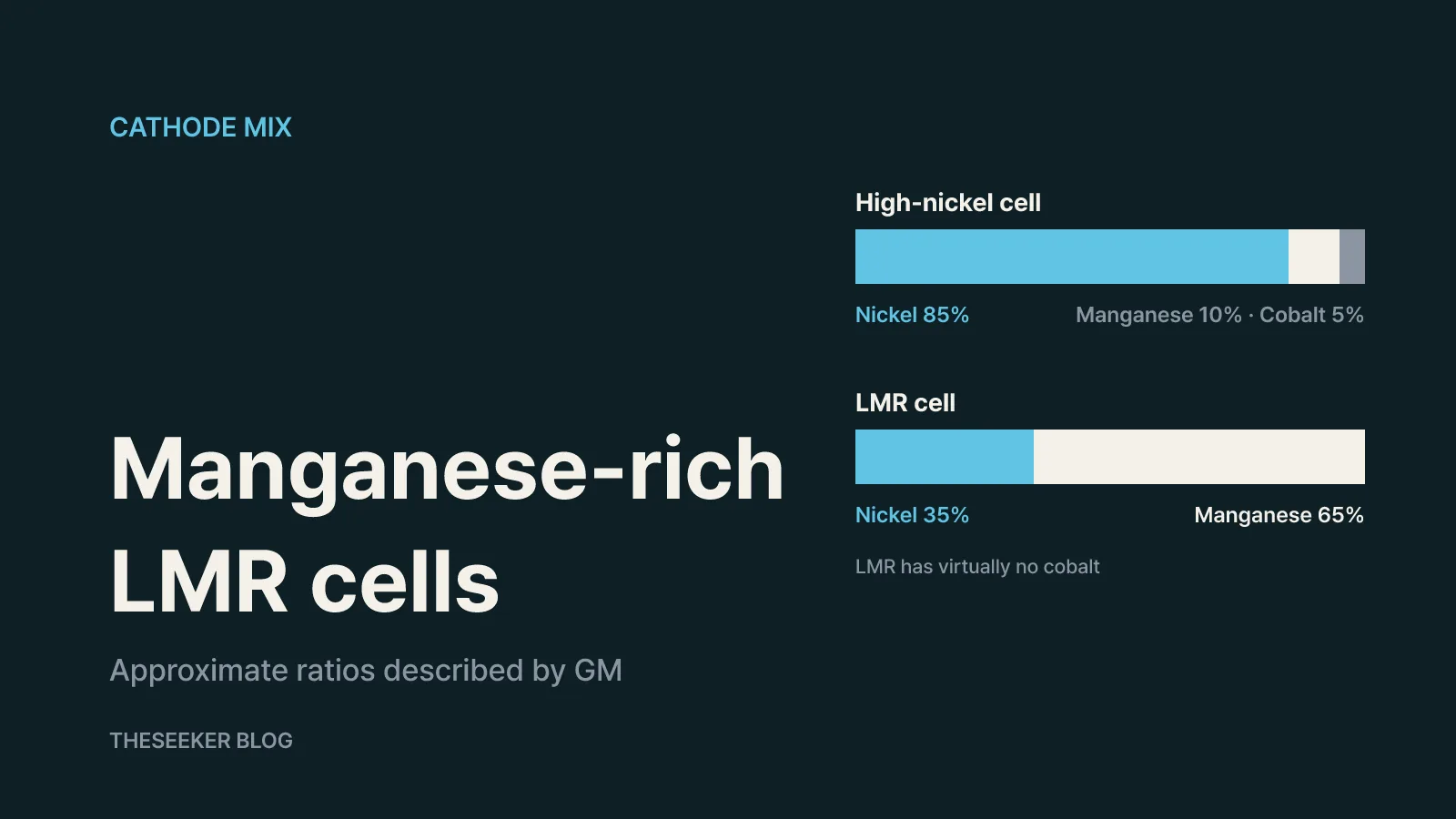
According to GM, a typical high-nickel cell is roughly 85% nickel, 10% manganese and 5% cobalt, while its LMR cells are around 35% nickel and 65% manganese with virtually no cobalt. GM's argument is simple: manganese is cheaper and more plentiful than either nickel or cobalt (GM News).
LFP vs NMC: range, cost and lifespan
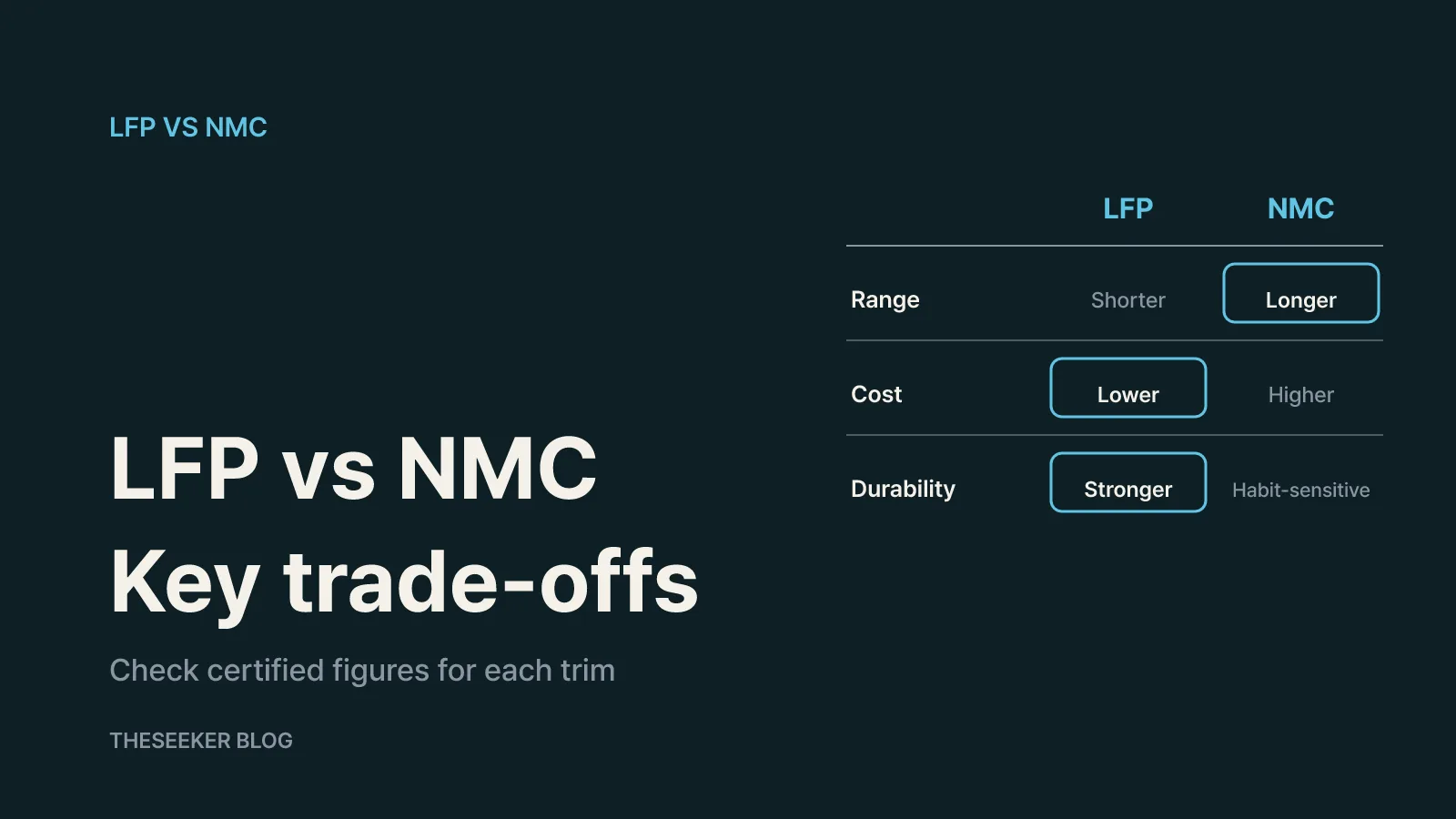
For drivers, the differences show up in three places: how far the car goes on a charge, how much the battery adds to the sticker price, and how well it holds up over years of use. The points below are general tendencies of each chemistry; always check the certified figures for the exact trim you are considering.
Range and energy density. High-nickel NMC fits more energy into the same weight and volume, which is why it shows up in long-range trims, large SUVs and pickups. GM uses high-nickel NMCA in its current electric trucks and SUVs, and says the Chevrolet Silverado EV Work Truck with Max Range is EPA-rated at 492 miles on a full charge. LFP stores less energy per pound and per liter, so matching the same range usually takes a bigger, heavier pack. That is why LFP often appears in smaller cars, city-focused models and standard-range trims.
Cost. GM describes LFP as another popular lower-cost EV battery chemistry. Skipping nickel and cobalt reduces exposure to those volatile materials, which is one reason standard-range LFP trims are often priced below long-range NMC trims of the same model. The battery is not the only factor, though; motors, equipment, incentives and pricing strategy all feed into the final price.
Lifespan and stability. LFP is widely regarded as tolerant of repeated charge cycles and thermally stable. NMC packs a lot of energy and tends to be more sensitive to habits such as routinely charging to the top. Real-world longevity, however, depends heavily on cell design, cooling and the battery management system. The most dependable comparison point for a buyer is the battery warranty: years, miles and the minimum capacity retention it guarantees.
In short: if you mostly commute and can charge at home or work, LFP's lower range is rarely a problem. If you regularly drive long highway stretches or live where fast chargers are sparse, a longer-range NMC trim in the same class may be the easier car to live with.
What LMR batteries are and when they arrive
LMR is not a new idea. GM says researchers have studied manganese-rich cathodes since the 1990s, but short battery life and voltage decay kept them impractical. When GM published its explainer in May 2025, it stated that there were no EVs with LMR batteries on the road (GM News).
Here is what GM and LG Energy Solution have announced:
- Production timing: Ultium Cells, the companies' joint venture, plans to start commercial production of LMR prismatic cells in the U.S. in 2028, for future GM electric trucks and full-size SUVs.
- Energy density: GM estimates its LMR cells will deliver 33% more energy density than LFP at a comparable cost.
- Range and cost targets: more than 400 miles of range in an electric truck, with significant pack cost savings compared with today's high-nickel pack.
- Durability fix: proprietary dopants, coatings, particle engineering and process changes are meant to stabilize the cells so they match the lifespan of current high-nickel cells. GM says that by the end of 2024 it had tested hundreds of large prismatic cells across 18 prototype varieties and 3 cell sizes, to the equivalent of 1.4 million miles of EV driving.
- Cell format: prismatic cells instead of pouch cells, which GM says cut battery module components by 75% and total pack components by 50%.
- Patents: LG Energy Solution holds more than 200 LMR-related patents worldwide.
Keep in mind that these are manufacturer targets and internal test results, not independent long-term field data, and the first applications are large trucks and SUVs. It is a stretch to assume LMR will make small, affordable EVs cheaper next year. For someone shopping in late 2026, LMR is better seen as a factor that could reshape range and pricing in large EVs after 2028 than as an option on today's order sheet.
Charging habits and cold-weather range
Chemistry also affects how you should charge. Many automakers recommend setting a daily charge limit below 100% for nickel-based packs, while some give different guidance for LFP-equipped vehicles. Because recommendations vary by brand, model and software version, the safest rule is to follow the chemistry-specific charging advice in your own owner's manual rather than habits borrowed from another car.
Cold weather reduces the efficiency of every lithium-ion battery. Beyond chemistry, cabin heating, whether the car has a heat pump and whether it can precondition the battery all shape winter range. GM's own EPA range footnote points out that actual range varies with ambient temperature, terrain, battery age and condition, loading, and how you drive and maintain the vehicle. LFP is often said to be weaker in the cold, but how much that matters depends a great deal on the car's thermal management.
So rather than guessing from the chemistry, look for cold-weather range data for the specific model: independent winter tests, manufacturer guidance or, in markets that publish them, separate cold-temperature range ratings. A small gap between mild-weather and cold-weather range is the clearest sign of a car that copes well with winter.
How to check which battery a car uses
Battery chemistry used to be surprisingly hard to find. Regulators are starting to change that. In South Korea, for example, the transport ministry proposed rules in September 2024, as part of an EV fire-safety package, requiring makers and importers to tell buyers the battery capacity, rated voltage and maximum output, plus the cell manufacturer, cell format and main materials, and to show this information on the vehicle registration certificate (Korea Policy Briefing). "Main materials" is exactly where LFP or NMC would be listed.
Wherever you live, this checklist covers the bases:
- Manufacturer spec sheet and price list: battery capacity in kWh and chemistry can differ by trim, even under the same model name.
- Dealer documentation: ask for the cell maker, format and chemistry in writing, and make sure the exact trim is on the quote or contract.
- Registration or vehicle documents: where battery details are printed, compare them with what you were told.
- In-car menus and the owner's manual: some vehicles display the battery type in a software information screen, and manuals often include chemistry-specific charging guidance.
- Battery warranty: compare years, mileage and guaranteed capacity retention across trims.
Matching a battery to how you drive
The chemistry label becomes useful once you map it to your own routine. Work through these questions:
- How far do you drive on a typical day? If most days use less than half of the rated range, LFP's shorter range is unlikely to bother you.
- Can you charge at home or work? Regular Level 2 charging shrinks the benefit of a big battery and makes purchase price and running costs more important.
- Do you take frequent long highway trips? Prioritize range and DC fast-charging performance within the same class; a long-range NMC trim often wins here.
- Do you live with long winters? Check cold-weather range, heat pump availability and battery preconditioning before worrying about chemistry.
- How long will you keep the car? The longer the ownership, the more the battery warranty and good charging habits matter.
- Should you wait for LMR? Under the announced plans, it arrives first in large GM trucks and SUVs from 2028. If you need a car now, there is little reason to hold out.
There is no single best battery. The best choice is the car whose certified range, winter performance and warranty fit your driving within your budget. Treat the LFP or NMC label as a clue, and let the range rating and the warranty document make the final call.
Sources
Frequently asked questions
Is an LFP battery worse than NMC?
Not worse, just different. LFP usually costs less and tolerates repeated charging well, but stores less energy for its size. If your daily driving is short and you can charge often, its lower range rarely matters.
When will LMR battery EVs be available?
GM and LG Energy Solution plan to begin commercial production of LMR prismatic cells in the U.S. in 2028 for future GM electric trucks and full-size SUVs. Timelines for other vehicle classes or markets have not been announced.
How do I find out which battery chemistry my EV has?
Check the manufacturer's spec sheet for your trim, ask the dealer for the cell maker and chemistry in writing, and look at the software information screen and owner's manual. Some countries, such as South Korea, have moved to require this information at sale.
Which battery type is better in cold weather?
Every lithium-ion battery loses efficiency in the cold. Heat pumps and battery preconditioning often matter as much as chemistry, so compare cold-weather range data for the exact model you are considering.
Can I charge an LFP car to 100% every day?
Recommended charge limits vary by manufacturer and model, and some brands give LFP vehicles separate guidance. Follow the chemistry-specific advice in your owner's manual.
blog.theseeker.io/en/posts/ev-battery-types-lfp-ncm-lmr-comparison
Ryan Mitchell
Ryan covers buying, insuring and maintaining a car, checking terms against manufacturer and agency publications so the options are easy to compare.
Read our editorial standards