Super Cub and Scooter Oil Change Intervals Explained
Honda's Japanese schedule puts air-cooled small bikes like the Super Cub on a first oil change at 1,000 km or one month, then every 3,000 km or one year. Here is how scooters differ and how to check the level.
 Ryan Mitchell
In this post
- Super Cub oil change interval: 1,000 km first, then 3,000 km or one year
- How engine type changes the schedule
- Why scooters differ, including the oil grade
- Delivery work, short trips and storage
- How to check the oil level on the dipstick
- Keep a record and know what to ask the shop
- Sources
- Frequently asked questions
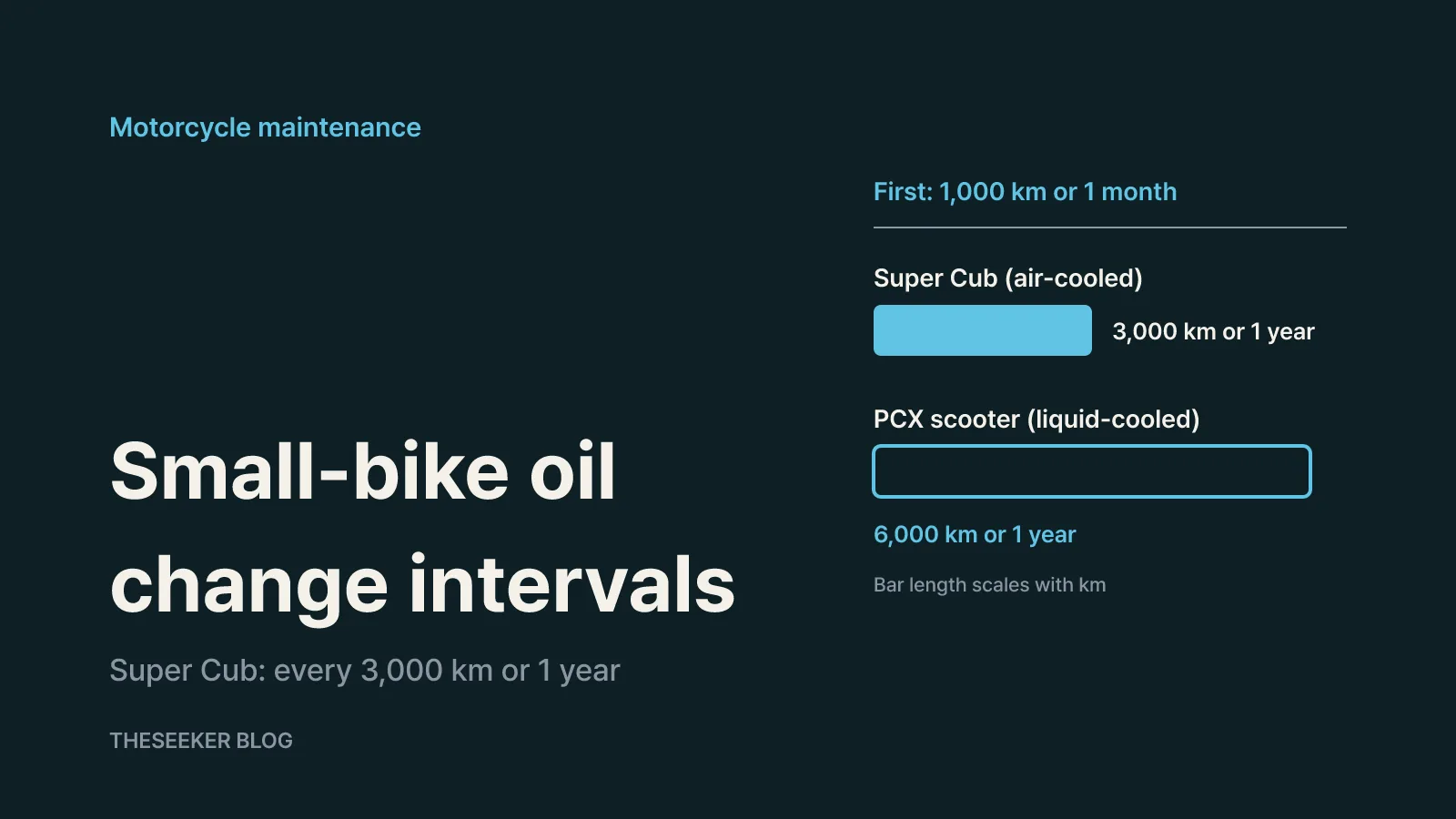
As of October 2026, Honda's official Japanese owner information gives a clear answer for air-cooled small motorcycles such as the Super Cub C125, Super Cub 110 and Cross Cub 110: change the engine oil first at 1,000 km or one month, then every 3,000 km or every year, whichever comes first. That is roughly 620 miles for the first change and about 1,860 miles after that. A liquid-cooled 125 cc scooter like the PCX gets a longer gap of 6,000 km (about 3,700 miles) or one year after the first change.
If you are used to car intervals, those numbers look short. Small engines hold very little oil, and air-cooled designs run on the same oil that cools and lubricates everything inside. One important caveat: these figures come from Honda's Japanese-market documents. Owner's manuals for other regions can print a different schedule for the same nameplate, so the manual that shipped with your bike, or the one published by Honda in your country, always takes priority. Use the figures below to understand how the schedule is built and what to ask your dealer.
Super Cub oil change interval: 1,000 km first, then 3,000 km or one year
Honda Japan's Super Cub FAQ on engine oil groups four models together: the Super Cub C125 (2026 model, JA71), Super Cub 110 (JA59), Super Cub 110 Pro (JA61) and Cross Cub 110 (JA60). All four share the same schedule of an initial change at 1,000 km or one month, followed by a change every 3,000 km or every year.
The same page lists the oil quantities. Total capacity is 1.0 L, and a routine drain-and-refill takes 0.8 L. Changing the oil filter at the same time adds a little more, and the exact amount differs by model, so check the line for your bike before you pour. The gap between total capacity and refill volume exists because some oil always stays inside the engine after draining. A single one-litre bottle usually covers a routine change, but always confirm the level on the dipstick after filling instead of emptying the bottle.
Why is there a separate first change? A new engine goes through a break-in period while internal parts settle against each other, so Honda shortens the first interval before the regular 3,000 km rhythm begins. If you bought your bike used and there is no service record, the simplest approach is to change the oil right away and treat that odometer reading as your new starting point.
Do not overlook the time limit. If you ride only 2,000 km a year, the one-year mark arrives before the distance does. Honda ties distance and time together with "or," so low mileage is not a reason to skip a change.
How engine type changes the schedule
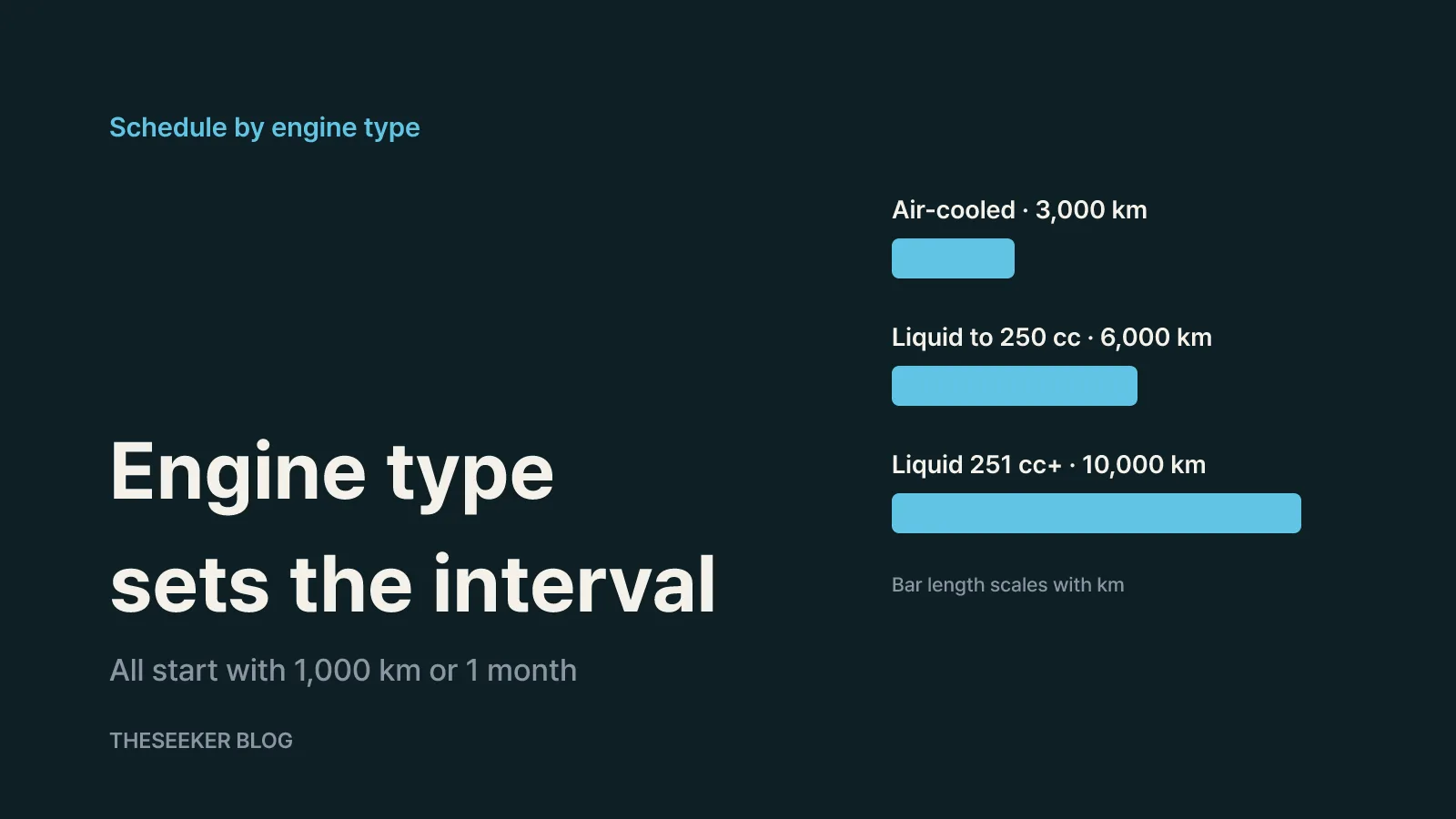
Honda Japan's periodic replacement parts table explains why two bikes of similar size can have very different intervals. It sorts engine oil changes into three groups:
← Swipe to see more
| Engine type | First change | After that |
|---|---|---|
| Air-cooled (excluding dry-sump bikes and air-cooled bikes with an oil cooler) | 1,000 km or 1 month | Every 3,000 km or 1 year |
| Liquid-cooled up to 250 cc, plus dry-sump bikes and air-cooled bikes with an oil cooler | 1,000 km or 1 month | Every 6,000 km or 1 year |
| Liquid-cooled 251 cc and above | 1,000 km or 1 month | Every 10,000 km or 1 year |
The Super Cub family sits in the first row. If you are not sure which row applies to your bike, look for a radiator and a coolant reservoir, or check whether the specifications page of your manual lists a coolant capacity. If it does, the engine is liquid-cooled.
The table covers more than oil. For example, a scooter drive belt is listed at every 20,000 km, but only 10,000 km for business use. That is a useful reminder that commercial riding such as delivery work can shorten replacement schedules. Honda also notes that the page covers both bikes up to 125 cc and bikes of 126 cc and above, so some items may not apply or may differ by model. Treat the table as a map of the ranges and confirm the final number in your own manual.
Why scooters differ, including the oil grade
Scooters do not all follow one rule. Honda's PCX/PCX160 online owner's manual lists an engine oil change at 1,000 km or one month, then every 6,000 km or one year, matching the liquid-cooled row above. A routine change takes 0.8 L, cleaning the strainer screen takes 0.85 L, and total capacity is 0.9 L.
The recommended oil is also worth reading carefully. For the PCX, Honda specifies JASO T 903 MB, SAE 10W-30 and API SJ or higher. JASO T 903 is the standard for four-stroke motorcycle engine oil, and it has two classes, MA and MB. A scooter uses a belt-driven automatic transmission, while many geared motorcycles let the engine oil reach the clutch as well. That is why a bottle labelled for motorcycles is not automatically right for every motorcycle. Match all three marks printed in your manual: the JASO class, the viscosity and the API service category. When shopping for Super Cub oil, check which JASO class your manual calls for and pick a product carrying that exact label.
Scooters also have a separate final-drive gear oil, often called transmission oil. On the PCX it holds just 0.12 L and is changed first at five years, then every four years. You do not replace it at every engine oil change, but keep it on your service log so you and the shop agree on which oil an "oil change" refers to.
Delivery work, short trips and storage
The official interval is a baseline. How quickly oil gets used up or contaminated depends on how you ride. In the following situations, check more often while you wait for the change interval.
- Delivery and commercial riding: long daily distances with constant stop-and-go. A 3,000 km interval can come around in a few weeks, so track the odometer rather than the calendar. Tell your shop the bike is used for work and agree on a check routine.
- Repeated short trips: if the engine is often shut off before it is fully warm, oil condition can decline faster than the mileage suggests. Respect the one-year limit even when distance is low.
- Long-term storage: a bike that sits for months still uses up the time allowance. Check the date of the last change before riding again in spring.
- Just bought used: without records, change the oil once to set a reference point.
To decide whether to change early, look at the evidence rather than guessing. If the dipstick reads near the lower mark, the level drops noticeably soon after a change, or you see oil seeping around the engine, have the bike inspected regardless of where you are in the interval.
How to check the oil level on the dipstick
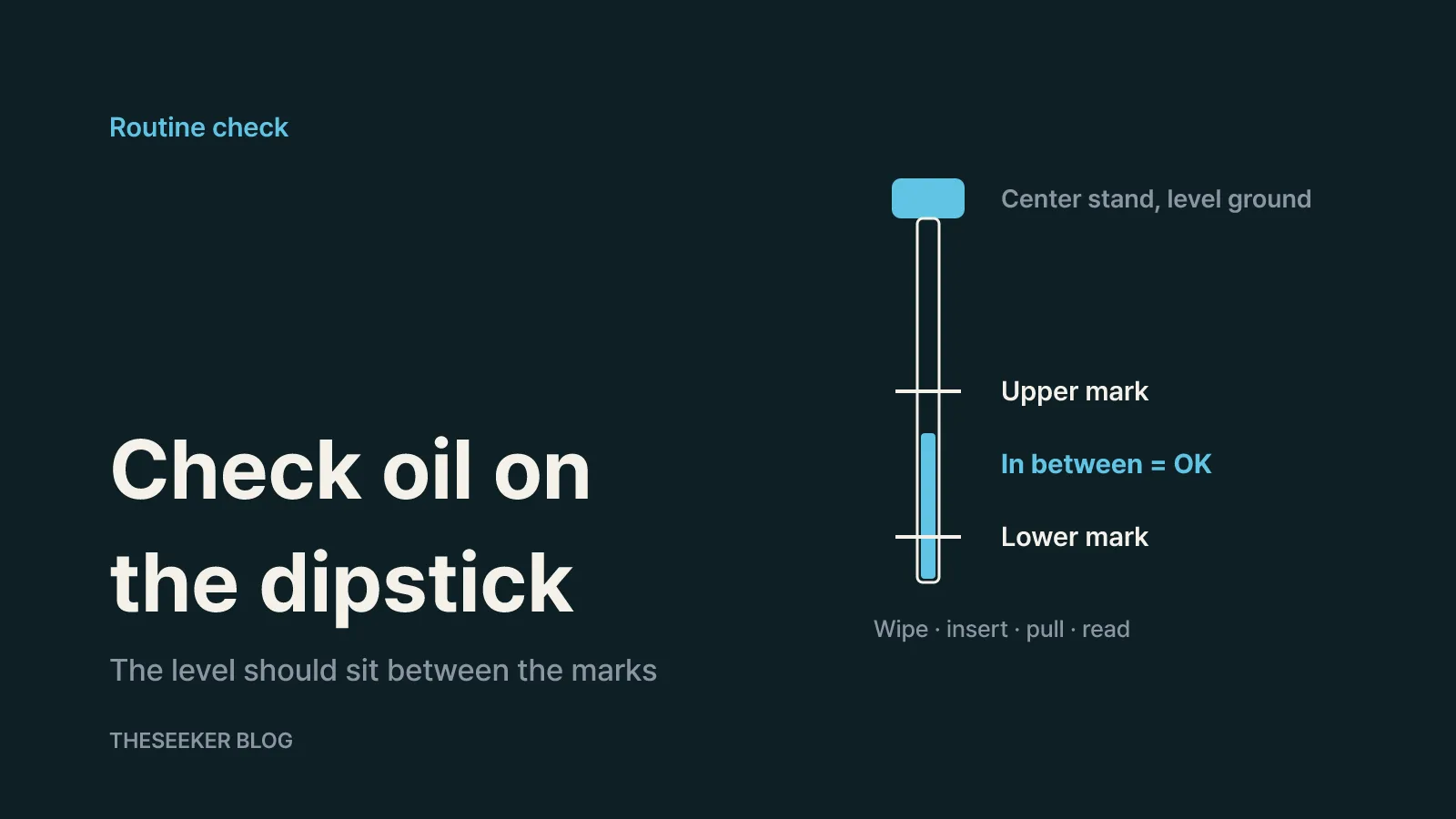
Honda's FAQ describes engine oil level as a daily inspection item, so keeping to the schedule is not enough on its own. The Super Cub and PCX both use a dipstick built into the filler cap. The general routine looks like this:
- Park on firm, level ground and put the bike on its center stand. A side stand tilts the bike and gives a false reading.
- If the engine is cold, idle it for the time your manual specifies, then switch off and wait briefly for the oil to settle.
- Remove the dipstick and wipe it clean.
- Insert it fully without screwing it in, then pull it out again.
- Confirm that the oil sits between the upper and lower marks.
- If it is near the lower mark, top up with the same grade only to the upper mark and refit the cap securely.
The two most common mistakes are overfilling and mixing different oils. Stay below the upper mark and use the grade listed in your manual. While you are there, look around the lower engine and drain bolt for leaks. Idle and wait times vary by model, so follow the sequence in your own manual.
Keep a record and know what to ask the shop
Short intervals make it easy to lose track. Each time, write down the date, odometer reading, oil grade and amount, and whether the filter or strainer was serviced. For example, if a Super Cub gets fresh oil at 12,400 km, the next change is due at 15,400 km or in the same month next year, whichever comes first.
When a shop does the work, confirm that:
- the oil meets the JASO class, viscosity and API category in your manual
- the job is an oil-only change or also includes the filter or strainer
- on a scooter, the invoice says whether engine oil or gear oil was replaced
- the receipt records the odometer reading and the work performed
In short, Honda Japan's schedule puts air-cooled small bikes like the Super Cub at every 3,000 km or one year and liquid-cooled scooters up to 250 cc like the PCX at every 6,000 km or one year, both after a first change at 1,000 km or one month. Follow the manual for your market first, check the dipstick regularly, and tighten your routine when your riding is hard on the oil.
Sources
Frequently asked questions
How often should I change the oil in a Honda Super Cub?
Honda Japan's official FAQ lists the Super Cub C125, 110, 110 Pro and Cross Cub 110 at a first change of 1,000 km or one month, then every 3,000 km or one year, whichever comes first. Manuals for other markets may differ, so check the one for your bike.
Can I skip an oil change if I ride very little?
No. Honda links distance and time with "or," so once a year has passed the oil is due even if you have not reached the distance. Bikes in long-term storage are included.
Is scooter oil the same as oil for a geared motorcycle?
Only if your manual lists the same grade. The PCX, for example, calls for JASO MB, SAE 10W-30 and API SJ or higher. JASO T 903 has two classes, MA and MB, so match the JASO class, viscosity and API category in your own manual.
How often should I check the oil level?
Honda treats engine oil level as a daily inspection item. Build a habit, such as checking at every fuel stop, with the bike on its center stand on level ground and the reading between the dipstick marks.
Should a delivery bike get more frequent oil changes?
Honda Japan's replacement table does not give a separate business-use oil interval, though it does shorten the scooter drive belt interval to 10,000 km for business use. Track changes by odometer, check more often and agree on a routine with your shop.
blog.theseeker.io/en/posts/motorcycle-scooter-engine-oil-change-interval
Ryan Mitchell
Ryan covers buying, insuring and maintaining a car, checking terms against manufacturer and agency publications so the options are easy to compare.
Read our editorial standards