How Korea Calculates EV Subsidies: National vs Local
Korea's EV purchase subsidy adds a national grant to a local grant, then applies a price coefficient based on the car's base price. Here is how performance, price, buyer status and location change the amount under the 2026 rules.
 Ryan Mitchell
In this post
- A Korean EV subsidy is a national grant plus a local grant
- How the national grant is calculated for each model
- How the car's base price cuts the final amount
- Why the local grant differs from city to city
- Buyer top-ups and the conversion bonus
- National subsidy ceilings by vehicle type
- What is known about 2027 EV subsidies
- A checklist before you sign
- Sources
- Frequently asked questions
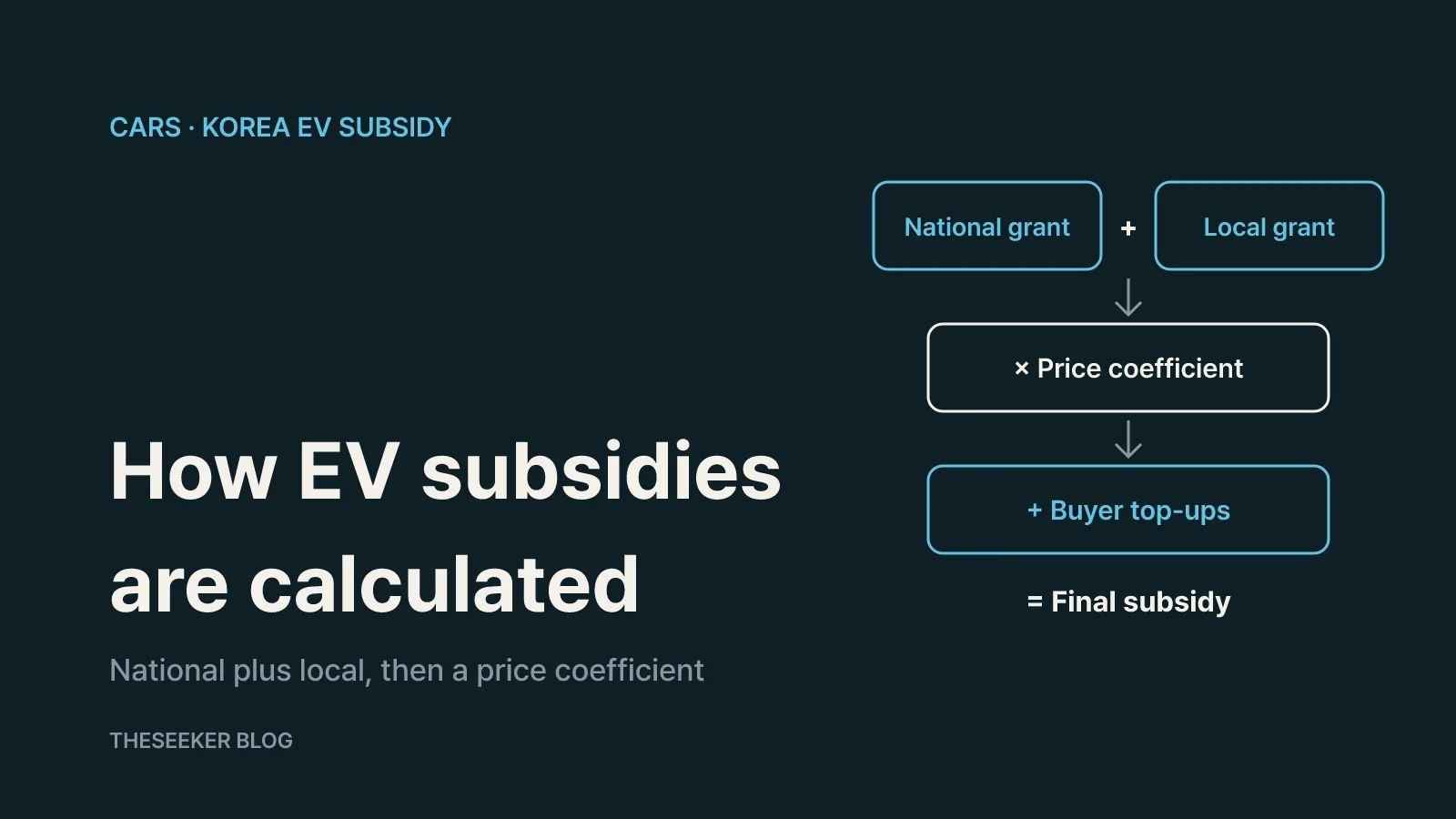
As of October 2026, South Korea calculates an electric car purchase subsidy in three layers: a national grant computed for each model, plus a local government grant that must scale with it, and then a price coefficient (100%, 50% or 0%) applied to the combined total based on the car's base price. On top of that, certain buyers receive extra support and a new conversion bonus for retiring a combustion car. That is why two people buying the same EV can receive different amounts in different cities, and why two trims of the same model can land in different bands.
This guide focuses on how the number is calculated rather than on the application paperwork. It draws on the Ministry of Climate, Energy and Environment's 2026 reform announcement, the government's plain-language law portal summarising the 2026 EV Subsidy Business Guidelines, and the ministry's 2027 budget proposal. Figures below are in Korean won; for rough orientation, 1 million won is written as "₩1M". The 2027 rules have not been finalised, so I separate what is confirmed from what is only proposed.
A Korean EV subsidy is a national grant plus a local grant
The legal basis sits in the Act on Promotion of Development and Distribution of Environment-Friendly Motor Vehicles (Article 10) and the Clean Air Conservation Act (Article 58). Both allow central and local governments to subsidise purchases within their budgets and to differentiate the support, for example by sale price (Korea easylaw portal).
In practice the money comes from two sources. The ministry calculates a national grant for each eligible model and publishes the confirmed amounts on the Zero Emission Vehicle portal (ev.or.kr). Your city or county then sets a local grant in its own programme notice, and buyers can only be paid once that notice is published (2026 reform press release).
The final figure is built roughly in this order:
- The ministry sets the model's base national grant (performance, battery and manufacturer factors).
- The local government sets a model-specific local grant in proportion to that national level.
- The national and local amounts are added, then multiplied by the price coefficient.
- Buyer-specific top-ups and the conversion bonus are added.
How the national grant is calculated for each model
For passenger EVs, the national grant varies with vehicle performance (efficiency and driving range), the maker's low-emission vehicle sales record and whether it cut prices, within a ceiling of ₩5.8M for mid-size and large cars and ₩5.3M for small cars (Korea easylaw portal). For 2026 the government stopped its annual ₩1M cut and kept the budget unit price for a representative mid-size or large car at ₩3M, saying a mid-size EV could reach up to ₩5.8M including additional components.
Treat "up to" as a ceiling, not a typical payout. Individual models often receive less depending on how they score on the formula. The 2026 changes emphasised:
- Battery energy density: the grading band moved from 365–500 Wh/L to 383–525 Wh/L across five grades.
- Charging speed: the threshold for extra support on passenger cars rose from 100–250 kW to 150–300 kW.
- Battery warranty: models with a battery warranty of at least 10 years or 500,000 km (SOH 65%) receive ₩0.3M more, without exceeding the ceiling.
- New technology: the former ₩0.2M for V2L became ₩0.1M each for V2L and Plug and Charge, with ₩0.1M for V2G announced from 2027.
There is also a manufacturer gate. Subsidies only apply to cars sold by makers and importers selected as programme participants. A new participant evaluation covering business capacity, after-sales support and industrial contribution took effect in July 2026, and Yonhap reported that vehicles from makers that failed it receive no subsidy (Yonhap).
How the car's base price cuts the final amount
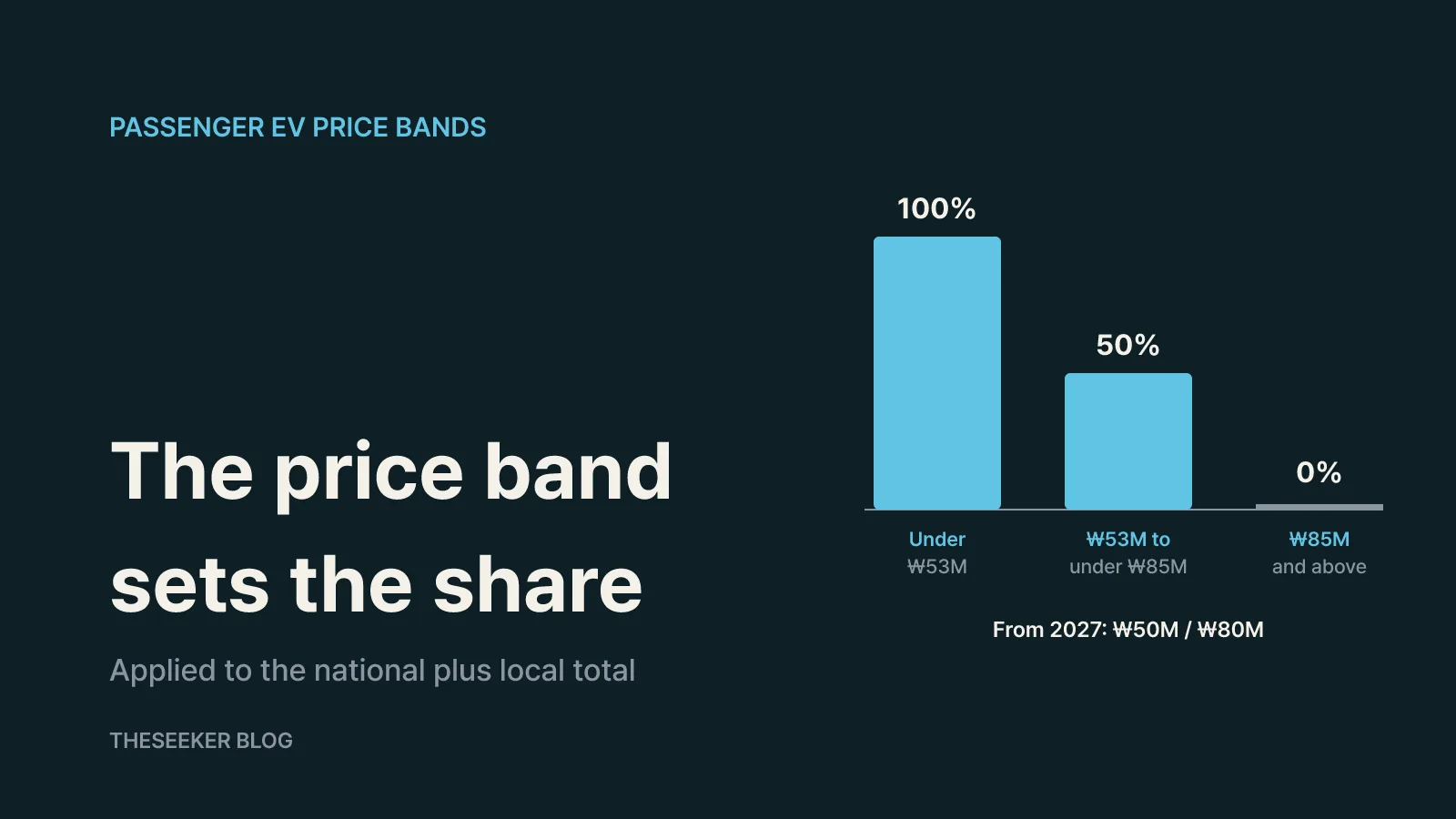
The single biggest swing comes from the price coefficient. Under the 2026 guidelines it applies to the combined national-plus-local amount (Korea easylaw portal):
← Swipe to see more
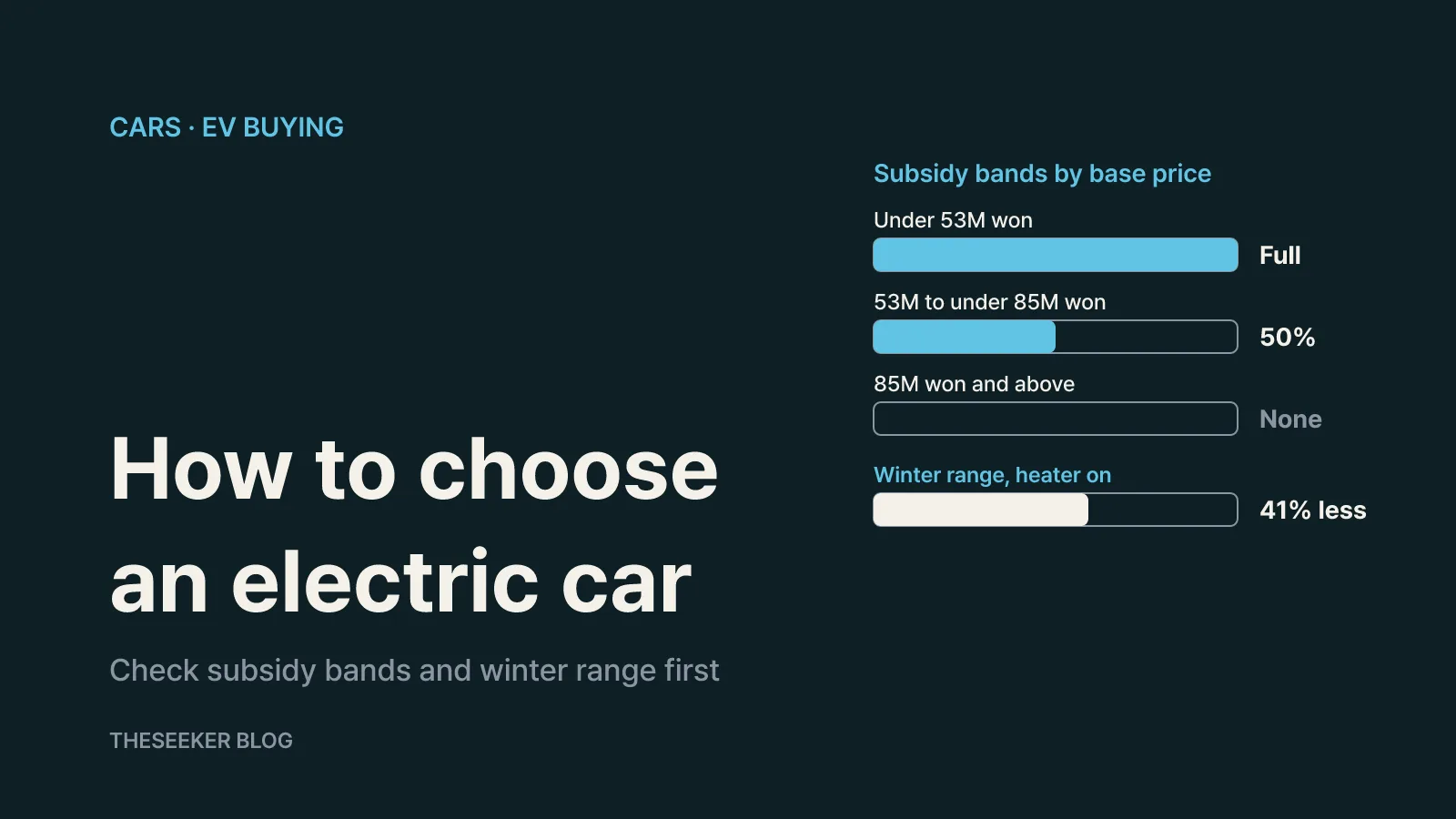
| Base price (passenger EV) | 2026 share paid | Announced bands from 2027 |
|---|---|---|
| Under ₩53M | 100% | Under ₩50M: 100% |
| ₩53M to under ₩85M | 50% | ₩50M to under ₩80M: 50% |
| ₩85M and above | 0% | ₩80M and above: 0% |
Because the coefficient hits the local share too, crossing ₩53M halves the whole subsidy, not just the national part. The ministry confirmed this in a July 2026 clarification: one imported model that had been under the ₩53M line saw its subsidy cut to 50% after the maker raised its price (ministry clarification). The same note restated that the bands are scheduled to tighten to ₩50M and ₩80M from 2027, as already flagged in the 2026 guidelines.
The practical lesson: check the official base price used for subsidy purposes, not your optioned quote, and note how far each trim sits from the line. Small electric trucks under 1.5 tonnes follow a simpler rule from 2026: full coefficient below ₩85M, zero above it, with no 50% band.
Why the local grant differs from city to city
Koreans often search for a specific city's subsidy because local amounts vary. Local governments cannot set them arbitrarily, though. The guidelines require them to differentiate the local grant by model in proportion to the national grant (Korea easylaw portal). A model with a high national grant therefore earns a relatively high local grant too.
Differences come from three places:
- The local base amount, which each authority sets according to its budget.
- Allocation volume, which differs by authority; once it runs out, later applicants may miss out that year.
- Eligibility and selection: residency requirements must be no longer than three months, and authorities choose between delivery or registration order, lottery or application order, with priority for groups such as vulnerable households and first-time buyers.
Authorities must publish their notice within three weeks of receiving the guidelines and split the year's volume across at least two rounds. Always use your own authority's latest notice rather than a third-party table. Yonhap also noted that a much larger 2027 allocation would require local governments to raise their share, which some may struggle to fund (Yonhap).
Buyer top-ups and the conversion bonus
For passenger EVs in 2026, national top-ups include (Korea easylaw portal):
- Near-poverty and lower-income households: an extra 20% of the national grant.
- Young first-time buyers aged 19 to 34: an extra 20% of the national grant.
- Families with two or more children aged 18 or under: ₩1M, ₩2M or ₩3M for two, three, or four or more children.
- Electric taxis: an extra ₩2.5M.
- Replacing an old EV whose BMS safety function cannot be updated: ₩0.2M until 31 December 2026.
Top-ups can be combined, but percentage-based support is calculated first and flat amounts are added last.
The new conversion bonus pays up to ₩1M when you scrap or sell a combustion car first registered at least three years ago (hybrids excluded; family transfers excluded). It is linked to the new car's subsidy: the full ₩1M applies when the purchase subsidy exceeds ₩5M, and it scales down below that. The ministry's own example is a ₩2.5M subsidy producing a ₩0.5M bonus, which is how a mid-size EV can reach ₩6.8M in total (2026 reform press release).
National subsidy ceilings by vehicle type
The calculation method changes with the vehicle class. The 2026 national ceilings are (Korea easylaw portal):
← Swipe to see more
| Type | 2026 national ceiling or method | Notes |
|---|---|---|
| Passenger, mid-size/large | Up to ₩5.8M, performance-based | 100/50/0% price coefficient |
| Passenger, small | Up to ₩5.3M, performance-based | Same coefficient |
| Passenger, micro | Flat ₩2M | +₩0.5M for regional hub projects |
| Bus, large/medium/small | Up to ₩70M / ₩50M / ₩15M | School buses: ₩115M / ₩85M / ₩30M |
| Truck, large/medium | Up to ₩60M / ₩40M | New classes in 2026 |
| Truck, small/light | Up to ₩10.5M / ₩7.7M | None at ₩85M base price or above |
| Truck, micro | Flat ₩3.8M | +₩0.5M for regional hub projects |
Trucks have their own top-ups: 30% of the national grant for lower-income individuals and small business owners, 10% for farmers and 10% for parcel-delivery vehicles. Individuals buying a second car of the same type within the two-year re-support restriction get no subsidy for it, and deregistering a subsidised car early triggers clawback, from 70% within three months down to 0% after 24 months in non-export cases.
What is known about 2027 EV subsidies
As of October 2026, the ministry's 2027 budget proposal raises the number of subsidised vehicles from 300,000 to 430,000 and extends the conversion bonus to commercial vehicles such as taxis. The National Assembly is expected to finalise it in December (2027 budget press release). Yonhap reported that the unit price for mid-size and large passenger cars stays at ₩3M while small trucks fall from ₩10M to ₩8M, and that the EV individual consumption tax relief cap is set to drop from ₩3M to ₩2M (Yonhap).
Model-by-model national amounts, detailed formula values and local grants remain unknown until the 2027 guidelines and local notices appear. If the announced ₩50M/₩80M price bands take effect, cars with base prices in the low ₩50M range could fall into the 50% band even with an unchanged unit price.
A checklist before you sign
- Confirm the trim's official base price and its distance from the price bands.
- Look up the model's national grant on ev.or.kr; wheel size or battery option can change it.
- Read your local authority's current notice for the local grant, residency rule, selection method and remaining volume.
- List which top-ups apply to you and prepare the evidence.
- Plan timing: if the car is not delivered within two months of selection, you can be cancelled or moved to the waiting list. After registration, submit documents within 10 days; payment follows within 14 days.
When a dealer quotes an expected subsidy, ask which authority and which notice round it assumes, then verify it yourself before signing.
Sources
Frequently asked questions
Do I apply separately for the national and local EV subsidy in Korea?
No. After signing a contract with the maker or importer, you submit one purchase-support application to your local authority, and the dealer can file it for you. Both portions are paid through that application.
If a car costs over ₩53 million, is only the national grant halved?
No. Under the 2026 guidelines the price coefficient applies to the combined national and local subsidy. Between ₩53M and ₩85M you receive 50% of the total; at ₩85M or above you receive nothing.
Why do local EV subsidies differ between Korean cities?
Each authority has a different budget and allocation volume, so its base amount differs. The guidelines still require the local grant to be set in proportion to each model's national grant.
Are the 2027 EV subsidy amounts confirmed?
Not as of October 2026. The budget proposal expands volume to 430,000 vehicles and awaits National Assembly approval in December. Per-model amounts depend on the 2027 guidelines and local notices.
Does everyone get the full ₩1 million conversion bonus?
No. The combustion car must be at least three years past first registration, hybrids and family transfers are excluded, and the bonus scales down if the new car's purchase subsidy is below ₩5M.
blog.theseeker.io/en/posts/ev-subsidy-calculation-korea-national-local
Ryan Mitchell
Ryan covers buying, insuring and maintaining a car, checking terms against manufacturer and agency publications so the options are easy to compare.
Read our editorial standards