iPhone Duo vs Galaxy Z Fold 8: Durability, Price, Ecosystem
Both foldables open to a 7.6-inch screen, but they differ on dust protection, weight, price and how they fit the devices you already own. Here is how to choose using the official specs.
 Lucas Bennett
In this post
As of October 2026, the short answer is this: choose the iPhone Duo if you already live with an Apple Watch, Mac or iPad and want the stronger dust and water rating; choose the Galaxy Z Fold 8 if you want the same screen size in a noticeably lighter body for a little less money. On paper the two phones look remarkably alike. Both open to a 7.6-inch inner display and fold into a wide, passport-shaped slab. The real differences sit in the ingress rating, the hinge behaviour, the price and the ecosystem around each phone. This comparison relies on Apple's and Samsung's published specifications and pricing pages rather than on viral fold-and-bend videos, whose test conditions vary from one channel to the next.
Same 7.6-inch screen, different engineering
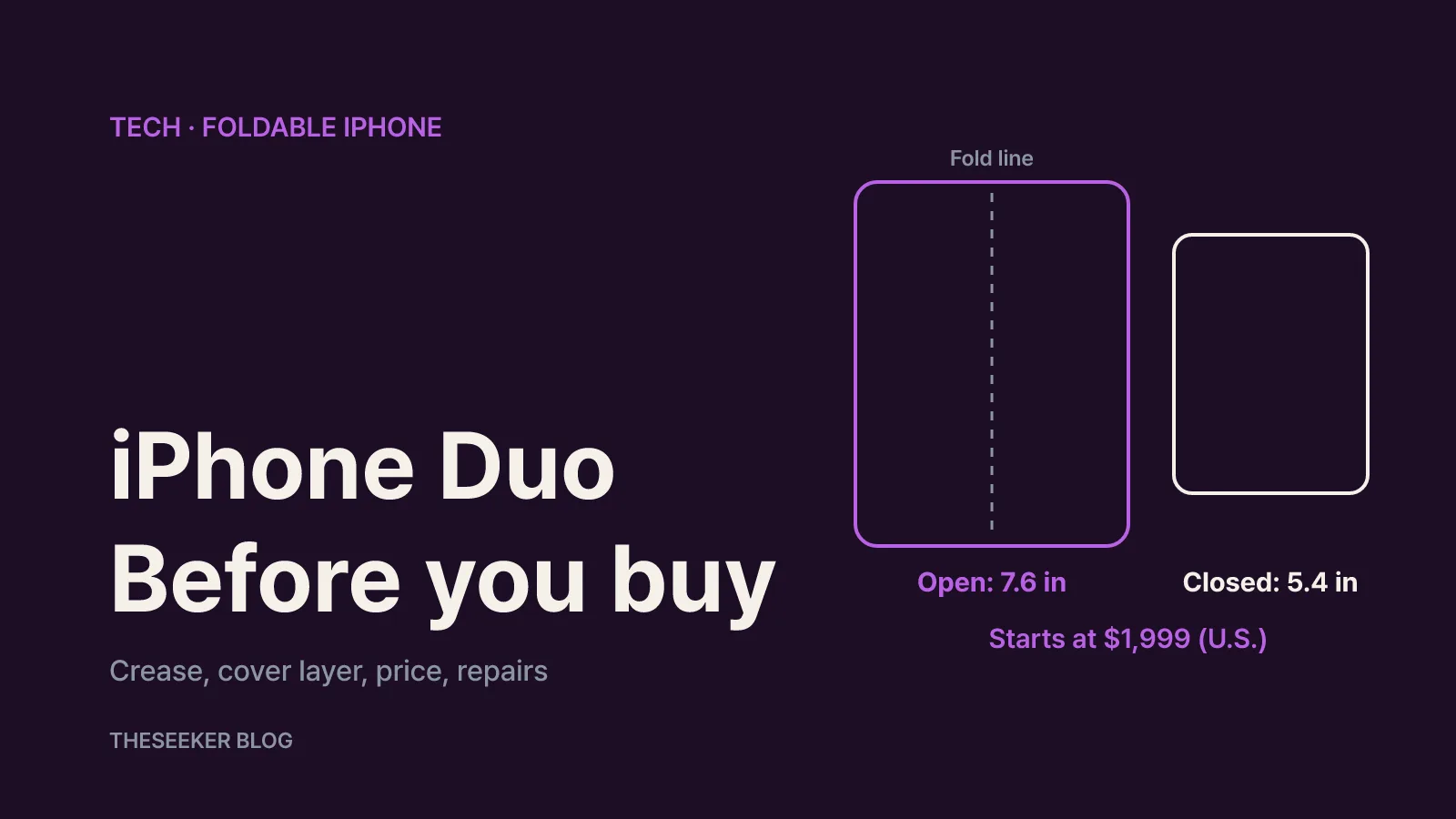
Apple announced the iPhone Duo on September 9, 2026 as its first foldable iPhone. It pairs a 7.6-inch inner display with a 5.4-inch outer display, and Apple gave both screens the same aspect ratio so apps scale proportionally when you open or close the phone. Pre-orders opened on October 16 and the phone went on sale on October 23 in more than 70 countries and regions, including the U.S.
Samsung got there first. At Galaxy Unpacked on July 22 it introduced the Galaxy Z Fold 8 as an all-new, wider form factor: a 7.6-inch main screen in a 4:3 ratio and a 5.5-inch cover screen in a 10:16 ratio. The traditional tall Fold design continues as the Galaxy Z Fold 8 Ultra with an 8-inch main display. That makes the iPhone Duo and the standard Fold 8 genuine like-for-like rivals, which is why "Galaxy Z Fold 8 vs iPhone Duo" has become such a common search.
← Swipe to see more
| Spec | iPhone Duo | Galaxy Z Fold 8 |
|---|---|---|
| Inner display | 7.6 in | 7.6 in (4:3) |
| Outer display | 5.4 in | 5.5 in (10:16) |
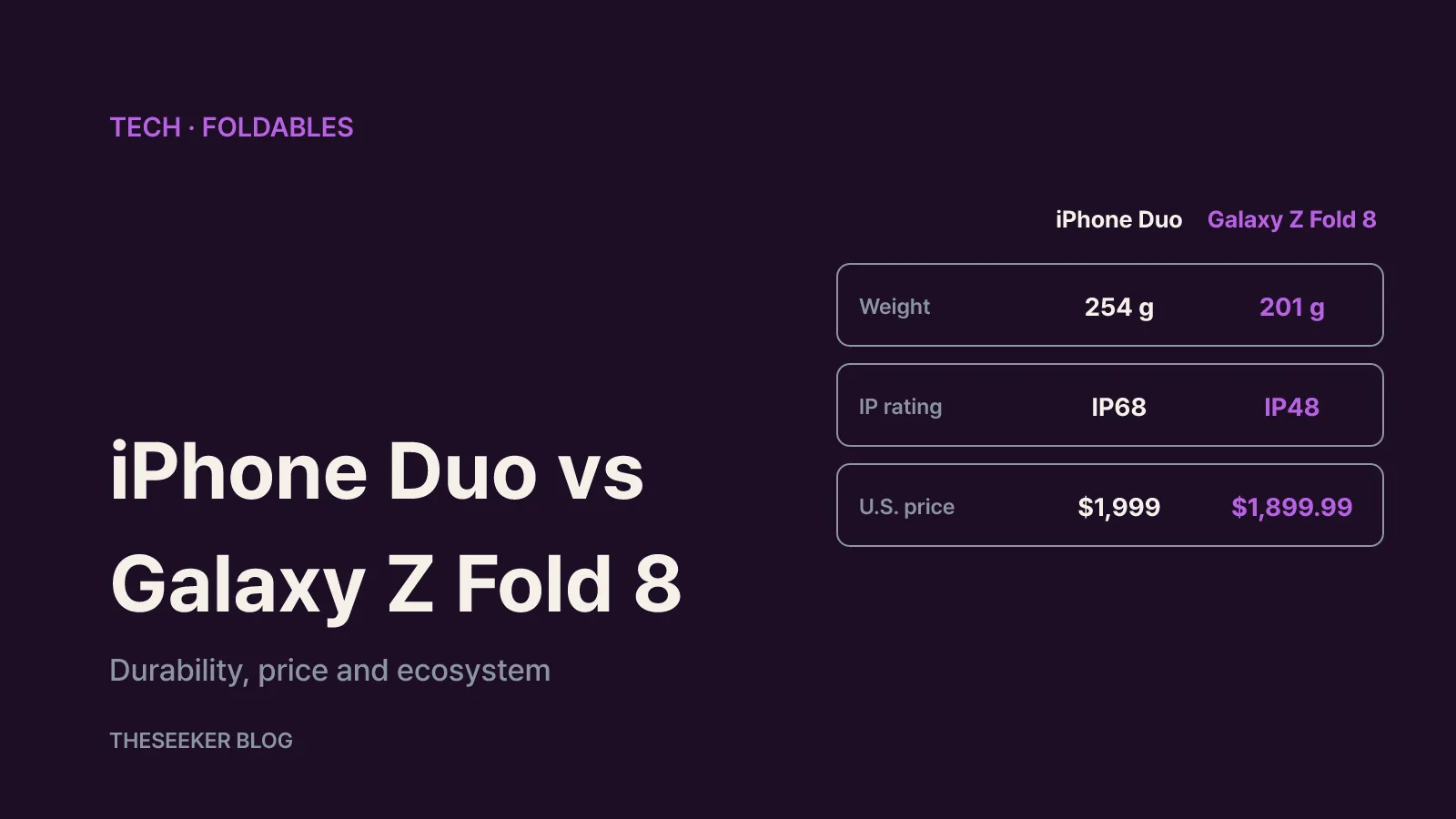
| Weight | 254 g (8.96 oz) | 201 g |
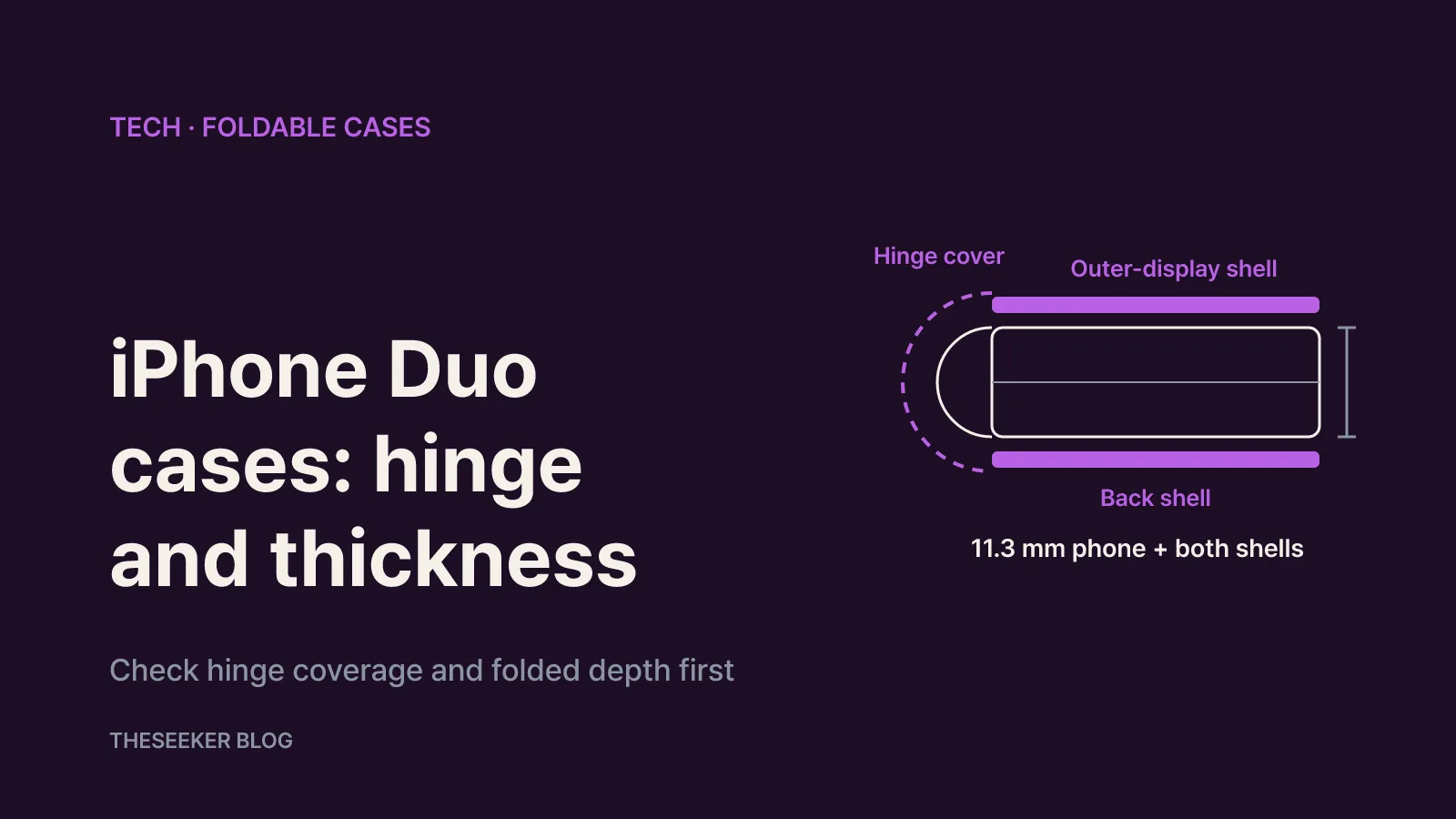
| Thickness open / closed | 5.2 mm / 11.3 mm | 4.5 mm / 9.7 mm |
| Ingress rating | IP68 | IP48 |
| Chip | A20 Pro | Snapdragon 8 Elite Gen 5 for Galaxy |
| U.S. starting price | $1,999 | $1,899.99 |
The iPhone figures come from Apple's technical specifications page; the Fold 8 figures come from Samsung's newsroom spec sheet and its U.S. product page. The 53-gram weight gap is the number most people will feel. If you read or watch video with the phone held open for long stretches, try both in a store for a few minutes each before deciding.
Durability: separate the hinge, the screens and the IP rating
"Durability" on a foldable is several questions at once. Neither manufacturer publishes a fold-cycle rating in the documents reviewed here, so treat any claim that one phone survives more folds than the other as a property of that particular test, not a spec.
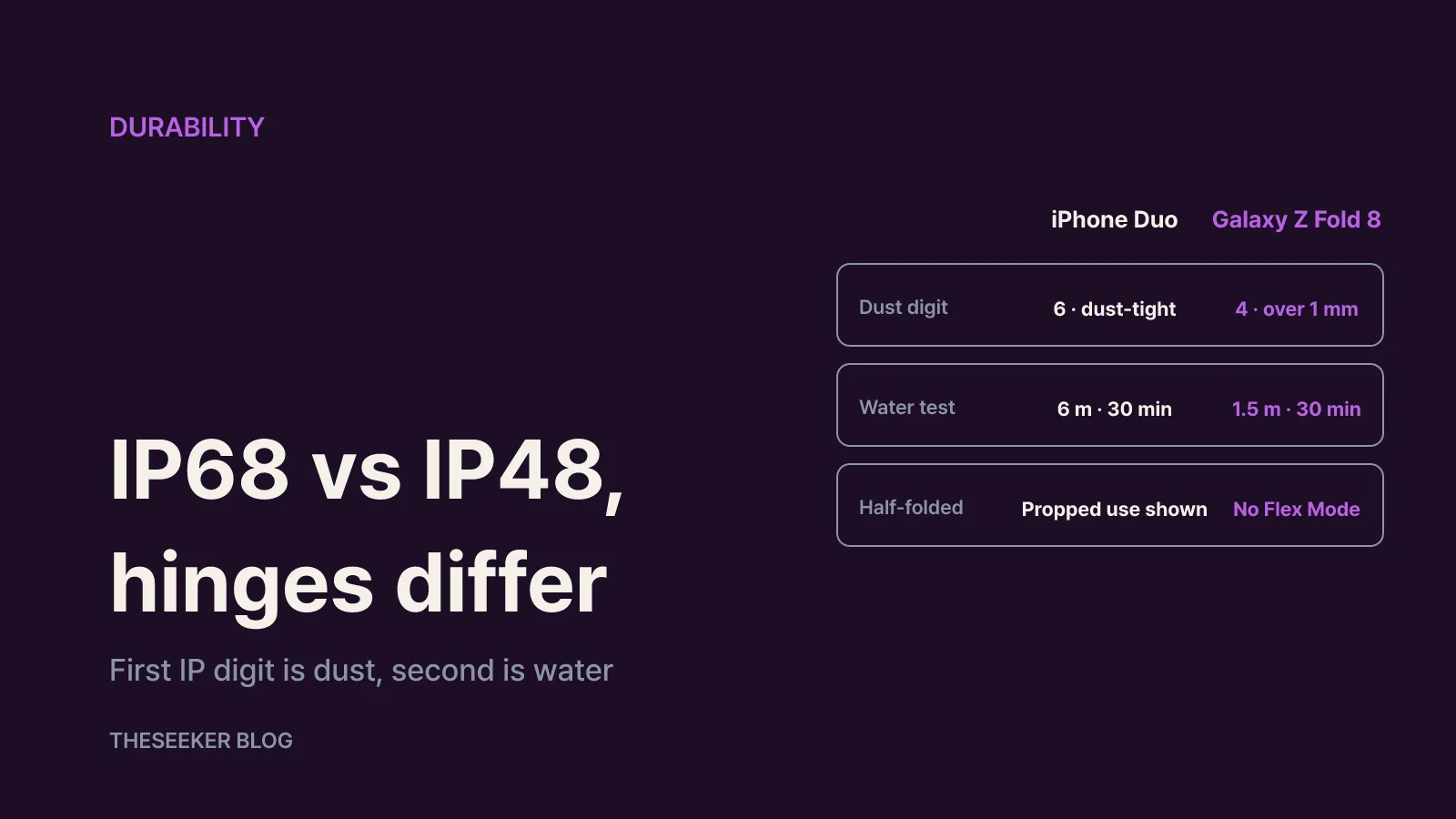
The ingress rating is the clearest difference. The iPhone Duo is rated IP68 under IEC 60529, which Apple specifies as a maximum depth of 6 meters for up to 30 minutes. The Galaxy Z Fold 8 is rated IP48, which Samsung bases on submersion in up to 1.5 meters of fresh water for up to 30 minutes, and Samsung says it is not advised for beach or pool use. In an IP code the first digit covers solid particles and the second covers water. A 6 means dust-tight; a 4 means protection against solid objects larger than 1 mm. Because a moving hinge is exactly where grit causes trouble, that first digit matters if you spend time at the beach, on job sites or anywhere dusty.
Both companies note that water resistance is not permanent and can decline with normal wear, and Apple states that liquid damage is not covered under its warranty. A higher rating is insurance against accidents, not permission to go swimming.
Hinge and display construction. Apple says the Duo's hinge is built from more than 100 components and supports the center of the display to hold it flat when open. The inner screen stacks a scratch-resistant coating and a nano-texture polymer cover layer over high-strength glass on both sides of the panel, with a titanium plate underneath. The outer display uses Ceramic Shield 2, which Apple rates at three times the scratch resistance of the previous generation, and the enclosure is grade 5 titanium.
Samsung pairs an Armor FlexHinge with what it calls Flex Titanium: a titanium-alloy film combined with an enhanced titanium plate that is meant to absorb pressure and reduce crease visibility over time. The cover screen uses Corning Gorilla Glass Ceramic 3, the back uses Gorilla Glass Victus 2, and the frame is Armor Aluminum.
One trade-off is easy to miss. Samsung's U.S. FAQ confirms that the Fold 8's hinge is designed for fully open and fully closed use, so the Fold 8 does not support Flex Mode, the half-folded laptop-style posture earlier Folds offered. Apple, by contrast, markets propping the Duo on a surface for hands-free FaceTime and time-lapse video. If you like standing your phone up half-open on a desk, this alone may decide it.
Price: the gap is small in the U.S., large elsewhere

In the U.S., the iPhone Duo starts at $1,999 for 256GB and is also offered in 512GB, 1TB and 2TB configurations. The Galaxy Z Fold 8 starts at $1,899.99, with 256GB, 512GB and 1TB options. At the entry tier that is roughly a $100 difference, and Samsung's U.S. store was advertising up to $200 off without a trade-in from October 12 to November 2, 2026.
The gap is far wider in some markets. In South Korea, Apple lists the 256GB Duo at ₩3,290,000 while Samsung's Korean newsroom lists the 256GB Fold 8 at ₩2,278,100, a difference of more than ₩1 million. If you are buying outside the U.S., check local pricing rather than converting dollar figures.
The sticker price is only the start. For a fair comparison, add up a two-year cost:
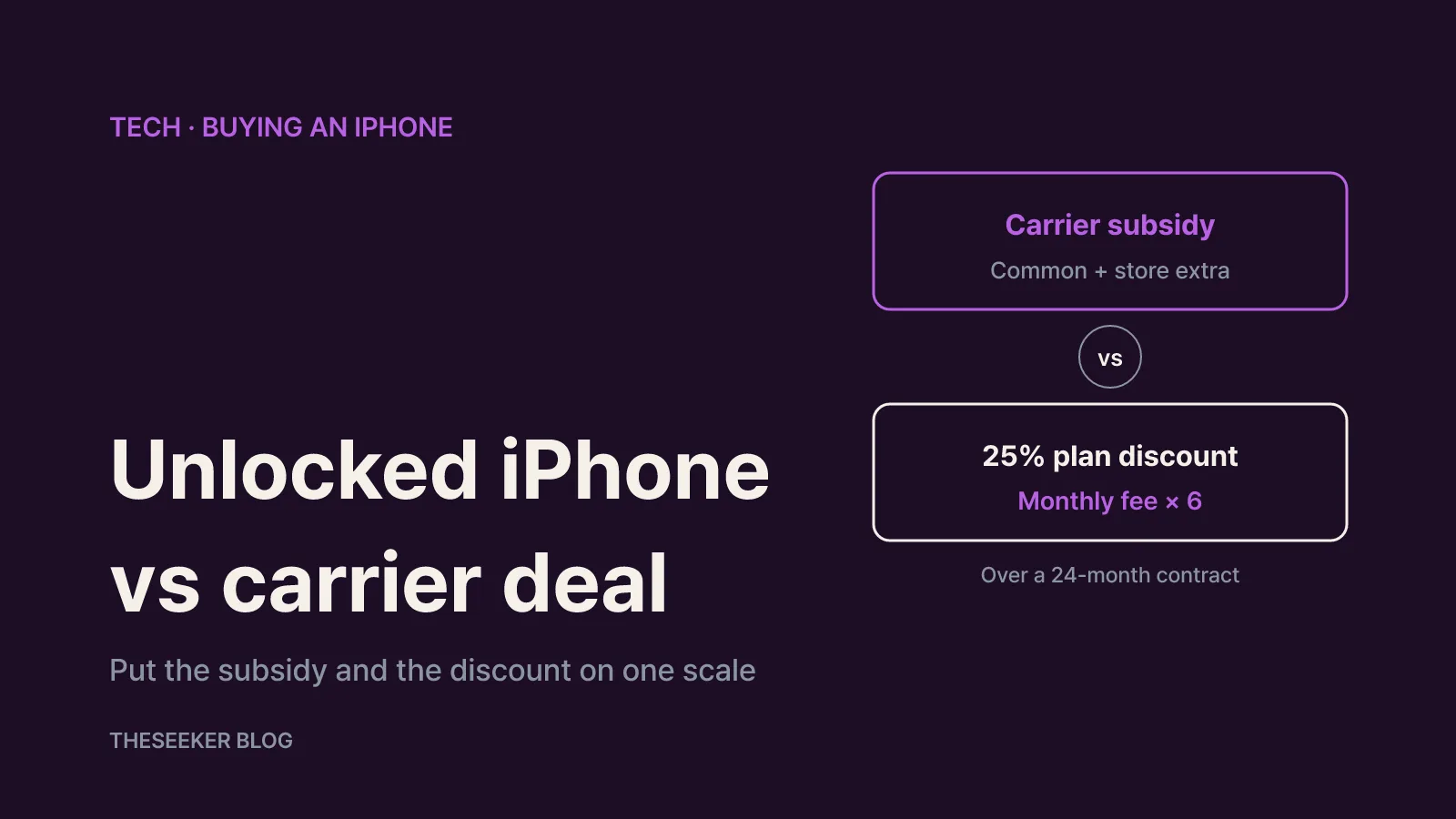
- Carrier deals and trade-in credit. These change quickly. The Fold 8 has been on sale since August, so its promotions have already rotated at least once.
- Protection plans. Apple offers AppleCare+ and AppleCare One, plus Apple Upgrade leasing in the U.S. from $57.99 per month over 24 months for the Duo. Samsung offers Samsung Care+. A folding screen is an expensive part on either phone, so read how each plan treats inner-display repairs and what the per-incident fee is before you buy.
- Accessories. Apple's iPhone Duo Case costs $79 and the Folio with Kickstand costs $129. Budget for a case either way.
Ecosystem and switching costs
A foldable spends more time doing tablet-style work, so the devices around it matter more than usual.
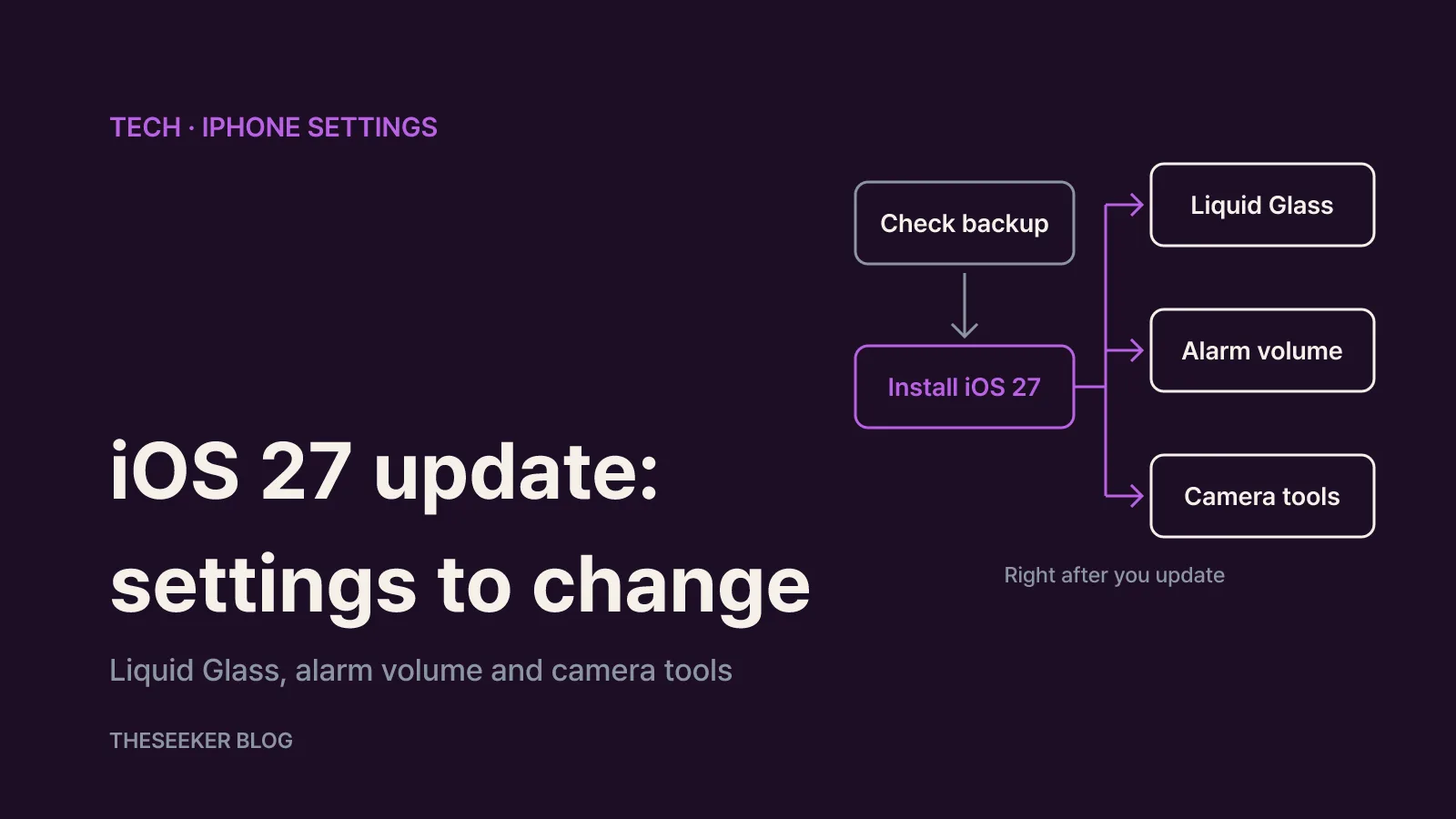
The iPhone Duo makes the most sense if you already use an Apple Watch, Mac, iPad or AirPods. Apple says the Duo can be unlocked with an Apple Watch and uses Touch ID in the side button so authentication works the same open or closed. iOS 27 brings Split View to iPhone for the first time, letting you run two apps side by side on the inner display, and Apple says apps such as Netflix, Zoom and Slack already take advantage of the folding layout. Note that the Duo is eSIM-only worldwide, so confirm your carrier supports eSIM before ordering.
The Galaxy Z Fold 8 makes the most sense if you use a Galaxy Watch, Galaxy Tab or Galaxy Book, or you already rely on Android multi-window. One UI 9 supports two- and three-way split view, Gemini-based features and Gemini Notebook. Samsung's U.S. page also advertises up to seven OS upgrades and security updates. The Fold 8 supports a nano-SIM plus eSIM.
Switching from iPhone is easier than it used to be. Samsung says its updated Smart Switch lets you scan a QR code on your iPhone and transfer data wirelessly without installing an app, and that Quick Share now works with AirDrop for sharing files with iPhone users. The catch is the Apple Watch: it pairs only with an iPhone, so watch owners face a bigger move.
Finally, check AI language support for your region. Apple launched Siri AI in beta with English first and announced additional languages in later updates, and Samsung notes that Galaxy AI features vary by language and market.
Which one fits how you use a phone
- Do you write with a stylus? The Fold 8 does not support the S Pen. Apple says Apple Pencil (USB-C) support for the Duo is coming later this year, without hover.
- Do you prop your phone half-open? The Fold 8 lacks Flex Mode; look at the Duo or the Fold 8 Ultra instead.
- Battery life? Apple quotes up to 31 hours of video playback on the Duo's inner display and 44 hours on the outer display. Samsung quotes up to 26 hours of video playback from a 4,800 mAh battery. Test methods differ, so these are not a head-to-head result.
- Charging speed? Apple says the Duo reaches 50% in about 20 minutes with a 60W-capable adapter; Samsung says the Fold 8 reaches 63% in about 30 minutes with a 45W adapter. Both adapters are sold separately.
- Need a telephoto lens? Neither phone has a dedicated telephoto camera; both use a main and an ultra-wide sensor. The Fold 8 Ultra adds a 3x optical telephoto.
- Weight above all? At 201 g, the Fold 8 is the clear winner over the Duo's 254 g.
A quick checklist before you buy
- List the watch, tablet and laptop you plan to keep and see which phone they work with.
- Decide whether dust and water exposure is part of your routine. If it is, weigh IP68 against IP48 first.
- Price your exact storage tier with current carrier and trade-in offers.
- Add protection-plan fees and per-incident charges for a two-year total.
- In a store, run a finger across the crease and type one-handed on the closed outer screen.
- Make sure stylus support, half-folded use or a telephoto lens is not a deal-breaker you are overlooking.
Neither phone is simply better. The iPhone Duo suits people anchored in Apple's ecosystem who value a dust-tight rating; the Galaxy Z Fold 8 suits people who want the lightest wide foldable at a lower price and do not need Flex Mode.
Sources
- Apple unveils iPhone Duo (Apple Newsroom, 2026-09-09)
- iPhone Duo - Technical Specifications (Apple)
- iPhone Duo 구입하기 - Apple (KR)
- Samsung Galaxy Z Fold8 Ultra, Fold8 and Flip8: Foldables, Perfected for Every Way of Living (Samsung Global Newsroom)
- 삼성전자, 갤럭시 Z 폴드8 울트라·폴드8·플립8 사전 판매 시작 (삼성전자 뉴스룸)
- Explore Galaxy Z Fold8 (Samsung US)
Frequently asked questions
Is the iPhone Duo more durable than the Galaxy Z Fold 8?
The clearest documented difference is the ingress rating: IP68 (up to 6 m for 30 minutes) on the iPhone Duo versus IP48 (up to 1.5 m of fresh water for 30 minutes) on the Fold 8, which means stronger dust protection on the Duo. Neither company publishes a fold-cycle rating in its spec pages.
How much more does the iPhone Duo cost than the Galaxy Z Fold 8?
In the U.S., the iPhone Duo starts at $1,999 and the Galaxy Z Fold 8 starts at $1,899.99, roughly a $100 gap at 256GB before promotions. In some markets, such as South Korea, the gap is much larger, so check local pricing.
Does the Galaxy Z Fold 8 support Flex Mode?
No. Samsung says the Fold 8's new hinge is designed for fully open and fully closed use to keep the main screen flatter, so it does not support Flex Mode.
Can I use a physical SIM card in the iPhone Duo?
No. The iPhone Duo is eSIM-only worldwide and has no SIM tray. The Galaxy Z Fold 8 supports a nano-SIM and an eSIM.
Does either phone support a stylus?
The Galaxy Z Fold 8 does not support the S Pen. Apple says Apple Pencil (USB-C) support for the iPhone Duo is coming later this year, without hover.
blog.theseeker.io/en/posts/iphone-duo-vs-galaxy-z-fold8-foldable-comparison
Lucas Bennett
Lucas covers practical guides to devices, apps and everyday technology, checking manufacturer and service documentation and writing steps you can follow in order.
Read our editorial standards