How to Check Remaining EV Subsidies in Korea by Region
Where to see how many EV purchase subsidy slots are left in your Korean city or district, how to read the four numbers on the status table, and why a slot count above zero can still mean closed.
 Ryan Mitchell
In this post
- Where to see EV subsidy slots left by region
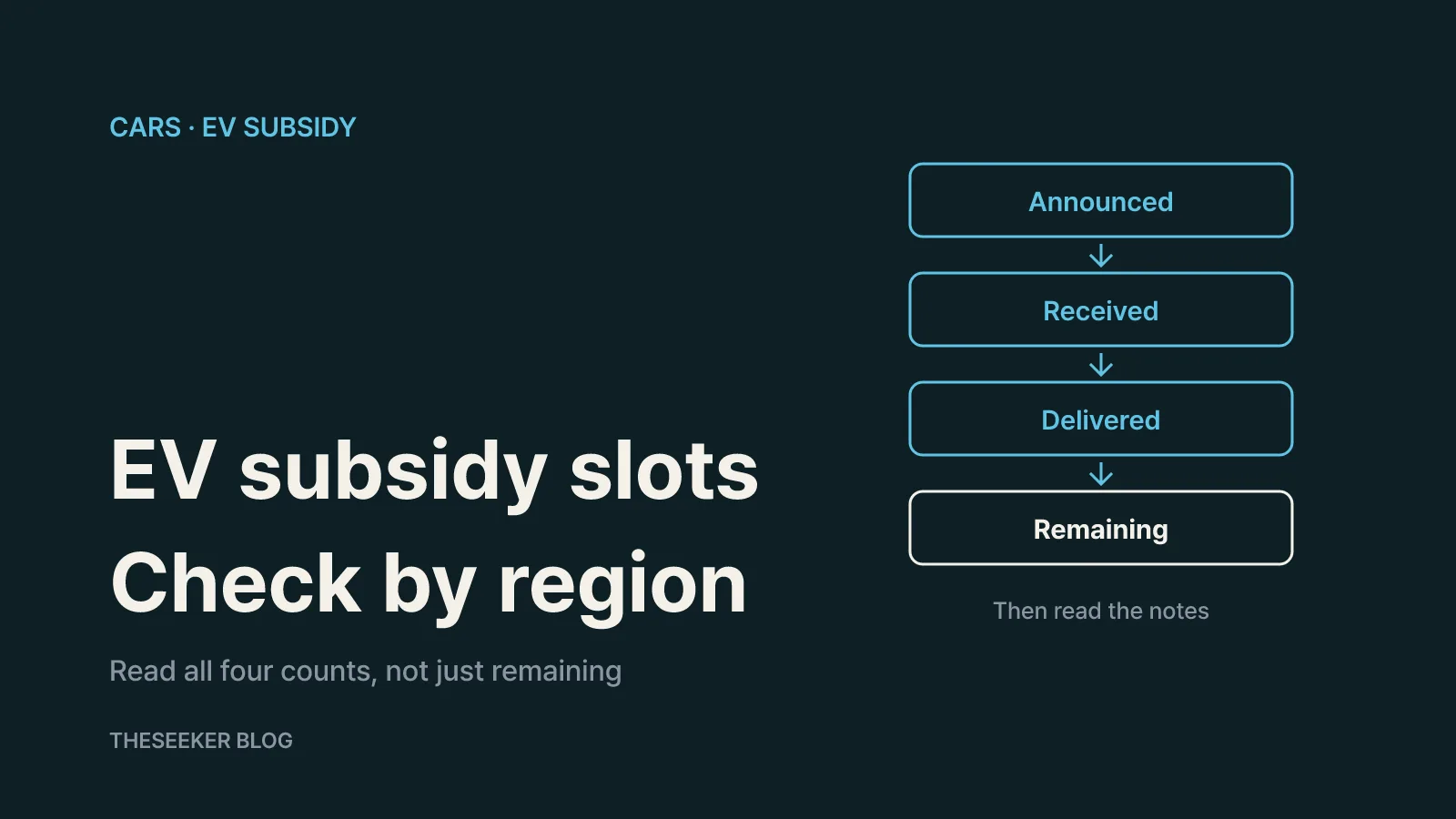
- How to read announced, received, delivered and remaining
- Why Seoul and Hwaseong are read differently
- Why a region can be closed with slots still showing
- What changed in 2026 and how it affects availability
- A checklist before you sign
- Sources
- Frequently asked questions
As of October 2026, the place to check how many electric vehicle purchase subsidies are left in your area of Korea is the local-government subsidy status page on the Zero Emission Vehicle portal (ev.or.kr). Choose your province or metropolitan city, then your city, county or district, then the vehicle type (passenger, cargo or van/bus), and the page shows four counts: announced slots, applications received, vehicles delivered and slots remaining. The remaining figure is a useful signal, but it is not the same as a guarantee that you can apply today. You also need to read the notes on the same page and the local government's own subsidy notice.
This guide is written for buyers who live in Korea, including foreign residents, and who want to check availability before signing a purchase contract. It walks through where the page is, what each number means, why Seoul and a city such as Hwaseong are read differently, why dealers sometimes say a region is closed when the table still shows slots, and what to check in order before you commit money.
Where to see EV subsidy slots left by region
Korea's Ministry of Climate, Energy and Environment finalised the 2026 EV subsidy guidelines on January 13, 2026 and published the guidelines and per-model national subsidy amounts on ev.or.kr (ministry press release, Korean). The national portion is set centrally, but each local government adds its own local subsidy and decides how many vehicles it will fund. That is why availability is tracked per local government rather than as one national number.
The lookup works like this:
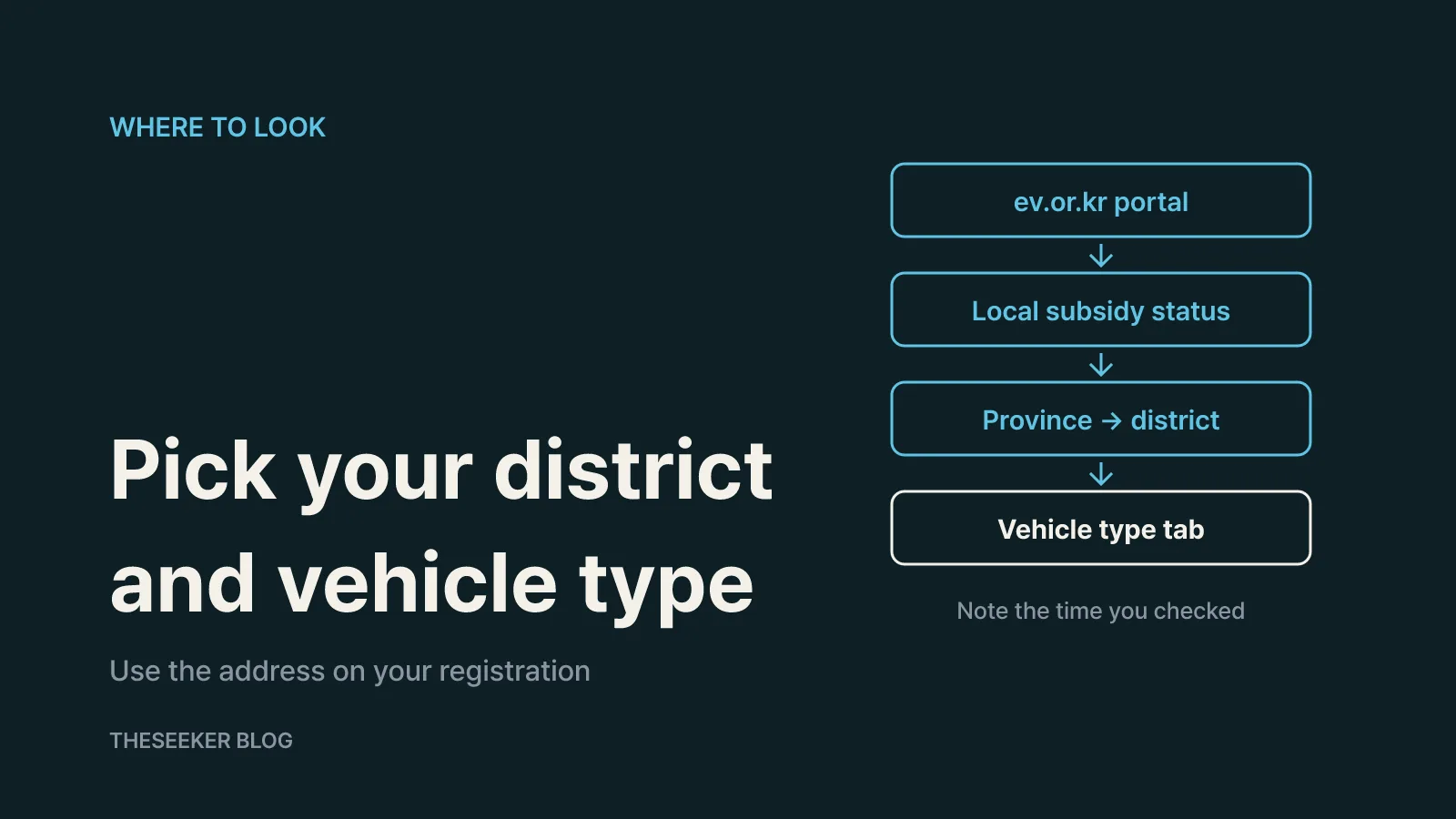
- Open ev.or.kr and go to the purchase subsidy section.
- Open the local-government subsidy status page (the menu label includes the Korean word 지자체별, meaning by local government).
- Select your province or metropolitan city first, then the city, county or district on your resident registration.
- Check each vehicle-type tab separately: passenger (승용), cargo (화물) and van/bus (승합).
Menu names change when the portal is redesigned. The independent guide site evlocal describes the path as purchase subsidy or subsidy payment status, then the local-government payment status table (evlocal lookup guide, Korean). If the wording differs slightly, look for the status menu that mentions local governments.
When you look at the table, note three things alongside the numbers: the date and time you checked, which vehicle tab you were on, and any notice text next to or below the table. The figures are snapshots, and words such as closed (마감), paused (일시중지) or waiting list (대기) often matter more than the count. Aggregator sites collect portal data for every region on one screen, which is handy for a quick scan, but evlocal itself states that its numbers are collection-time snapshots and that the portal and the local notice are the final reference.
How to read announced, received, delivered and remaining
The status table normally shows four figures. Knowing the difference is what lets you make sense of a dealer saying no when the table seems to say yes (evlocal guide to reading status, Korean).
- Announced (공고대수): the number of vehicles the local government has announced it will support for that round and vehicle type. Treat it as the ceiling.
- Received (접수대수): applications filed. An application is not an approval; it can be delayed by document checks, eligibility review or queue order.
- Delivered (출고대수): vehicles that have been delivered and registered so the process has moved forward. When a case counts as delivered can vary by local government.
- Remaining (잔여대수): what is left after subtracting used-up slots from the announced total. Zero usually means effectively closed, although an additional round can reopen it.
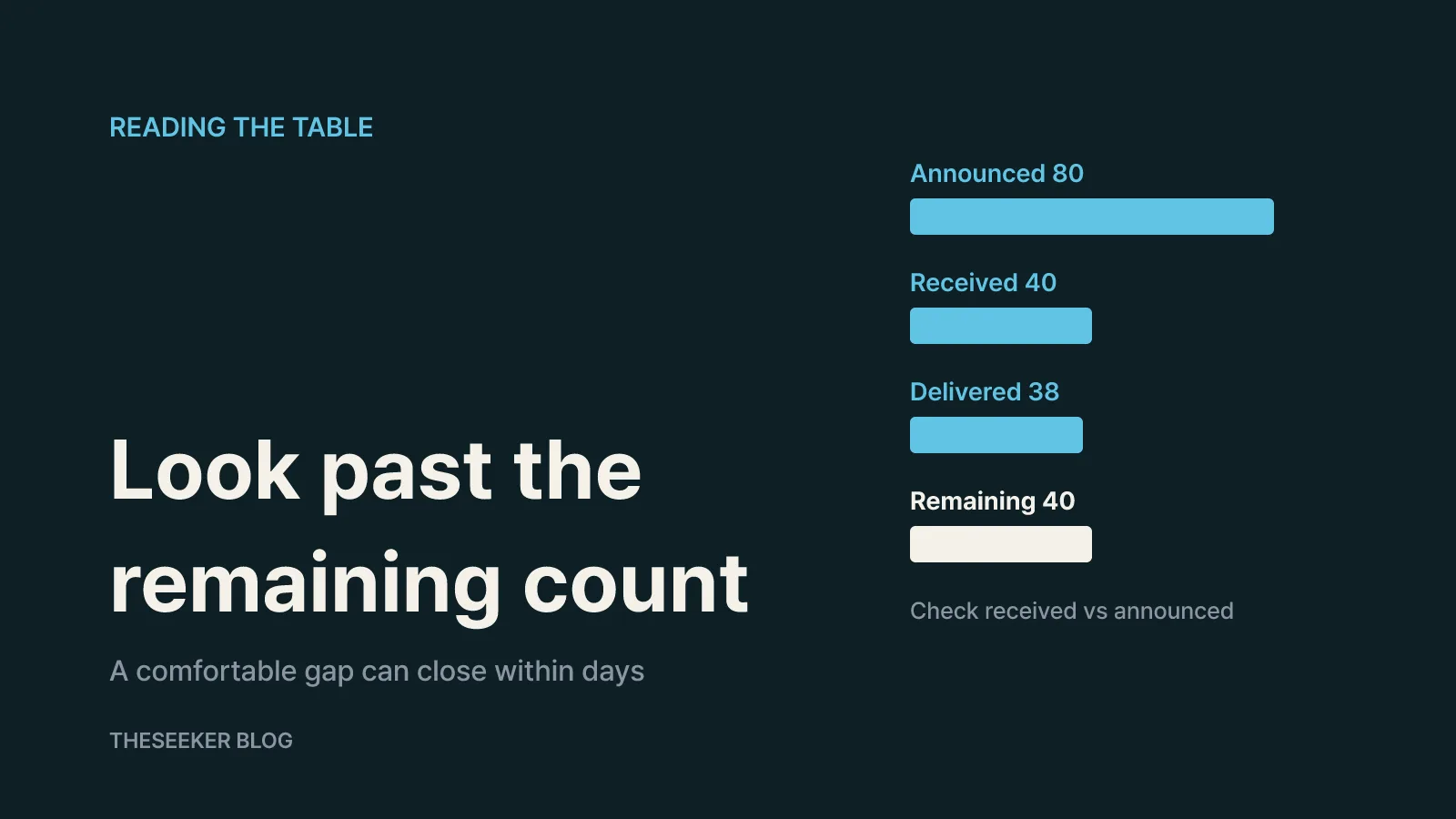
The most useful habit is to compare announced with received, not just to read the remaining count. If a table calculates remaining from deliveries, applications that are filed but not yet delivered are still sitting inside that remaining figure, so a healthy-looking number can already have a queue in front of it. If received is well below announced, there is more likely to be genuine room. When you cannot tell whether remaining is based on applications or deliveries, ask the local government's EV subsidy office directly.
The evlocal guide gives three examples worth remembering:
- Announced 100, received 130, remaining 0: applications exceed the allocation. The region may be taking applications first and selecting later. Cancellations can produce calls from the waiting list, but a large deposit before confirmation is risky.
- Announced 80, received 40, delivered 38, remaining 40: it looks comfortable, yet a busy weekend can change it within days. Record the time and check again just before signing.
- Passenger remaining 0, cargo remaining 5: passenger cars are closed unless you change vehicle type.
Why Seoul and Hwaseong are read differently
Applications are filed with the local government that has jurisdiction over where you live and register the car, so you need to look at the unit that actually takes applications. evlocal recommends matching the city, county or district on your resident registration before reading any numbers.
For Seoul, read the Seoul entry on the portal and the notice itself rather than relying on a search result. Metropolitan cities may run one city-wide notice or separate district notices, and that can change from year to year. The notice tells you who accepts applications, which tells you which row to read.
For Hwaseong and other cities inside a province, the province name alone does not identify the application unit. Choose Gyeonggi-do, then Hwaseong-si. Watch for duplicate names too: Gwangju-si in Gyeonggi-do and Gwangju Metropolitan City are different governments, and district names such as Jung-gu exist in several cities.
Amounts differ as well. In evlocal's September 2026 snapshot of 161 regions, the maximum local subsidy for passenger EVs ranged from 1.94 million won to 12.24 million won. Moving your address to chase a larger amount can backfire, because local governments can set residency-period requirements in their notices.
Why a region can be closed with slots still showing
evlocal lists delayed aggregation, applications waiting for selection and vehicle-type mismatches as common causes. Other structures you will see in the notes include:
- Separate actual-remaining figures: notes such as the portal remaining differs from the actual remaining mean the local government's own count is the reference.
- Support-availability requests: some regions order applicants by the time and number of a request that only designated dealers can submit. Refreshing the portal yourself does not create a place in line, and a slot can pass to the next number if delivery is not confirmed.
- Early closure: a notice saying it closes when the budget runs out can end intake before the printed deadline. Weekend surges often show up as a sharp drop on Monday.
- Paused intake: applications stop until a resumption notice is posted, whatever the table shows.
In the same September 2026 snapshot, 15 of 161 regions were accepting applications, 65 were closed and 80 were paused or on a waiting list. A closed region in autumn does not always mean the year is over; watch the local government's announcements for an additional round or cancellation call-ups, and treat a waiting-list place as a waiting-list place, not an approval.
What changed in 2026 and how it affects availability
According to the ministry's policy briefing, the 2026 EV subsidy budget is about 1.6 trillion won, enough for roughly 300,000 vehicles across all types (Korea.kr policy briefing, Korean). Per-vehicle rates were held at 2025 levels, and a new conversion bonus of up to 1 million won applies when you scrap or sell a combustion car that is more than three years past delivery and buy a new EV; transfers between family members are excluded. The briefing said the maximum for a mid-size passenger car rises from about 5.8 million won to 6.8 million won with the bonus. The guidelines also set expectations for the volume local governments fund with local money, aimed at regions running short of local budget.
For reading the status table, the takeaway is simple: national rates are the same everywhere, but regional availability still depends on how many vehicles each local government funds. When a second or third round opens, announced slots, local amounts, eligible models, contract-date cut-offs and priority allocations can all change, so reread the new notice instead of reusing an earlier quote.
A checklist before you sign
- Write down the province and city, county or district on your resident registration, and check for duplicate names.
- Open the local-government status page on ev.or.kr, select your region and vehicle tab, and record the figures with the time.
- Compare announced with received, not just remaining.
- Read the notes for closed, paused, actual-remaining, support-availability request or cut-off number wording.
- Read the local notice for residency rules, contract-date rules, priority allocations and who accepts applications.
- Ask the dealer which local government they will file with and when the car is expected to be delivered.
- If the table and the dealer disagree, call the local EV subsidy office and ask whether remaining is counted from applications or deliveries.
If everything lines up, you can sign with far less guesswork. If any step raises doubt, keep the deposit small, adjust the delivery timing or wait for the next round.
Sources
Frequently asked questions
Where can I check how many EV subsidies are left in my area of Korea?
Use the local-government subsidy status page on ev.or.kr. Select your province or metropolitan city, your city, county or district, and the vehicle type to see announced, received, delivered and remaining counts. Confirm with the local government's notice before signing.
If the remaining count is above zero, can I apply right away?
Not necessarily. Delayed aggregation, applications awaiting selection, type-specific closures, separate actual-remaining counts or dealer-only request systems can all make the real availability lower than the table suggests.
Do I check Seoul as one city or by district?
It depends on how that year's notice is organised. Read the Seoul entry on the portal and the notice's statement about who accepts applications to decide which figures apply to you.
Is the subsidy over for the year once remaining hits zero?
Not always. Additional rounds or cancellation call-ups can reopen intake, but conditions such as slots, local amounts and contract-date rules may change between rounds.
blog.theseeker.io/en/posts/ev-subsidy-remaining-status-by-region-korea
Ryan Mitchell
Ryan covers buying, insuring and maintaining a car, checking terms against manufacturer and agency publications so the options are easy to compare.
Read our editorial standards