Certifications in Your 30s in Korea: A Practical Guide
Choose a Korean certification by job relevance, exam eligibility and the next exam round rather than popularity rankings, using Q-Net and Work24 sources.
 Hannah Price
In this post
- Set three filters before you pick a certification
- Job relevance: read the job ads, not the rankings
- Eligibility: can you sit the exam now?
- Timing: work backwards from the next round
- Check eligibility for Engineer and Industrial Engineer exams
- Choose by goal: career change or on-the-job value
- Career change: meet the entry requirements of the new role
- On-the-job value: prove and extend what you already do
- Plan your study around the 2027 exam rounds
- See whether the Tomorrow Learning Card can cut course costs
- A checklist for workers in their 30s
- Sources
- Frequently asked questions
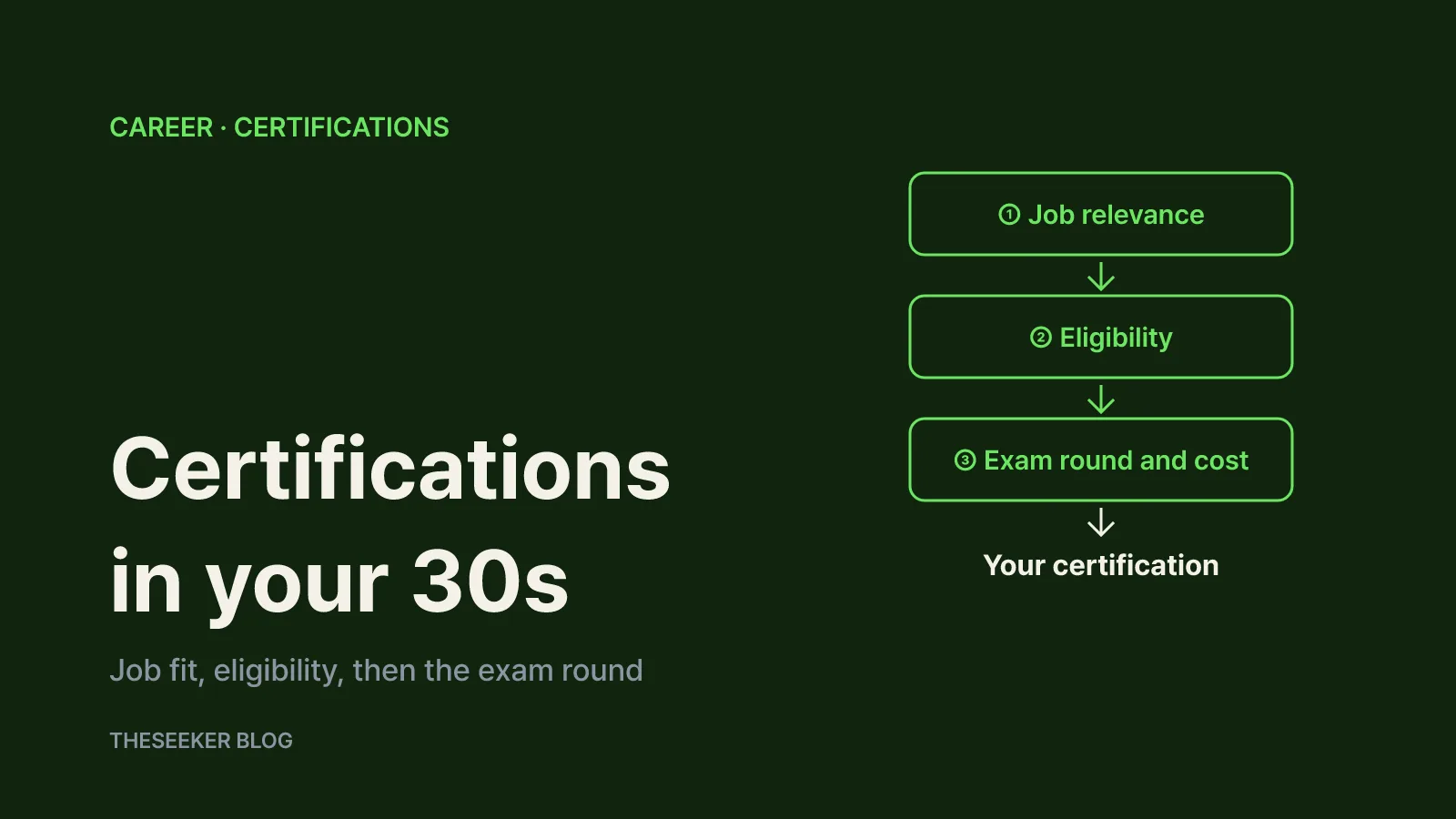
As of October 2026, the most reliable way to choose a certification in your 30s in Korea is to ignore popularity rankings at first and answer three questions. Does the qualification actually appear in the job ads for the role you do now or want next? Can you sit the exam today with your current education and work history? And does the next exam round leave enough time to study around a full-time job? This guide applies those questions to Korea's National Technical Qualifications, using the eligibility rules and exam calendar published on Q-Net, the exam portal run by HRD Korea (Human Resources Development Service of Korea), together with a Ministry of Employment and Labor interpretation and the Work24 guide to the Tomorrow Learning Card.
The focus here is the Korean system. If you work in Korea, whether you are Korean or an international employee planning to stay, these are the credentials that Korean employers list in job ads, and the rules below are specific to them. They do not translate directly to licensing systems in other countries.
Set three filters before you pick a certification
Job relevance: read the job ads, not the rankings
A ranking tells you how many people sit an exam, not whether the job you want requires it. Collect a batch of job ads for your target role and copy every qualification named under required qualifications and preferred qualifications. Count the required ones separately from the preferred ones. The required list tells you what to study first if you are changing careers; the preferred list tells you what can wait. If you plan to stay with your employer and broaden your role, check the internal job descriptions, promotion criteria and any certification allowance policy instead.
Eligibility: can you sit the exam now?
National Technical Qualifications are graded, and each grade has its own entry requirements. The Craftsman grade (gineungsa) has no requirements at all, but the Engineer grade (gisa) and Industrial Engineer grade (saneop-gisa) require a qualifying degree, relevant experience or a lower qualification. People in their 30s often already have enough work experience to open a route that has nothing to do with their university major. The catch is that experience in an unrelated field usually does not count.
Timing: work backwards from the next round
In 2026 the regular Engineer and Industrial Engineer exams ran in three rounds, and each round covered a different list of subjects. Find out which round includes your subject, then plan backwards from the written-exam application window so the exam does not land in your busiest season at work.
If the answer to any of the three questions is no, the certification is not the right one to start now, however highly it ranks. If all three are yes, even a less famous qualification can be the most efficient choice for your career.
Check eligibility for Engineer and Industrial Engineer exams
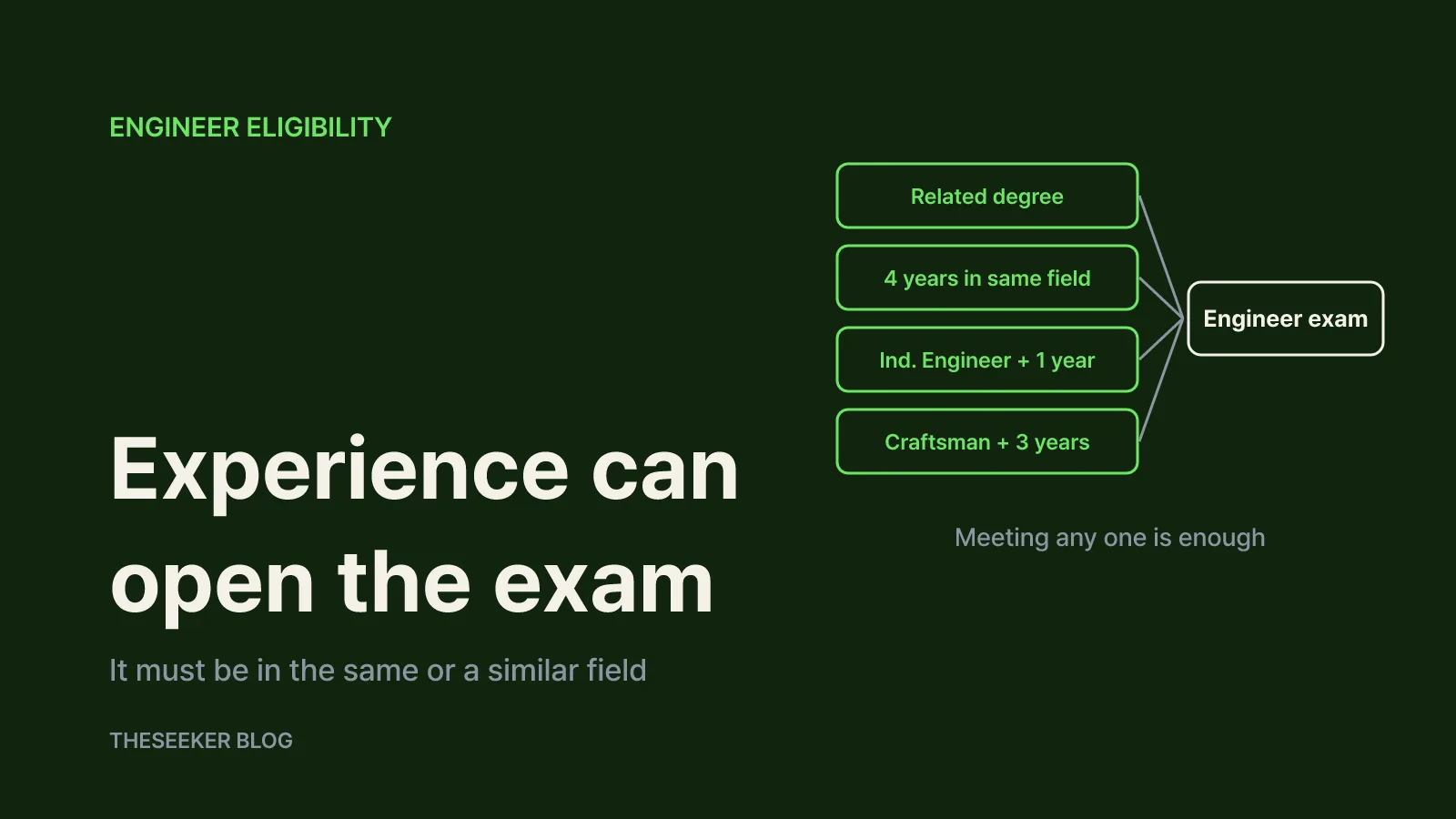
According to the Q-Net eligibility overview and a Ministry of Employment and Labor interpretation quoting Appendix 4-2 of the Enforcement Decree of the National Technical Qualifications Act, you can sit an Engineer exam if you meet any one of the following:
- You hold, or are about to receive, a university degree in a related major
- You have 4 years of hands-on experience in the same or a similar job field as the exam subject
- You hold an Industrial Engineer qualification and have 1 year of experience in the same or a similar field
- You hold a Craftsman qualification and have 3 years of experience in the same or a similar field
- You graduated from a related three-year college program and have 1 year of experience, or from a two-year program and have 2 years
- You already hold an Engineer-grade qualification in another subject within the same or a similar field
For the Industrial Engineer grade, routes include 1 year of experience after a Craftsman qualification, a related university or college degree (or being in your final year), or 2 years of relevant experience. The ministry's interpretation notes that meeting a single condition, or a single combined condition such as qualification plus experience, is enough.
The key word for workers in their 30s is experience. It means time spent doing work in the job field to which the exam belongs, or a field the rules treat as similar. It does not mean your total years of employment. Someone without a related degree who has spent more than 4 years in quality management can look at the experience route for a quality-related Engineer exam, but switching to an unrelated field may not count. Use the eligibility self-check on Q-Net and the appendix to the regulations to confirm which fields count as similar.
There is also an education route. The notes to the decree say that a person recognized for 106 or more credits under the Act on Acknowledgment of Credits is treated as a prospective university graduate, provided at least 18 of those credits are not simply converted from credits earned while enrolled at a university. This is why some workers without a related degree use the Academic Credit Bank System to open an eligibility route. Prospective-graduate status is judged as of the written exam date.
If you do not qualify for the Engineer grade yet, starting with the Craftsman grade is a legitimate path. After a Craftsman qualification plus 3 years of experience in the same or a similar field, you can sit the Engineer exam. It looks like the long way round, but if the subject matches your current work, the qualification and the experience build at the same time.
Plan for paperwork as well. The Q-Net 2026 exam calendar states that candidates who provisionally pass the written exam must submit original eligibility documents within that round's submission period, and that you can only apply for the practical exam once your documents have been submitted and reviewed. If you are relying on work experience, ask your employer early about issuing a certificate of employment history.
Choose by goal: career change or on-the-job value
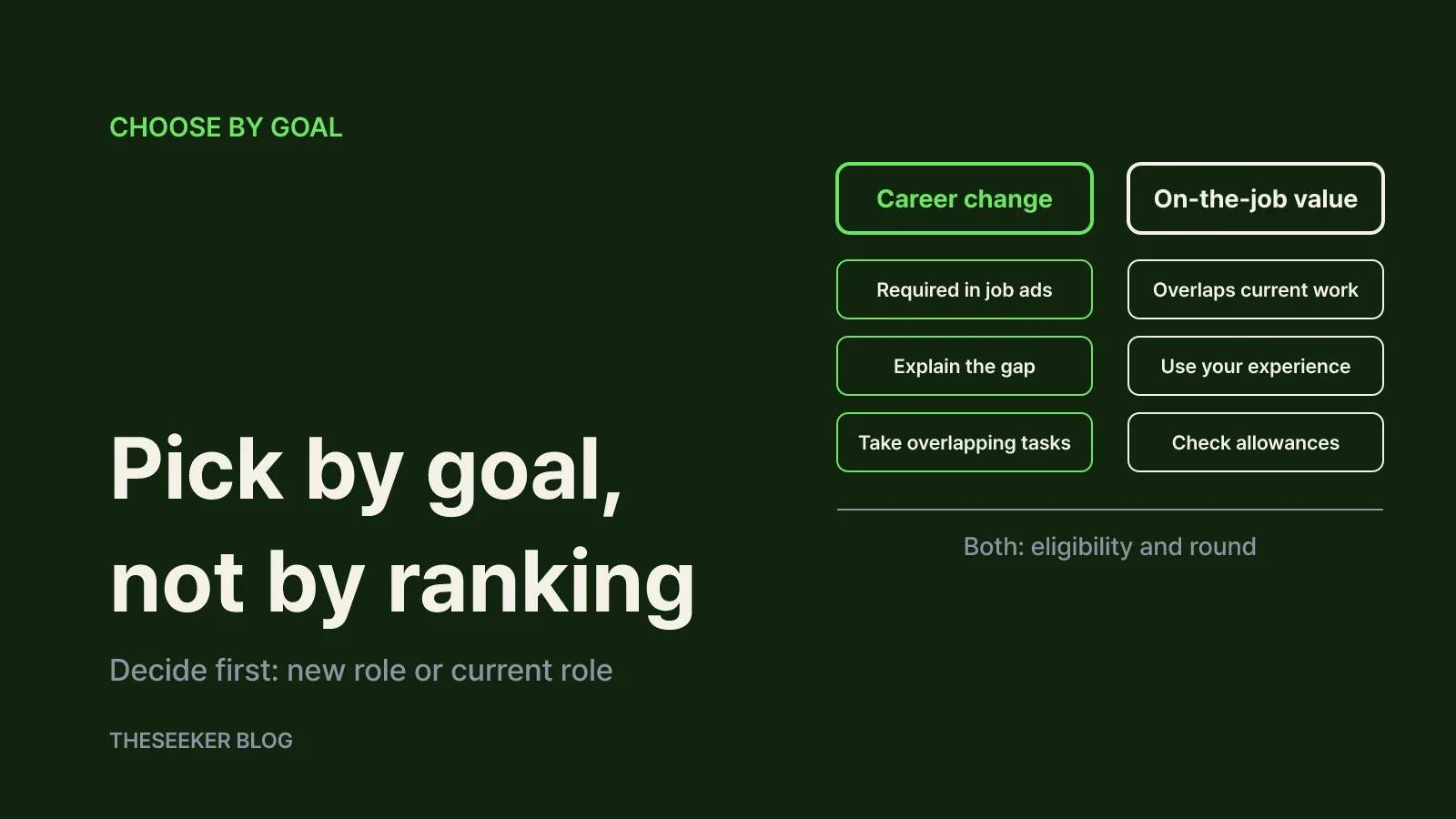
Two people of the same age can need very different certifications. Write down in one sentence which goal applies to you.
Career change: meet the entry requirements of the new role
When you switch roles, a certification helps explain why you are credible despite limited experience in that field. Prioritize the subjects that show up repeatedly as required in job ads. In practice, a certification alone rarely gets someone in their 30s into an experienced-hire role, so pair your study with any overlapping tasks you can take on in your current job. That experience in the same or a similar field also counts later if you want to move up a grade.
On-the-job value: prove and extend what you already do
If you are staying in your role and want to show expertise, the most efficient choice is a subject that overlaps heavily with your daily work. You revise while you work, and your experience is more likely to satisfy eligibility. Check whether your employer offers a certification allowance or covers training costs.
The 2026 subject lists on Q-Net include qualifications across many office and technical fields. The table below is a starting point by job area, not a ranking.
← Swipe to see more
| Current or target work | National Technical Qualifications to consider | Check first |
|---|---|---|
| Software and IT operations | Engineer Information Processing, Industrial Engineer Information Processing | Eligibility route by grade |
| Office administration | Industrial Engineer Office Automation | Industrial Engineer eligibility |
| Quality and production management | Engineer and Industrial Engineer Quality Management | Same or similar field experience |
| Safety and health | Engineer Industrial Safety, Engineer Construction Safety, Engineer Industrial Hygiene Management | Exam standard period |
| Facilities and electrical | Engineer Electricity, Engineer Fire Protection System (Electrical) | Practical exam format |
| Research and surveys | Social Research Analyst Level 2 | Service-field eligibility |
| HR, training and counseling | Vocational Counselor Level 2 | Service-field eligibility |
| Events and marketing | Convention Planner Level 2 | Which round offers it |
Service-field qualifications follow a separate eligibility system that varies by subject; Q-Net points to Appendix 11-4 of the Enforcement Rules for the full list. Deprioritize anything in the table that does not connect to your work, and look first at any qualification that appears repeatedly in ads for your target role, even if it is not listed here.
Plan your study around the 2027 exam rounds
In the 2026 regular exams, the third-round practical exam runs from October 24 to November 13, 2026, with final results on December 11 and December 18. Applications for that round, including the extra application window for vacated places, have already closed. If you start studying now, a 2027 round is the realistic target. The 2027 dates must be confirmed on Q-Net, but the 2026 pattern gives you a usable framework.
← Swipe to see more
| 2026 round | Written application | Written exam | Practical exam | Final results |
|---|---|---|---|---|
| Round 1 | Jan 12 to 15 | Jan 30 to Mar 3 | Apr 18 to May 6 | Jun 5 and 12 |
| Round 2 | Apr 20 to 23 | May 9 to 29 | Jul 18 to Aug 5 | Sep 4 and 11 |
| Round 3 | Jul 20 to 23 | Aug 7 to Sep 1 | Oct 24 to Nov 13 | Dec 11 and 18 |
In Round 1, the time from the written-exam application to final results was about 5 months. Pick a round where the gap between the written and practical exams does not collide with your peak workload. Applications open at 10:00 on the first day and close at 18:00 on the last day, and you cannot apply on weekends or public holidays, although the extra window for vacated places does include holidays.
Always check which round offers your subject. Engineer Information Processing and Engineer Industrial Safety appeared in all three 2026 rounds, but Vocational Counselor Level 1 and Social Research Analyst Level 1 appeared only in Round 3, and Convention Planner Level 1 only in Round 2. If your subject is offered once a year, missing that round means waiting a full year.
Check fees and exam standards on the subject page. The Q-Net page for Engineer Industrial Safety lists fees of 19,400 won for the written exam and 34,600 won for the practical exam, and shows two exam standards: one for January 1, 2024 to December 31, 2026 and another for January 1, 2027 to December 31, 2029. If you sit the exam in 2027, make sure your textbook or course reflects the new standard.
See whether the Tomorrow Learning Card can cut course costs
If you plan to take a course, check whether you qualify for the National Tomorrow Learning Card. According to Work24, the card covers up to 3 million won in training fees over 5 years, and certain groups, such as fixed-term, dispatched and part-time workers, can receive an extra 2 million won, up to a total of 5 million won. You normally pay 15 to 55 percent of the course fee yourself; the exact share falls between 0 and 55 percent of the government-approved fee and depends on factors such as the average employment rate for the course's occupation.
The exclusions matter for people in their 30s. Public servants, private school staff, and employees of large companies who earn 3 million won or more per month and are under 45 are not eligible. If you work for a large company, confirm your status before building a study budget around the card. People who are already employed generally do not need to register as job seekers to apply on Work24.
Know the conditions, too. The card is valid for 5 years, and any unused balance disappears when it expires. Courses of 140 hours or more require a training consultation before you enroll. If you drop out without an unavoidable reason, your limit is reduced by 200,000 won, 500,000 won or 1 million won depending on how many times it has happened. If you are unsure which course to take, Work24 offers a consultation that assesses your job skills and recommends training and certifications.
A checklist for workers in their 30s
- Collect job ads for your target role and separate required qualifications from preferred ones.
- Use the Q-Net eligibility self-check to see whether education, experience or an existing qualification gives you a route.
- If you are using experience, confirm it is in the same or a similar field and ask your employer how to get an employment history certificate.
- Check the 2027 Q-Net notice to see which rounds offer your subject.
- Check fees and the exam standard period on the subject page before buying study materials.
- If you plan to take a course, confirm whether you are excluded from the Tomorrow Learning Card and what share you would pay.
- Work backwards from the written-exam application date to set weekly study hours, and add the eligibility document deadline to your calendar in advance.
In your 30s, one certification that connects to your experience and is earned on time usually does more than several unrelated ones. Before you look at any ranking, line up three things: the job ads, your eligibility and the exam round.
Sources
Frequently asked questions
Can I take an Engineer exam in Korea without a related degree?
Yes, through other routes. 4 years of experience in the same or a similar job field qualifies you regardless of your degree, as does a Craftsman qualification plus 3 years of experience or an Industrial Engineer qualification plus 1 year. Recognition of 106 or more credits through the Academic Credit Bank System can also count as prospective-graduate status, subject to conditions.
Should I start with the highest-ranked certification?
Rankings reflect how many people take an exam, not what your target employer requires. Start with the qualifications that appear repeatedly as required or preferred in job ads for the role you want.
Can I still apply for a 2026 Engineer exam?
No. Applications for the third round of the 2026 regular exams, including the extra window, have closed, and the practical exam runs from October 24 to November 13. If you are starting now, aim for a 2027 round and check Q-Net for the dates.
Does the Tomorrow Learning Card pay for certification courses?
It covers training fees for courses registered on Work24, up to 3 million won over 5 years, and you usually pay 15 to 55 percent of the fee. Employees of large companies who earn 3 million won or more per month and are under 45 are excluded.
What do people most often miss after passing the written exam?
Submitting eligibility documents. Candidates who provisionally pass the written exam must submit original documents within that round's submission period, and they can only apply for the practical exam after the documents have been reviewed.
blog.theseeker.io/en/posts/certifications-30s-career-change-job-value-guide
Hannah Price
Hannah covers job searching, the workplace and preparing for professional exams, confirming dates and requirements against notices from the bodies that run them.
Read our editorial standards