How to Get a Forklift License in Korea: Exams, Costs, Jobs
In Korea, forklifts of 3 tonnes or more require the Craftsman Fork Lift Truck Operator certificate, while smaller ones can be licensed through a training course. Here is how the exams, costs, licence paperwork and job market actually work.
 Hannah Price
In this post
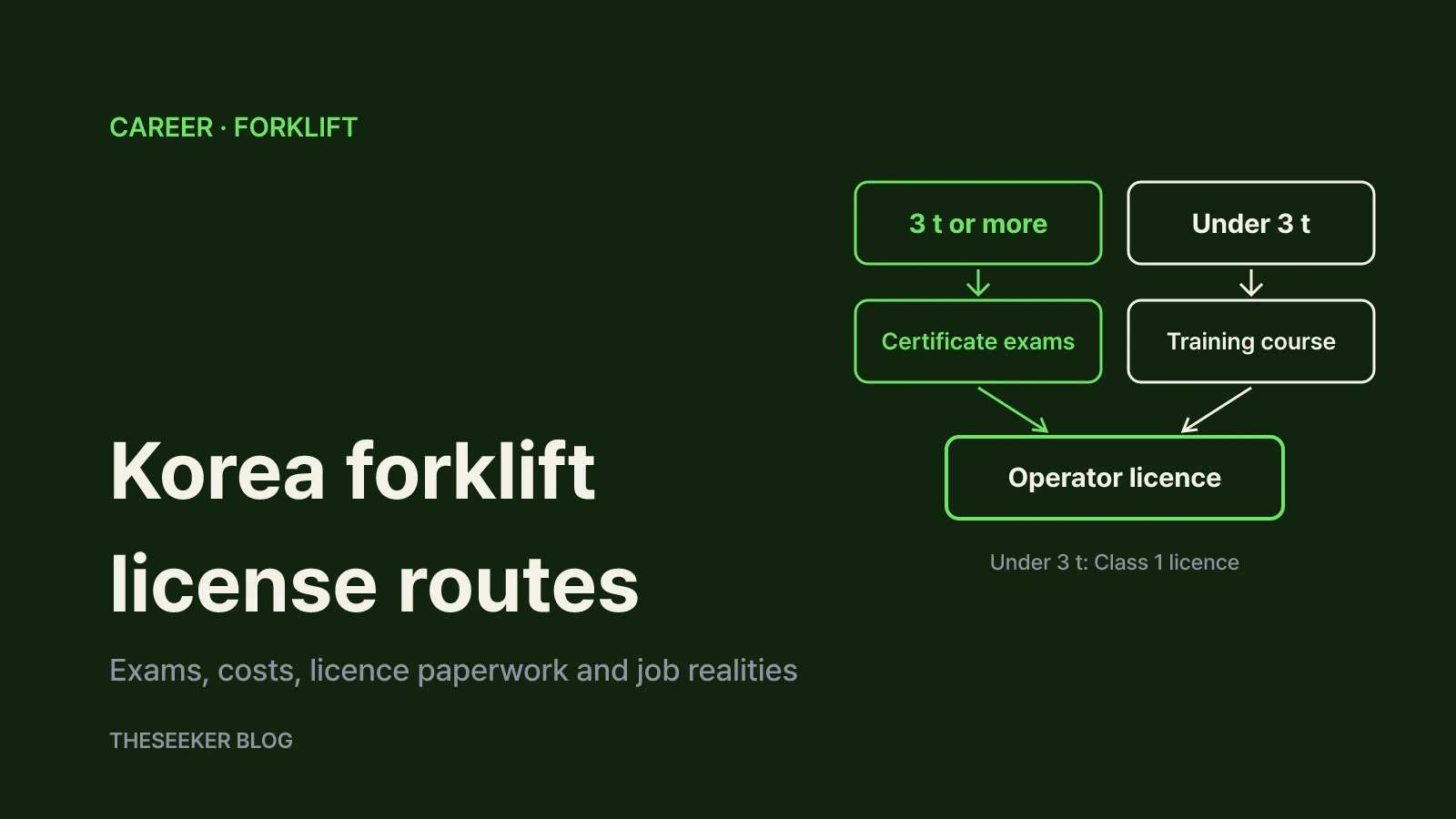
As of October 2026, there are two routes to operating a forklift legally in South Korea. For forklifts of 3 tonnes or more, you pass the national technical qualification called Craftsman Fork Lift Truck Operator (지게차운전기능사), run by HRD Korea, and then apply to your local city, county or district office for a construction machinery operator licence. If you will only operate forklifts under 3 tonnes, you can instead complete a small construction machinery operation course at a designated training institution. The certificate exam has no eligibility restrictions: the written test is 60 multiple-choice questions in 60 minutes, and the practical test covers forklift operation and driving. Be realistic, though. Fewer than half of practical candidates have passed in each of the last three years, and the certificate on its own does not guarantee a high salary.
Two routes, split at 3 tonnes
Korea treats forklifts as construction machinery under the Construction Machinery Management Act. According to a legal interpretation published by the Ministry of Government Legislation, anyone operating construction machinery generally needs a construction machinery operator licence. However, for small construction machinery defined by ministry ordinance, completing an operation course at an institution designated by the provincial governor counts as holding the licence, and "forklifts under 3 tonnes" are on that list (Ministry of Government Legislation interpretation 08-0372).
That gives you two options:
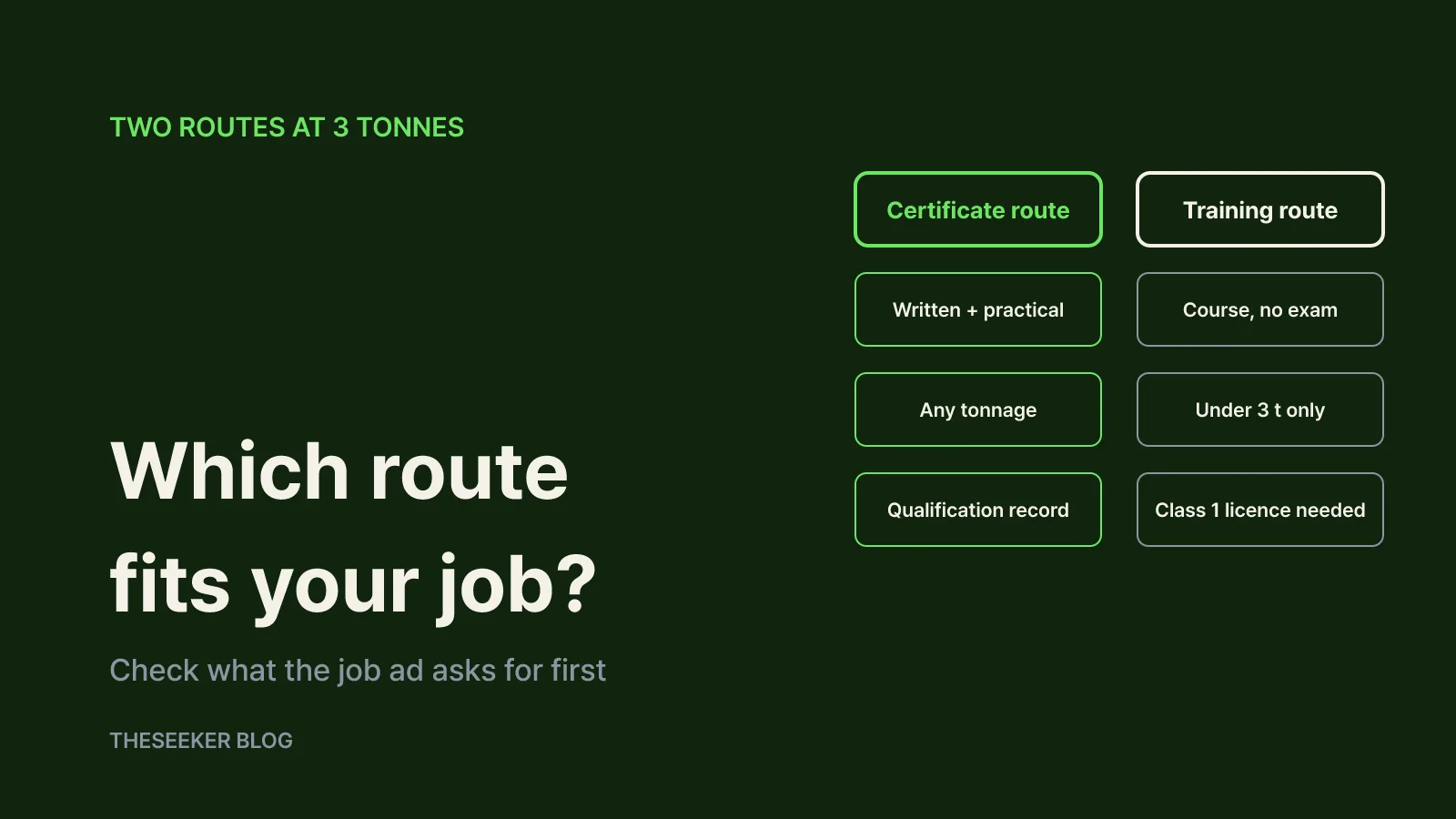
- Certificate route: pass the Craftsman Fork Lift Truck Operator exam, then apply for the operator licence using your qualification record. You need this route to operate machines of 3 tonnes or more.
- Training route: complete the small machinery course and apply for a licence with the completion certificate, without an exam. The licence is limited to forklifts under 3 tonnes.
The training route has one major condition. The same interpretation states that operating a forklift under 3 tonnes requires a Class 1 ordinary driving licence or higher, and that a Class 2 ordinary licence is not enough. Cheonan City's vehicle registration office repeats this on its licence page (Cheonan City licence guide). The interpretation reflects the law at the time it was issued, so confirm current requirements with your local office before you pay for a course.
Let the job decide. Check whether the warehouse or factory you are targeting uses machines under 3 tonnes, and whether job ads ask specifically for the certificate. If they do, a training-course licence may not meet the requirement.
The written exam: 36 correct answers out of 60
Q-Net, the official exam portal, lists the Ministry of Land, Infrastructure and Transport as the responsible ministry and HRD Korea as the exam body, and notes that the certificate can also be earned through a course-based assessment route (Q-Net certificate page). There are no education, experience or age requirements to sit the exam (SchoolMap summary of Q-Net data).
The written test has 60 four-option multiple-choice questions in 60 minutes, and you pass with 60 out of 100, which means 36 correct answers. Subjects cover driving, loading, transport, unloading and safety management. In practice, that includes protective equipment, pre- and post-shift inspections, road traffic rules, construction machinery law, and the structure of engines, hydraulics and attachments.
A practical study order:
- Start with law and safety. Questions on road signs, machinery registration and penalties are mostly memorisation and are quick wins.
- Learn machine parts visually. Mast, lift chain, tilt cylinder and hydraulic pump also come up in the practical inspection, so learn where each part sits.
- Practise in computer-based format. Q-Net offers a CBT trial menu, so look at the screen layout before exam day.
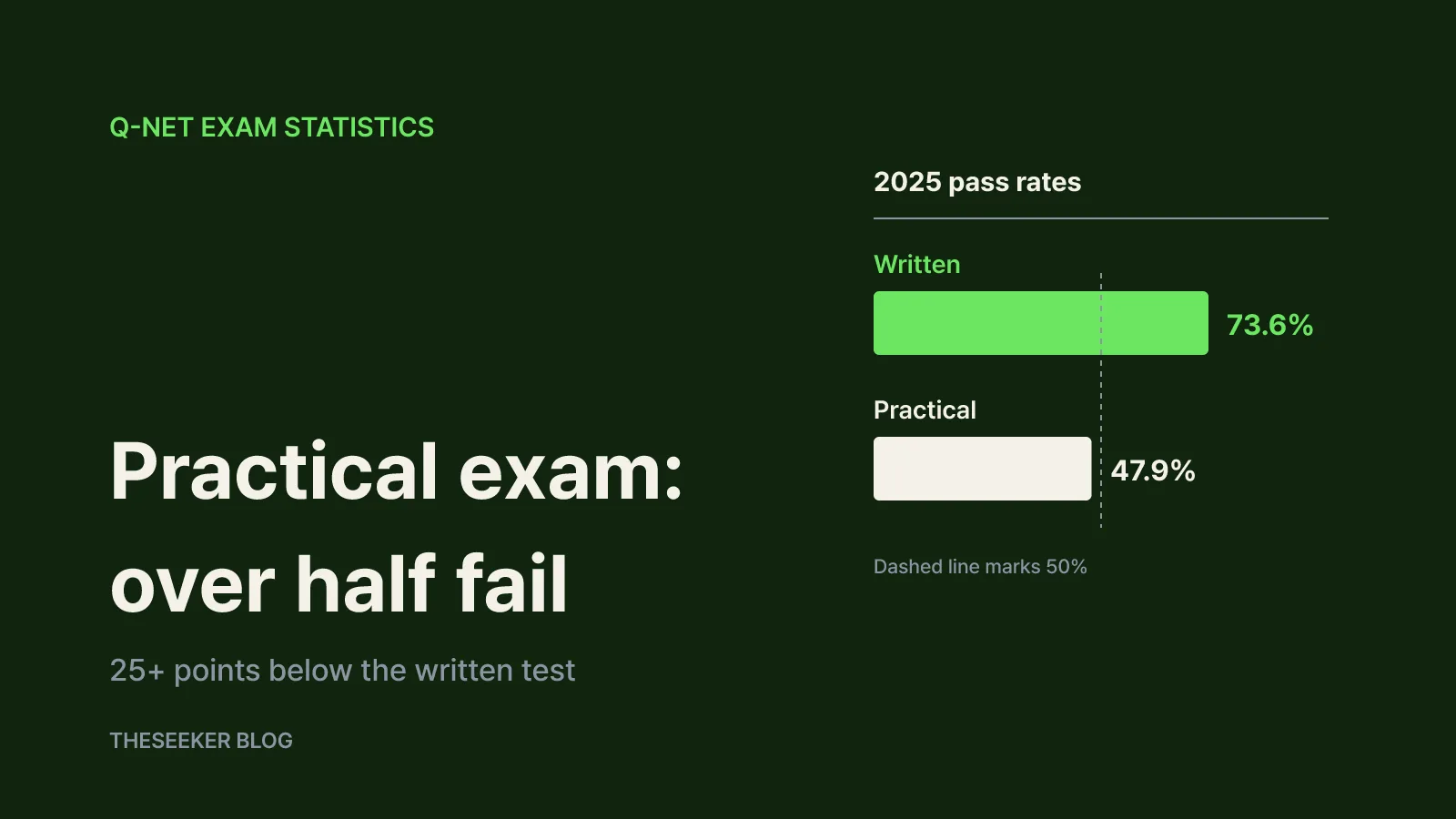
According to Q-Net figures compiled by SchoolMap, the written pass rate was 73.6% in 2025 (110,316 candidates), 74.6% in 2024 and 73.6% in 2023. Passing the written test exempts you from it for a set period. Check the exact window on Q-Net's written-exam exemption page.
The practical exam: more than half fail
The practical test, "forklift operation and road driving", is a hands-on task of about four minutes held outdoors, with a pass mark of 60 out of 100. Wearing protective gear, keeping the area tidy and following safety rules can all be scored.
The pass rate is the real hurdle: 47.9% in 2025 (126,757 candidates), 46.8% in 2024 and 47.3% in 2023. That is more than 25 percentage points below the written exam. More people sit the practical than the written test, which suggests many candidates are retaking it. Lifting a load and setting it down precisely means managing steering, fork height and mast tilt at the same time, and that only comes with seat time.
The dress code is strict. Q-Net requires long sleeves and long trousers that leave no skin exposed (arm sleeves are allowed). Shorts, cropped trousers, ripped jeans and skirts are not allowed. Footwear must be safety shoes or trainers, and sandals, slippers and high heels are not allowed. Candidates with a blood alcohol concentration of 0.03% or higher, the Road Traffic Act threshold, cannot sit the test (Q-Net candidate checklist). Test centres may also use different machine models, so ask before you book.
What it costs: practice time matters more than fees
Break the budget into four parts:
← Swipe to see more
| Item | What it covers | Where to check |
|---|---|---|
| Written exam fee | Set per session | Q-Net written exam fee page |
| Practical exam fee | Varies by certificate | Q-Net practical exam fee page |
| Training school | Practical lessons or the under-3-tonne course | Course provider notices |
| Licence issuance | Local government fee | Your city or district office |
Cheonan City lists the licence issuance fee as 2,500 won. Exam fees can change, so this guide does not quote them. Use the amount shown on Q-Net when you register.
The biggest cost differences come from lessons and retakes. Many people self-study for the written test, but the practical requires access to a real machine. With a pass rate below 50%, it is sensible to budget for one retake: another practical fee plus extra practice hours. When comparing schools, ask whether you will practise on the same model used at your test centre, how many practice hours are included, whether the course qualifies for government training support such as the National Tomorrow Learning Card, and whether the course is the certificate prep class or the under-3-tonne licence course.
After you pass: licence paperwork and ongoing duties
Passing the exam does not let you drive a forklift yet. You still need the operator licence. Cheonan City lists these documents for a new licence:
- An application form for the construction machinery operator licence
- Your national technical qualification record, or the original small machinery course completion certificate
- A medical certificate meeting the Class 1 driving licence standard, or a Class 1 driving licence (Class 1 ordinary or higher is mandatory for the under-3-tonne forklift licence)
- One 3.5 × 4.5 cm photo taken within the last six months
The obligations continue after that. If you operate construction machinery, or plan to that year, you must complete 4 hours of safety training every 3 years from the date you first obtained the licence or added a category. Licence holders must take a periodic aptitude test every 10 years (every 5 years from age 65). If you will not use the licence, return it before the test deadline. Cheonan City warns that failing to do so can lead to a fine of up to 2 million won and cancellation of the licence.
Job realities to know before you apply
You will see claims online that a forklift certificate leads straight to a big pay packet. This guide does not quote salaries, because pay depends heavily on region, company size, shift patterns and whether the role also includes loading, picking or inspection work. Compare actual job ads instead.
When reading a posting, check four things:
- Experience: many ads ask for experience or familiarity with specific equipment alongside the certificate. New holders should target postings without experience requirements and be ready to describe their practice hours in detail.
- Scope: driving only, or driving plus manual handling? The physical load differs a lot.
- Shifts: logistics centres often run night and weekend shifts, so confirm hours and breaks before signing.
- Equipment: a training-course licence may be enough where only machines under 3 tonnes are used, but if the ad asks for the certificate, the ad is the standard.
Treat the certificate as an entry ticket. Safe handling habits and site experience are what widen your options later. A good first step is to check the next written-exam session and your nearest practical test centre on Q-Net today.
Sources
Frequently asked questions
Are there age or education requirements for the Korean forklift certificate exam?
No. The Craftsman Fork Lift Truck Operator exam has no education, experience or age requirements. When you apply for the operator licence afterwards, you need a medical certificate at the Class 1 driving licence standard or a Class 1 driving licence.
Can I get the under-3-tonne forklift licence with a Class 2 driving licence?
According to a Ministry of Government Legislation interpretation and local government guidance, the under-3-tonne forklift licence requires a Class 1 ordinary driving licence or higher. Confirm current rules with your local office before enrolling in a course.
Can I operate a forklift as soon as I pass the exam?
No. You must apply separately to your city, county or district office for a construction machinery operator licence, submitting your qualification record, medical certificate and photo. Cheonan City lists the issuance fee as 2,500 won.
What should I wear to the practical test?
Q-Net requires long sleeves, long trousers and safety shoes or trainers. Shorts, cropped trousers, skirts, sandals and slippers are not allowed, and candidates at or above 0.03% blood alcohol cannot sit the test.
How much are the exam fees?
Fees can change, so check the written and practical exam fee pages on Q-Net or the amount shown during registration. If you retake the practical, you pay the fee again.
blog.theseeker.io/en/posts/forklift-license-korea-exam-cost-job-guide
Hannah Price
Hannah covers job searching, the workplace and preparing for professional exams, confirming dates and requirements against notices from the bodies that run them.
Read our editorial standards