Choosing Diet Meal Delivery: Calories, Protein and Terms
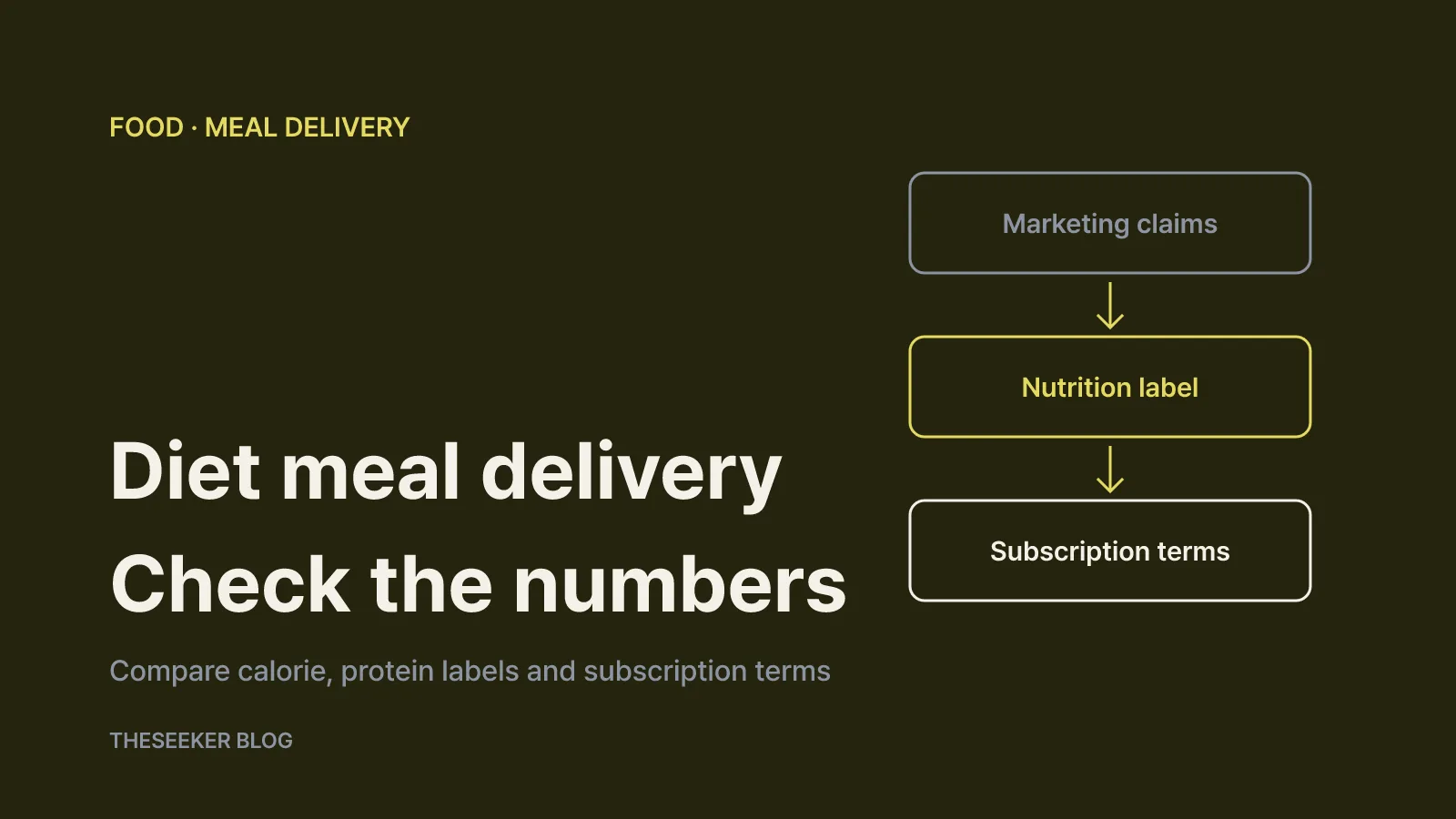
Read the nutrition label's serving basis before the marketing, then compare cost per meal, delivery rhythm, storage and cancellation terms side by side.
 Chloe Morgan
In this post
- What a consumer agency test found in subscription diet meals
- How to read calories and protein on a meal label
- What low-calorie and high-protein claims are allowed to mean
- Comparing subscriptions: cost per meal, delivery and storage
- Cancellation and refund rules to check before you subscribe
- A final pre-order checklist
- Sources
- Frequently asked questions
As of October 2026, the most reliable way to choose a diet meal delivery service is to ignore the "low-calorie" and "high-protein" badges at first and read two things instead: the numbers on the nutrition label and the subscription's delivery and cancellation terms. That advice comes from evidence, not caution for its own sake. When South Korea's consumer agency, the Korea Consumer Agency (KCA), tested 52 subscription lunchboxes, 37 failed the country's food labeling standards. The rules quoted below are Korean, but the checking routine works for any healthy meal delivery comparison, and this guide does not recommend any particular company.
What a consumer agency test found in subscription diet meals
The KCA survey, as reported by Food Journal, shows exactly where labels go wrong. Of the 52 products, 33 made nutrient claims such as low-calorie, low-sodium or high-protein, and 12 of those (36.4%) did not meet the claim criteria.
The low-calorie claims were the weakest. All nine products marketed as low-calorie exceeded the legal threshold of 40 kcal per 100 g, coming in at 140 to 237 kcal per 100 g, or 3.5 to 5.9 times the limit. One of eight high-protein products contained 9 g of protein against an 11 g threshold. Nine of 12 low-sodium products and three of nine low-fat products also missed their criteria.
Plain numbers were not always accurate either. Among 50 products that printed a nutrition panel, 33 (66.0%) fell outside the permitted tolerance, with gaps of up to 433%. Sugar was the most common problem, affecting 26 products, and three meals labeled "0 g sugar" contained 2 to 4 g. In addition, 28 products used wording that could suggest disease benefits, such as references to diabetes, obesity suppression or detox, and eight lacked mandatory details such as the use-by date. The agency recommended corrections and said it would ask the food safety regulator to prevent ordinary meal boxes from being mistaken for medical-purpose meal products designed for patients with conditions such as diabetes or hypertension.
How to read calories and protein on a meal label
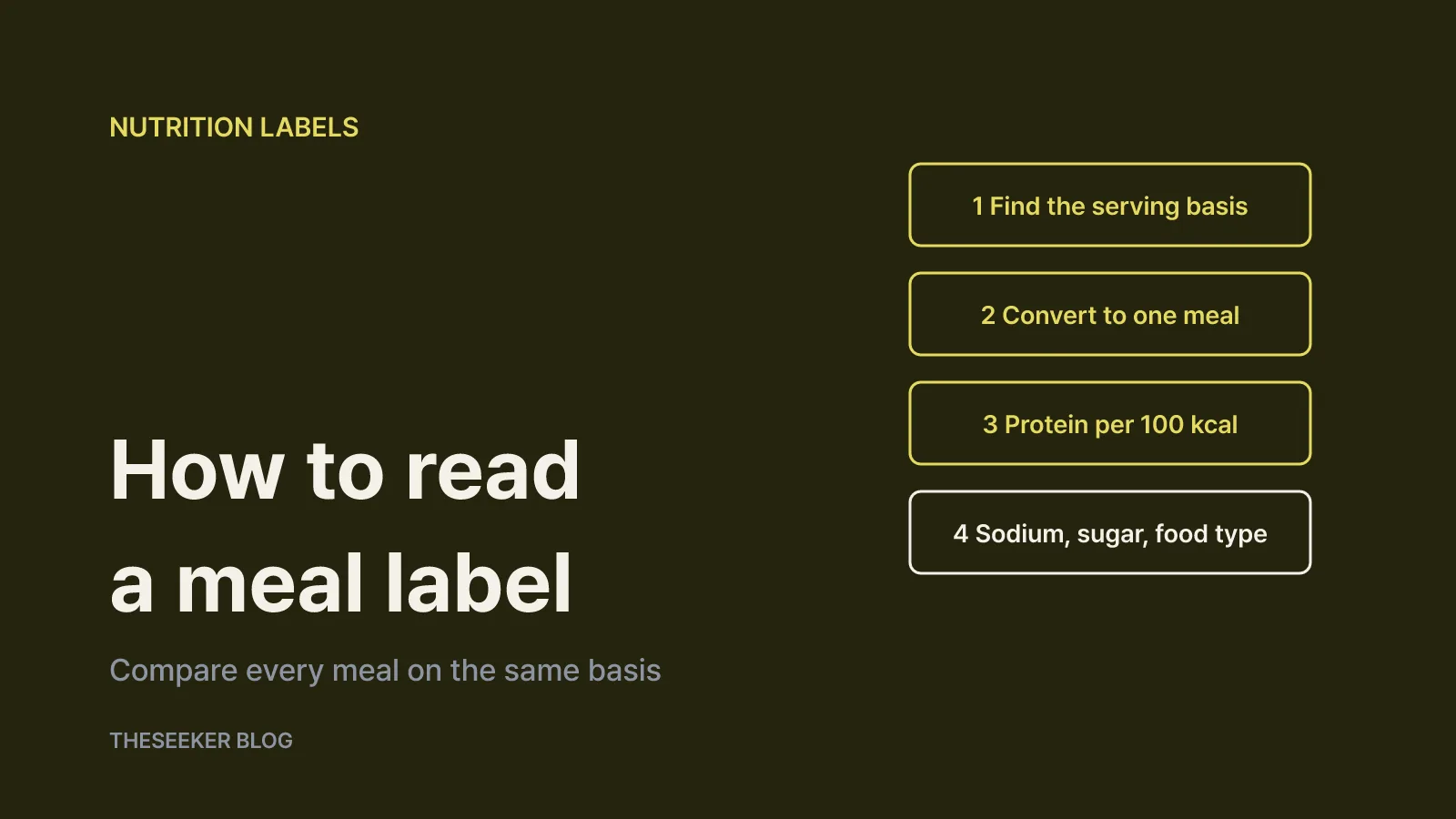
Product pages lead with photos and reviews, but a fair comparison starts with the label. Work through it in this order.
- Find the serving basis. A figure can refer to the whole pack, to 100 g or to a reference serving. If you eat the whole box in one sitting, record the whole-pack calories and protein.
- Convert everything to one meal. If one brand lists values per 100 g and another per pack, multiply or divide by the net weight. If the weight is missing, mark the row "needs checking" rather than guessing.
- Calculate protein density. Divide grams of protein by calories and multiply by 100 to get protein per 100 kcal. A 350 kcal meal with 25 g of protein gives roughly 7.1 g per 100 kcal. Between two meals with similar calories, the denser one delivers more protein for the same energy.
- Add sodium and sugar to the same row. Some low-calorie meals rely on heavily seasoned sauces. Under the Korean standard, sugar below 0.5 g may be printed as zero.
- Check the food type and ingredients. Confirm whether the product is ordinary food or a medical-purpose meal product, and read allergen information at the same time.
If sauces come in separate sachets, check whether the label includes them, because using the whole sauce can change both calories and sodium.
What low-calorie and high-protein claims are allowed to mean
According to the KCA consumer webzine, Korea's labeling standard sets these claim thresholds:
- Low-calorie: under 40 kcal per 100 g
- High-protein: at least 11 g per reference serving, which is 20% of the 55 g daily value
With those numbers in mind, a rice-and-sides lunchbox labeled low-calorie deserves a second look. Ask whether the phrase is a formal nutrient claim or simply marketing that means "lighter than a regular lunchbox".
Labels also carry tolerances. The same webzine explains that actual carbohydrate and protein must be at least 80% of the declared amount, while fat and sodium must be below 120%. A meal declaring 25 g of protein can therefore contain somewhat less and still comply, so if you are tracking a tight protein target, plan your day with some margin. In the agency's separate test of subscription chicken salads, six of 17 labeled products fell outside tolerance, with fat reaching up to 185% of the declared value.
Comparing subscriptions: cost per meal, delivery and storage
Once two or three candidates pass the label check, compare the subscription terms. Many plans are sold by period, such as two weeks, but the same period can include different numbers of meals and deliveries.
- Cost per meal: (plan price + delivery fee) ÷ meals actually received. Calculate it again without the first-order discount.
- Menu rotation: how often dishes repeat, whether you can choose, and whether you can exclude ingredients.
- Delivery method and days: early-morning or courier delivery, how many days arrive at once, and what happens if you are out.
- Chilled or frozen: this decides how much fits in your fridge and how quickly you must eat it before the use-by date.
- Skips, pauses and billing: whether you can postpone a week, when the next automatic charge happens, and the cutoff for changes.
Storage is a safety issue too. The KCA found E. coli above the standard in 13 of 30 subscription salads (43.3%). It advises ordering for a time you can receive the box, checking the packaging immediately, keeping the fridge at 4°C or below and the freezer at -18°C or below, and eating within the use-by date.
Cancellation and refund rules to check before you subscribe
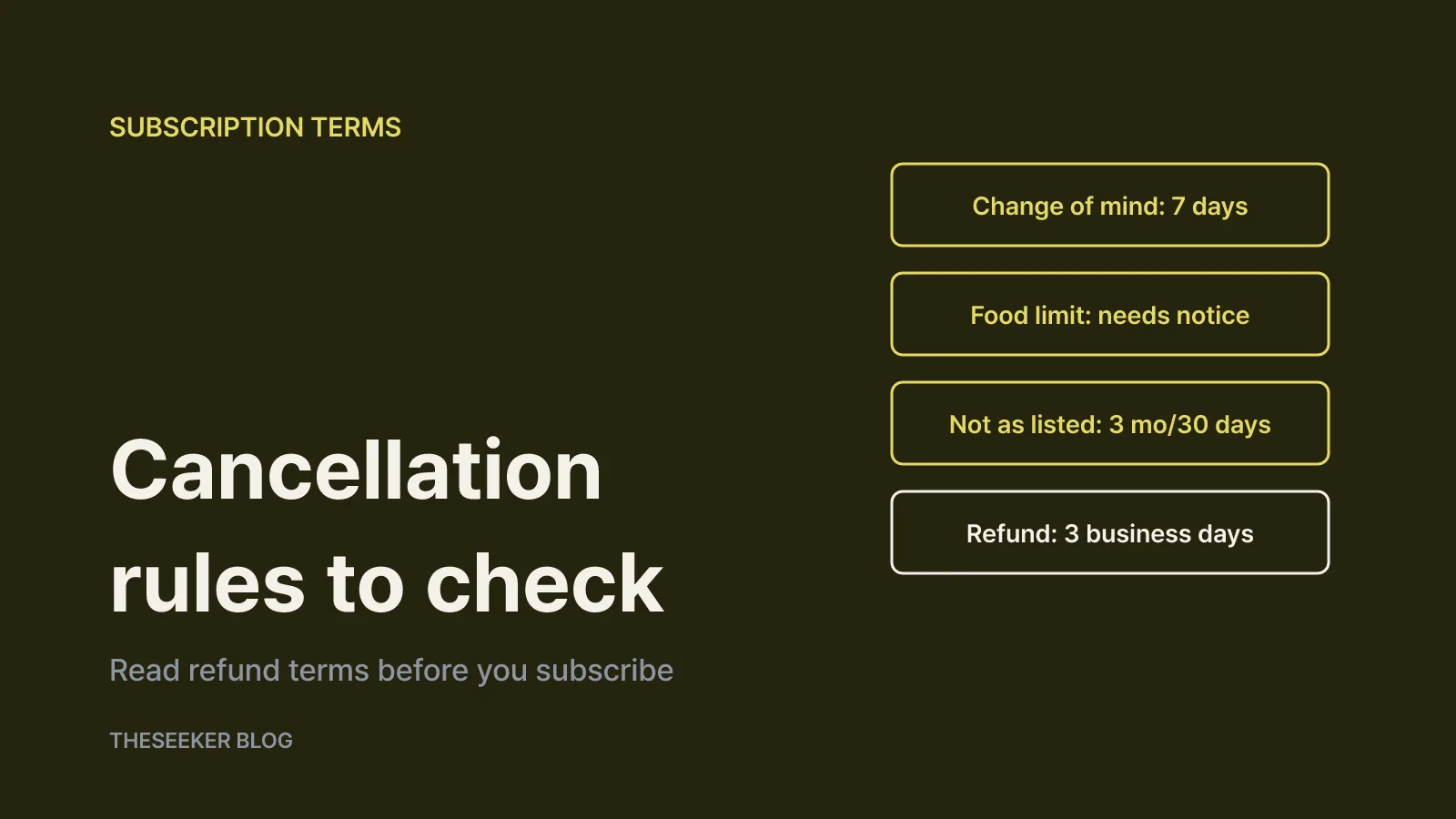
The Korean government's plain-language law guide explains that online purchases can generally be withdrawn within 7 days of receiving the written contract terms, or from delivery if the goods arrive later.
Food can be an exception. The Consumer24 guidance on withdrawal limits notes that perishable goods may lose resale value over time, which can restrict withdrawal. To rely on that limit, however, the seller must state clearly on the product page or packaging that withdrawal is not possible. Without that notice, you can still withdraw.
If the meals differ from the advertisement or the contract, you have three months from delivery, or 30 days from when you knew or could have known. For a simple change of mind you pay return shipping, but the seller pays when the goods do not match the listing. Refunds are due within three business days of the seller receiving the returned goods, with 15% annual interest for delays. Terms that cut the period short, such as "returns within 3 days only", are listed as examples of unlawful obstruction. For subscriptions, separate meals already delivered from future deliveries and read how the remaining weeks are cancelled and refunded. Screenshot your order and the product page in case of a dispute.
A final pre-order checklist
- Did you confirm the label's serving basis?
- Are calories, protein, sodium and sugar recorded per meal in one table?
- Do low-calorie or high-protein claims match the thresholds of 40 kcal per 100 g and 11 g of protein?
- If the copy hints at treating a disease, did you check the food type?
- Did you calculate cost per meal with delivery fees and without discounts?
- Do chilled or frozen storage and the use-by date fit your fridge and eating pace?
- Do you know the skip, pause, billing and change-cutoff rules?
- Did you read the withdrawal notice and how remaining deliveries are refunded?
Starting with a short plan before committing to a longer one lets you test taste, portions and delivery timing at low risk. A diet only works if you can keep eating it, so weigh flavor and routine as seriously as the numbers.
Sources
Frequently asked questions
Can I trust a low-calorie label on a diet meal?
In South Korea a low-calorie claim requires under 40 kcal per 100 g. All nine low-calorie subscription lunchboxes tested by the Korea Consumer Agency exceeded that limit, so check the calories and serving basis yourself.
How much protein should a high-protein meal contain?
The Korean threshold is at least 11 g per reference serving, 20% of the 55 g daily value. Actual protein only has to reach 80% of the declared amount, so leave some margin in your daily target.
Can I cancel a meal subscription within 7 days?
Generally yes, within 7 days of receiving the contract terms or the goods. Perishable food can be restricted if it cannot be resold, but only when the seller clearly states that withdrawal is not possible.
How do I compare prices across meal delivery services?
Add the delivery fee to the plan price and divide by the number of meals you actually receive. Then repeat the calculation without the first-order discount.
What extra checks matter if I have diabetes or high blood pressure?
Confirm whether the product is ordinary food or a medical-purpose meal product. The Korea Consumer Agency warned that relying on nutrient claims alone over a long period could harm patients.
blog.theseeker.io/en/posts/diet-meal-delivery-calorie-protein-subscription-guide
Chloe Morgan
Chloe covers easy recipes and how to prepare and store ingredients, written in quantities and steps that work in a home kitchen.
Read our editorial standards