How to Choose an Electric Car: Budget, Range and Body Type
A step-by-step EV buying guide: set your budget around incentive price bands, calculate the net price, re-read rated range for winter, then match body type and charging access.
 Ryan Mitchell
In this post
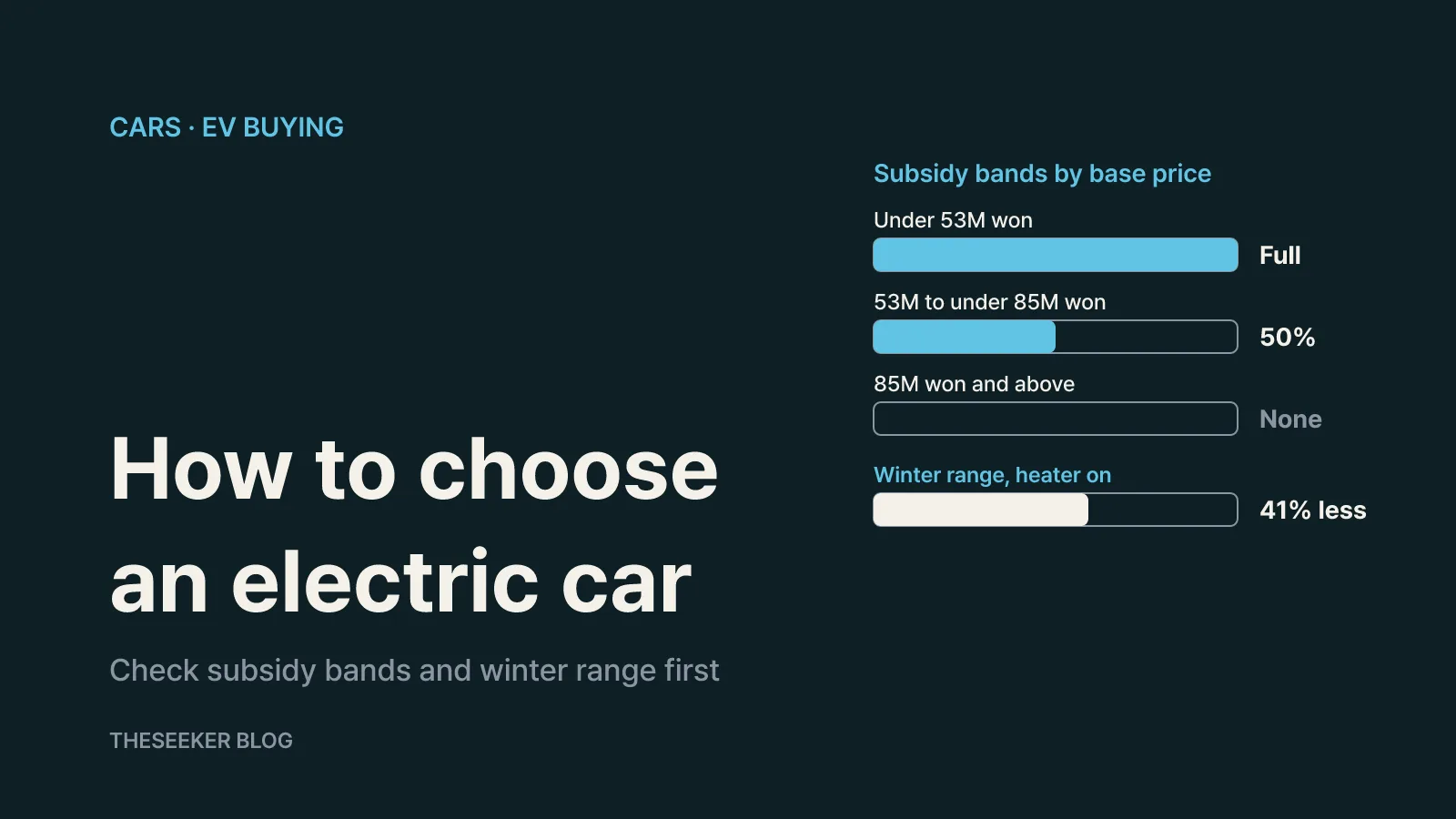
As of October 2026, the fastest way to choose an electric car is to fix the order of your comparison before you fall for a model. First, sort your budget by the price bands that decide how much incentive you get. Second, calculate the net price after incentives. Third, re-read the rated range for cold weather. Finally, match the body type and your charging access to how you actually drive. Do that and most shortlists shrink to two or three cars. This guide does not recommend specific models; it sticks to criteria you can verify in public government sources.
Incentives depend on where you register the car. To show how much they can reshape a budget, this guide uses South Korea's 2026 passenger EV subsidy program as the worked example, based on the summary published by the Ministry of Government Legislation's Easy Law service. The range and charging guidance comes from U.S. Department of Energy and EPA resources and applies to any market. If you live elsewhere, run the same steps with your own national, state and utility programs.
Set your budget around incentive price bands
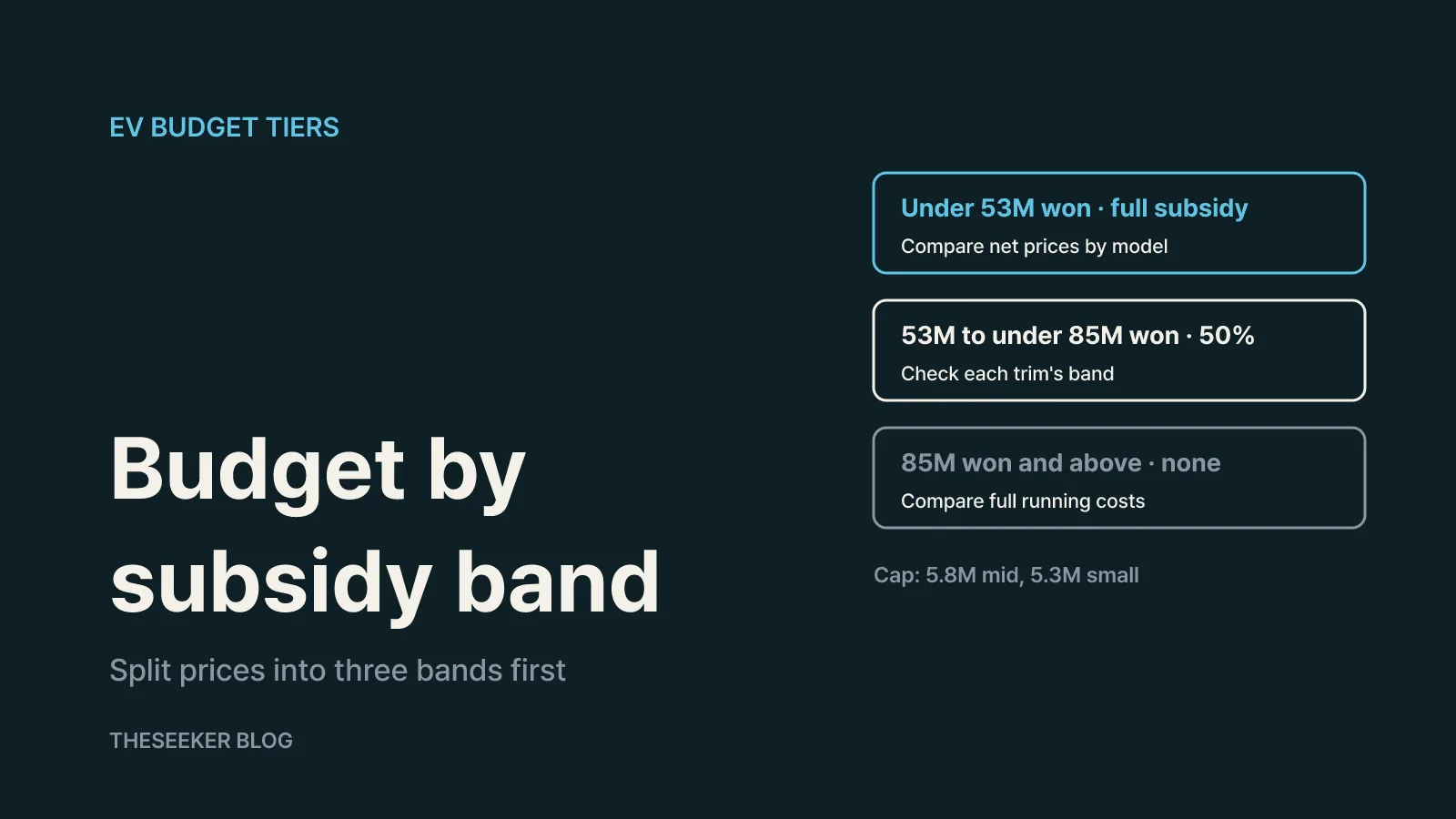
The most useful way to split EV price ranges is by the points where the incentive changes. Under South Korea's 2026 guidelines, the final subsidy (national plus local) is paid in full for cars with a base price below 53 million won, at 50% from 53 million up to 85 million won, and not at all at 85 million won or more (Easy Law summary). Two cars that both look like mid-priced EVs can therefore end up far apart once one of them crosses the first threshold.
That gives you three practical budget tiers:
- Below 53 million won: the full subsidy applies. National subsidies still vary by model performance within this band, so cars with similar sticker prices can swap places on net price.
- 53 million to below 85 million won: half the subsidy applies. Check every trim separately, because a base trim may sit in the full band while an upper trim slips into this one.
- 85 million won and above: no subsidy, so compare purchase price, taxes, insurance and charging costs directly.
The national subsidy also has a ceiling by size class. It is graded by efficiency, driving range, the maker's low-emission sales record and whether the price was cut, up to 5.8 million won for mid-size and large cars and up to 5.3 million won for small cars. Microcars receive a flat 2 million won. When you write down your budget ceiling, include home charger installation and first-year insurance, not just the car.
U.S. readers should note that the federal credit pages on FuelEconomy.gov cover vehicles acquired from January 1, 2023, through September 30, 2025, so check current state and utility programs before counting on any incentive.
Calculate the net price in this order
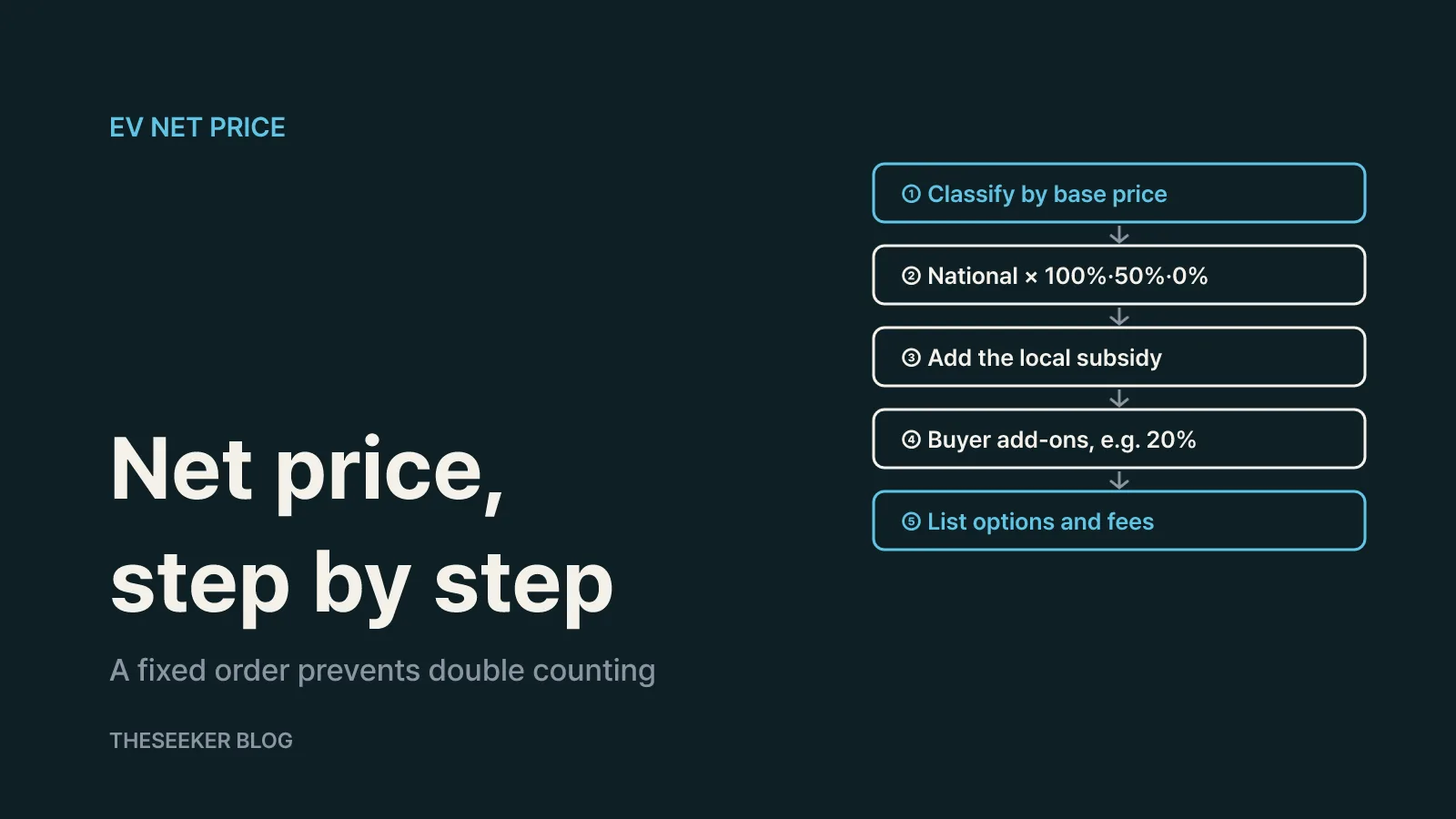
Working in a fixed order prevents double counting:
- Classify by base price. The Korean rule refers to the base price. Keep it separate from the price with options and confirm which band your chosen trim falls into with the dealer and the official EV portal (ev.or.kr).
- Look up the national subsidy for that exact model, then apply the band rate of 100%, 50% or 0%.
- Add the local subsidy. Local governments set it in proportion to the national amount, so the same car can cost a different amount in a different city. Local notices include a residency requirement, which must be set at three months or less.
- Add buyer-specific support. A first-time car buyer aged 19 to 34 gets an extra 20% of the national subsidy, as do lower-income buyers. Households with two or more children aged 18 or under get a flat 1, 2 or 3 million won for two, three, or four or more children. Percentage add-ons are calculated first and flat amounts are added last.
- List purchase costs separately: options, delivery, registration and any tax relief, which is a separate program from the subsidy.
Timing matters too. You sign with the maker or importer, then apply to the local government, and the maker can file on your behalf. Recipients are chosen by delivery and registration order, lottery or application order. If the car is not delivered within two months of selection, the selection can be cancelled or moved to the waiting list. Ask for a realistic delivery date before signing. After registration you submit documents within 10 days, and payment follows within 14 days.
Re-read rated range for winter
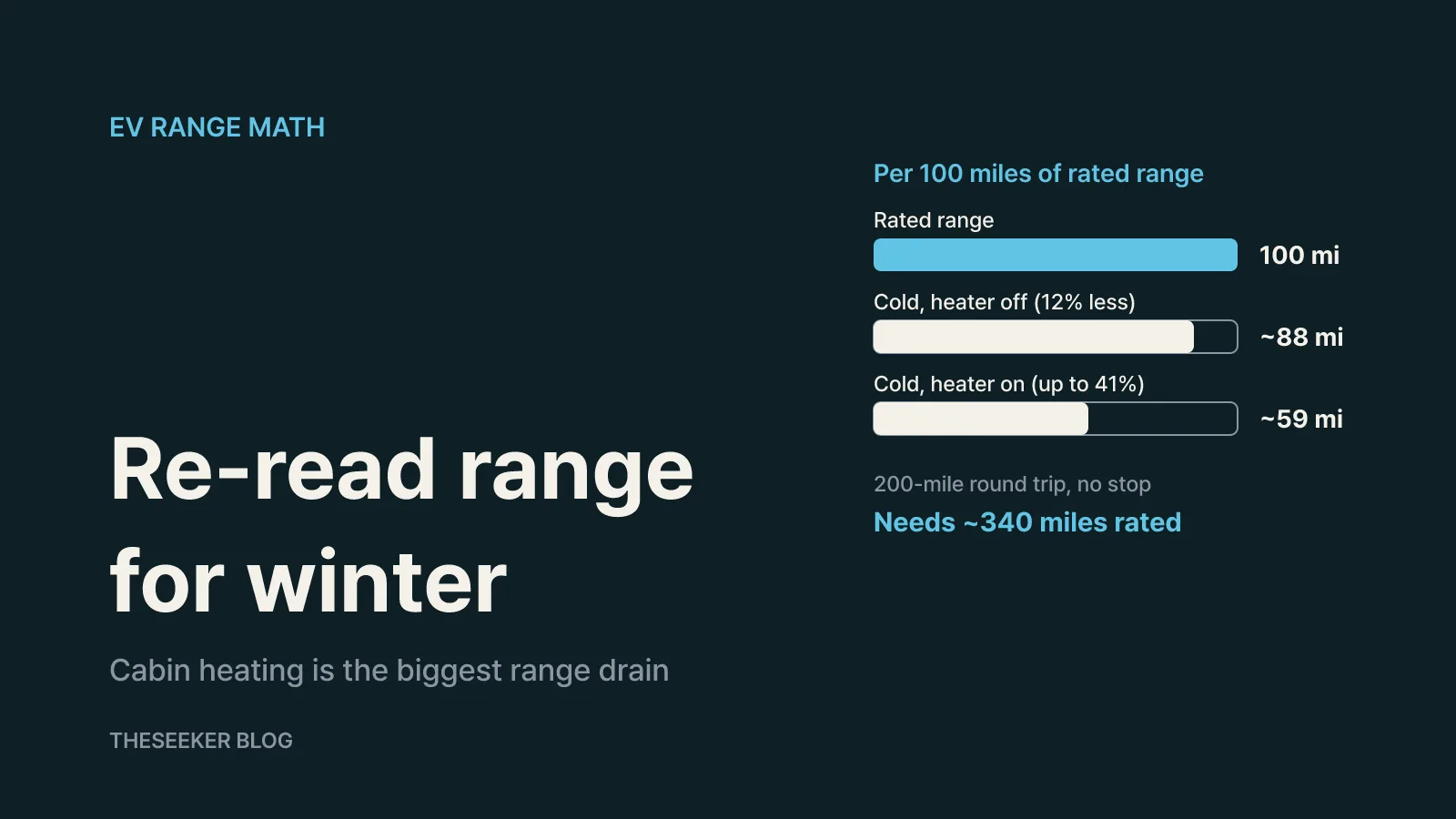
The range on the spec sheet comes from a standard test. Real range moves with temperature, heating and speed, and cabin heating is the biggest swing factor. FuelEconomy.gov, run for the Department of Energy and EPA, cites AAA testing showing that at 20°F with the cabin heater on, combined city and highway efficiency dropped about 39% compared with 75°F, and range dropped by as much as 41%. About two-thirds of the extra energy went to heating the cabin. With the heater off, efficiency fell 8% and range about 12%.
Applied to a rated 100 miles, that is roughly 59 miles in hard cold with the heat on and 88 miles with it off. Results vary by model and heating system, so treat these as a planning margin rather than a forecast. For cars sold in Korea, compare the room-temperature and low-temperature range figures listed on the spec sheet and the official EV portal.
To size your range need, start with the longest day you regularly drive. If you want to complete a 200-mile round trip without stopping, a 41% winter loss means you need roughly 340 miles of rated range (200 ÷ 0.59). If long trips happen only a few times a year, accepting one charging stop and buying a cheaper car can be the better trade.
The same source lists ways to soften the loss: preheat the cabin while plugged in, and use seat heaters instead of the cabin heater. Cold air is denser and raises aerodynamic drag at highway speed, tire pressure drops and increases rolling resistance, and weaker battery performance cuts regenerative braking. If you can, take your test drive on a cold morning.
Compare body types: small cars, sedans and SUVs
Body type affects incentives, efficiency and daily practicality at once. In the Korean example, the national subsidy ceiling is 5.3 million won for small cars and 5.8 million won for mid-size and large cars, and the size class follows the vehicle regulations, so two cars that look similar can be classed differently.
Sedans sit lower and usually face less aerodynamic drag at speed. With the same battery, that can mean more usable highway range for drivers who spend a lot of time on motorways. Trunk openings and rear headroom vary widely, so check them in person.
Electric SUVs offer cabin space, cargo room and a higher seating position. A taller, heavier body can lower efficiency on the same battery, which is the same reason FuelEconomy.gov advises removing roof racks when you are not using them. When comparing SUVs, look at efficiency (miles per kWh or kWh per 100 miles) alongside battery size. If you often carry a roof box, stack that drag on top of the winter margin.
Small and compact EVs suit city driving or a second car and are more likely to land in the full-subsidy band. With a smaller battery, though, the winter loss is felt more, so judge them against your longest regular day. Microcars get a flat subsidy but are a different kind of vehicle and should not be judged against regular passenger cars.
Decide on charging before the model
Charging access shapes ownership more than any spec. The DOE's Alternative Fuels Data Center notes that most EV drivers charge overnight at home with Level 1 or Level 2 equipment. Level 2 makes sense for longer commutes, irregular schedules or large batteries, and an electrician should confirm your home has enough electrical capacity. Charging at multifamily housing needs extra planning and can feel more like public charging.
If you live in an apartment, check how many chargers the building has, whether they are slow or fast, whether they are free when you park, and whether you may install your own. Without regular home or workplace charging you will rely on public fast chargers, so charging speed becomes more important than a few extra miles of range.
To estimate running costs, multiply the car's consumption by your electricity price. The AFDC example: at 10.7 cents per kWh, a car using 27 kWh per 100 miles costs about $0.03 per mile, and filling a fully depleted 54 kWh battery costs about $6. Plug in the tariff of the chargers you will actually use, since time of day and location change the price.
Check the battery and its warranty
Look at capacity (kWh), chemistry (such as LFP or NCM) and the warranty together. The chemistry is listed on the spec sheet, and recommended daily charge limits and cold-weather care differ by maker, so read the owner's manual before you buy.
Warranty terms even feed into the Korean subsidy: cars with a battery warranty of at least 10 years or 500,000 km (to 65% state of health) receive an extra 300,000 won, within the size-class ceiling. When reading any warranty, check not only the years and distance but the capacity level that triggers a claim.
Know the strings attached to a subsidy as well. An individual buying two or more cars of the same type within the two-year re-support restriction gets support only for the first. Deregistering during the mandatory operation period triggers repayment on a sliding scale: outside of export cases, 70% under three months down to 20% at 21 to under 24 months, and nothing from 24 months. If you sell within the period, the buyer takes over the remaining obligation.
Final checklist before you sign
- Base price of each trim and its subsidy band
- National and local subsidy for your address, plus any buyer-specific support
- Delivery possible within two months of selection
- Rated range, low-temperature range and a 41% winter margin
- Efficiency and the space your household needs
- Home or workplace charging and your price per kWh
- Battery warranty years, distance and capacity threshold
- Re-support restriction and mandatory operation period
Only test drive the cars that pass the budget and charging rows. Subsidy amounts and local notices change during the year, so recheck the official portal and your local notice right before you sign.
Sources
Frequently asked questions
Does the 53 million won threshold include options?
The 2026 Korean guideline summary refers to the base price. Keep it separate from the optioned price and confirm the band for your trim with the dealer and the official EV portal.
How much range does an EV lose in winter?
In AAA testing cited by FuelEconomy.gov, range fell by as much as 41% at 20°F with the cabin heater on and about 12% with it off. Results vary by model.
Is an electric SUV or a sedan more efficient?
Sedans usually have less aerodynamic drag at highway speed, while SUVs offer more space. Compare efficiency figures and the space you need rather than battery size alone.
How do I estimate EV charging costs?
Multiply consumption by your electricity price. The AFDC example shows a car using 27 kWh per 100 miles at 10.7 cents per kWh costs about $0.03 per mile.
What happens if I sell a subsidized EV early in South Korea?
If you sell during the mandatory operation period, the buyer inherits the remaining obligation. Deregistering triggers partial repayment, which ends after 24 months outside export cases.
blog.theseeker.io/en/posts/how-to-choose-electric-car-budget-range-body-type
Ryan Mitchell
Ryan covers buying, insuring and maintaining a car, checking terms against manufacturer and agency publications so the options are easy to compare.
Read our editorial standards