Jeonse Loans for Newlyweds and Newborn Families in Korea
How Korea's Housing and Urban Fund jeonse loans for newlyweds and for families with a newborn compare on income, net assets, loan caps, rates, deadlines and documents.
 Olivia Hartman
In this post
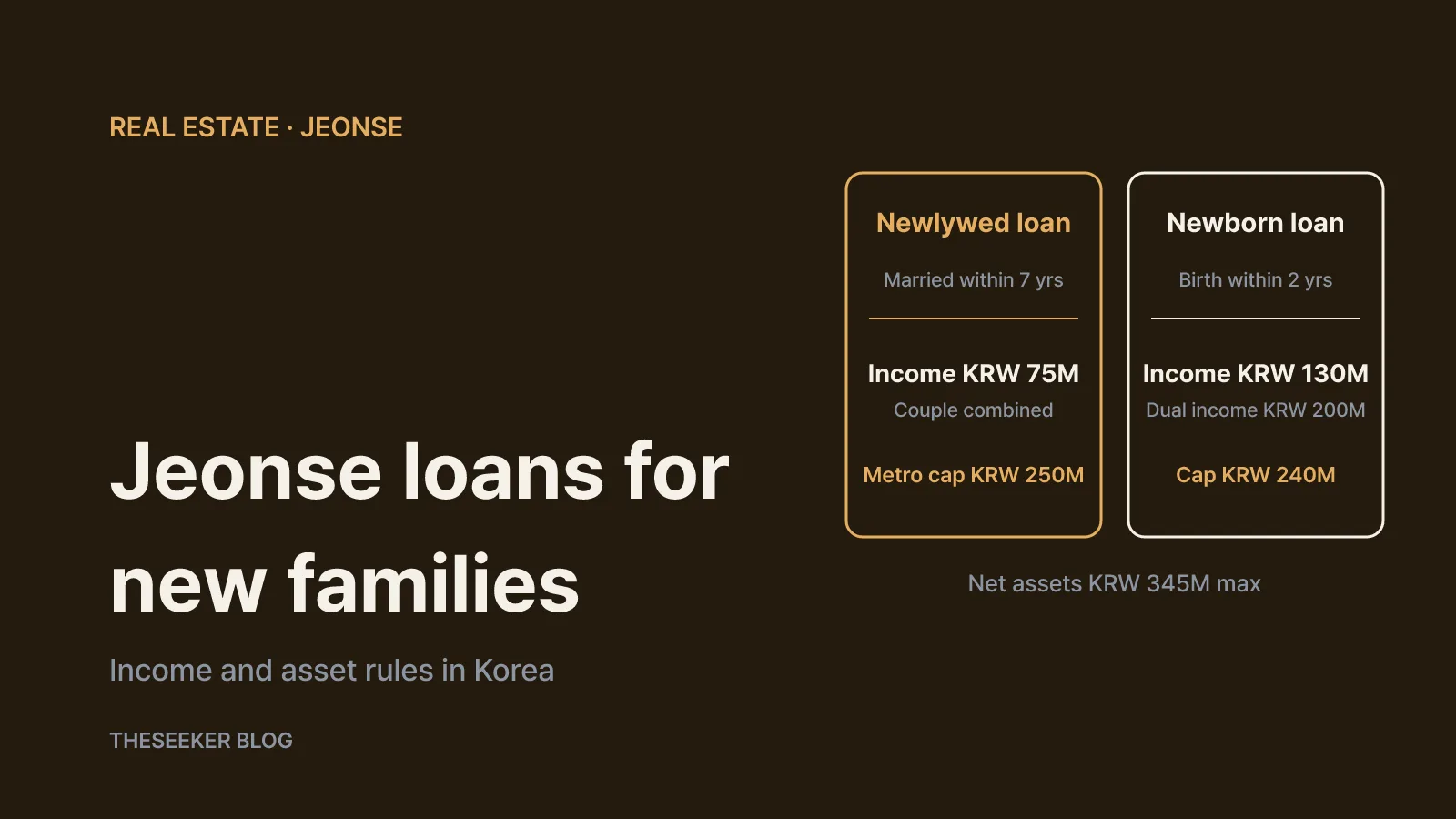
As of October 2026, Korea's government-backed Housing and Urban Fund offers two jeonse (lump-sum deposit lease) loans aimed at young families. Couples married for seven years or less can use the Newlywed Jeonse Loan if their combined annual income is KRW 75 million or less and their net assets are KRW 345 million or less. Households that had or adopted a baby within two years of the loan application can use the Newborn Special Beotimmok Loan if combined income is KRW 130 million or less (KRW 200 million for dual earners) and net assets are KRW 345 million or less. Both require that every member of the household owns no home, and both cap the loan at 80% of the deposit.
This guide is based on the official product pages of the Housing and Urban Fund for the newlywed loan, the MyHome portal page for the newborn special loan and the fund's application steps and document list for the newborn loan, all read in October 2026. Rates are variable and set by the Ministry of Land, Infrastructure and Transport, so confirm them again when you apply.
Who qualifies: newlywed loan vs newborn special loan
In a jeonse lease, the tenant pays a large refundable deposit instead of monthly rent. These policy loans fund part of that deposit at below-market rates. The two products start from different questions: the newlywed loan asks how long you have been married, while the newborn loan asks when your child was born.
← Swipe to see more
| Item | Newlywed Jeonse Loan | Newborn Special Beotimmok Loan |
|---|---|---|
| Household test | Married 7 years or less, or marrying within 3 months | Child born or adopted within 2 years of application (born on or after January 1, 2023) |
| Combined annual income | KRW 75M or less | KRW 130M or less (KRW 200M dual income) |
| Net assets | KRW 345M or less | KRW 345M or less |
| Deposit ceiling | KRW 400M Seoul metro area, KRW 300M elsewhere | KRW 500M Seoul metro area, KRW 400M elsewhere |
| Loan cap per home | KRW 250M metro, KRW 160M elsewhere | KRW 240M |
| Annual rate | 1.9% to 3.3% | Special rate 1.3% to 4.3% |
| Maximum term | 10 years | 12 years |
The Seoul metropolitan area here means Seoul, Incheon and Gyeonggi Province.
For the newlywed loan, marriage length is counted from the marriage certificate with your current spouse; if you remarried the same person, it runs from the first marriage date. Engaged applicants must form a household within three months and submit a resident registration copy listing the spouse within three months after the loan. Missing that deadline triggers acceleration and the loan must be repaid, although a written explanation (for example, a honeymoon) can extend it to six months from disbursement.
The newborn loan focuses on the birth itself. Children born on or after January 1, 2023 count; an unborn child does not. Adopted children qualify if they are under two years old on the application date. Unmarried parents can apply too. In that case, the income and net assets of both parents listed on the child's family relation certificate are combined, and both must be homeless in the program's sense, meaning neither owns a home.
Some conditions are shared. The applicant must be an adult head of household on the application date, or become one within a month of disbursement. Existing Housing and Urban Fund loans, bank jeonse loans or mortgages generally block a new loan. Living in public rental housing also disqualifies you unless that unit is the one being financed or you are moving out. Unresolved delinquency or credit-recovery records will stop the application.
How income and net assets are tested
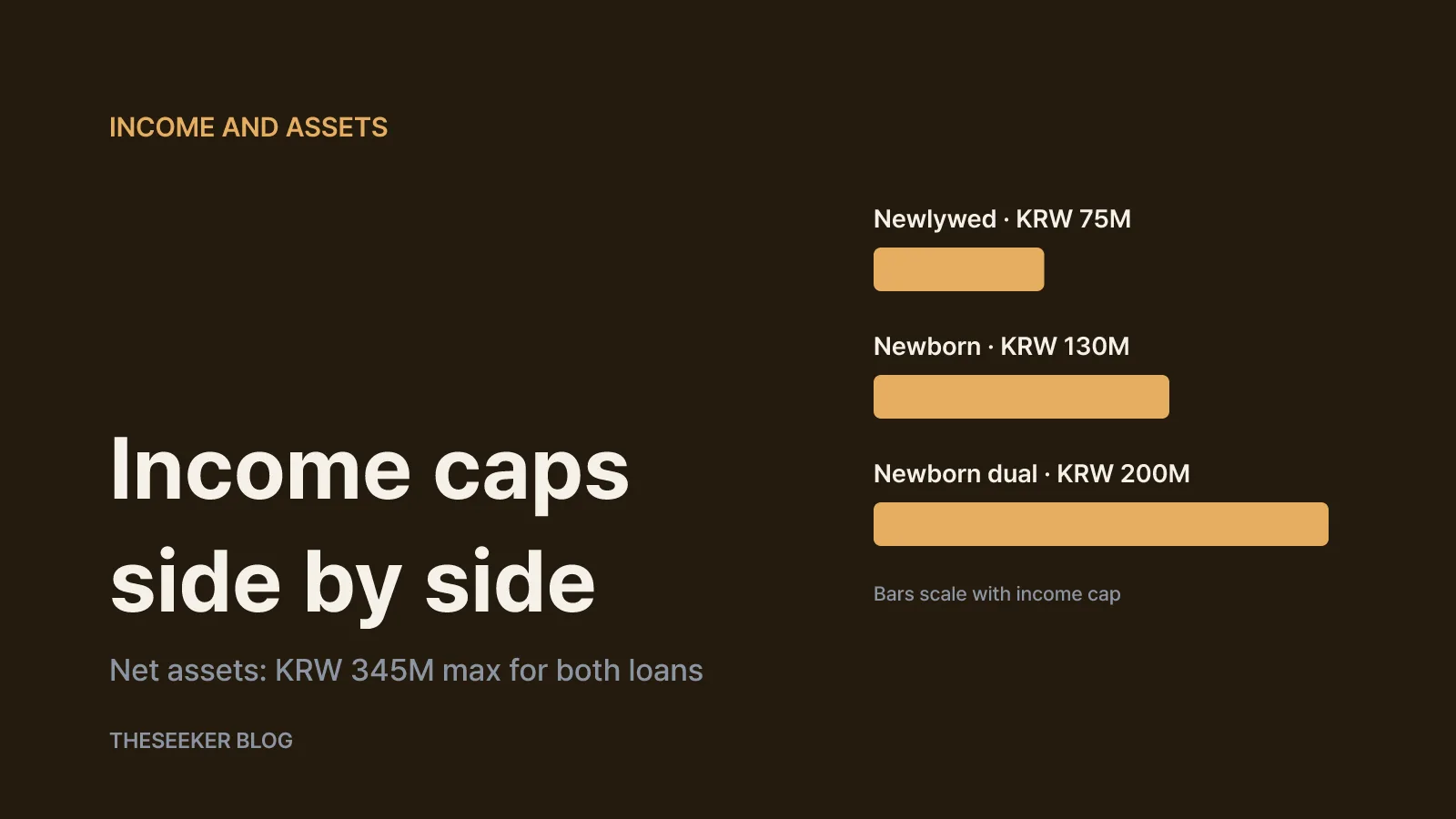
Income means the combined gross income of the applicant and spouse. The newlywed loan limit is KRW 75 million, but there is an exception: if the couple earns more than that and the applicant alone earns KRW 50 million or less, the loan is still available, with 0.3 percentage points added to the top rate for the deposit band at the initial loan. Employees verify their current job with a national health insurance eligibility certificate and business owners with a business registration.
The newborn loan allows KRW 130 million in combined income. When both spouses earn income, the ceiling rises to KRW 200 million, but each spouse must individually earn KRW 130 million or less. If one partner earns more than that, the dual-income rule does not apply even if the total is under KRW 200 million.
Net assets use the same yardstick for both products: the average net worth of third-quintile income households in Statistics Korea's annual Survey of Household Finances and Living Conditions. For 2026 that figure is KRW 345 million, and it is updated every year. After you apply, Korea Housing and Urban Guarantee Corporation (HUG) collects your asset data, runs the review and sends the result by text message. The fund notes that applicants who fail the asset review may face an added rate, so list both spouses' assets and debts before applying.
Job tenure also matters. Both product pages say the loan may be limited to KRW 20 million or less for applicants employed for under one year.
Loan caps and how the rate is set
The loan amount is the smallest of three limits. The first is the cap per home: KRW 250 million in the metro area and KRW 160 million elsewhere for the newlywed loan, and KRW 240 million anywhere for the newborn loan. Leases signed on or before June 27, 2025 keep the older caps of KRW 300 million and KRW 200 million (newlywed) or KRW 300 million (newborn). The second is 80% of the deposit for a new lease, or for a renewal, the increase in deposit up to 80% of the new total. The third is the limit set by the guarantor, either Korea Housing Finance Corporation (HF) or HUG.
A worked example: a new jeonse with a KRW 250 million deposit gives an 80% figure of KRW 200 million. In the metro area both products have per-home caps above that, so KRW 200 million is the binding limit before guarantor review. Outside the metro area, the newlywed loan stops at KRW 160 million while the newborn loan can still reach KRW 200 million.
The newlywed loan rate runs from 1.9% to 3.3% a year depending on income and deposit band, with 0.2 points off for homes outside the metro area. Child discounts are 0.3 points for one child, 0.5 for two and 0.7 for three or more, applied for four years per child (up to 12 years) for applications from March 24, 2025. Signing the lease through the government's electronic contract system takes off 0.1 points for the first term on applications through December 31, 2026, and borrowing 30% or less of your approved amount earns 0.2 points for up to four years. The final rate cannot fall below 1.0%.
The newborn special rate ranges from 1.3% to 4.3%. For example, a household earning KRW 20 million or less with a deposit of KRW 50 million or less pays 1.30%, while a dual-income household earning over KRW 170 million with a deposit above KRW 150 million pays 4.30%. Homes outside the metro area get 0.2 points off. The special rate lasts four years by default and extends by four years for each additional child born within two years of application, up to 12 years. After it ends, households whose income at application was KRW 75 million or less move to roughly the newlywed loan rate level, and higher earners move to a market-linked rate with a floor, so plan for a possible increase.
Eligible homes and application deadlines
The rented home must have 85 square meters or less of exclusive floor area (100 square meters in non-urban towns outside the metro area), and residential officetels qualify up to 85 square meters. Because the deposit ceilings differ, a metro-area home with a deposit between KRW 400 million and KRW 500 million fits only the newborn loan.
Timing is strict for both products. For a new lease, apply within three months of the earlier of the final payment date or the move-in registration date. For a renewal, apply within three months of the renewal date. The HF or HUG guarantee must also be requested within its own deadline. Terms start at two years and can reach 10 years (newlywed) or 12 years (newborn), with two more years per minor child after that, up to 20 years in total. The newlywed loan page lists no early repayment fee.
Application steps and documents
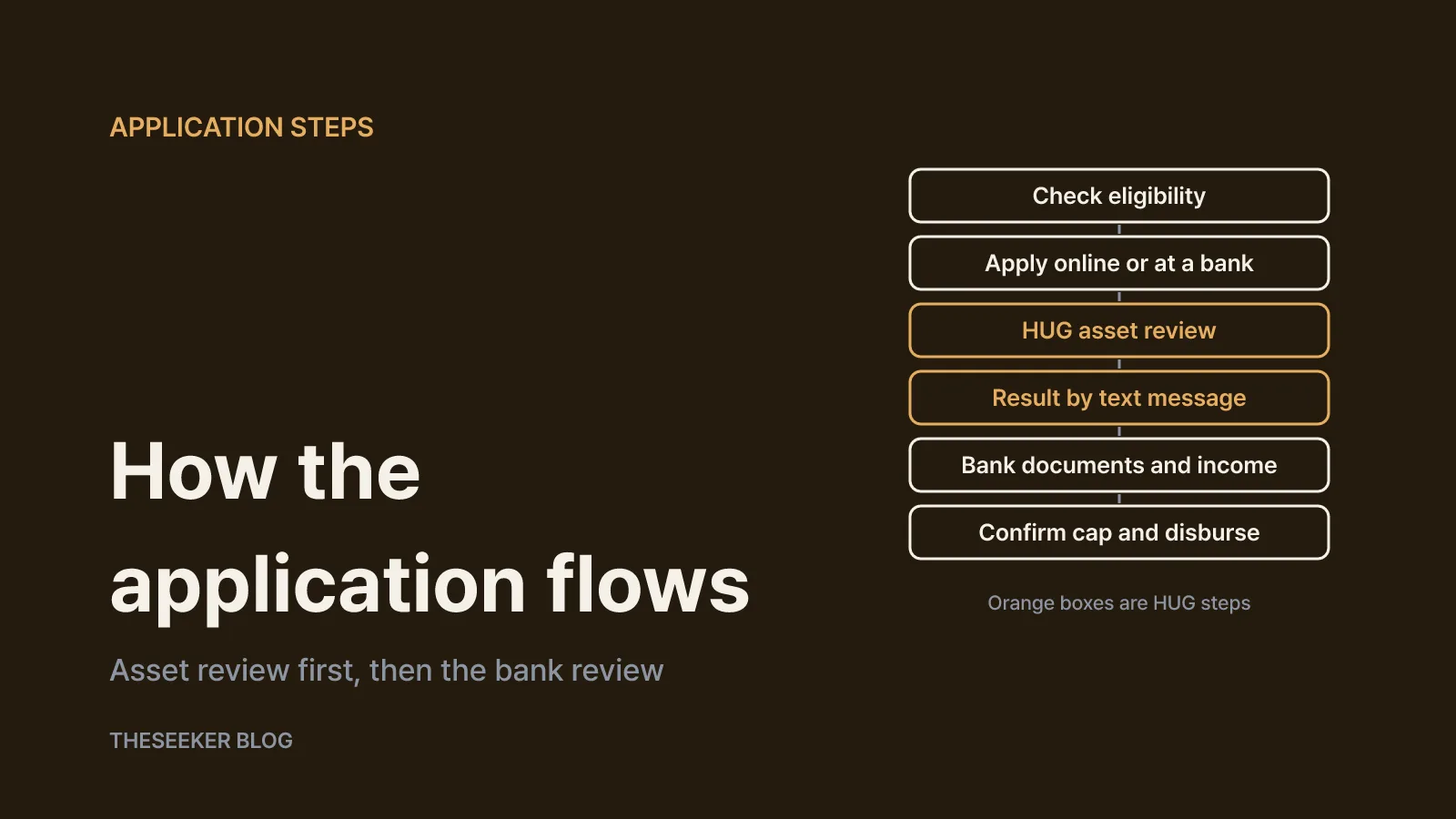
The newborn loan page describes six steps: check eligibility, apply online through the Gigeum e-Deundeun site or at a bank branch, HUG asset review, a text message with the result, document submission and income and collateral review at the bank, and finally disbursement. Online applications can be routed to five banks: Woori, KB Kookmin, Shinhan, NongHyup and Hana. The newlywed loan follows the same fund structure, but confirm its document list with your bank.
The newborn loan document list includes:
- ID card, driver's license or passport
- Resident registration copy, plus a family relation certificate when needed, and a wedding hall contract or invitation for engaged applicants
- A hospital-issued birth certificate, or an adoption relation certificate
- National health insurance eligibility certificate to confirm employment
- Income proof such as an income amount certificate or withholding tax receipt
- The lease with a fixed-date stamp and the building's registry certificate
The loan is normally paid directly to the landlord.
Final checks before you sign the lease
- Check the deposit and floor area against each product's ceiling before signing.
- If the lease is signed after June 27, 2025, use the reduced per-home cap in your budget.
- Clear or plan around existing jeonse loans, mortgages and fund loans. Borrowers on the standard or youth Beotimmok loans can switch to the newlywed loan after marriage on condition that the old loan is repaid.
- Mark the three-month application deadline and the guarantee deadline on your calendar.
- If you apply as an engaged couple, submit the updated resident registration within three months.
- Buying a home after the loan requires repayment, and a past acceleration on a fund loan blocks new fund loans for three years.
- You can withdraw from the loan contract within 14 days of the latest relevant date, such as disbursement.
For questions about loan review, HUG's call center (1566-9009) and the lending bank branches are the official contacts listed by the fund.
Sources
Frequently asked questions
Can unmarried parents get the newborn special jeonse loan in Korea?
Yes. The combined income and net assets of both parents on the child's family relation certificate are reviewed, the child must be born on or after January 1, 2023, and neither parent may own a home.
Our combined income is KRW 150 million. Do we qualify for the newborn loan?
Possibly. If both spouses earn income and each earns KRW 130 million or less, the dual-income ceiling of KRW 200 million applies. If one spouse earns more than KRW 130 million, it does not.
Is there any way to get the newlywed loan with income above KRW 75 million?
Yes, if the applicant alone earns KRW 50 million or less. In that case 0.3 percentage points are added to the top rate for the deposit band at the initial loan.
Can I apply for the newborn loan while pregnant?
No. An unborn child does not count. You can apply after the birth, within two years, with a hospital-issued birth certificate.
What is the deadline to apply for these jeonse loans?
For a new lease, within three months of the earlier of the final payment date or move-in registration date; for a renewal, within three months of the renewal date. The HF or HUG guarantee has its own deadline.
blog.theseeker.io/en/posts/newlywed-newborn-jeonse-loan-korea-conditions
Olivia Hartman
Olivia covers home buying, leases, mortgages and housing taxes, following official notices and legal guidance to explain where the rules and steps change.
Read our editorial standards