Choosing an iPhone Duo Case: Hinge Protection and Thickness
iPhone Duo cases come in three main designs: two-piece, hinge-cover and folio. Here is how to check hinge coverage, folded thickness and MagSafe accessory fit before you buy.
 Lucas Bennett
In this post
As of October 2026, the two things that matter most when choosing an iPhone Duo case are how it handles the hinge and how thick the phone becomes when folded. Because iPhone Duo is Apple's first foldable iPhone, it cannot use a single-shell case like a regular iPhone. Cases fall into three practical groups: two-piece cases that leave the hinge exposed, hinge-cover cases that wrap the spine, and folio or kickstand cases that add a cover or stand. Each group trades protection against bulk and accessory compatibility in a different way. This guide uses Apple's published specifications and the first case roundups to show what to look for on a product page, rather than declaring one case the winner.
Why an iPhone Duo case is different from a regular iPhone case
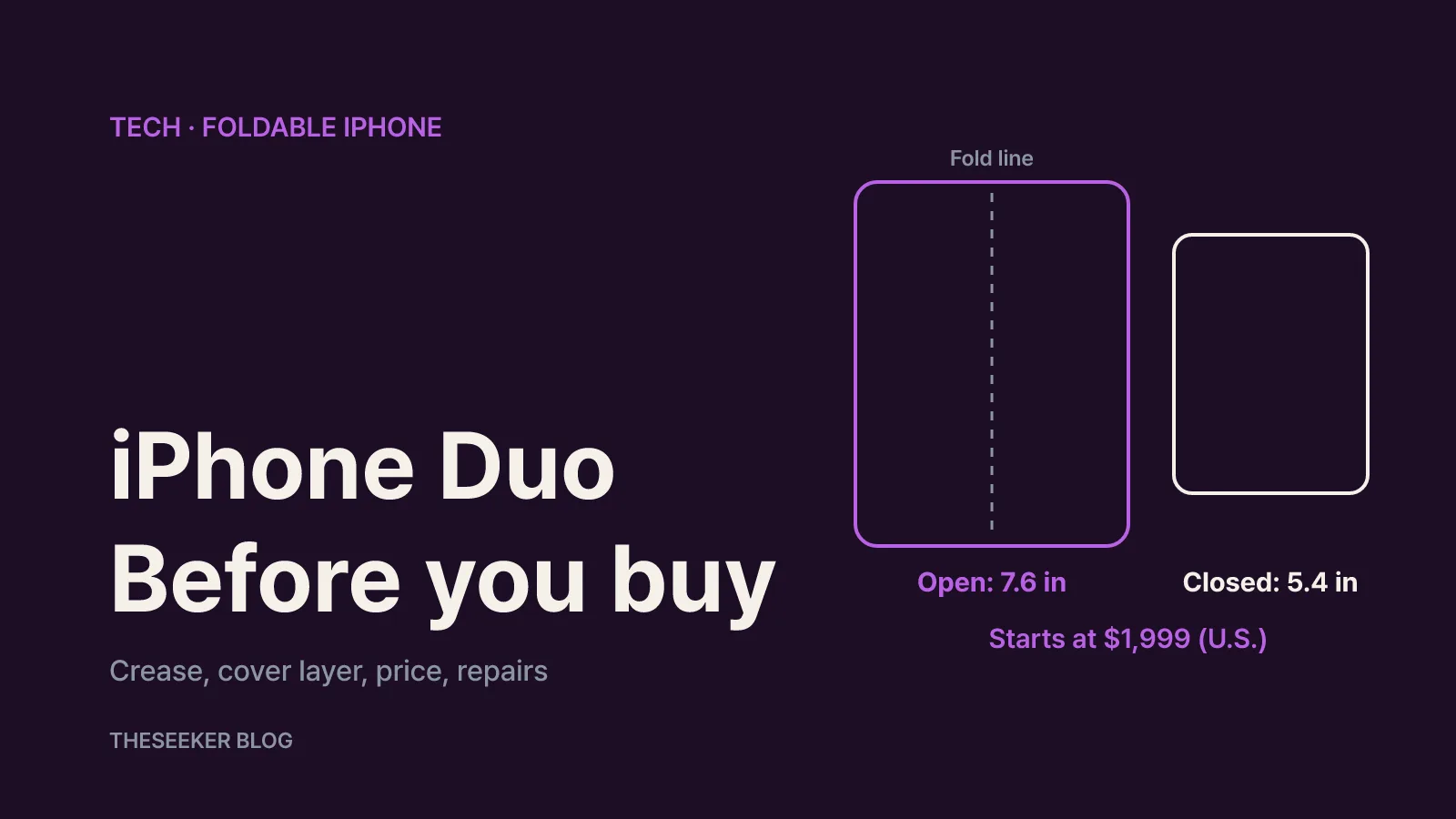
Apple announced iPhone Duo on September 9, 2026, with pre-orders from October 16 and availability from October 23 (Apple Newsroom). It folds like a book: a 7.6-inch inner display opens out, and a 5.4-inch outer display handles everyday use when the phone is closed.
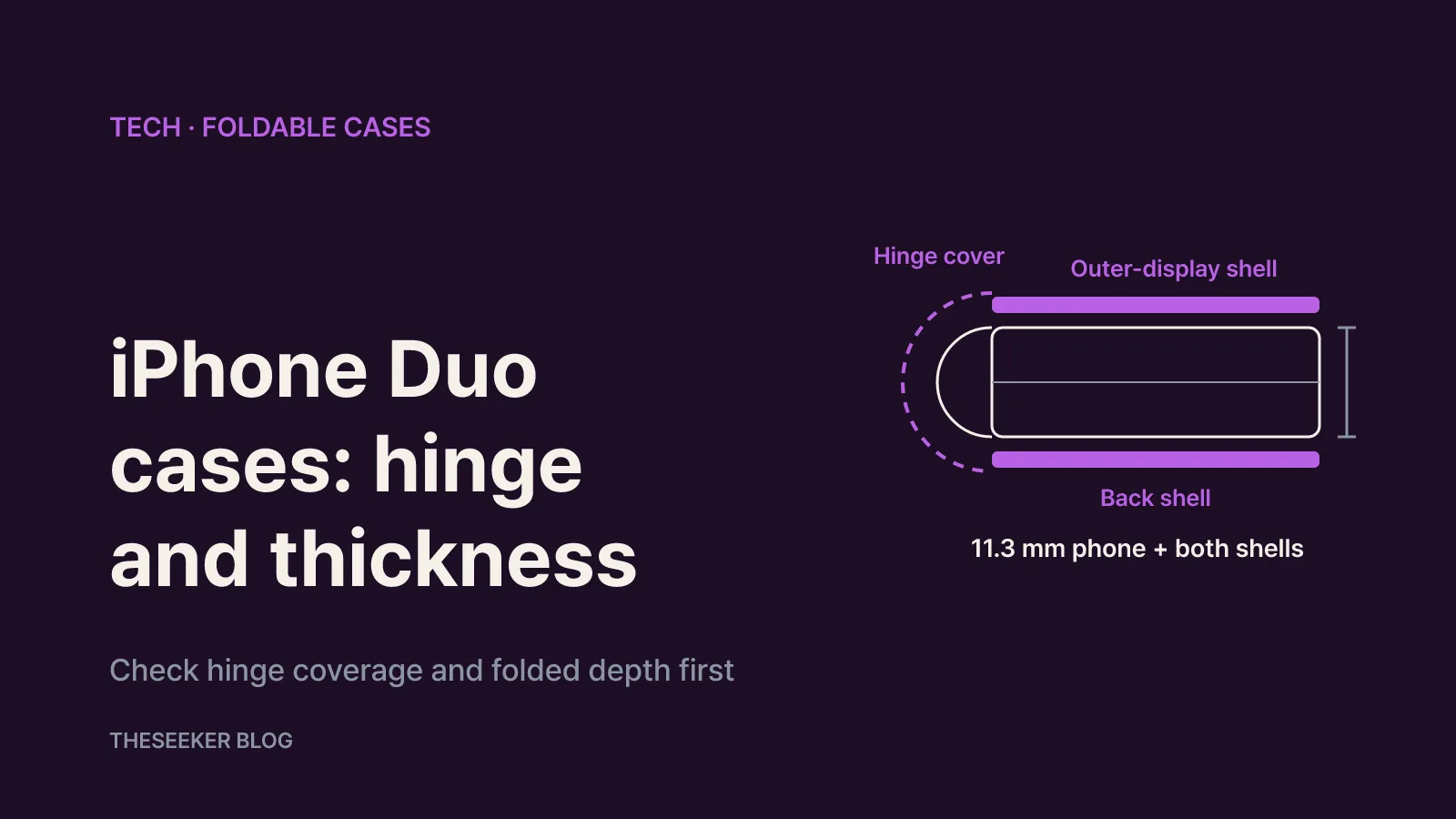
Apple's technical specifications put the phone at 164.6 mm wide, 117.8 mm tall and 5.2 mm deep when open, and 84.1 mm wide, 117.8 mm tall and 11.3 mm (0.44 inch) deep when closed. It weighs 254 grams. Three consequences follow for anyone shopping for a case:
- There is a moving part in the middle, so the case cannot be one rigid piece.
- When the phone is closed, both the outer-display side and the back face outward, so case material stacks up on both sides.
- At 117.8 mm (4.64 inches) tall, it is shorter than a conventional iPhone, so MagSafe accessories designed for slab phones may hang over the edges.
The hinge itself deserves attention. Apple says it is built from more than 100 components that control opening and closing and support the center of the display, and that an integrated magnet array helps the phone close securely. The frame and the 3D-printed hinge cover are grade 5 titanium, with the hinge cover given a micro-blasted finish. That is sturdy metal, but when the phone is folded, the spine is also one of the edges most likely to hit the floor in a drop.
iPhone Duo is rated IP68 under IEC standard 60529 (a maximum depth of 6 meters for up to 30 minutes). Apple notes that splash, water and dust resistance are not permanent conditions, that resistance may decrease with normal wear, and that liquid damage is not covered under warranty. A case does not add water resistance, even one with port covers, so base any decisions about water on the phone's own rating.
Foldable case types: two-piece, hinge cover and folio
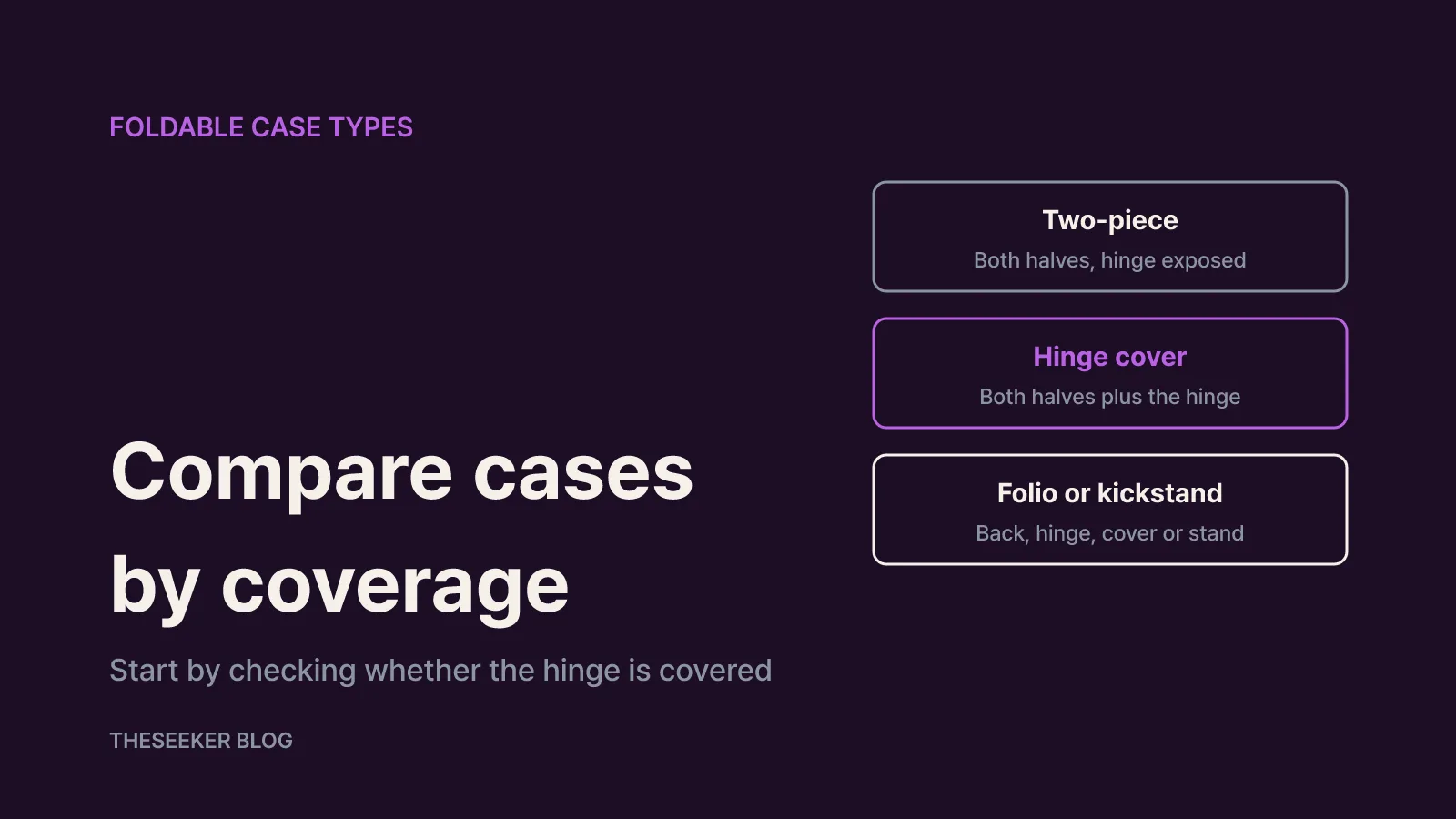
Macworld's iPhone Duo case roundup frames the choice simply: a foldable case can be made from one or two shells, and the next question is whether it covers the hinge or leaves it bare. Looking at what is actually on sale, three groups emerge.
Two-piece, hinge exposed. One thin shell goes on the outer-display half, another on the back half, and the hinge in between stays uncovered. Apple's own iPhone Duo Case works this way. It costs $79 in the US, comes in Sand and Navy Blue, and is made from matte-coated polycarbonate (GadgetBond). Macworld points out that leaving the hinge unobstructed lets the phone close completely flat, but it also leaves the hinge exposed. It adds that, like most two-piece cases without a hinge cover, Apple's case relies on adhesive strips for a secure fit, which makes it harder to remove and reattach than a magnetic design. You get the slimmest profile and give up spine protection.
Hinge-cover cases. These add a piece that covers the spine, on top of the front frame and back plate. MOFT's MOVAS Modular Case, for example, comes in three parts: front frame, hinge and back plate. ESR, Torras and OtterBox are among the brands that list hinge protection. What separates good examples from bad ones is whether the hinge cover moves smoothly as the phone opens and whether it closes without gaps or rattling.
Folio and kickstand cases. These add a front cover, a rear stand, or both. Apple's iPhone Duo Folio with Kickstand costs $129 in the US, comes in Taupe and Navy Blue, and uses Apple's TechWoven fabric. According to Macworld, it is a one-piece case that attaches magnetically and protects the outer display and the hinge, with a fabric hinge cover that retracts when you unfold the phone. Unlike the basic Apple case, though, it has no protective frame around the phone's edges. The kickstand folds into the case when you are not using it, and Apple says a MagSafe charger can attach behind it while the stand is open.
The real difference between the three is coverage. Two-piece cases protect the two halves; hinge-cover cases protect the halves plus the spine; folios focus on the back, the hinge and a cover. Decide whether you drop your phone often, whether pocket thickness matters most, or whether you will prop the big screen up for video, and the right group usually becomes obvious.
How to check hinge protection
A product name that says "hinge protection" can mean very different designs. Macworld says its assessment went beyond whether a hinge cover exists: it opened and closed each case, checking for stiffness, rattling, gaps and smooth movement of the cover, and whether both shells stayed firmly attached throughout. You can look for the same things in product photos and videos before you buy.
- Hinge cover material and attachment. Is it a rigid plastic guard or a flexible material such as fabric or silicone? Does it attach magnetically, clip onto the front frame, or use adhesive?
- Where the cover sits when open. Check that the cover does not protrude toward the inner display or press on its edge. Apple's folio is described as having a hinge cover that tucks away when unfolded so it does not affect the outer screen.
- Whether it closes fully. Apple designed the Duo's hinge and magnet array to deliver a secure closure. Avoid cases whose thickness or hinge guard stops the phone from closing completely or makes it spring back open.
- How often you will remove it. Adhesive strips hold well but make reinstalling a chore. If you like switching cases, prioritize magnetic or snap-on designs.
Macworld's first round of assessments used a dummy handset, and the publication says the effect on a working phone's hinge movement and opening angle still needs testing. Early in a product's life, it is safer to combine reviews with the manufacturer's stated specifications and a clear return policy.
Working out folded thickness and grip
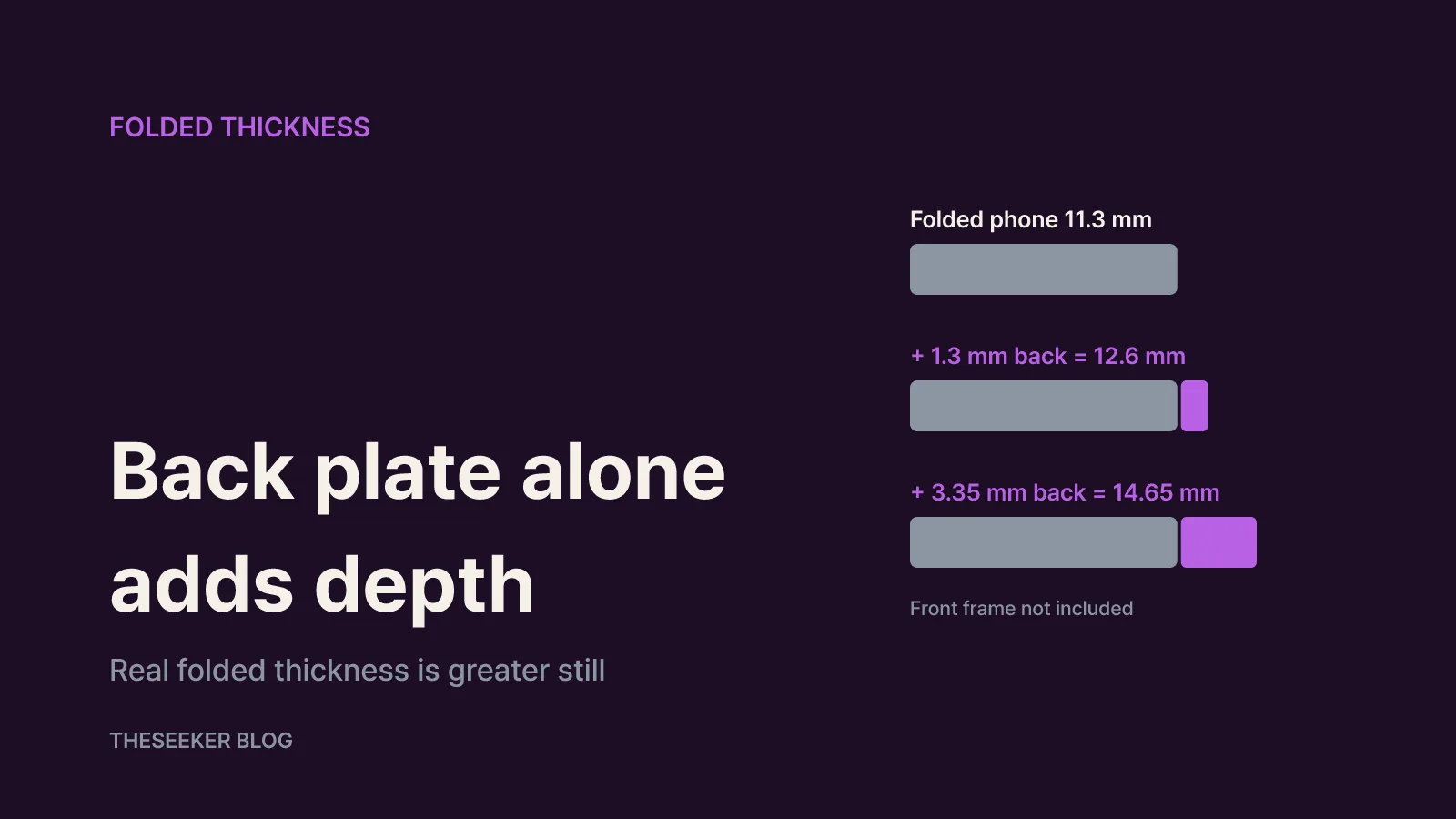
iPhone Duo is just 5.2 mm thick when open, but the thickness that matters for your pocket is the closed figure: 11.3 mm. A case adds material to both outside faces of that 11.3 mm. If you only read the "back plate thickness" line on a spec sheet, you will underestimate how thick the phone feels in your hand.
The manufacturer figures Macworld compiled show a wide spread. Benks ArmorGrid Air lists a 1.3 mm back plate and 23.5 g total weight. ESR Atelier lists 2.3 mm and 59 g, ESR Cyber Tough 2.5 mm and 65 g, Torras Ostand Q3 3.35 mm and 46 g, and MOFT Dynamic Folio 1.9 mm and 73 g. Nomad's leather folio lists a 2.7 mm back plate and an overall folio thickness of 3.8 mm.
Some quick arithmetic helps. Adding only the back plate gives 11.3 mm + 1.3 mm = 12.6 mm for the Benks case and 11.3 mm + 3.35 mm = 14.65 mm for the Torras case. The outer-display frame and any raised lip sit on top of that, so the real folded thickness will be greater than those figures. Weight works the same way: the case adds to the phone's 254 g, and a 23.5 g case feels very different from a 73 g one.
Consider grip alongside thickness. Folded, the Duo is 84.1 mm wide, which suits one-handed use, but its short height means the weight can feel unevenly balanced depending on where you hold it. Textured sides, rotating stands and grips add security, but they also add depth. Macworld says it marks down cases that add bulk without a clear protective benefit, because the Duo's slim profile is part of its appeal.
Check lip heights as well. Some makers list camera and screen lips in millimeters: Benks quotes 2 mm for the camera and 1.5 mm for the screen, while Torras quotes 1.2 mm for both. Higher lips keep glass off flat surfaces but add thickness. Drop-height claims are manufacturer claims made under different conditions, so they are not a like-for-like comparison.
MagSafe, charging and screen protection
iPhone Duo supports MagSafe and Qi2 wireless charging at up to 25W, according to Apple's specifications. Both Apple cases support magnetic alignment and are listed as compatible with MagSafe, Qi2 25W and Qi-certified chargers. For third-party cases, look for an explicit MagSafe compatibility statement or a built-in magnet ring.
Accessory size is the easy thing to miss. Macworld warns that because the Duo is shorter than a conventional iPhone, larger magnetic power banks and wallets may extend past its edges or overlap the camera bar. A kickstand or hinge cover can also stop an accessory from sitting flat or get in the way of unfolding, and some wallets and power banks may need to come off before you open the phone. If you already own MagSafe accessories, measure them against the 117.8 mm height and the camera position first.
Think about how you will charge, too. Apple's footnotes say its fast-charge testing was done with the phone in the open configuration. Decide whether you will charge folded or open, and check that a deployed kickstand still leaves room for a charger. Thicker cases can recess the USB-C opening so deeply that some cable plugs will not seat fully, so look at the clearance around the port.
Treat the two screens separately. The outer display uses Ceramic Shield 2 and the back uses Ceramic Shield, while the folding inner display has a scratch-resistant coating and a nano-textured cover layer. Some bundles, such as Benks' combo, include a protector for the outer display; Macworld notes that it is not for the unfolded inner screen. Only add a film to the inner display if the maker specifically says it is designed for it.
Touch ID is built into the side button, and there is also a Camera Control. Thick button covers can make fingerprint unlocking awkward, so check that the side button is cut out or that the case explicitly supports Touch ID.
A checklist before and after you buy
Case models and spec listings change quickly after a launch. Working through this list keeps comparisons manageable.
Before you buy
- Confirm the listing names iPhone Duo as the compatible model, not another iPhone released the same season.
- Identify the design (two-piece, hinge cover or folio) and confirm from photos whether the hinge is covered.
- Copy the numeric specs into a simple table: back plate thickness, weight, camera and screen lip heights. Mark missing figures as "not stated" rather than guessing.
- Check the attachment method (magnetic, snap-on or adhesive) and whether the case can be reinstalled.
- Compare the size of any MagSafe accessories you already use with the phone and its camera position.
- Read the return policy. Few early reviews have tested cases on a working phone.
After you fit it
- Make sure the phone closes fully and stays closed.
- Open it slowly and check that the hinge cover does not catch or press on the inner display edge.
- Test Touch ID on the side button and the Camera Control.
- Attach a MagSafe charger with the phone folded and open, and confirm that charging starts.
- Check that your USB-C cable seats fully in the port.
US prices are quoted here; check your local Apple Store for pricing in your country. Whether you buy Apple's cases or a third-party design, decide first which parts you most want to protect (hinge, corners or outer display) and how much thickness you can live with. The shortlist gets short very quickly after that.
Sources
Frequently asked questions
Can I use a regular iPhone case on iPhone Duo?
No. Folded, iPhone Duo measures 84.1 mm wide, 117.8 mm tall and 11.3 mm deep, which does not match any slab iPhone, and its hinge means it needs a dedicated case made of two or more pieces.
Is a two-piece case that leaves the hinge exposed a bad idea?
Not necessarily. The hinge cover is grade 5 titanium, but if the folded phone is dropped, the spine can be the first edge to hit the ground. Choose a two-piece case for the slimmest profile, or a hinge-cover or folio case if you drop your phone often.
How much thicker does a case make iPhone Duo when folded?
The case adds material to both sides of the 11.3 mm phone. The back plate alone takes it to 12.6 mm with a 1.3 mm case or 14.65 mm with a 3.35 mm case, and the front frame and raised lips add more on top.
Does MagSafe charging work through iPhone Duo cases?
Apple lists both its iPhone Duo Case and Folio with Kickstand as compatible with MagSafe, Qi2 25W and Qi-certified chargers. For third-party cases, look for a MagSafe compatibility statement, and check that larger power banks or wallets do not overhang the shorter phone or block unfolding.
What is the difference between Apple's two iPhone Duo cases?
The iPhone Duo Case ($79 in the US) is a two-piece polycarbonate case that frames the edges but leaves the hinge exposed. The Folio with Kickstand ($129 in the US) is a magnetic one-piece TechWoven case that protects the hinge and outer display and includes a stand, but has no protective edge frame.
blog.theseeker.io/en/posts/iphone-duo-case-guide-hinge-protection-thickness
Lucas Bennett
Lucas covers practical guides to devices, apps and everyday technology, checking manufacturer and service documentation and writing steps you can follow in order.
Read our editorial standards