How to Read Your Korean Health Checkup Results
A practical guide to the verdict codes and key numbers on a Korean national health screening report: blood pressure, fasting glucose, liver enzymes, cholesterol and kidney markers.
 Sophia Reed
In this post
- Start with the verdict page, then the item-by-item page
- Blood pressure and fasting glucose: learn the three tiers
- Cholesterol and triglycerides: read four numbers separately
- Liver enzymes: AST, ALT and gamma-GTP
- Kidney, anemia and body-size markers
- What to do when a number is out of range
- Sources
- Frequently asked questions
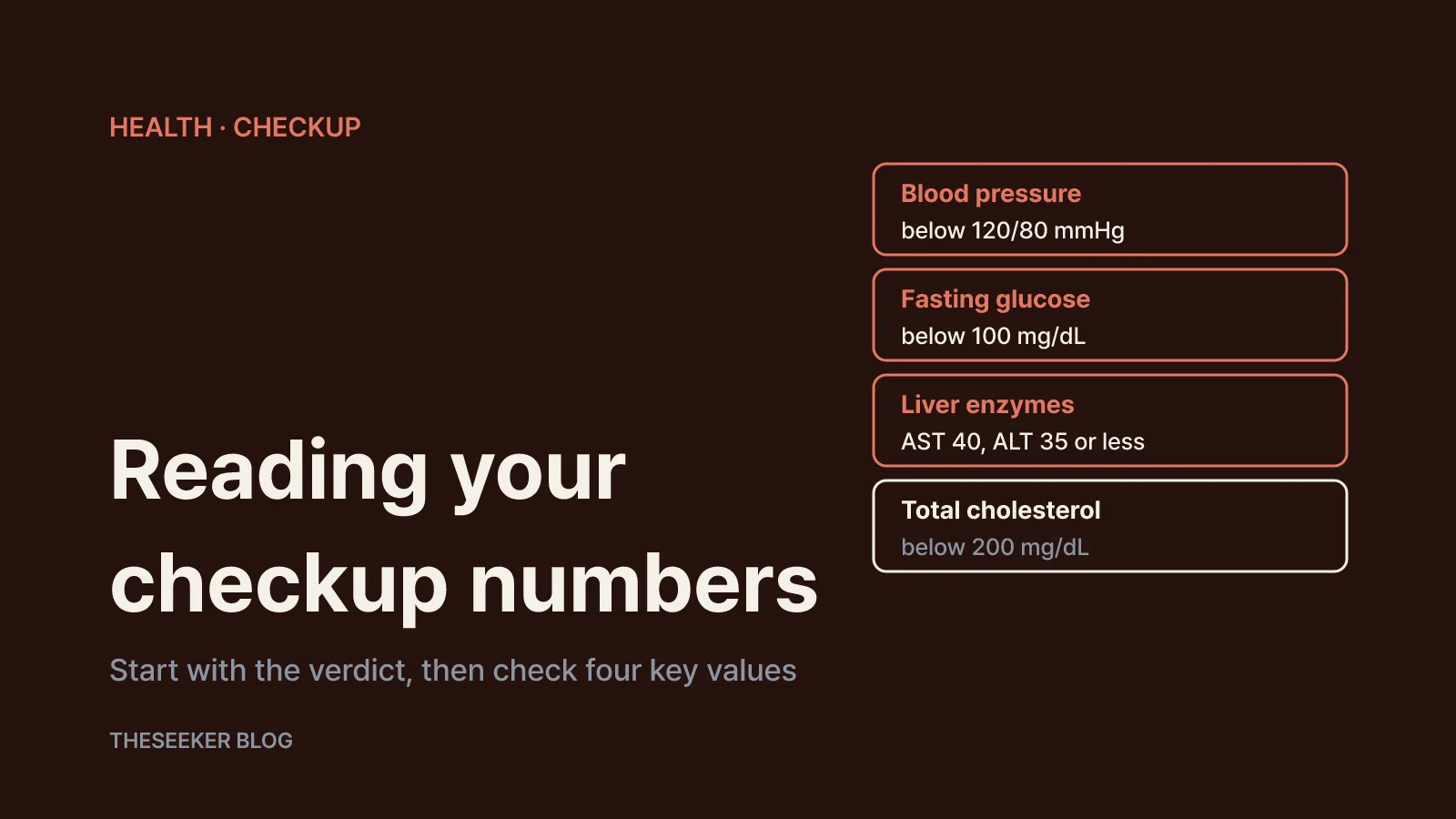
As of October 2026, the quickest way to read a Korean national general health screening report is to start with the overall verdict on the first page, then check four numbers on the next page: blood pressure, fasting glucose, liver enzymes (AST, ALT and gamma-GTP) and cholesterol. The normal cut-offs printed on the report are blood pressure below 120/80 mmHg, fasting glucose below 100 mg/dL, AST 40 or less, ALT 35 or less and total cholesterol below 200 mg/dL. If the verdict says a disease is suspected, the next step is a clinic visit and a repeat test rather than drawing conclusions from one number.
This guide is based on the National Health Insurance Service (NHIS) general health screening page and two pages from the Korea Disease Control and Prevention Agency's national health information portal: its guide to interpreting checkup results and its dyslipidemia page. The thresholds below are the Korean screening criteria, so they may not match the categories you have seen in other countries. Always read them alongside the reference values printed on your own report.
Start with the verdict page, then the item-by-item page
The report usually has two parts. The first page, the overall opinion, shows your verdict. The second page lists each test with its reference value, your result and the category you fall into. Reading the verdict first gives you the big picture before you look at individual numbers.
There are five verdict categories, and more than one can be ticked at the same time:
- Normal A: the screening results are normal.
- Normal B (borderline): no disease, but self-care and prevention, such as changes to diet or habits, are recommended.
- Suspected general disease: a result could develop into a disease, so follow-up testing or an accurate diagnosis at a medical facility is needed.
- Suspected hypertension or diabetes: you become eligible for a confirmatory test.
- Existing condition: you were already diagnosed with hypertension, diabetes, dyslipidemia or tuberculosis and are taking medication.
Normal B is the category people most often skip because it contains the word normal. The official description, however, is a state that calls for self-management. When you see it, find the item that triggered it and compare that same item at your next screening.
Blood pressure and fasting glucose: learn the three tiers
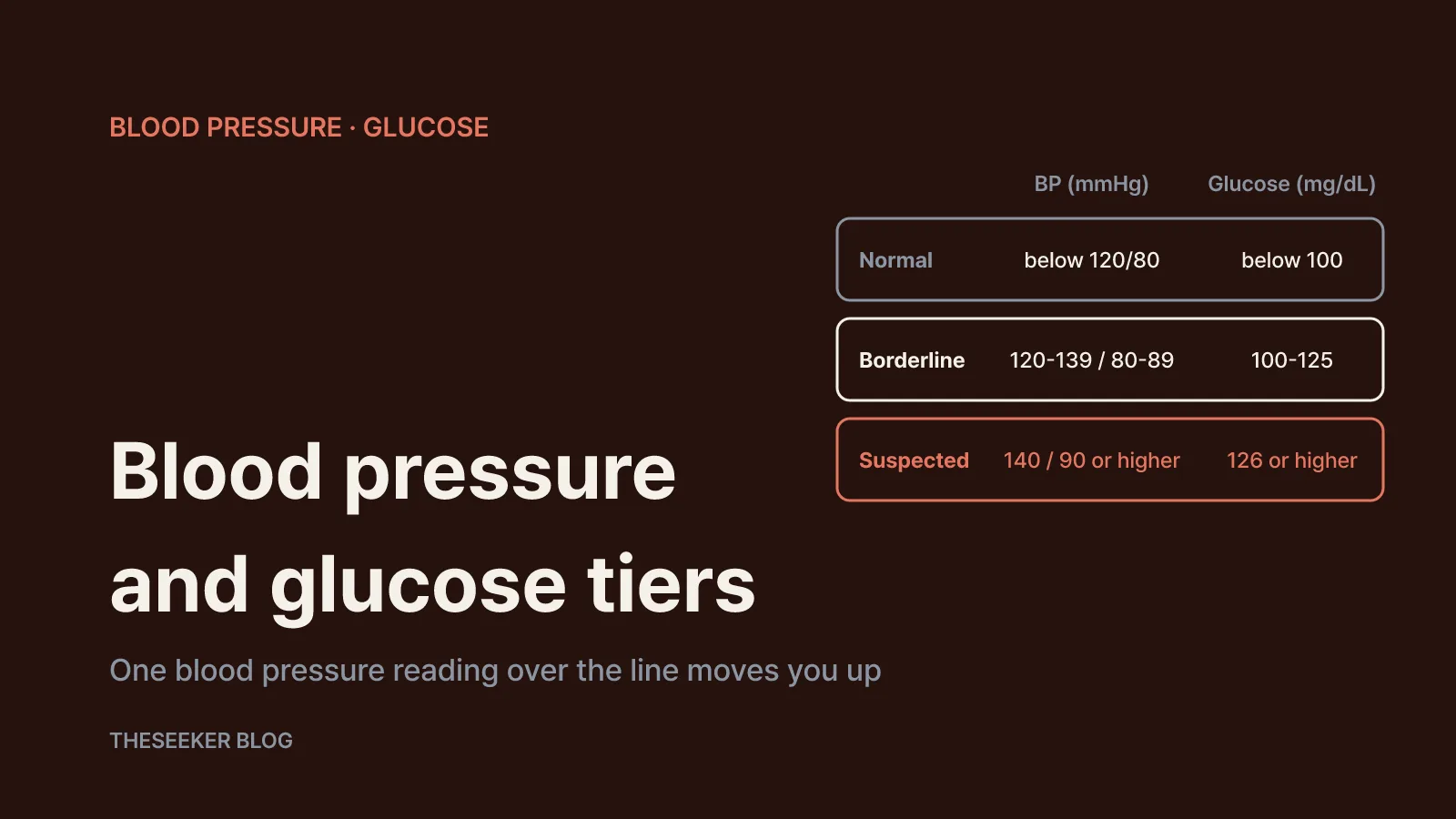
Blood pressure is written as two numbers. Systolic pressure is the peak when the heart contracts, and diastolic pressure is the lowest point when it relaxes. The KDCA portal lists these screening tiers:
← Swipe to see more
| Tier | Blood pressure (mmHg) | Fasting glucose (mg/dL) |
|---|---|---|
| Normal | Systolic below 120 and diastolic below 80 | Below 100 |
| Borderline | Systolic 120-139 or diastolic 80-89 (prehypertension) | 100-125 (impaired fasting glucose suspected) |
| Suspected disease | Systolic 140 or higher or diastolic 90 or higher | 126 or higher |
Pay attention to the words and and or. To be normal, both readings must sit below the line. To land in a higher tier, only one reading needs to cross it. A reading of 118 over 84, for example, counts as prehypertension, not normal.
For fasting glucose, two lines matter: 100 and 126. If you are flagged for suspected hypertension or diabetes, the NHIS says confirmatory testing for suspected hypertension, diabetes and tuberculosis takes place at hospitals and clinics, and the KDCA portal advises visiting a nearby clinic. Because both measurements can shift with conditions on the day, bring home blood pressure readings taken at the same time of day if you have them, and tell the doctor if you ate or drank something sweet before the blood draw.
Cholesterol and triglycerides: read four numbers separately
The lipid panel is not part of every screening. According to the NHIS, total cholesterol, HDL cholesterol, triglycerides and LDL cholesterol are tested once every four years for men aged 24 and over and women aged 40 and over. If your report has no cholesterol section this year, you were probably not due.
When you do have the panel, read each value on its own. The KDCA dyslipidemia page says dyslipidemia is diagnosed when one or more of the following apply:
- Total cholesterol of 200 mg/dL or higher
- LDL cholesterol of 130 mg/dL or higher
- HDL cholesterol below 40 mg/dL in men or below 50 mg/dL in women
- Triglycerides of 150 mg/dL or higher
LDL is the so-called bad cholesterol that can build up in artery walls and is most closely tied to cardiovascular risk. HDL works the other way: it carries excess cholesterol back to the liver, so a higher number is better. Remembering that HDL is the one value where higher is better prevents a common misreading.
Triglycerides respond strongly to food. KDCA notes that a fast of at least 9 hours, ideally 12, is needed before a lipid test, and that without fasting only total and HDL cholesterol can be used for reference. The LDL level at which treatment starts also depends on your cardiovascular risk group, so the same LDL result can lead to different advice for different people. KDCA reports that about 47.4% of Korean adults had dyslipidemia as of 2024, mostly without symptoms, which is a good reason not to ignore a result that only comes round every four years.
Liver enzymes: AST, ALT and gamma-GTP
The liver section typically shows three values. On the KDCA portal, normal is AST 40 or less and ALT 35 or less, and gamma-GTP 63 or less for men and 35 or less for women. Anything above these is marked as suspected abnormal liver function. Units appear as U/L or IU/L.
AST and ALT are enzymes that leak into the blood when liver cells are damaged. They also exist in the heart, skeletal muscle, kidneys and brain, so damage there can raise them too. KDCA adds that medication, non-alcoholic fatty liver and obesity can keep them elevated over time. Gamma-GTP can rise with long-term drinking and even after drinking the day before the test. If only gamma-GTP is slightly high, think about recent alcohol and recheck after avoiding it. If all three are high, or well above the cut-offs, see a doctor promptly.
Kidney, anemia and body-size markers
The NHIS common blood tests also include hemoglobin, serum creatinine and eGFR, alongside a urine test and body measurements. KDCA lists these reference points:
- Kidney function: serum creatinine of 1.5 mg/dL or less and eGFR of 60 or higher are normal.
- Urine protein: negative is normal, trace (±) is borderline and +1 or more suggests proteinuria. A high-fat meal, intense exercise or sudden stress the day before can also cause a positive result.
- Hemoglobin: normal is 13-16.5 g/dL for men and 12-15.5 g/dL for women; below 13 for men or 12 for women suggests anemia.
- Body size: BMI below 18.5 is underweight, 18.5-24.9 normal, 25-29.9 overweight and 30 or more obese. A waist of 90 cm or more for men or 85 cm or more for women indicates abdominal obesity.
Some reports also include a cardiovascular risk assessment comparing your absolute risk with the average for your age and sex, expressed as a cardiovascular age. It shows how the separate numbers add up.
What to do when a number is out of range
- Check the verdict type. Normal B, suspected general disease and suspected hypertension or diabetes lead to different next steps.
- Recall test-day conditions. Fasting time, alcohol the night before, hard exercise and medication can all move triglycerides, gamma-GTP and urine protein.
- Compare with earlier years. You can look up past results through the NHIS checkup results menu and line up the same items.
- Use the reference values on your report. Treat the numbers printed by your screening centre as the primary guide.
- Write down questions. Ask whether a retest is needed, when to recheck and which habit to change first.
For lifestyle, KDCA recommends moderate aerobic exercise five times a week for at least 30 minutes a day, plus strength training at least twice a week, along with not smoking, limiting alcohol and cutting saturated fat. Finally, note your screening cycle: household heads and dependants aged 20 and over are screened every two years, office workers every two years and non-office workers every year.
Sources
Frequently asked questions
What does Normal B mean on a Korean checkup report?
Normal B (borderline) means no disease was found, but self-care and prevention such as changes to diet and habits are recommended. Find the item that triggered it and compare it at your next screening, and see a doctor if it keeps recurring or you have symptoms.
Why is there no cholesterol result on my report this year?
In the Korean general health screening, the lipid panel is done once every four years for men aged 24 and over and women aged 40 and over. If it was not your year, the section may be empty.
Does drinking the night before affect liver results?
Yes, gamma-GTP can rise after drinking the day before the test as well as with long-term drinking. Tell the doctor, and recheck after avoiding alcohol.
My blood pressure was 118/84. Is that normal?
No. Normal requires systolic below 120 and diastolic below 80. Because the diastolic reading of 84 falls in the 80-89 range, it is classed as prehypertension.
blog.theseeker.io/en/posts/how-to-read-health-checkup-results-key-numbers
Sophia Reed
Sophia covers checkups, nutrition and everyday health habits, drawing on guidance published by public health agencies and medical societies.
Read our editorial standards