How to Choose a Health Checkup Clinic in Korea
Korea's national health screening can be taken at any designated provider nationwide. Here is how to find one through NHIS and what to confirm before you book.
 Sophia Reed
In this post
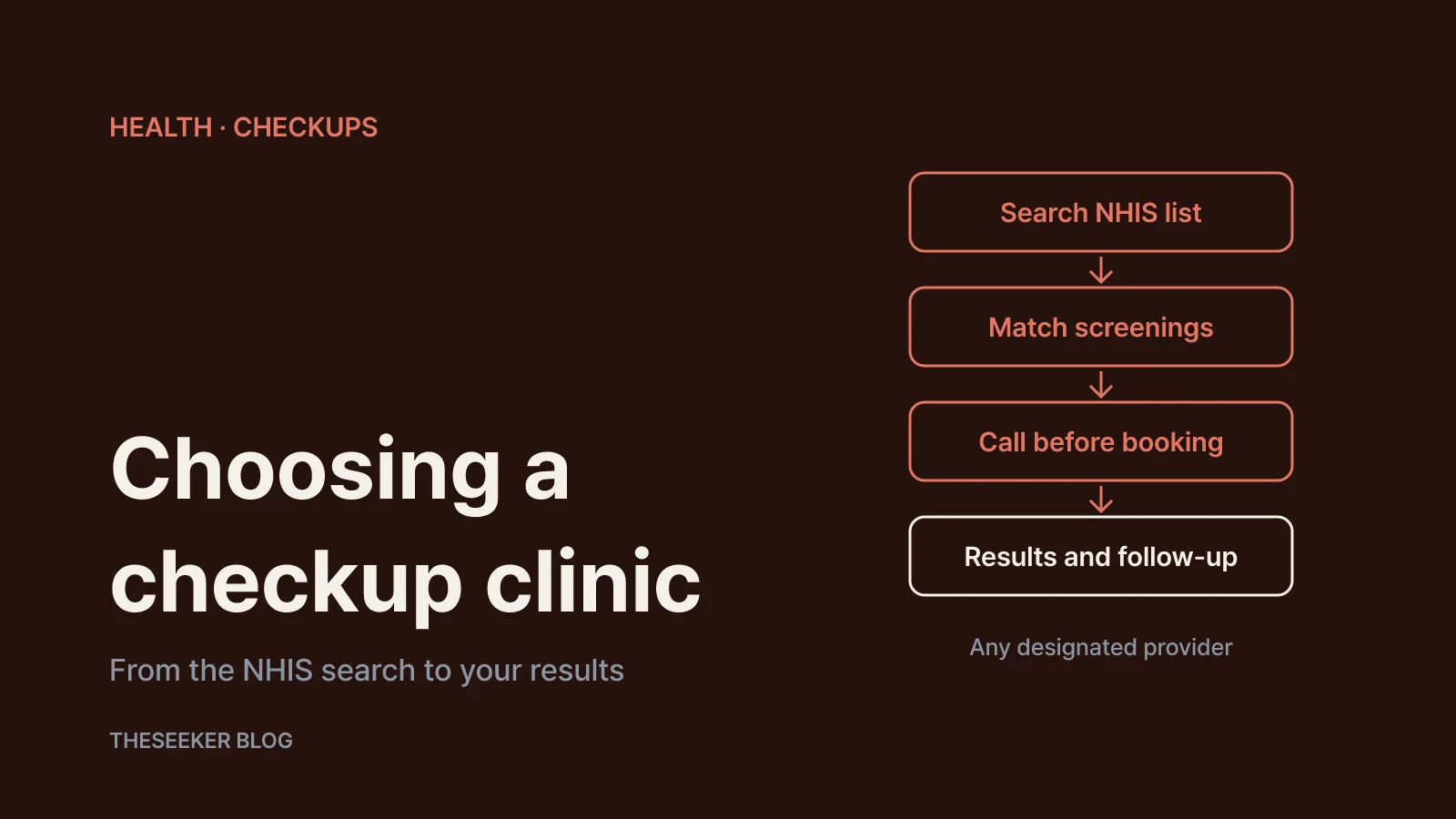
As of October 2026, if you are covered by Korea's National Health Insurance Service (NHIS) and have been notified that you are due for a national health screening, you can take it at any designated screening provider in the country, regardless of your registered address (Korea Disease Control and Prevention Agency). The practical way to choose is to search the NHIS provider directory by the screening types you need, shortlist two or three clinics, and then call each one to confirm endoscopy options, booking rules, extra charges and how results are explained.
This guide does not recommend particular hospitals. It walks through the selection process using information published by Korean public agencies. It assumes you already know whether you are eligible this year; if not, check your eligibility with NHIS first, because the screening types you are due for determine which providers make sense.
Search designated providers through NHIS
The official starting point is the NHIS provider search. According to the KDCA, on the NHIS website (www.nhis.or.kr) the path is 건강모아 (Health Moa) → 기관 찾기 (Find institutions) → 병(의)원/검진기관 찾기 (Find hospitals/screening providers), and in the NHIS mobile app 건강보험25시 the path is 건강모아 → 검진기관/병(의)원 찾기 (KDCA). The menus are in Korean, so it helps to keep those labels handy. No application is required; the directory is open to everyone.
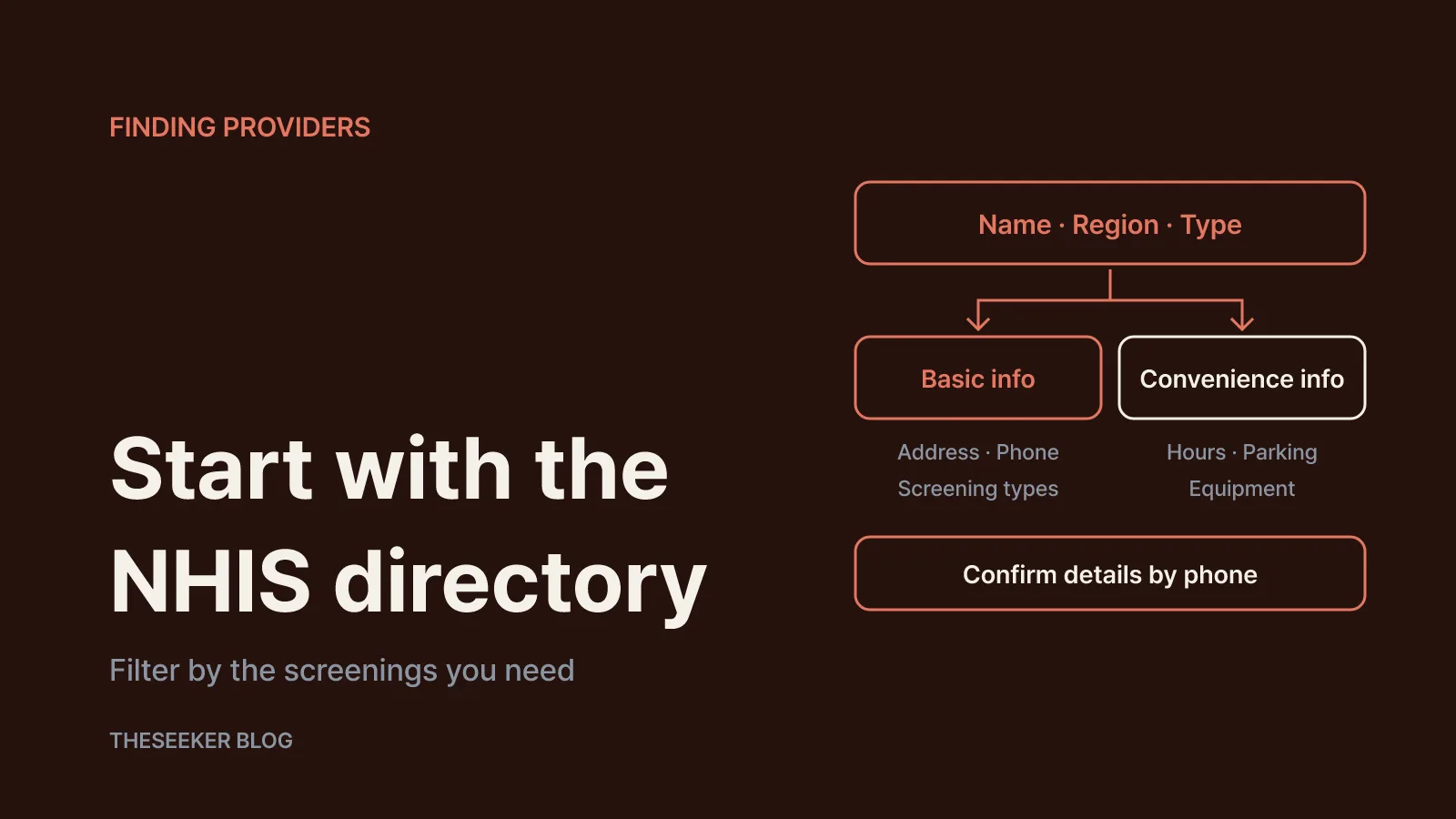
The Gov24 service listing describes three search filters: name, region and screening type. Screening types include the general health checkup (including the life-transition checkup), cancer screening, oral checkup, infant and child checkup, checkups for out-of-school youth, disability-friendly providers and holiday screening (Gov24). Filtering by type matters more than filtering by distance. If you are due for both the general checkup and stomach cancer screening, a provider that offers both lets you finish in a single visit.
Each listing has two layers. Basic information covers the address, phone number, screening types and medical departments. Convenience information covers opening hours, location and parking, holiday screening and the equipment the provider holds. The convenience layer is entered by the providers themselves, so it may be missing entirely or out of date. Gov24 explicitly advises calling the provider when you need accurate details (Gov24). Treat the search results as a shortlist, not a final answer.
Because there is no address restriction, you can include clinics near your workplace or ones that are easier to reach after work. The same Find institutions menu also has a separate section for provider evaluation information (NHIS), which is worth a look when you are choosing between several candidates.
Match the clinic to the screenings you are due for
Providers are designated for specific screening types, so a clinic that runs the general checkup may not offer every cancer screening. Cancer screening is where the choice of provider matters most, because the test method differs by cancer. The KDCA summarizes the national cancer screening program as follows (KDCA cancer screening):
- Stomach cancer: adults aged 40 and over, every 2 years, by upper endoscopy. An upper GI contrast study may be used where endoscopy is difficult. Any extra cost for sedated endoscopy or a Helicobacter test is paid by the patient.
- Colorectal cancer: adults aged 50 and over, every year, by fecal occult blood test (FOBT). A positive result leads to colonoscopy. If you skip the FOBT and go straight to colonoscopy, you pay the full cost yourself.
- Breast cancer: women aged 40 and over, every 2 years, by mammography.
- Cervical cancer: women aged 20 and over, every 2 years, by cervical cytology (Pap test).
- Liver cancer: high-risk adults aged 40 and over, twice a year, by liver ultrasound plus a serum alpha-fetoprotein test.
- Lung cancer: high-risk adults aged 54 to 74 with a smoking history of 30 pack-years or more, every 2 years, by low-dose chest CT.
Turn that list into questions. If you are due for stomach screening, ask whether the clinic performs upper endoscopy, whether sedation is available and what it costs. Women may want mammography and the Pap test at the same site. High-risk smokers should confirm the clinic has low-dose CT. Equipment may appear in the convenience information, but since providers enter it themselves, confirm by phone.
Knowing the cost structure also helps. The general checkup is fully paid by NHIS, and Medical Aid recipients are covered in full by national and local government (KDCA). For national cancer screening, the patient normally pays 10%, Medical Aid recipients pay nothing, and colorectal and cervical screening are fully covered by NHIS (KDCA cancer screening). If a quote does not fit this pattern, ask which part is an optional service outside the national program.
Five things to confirm by phone before booking
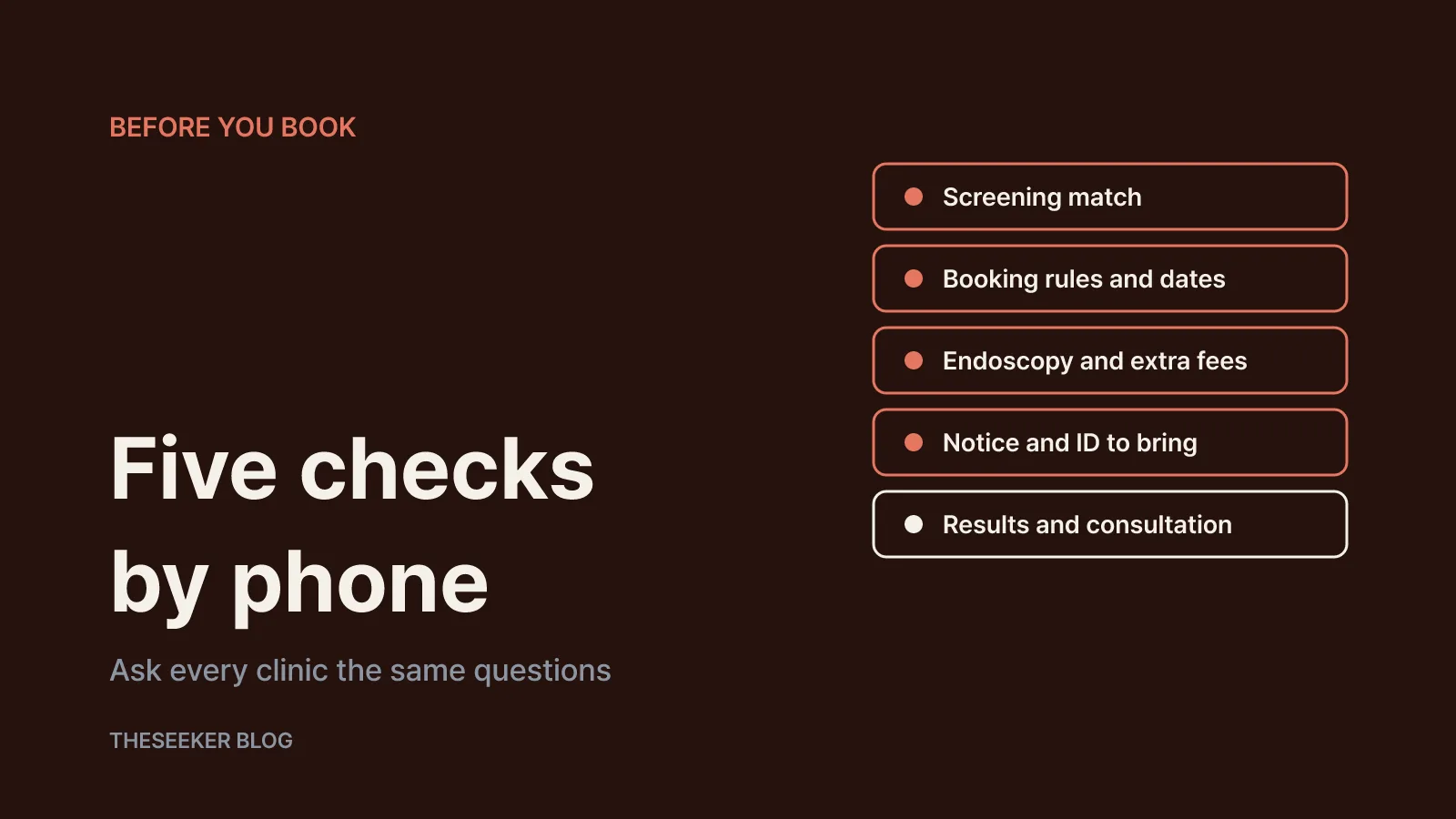
Once you have a shortlist, ask every clinic the same questions so the answers are easy to compare.
- Screening match: name the exact screenings, for example the general checkup plus stomach cancer screening, and confirm the clinic currently offers both.
- Booking rules and dates: whether an appointment is needed, whether walk-ins are accepted, how to book and whether they screen on public holidays. Holiday availability is listed as self-reported convenience information, so verify it.
- Endoscopy details: whether endoscopy is scheduled separately, whether sedation is offered and the extra fee. Ask for written preparation instructions, because they can differ between providers.
- What to bring: the standard items are your screening notice and ID, but the KDCA notes you can be screened with just your ID. A lost notice can be reissued through NHIS (1577-1000) or a local branch, or printed from the NHIS website after identity verification (KDCA).
- Results and consultation: general checkup results are sent by the provider by mail or email within 15 days and can also be viewed in the 건강보험25시 app. Ask whether you can review them with a doctor and whether that needs a separate appointment.
You may be offered extra tests outside the national program. Ask whether the test is separate from the national screening, what it costs and whether declining it affects your national checkup. Whether an add-on is useful depends on your own health, so take time to understand it before agreeing.
Think about follow-up care, not just screening day
A good choice also considers what happens after the results arrive. According to the KDCA, if the general checkup suggests hypertension, diabetes, dyslipidemia, pulmonary tuberculosis, depression, early psychosis or hepatitis C, you can get a confirmatory test or consultation at a nearby clinic, and the first confirmatory test is exempt from your co-payment. For dyslipidemia only the first consultation fee is supported, not the test itself. Tuberculosis and hepatitis C can be confirmed at any level of hospital, while the other conditions are confirmed at clinics and hospitals rather than general or tertiary hospitals (KDCA).
That makes a local clinic you already use, if it is a designated provider, a convenient option: you can move from results to treatment in one place. If you prefer a large screening center, identify a nearby clinic for follow-up in advance.
Clear explanations matter most for cancer screening. The KDCA reports that among 1,000 women aged 40 and over in the national breast cancer screening program, about 140 are told they need further tests or action, yet only about 2 are diagnosed with cancer (KDCA cancer screening). An abnormal finding is not a diagnosis, so a provider that explains why further testing is needed is worth choosing.
If you miss this year's window, NHIS runs a service that lets you apply in the following year for a national checkup you missed, at no extra cost. You can apply through the NHIS website, the 건강보험25시 app or the visual ARS at 1577-1000 (KDCA). Still, appointments tend to fill up toward the end of the year, so book early once you have chosen.
Sources
Frequently asked questions
Do I have to get my national health checkup near my registered address?
No. The national health screening can be taken at any designated provider anywhere in Korea, regardless of your address, so a clinic near your workplace is fine.
I lost my screening notice. Can I still get checked?
Yes. According to the KDCA, you can be screened by bringing your ID alone. You can also have the notice reissued through NHIS (1577-1000) or a branch office, or print it from the NHIS website after verifying your identity.
Is sedated endoscopy covered by the national program?
The extra cost of sedated endoscopy or a Helicobacter test during stomach cancer screening is paid by the patient. Fees vary by provider, so ask before booking.
Can I get a colonoscopy directly through national screening?
National colorectal screening starts with a fecal occult blood test. Colonoscopy follows a positive result. If you skip the stool test and have a colonoscopy directly, you pay the full cost.
When will I get my results?
Results of the general health checkup are sent by the provider by mail or email within 15 days of the screening, and you can also view them in the NHIS 건강보험25시 app.
blog.theseeker.io/en/posts/korea-health-checkup-clinic-search-booking
Sophia Reed
Sophia covers checkups, nutrition and everyday health habits, drawing on guidance published by public health agencies and medical societies.
Read our editorial standards