Does a Health Checkup in Korea Include an HIV Test?
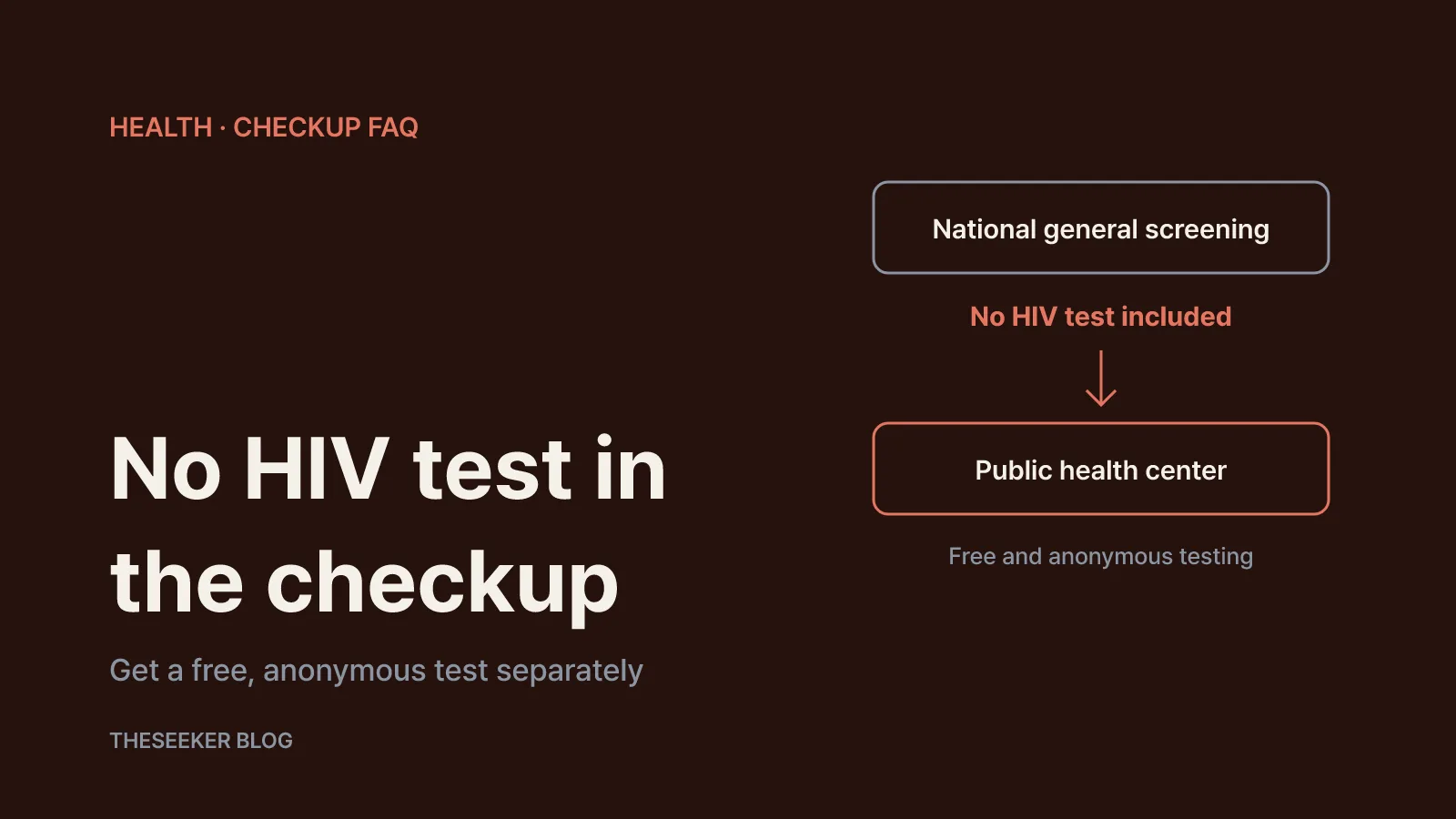
Korea's national general health screening does not include an HIV test. Here is how to check a private checkup package, get a free anonymous test at a public health center, and time it correctly.
 Sophia Reed
In this post
- Korea's national general screening does not test for HIV
- Private and employer checkups: read the item list
- How to get a free, anonymous test at a public health center
- When to test for an accurate result: 4, 6 and 12 weeks
- What the result means and what happens next
- A quick checklist before you test
- Sources
- Frequently asked questions
As of October 2026, the short answer is no: the standard items in Korea's national general health screening, run by the National Health Insurance Service (NHIS), do not include an HIV test. The common screening items listed by the Korea Disease Control and Prevention Agency (KDCA) are a consultation, body measurements, vision and hearing, blood pressure, a chest X-ray, blood tests, a urine test and an oral exam, and none of the sex- and age-specific add-ons is an HIV test either. If you want to know your HIV status in Korea, you need to request a test separately at a public health center (bogeonso) or a clinic, and public health centers offer it free and anonymously. This guide covers how to tell whether a checkup includes HIV, how to get tested on your own, when testing is accurate, and how results are protected.
Korea's national general screening does not test for HIV
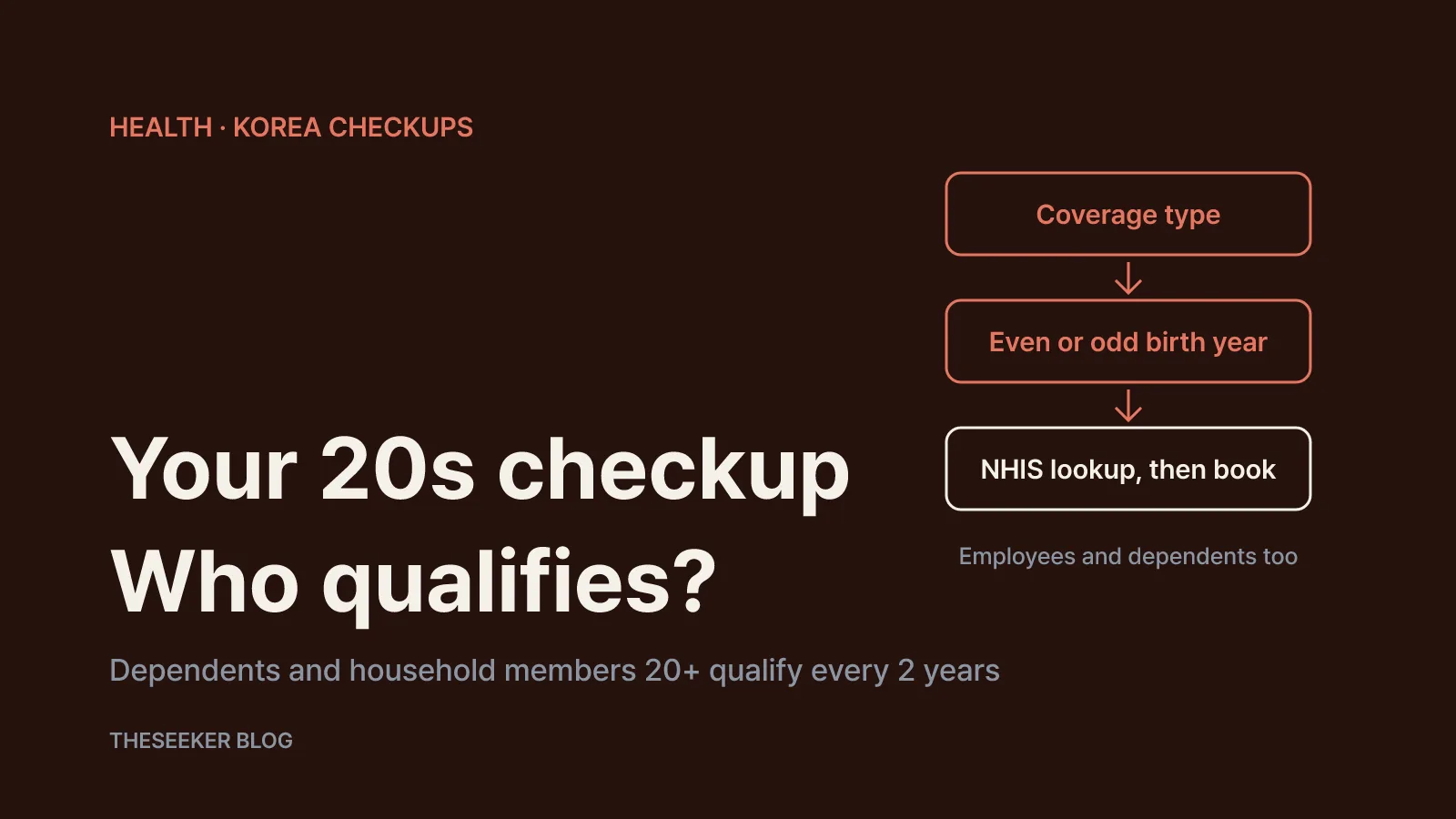
National health screening is screening paid for by the NHIS or by central and local government. It includes general health screening, cancer screening, infant screening and student screening. Adults are eligible for general screening every two years, or every year for non-office workers. The blood panel measures hemoglobin, fasting glucose, AST, ALT, gamma-GTP, serum creatinine and eGFR, which look at anemia, diabetes, liver function and kidney function. Having blood drawn does not mean infectious diseases are automatically tested.
The age-based add-ons follow the same pattern. According to the KDCA's National Health Information Portal, hepatitis B testing is done at age 40 and hepatitis C antibody testing at 56. Other items such as cholesterol, bone density, lung function, cognitive screening, mental health, lifestyle, physical function for older adults and dental plaque are added at set ages. The only infection-related blood tests are for hepatitis, and HIV is absent.
The same page explains how conditions are chosen for population screening: the problem should be important, treatable when caught early, tested by an acceptable method, more beneficial than harmful and cost-effective. The practical takeaway is simple. A clean general screening report should not be read as an HIV-negative result, because HIV was never tested.
Private and employer checkups: read the item list
Comprehensive checkups offered as an employee benefit, or packages sold by hospital health centers, are designed by each provider. Whether HIV is included, offered as an add-on or left out varies by provider and package, so there is no general rule. The reliable approach is to read the test item list you receive when booking. Look in the infection or blood test section for terms such as HIV, HIV Ag/Ab or AIDS. If it is not listed, ask the center directly whether the package includes HIV testing and whether it can be added. If you already had the checkup, check the blood test list in your report; if HIV is not there, it was not tested.
Many people worry that an employer-paid checkup could reveal HIV results to the company. Article 8-2 of Korea's AIDS Prevention Act says whoever performs an HIV test may not notify anyone other than the person tested. Exceptions exist for people in communal settings such as the military or correctional facilities, where the head of the institution is notified, and for minors, where a legal representative is notified. Paragraph 3 of the same article states that an employer may not require a worker to submit HIV test results, and Article 3 prohibits employers from disadvantaging or discriminating against workers because they live with HIV beyond what the law provides. The Act also contains penalty provisions for violations.
If you still feel uneasy, you can keep the two separate: skip any HIV item in a work checkup and use an anonymous test at a public health center instead.
How to get a free, anonymous test at a public health center
The KDCA's HIV testing page says public health centers offer free HIV testing without revealing your name or other personal details if you choose. The law backs this up: anyone performing HIV tests must tell the person beforehand that they can be tested without giving a name, resident registration number or address, or under a pseudonym, and must test them if they request it (Article 8, paragraph 4).
Procedures differ by district. The Gangnam-gu Public Health Center in Seoul describes the following:
- All 25 public health centers in Seoul offer free anonymous testing regardless of where you live.
- The standard EIA test uses a 5 to 10 cc venous blood draw with results in 3 to 7 days; the rapid test uses a single drop from a fingertip with results in about 20 minutes.
- Instead of your name, you write a number or pseudonym on the receipt and get a slip with a reception number and the lab phone number.
- You collect the result by showing the slip or by calling and giving your pseudonym or number.
- Gangnam lists rapid testing hours as weekdays 10:00 to 11:20 and 13:00 to 17:00, and notes mornings can be busy.
Outside Seoul, HIV testing is available at public health centers and clinics nationwide, and anonymous testing is offered at public health centers across the country. Whether a rapid test is available, which days and hours apply and how results are delivered can vary, so call the infectious disease team at your local public health center before going. Gangnam's page also states that rapid tests for minors are done with a guardian's consent.
Clinics and hospitals can test you too. The KDCA portal notes that most clinics in Korea use a venous-blood antigen/antibody combination test. Fees and how results are delivered vary, so ask when booking.
When to test for an accurate result: 4, 6 and 12 weeks
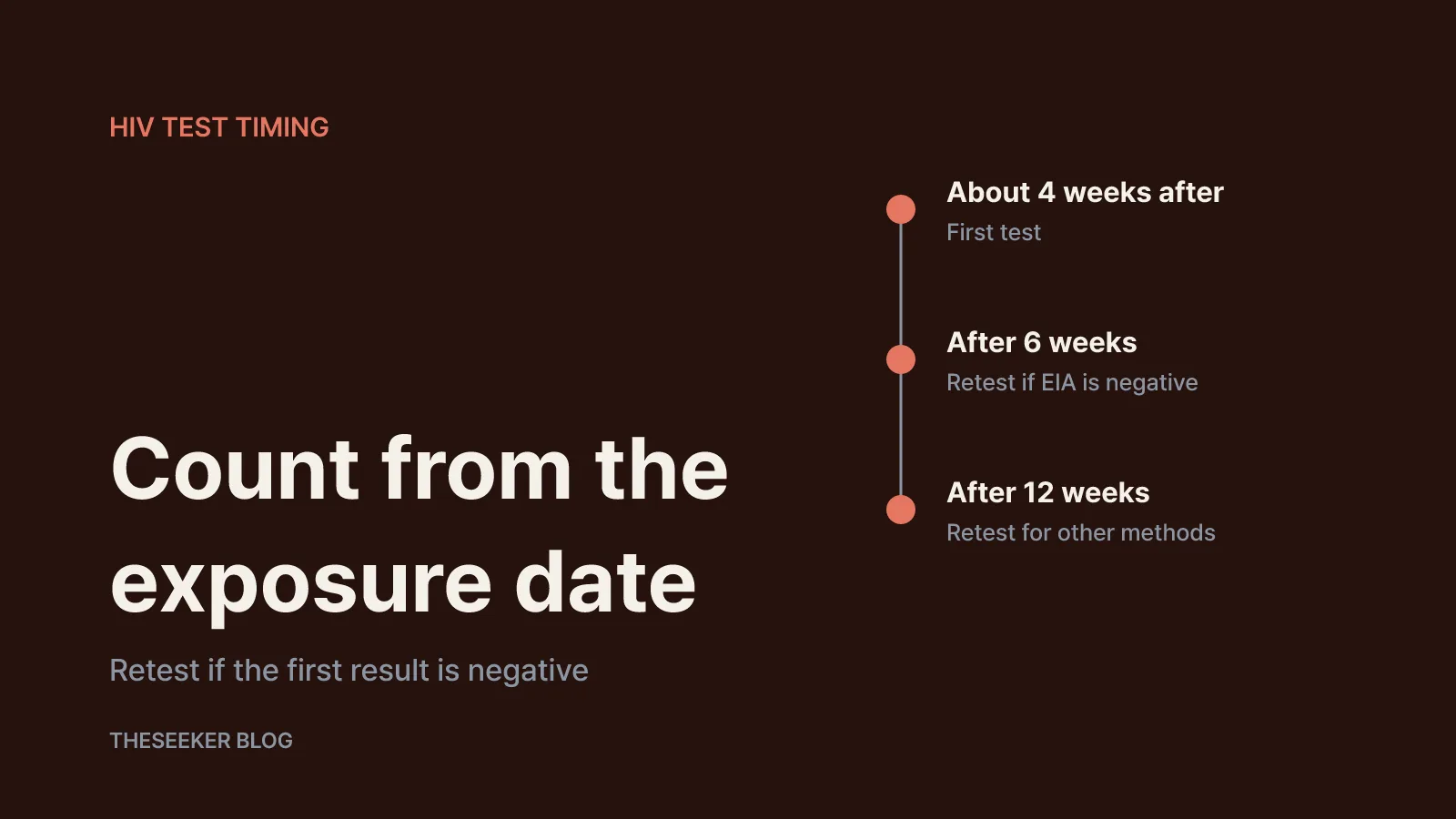
Timing is the step people miss most often. Right after infection, antibodies or antigens may not yet be detectable, so a test can be negative even when infection has occurred. This is the window period. The KDCA therefore recommends testing about 4 weeks after the exposure and, if negative, retesting 6 weeks after the most recent exposure for enzyme immunoassay (EIA), or 12 weeks after for other methods.
Detection windows by method, based on KDCA material:
- Antigen/antibody combination test: antigen may be detectable at 2 to 3 weeks and antibodies at 3 to 4 weeks. The KDCA portal gives its window as 18 to 45 days, roughly 6 weeks.
- Rapid test: rapid tests sold in Korea detect antibodies only and can detect infection 6 to 8 weeks after it occurs. Results take 15 to 30 minutes, but sensitivity is lower than lab-based tests, so a negative result should be followed by a retest 12 weeks after the last exposure.
- Nucleic acid test: can detect the virus about 11 days after exposure but is costly, so it is mainly used for confirmation and treatment monitoring.
A negative result a few days after a worrying event is not a final answer. Count from the date of the most recent exposure and book your retest in advance. If you think you may need preventive medication right after an exposure, seek medical advice immediately rather than waiting for the testing window; the KDCA portal describes post-exposure prophylaxis (PEP), taken within 72 hours of exposure.
What the result means and what happens next
The first test at a public health center or clinic is a screening test. According to the KDCA portal, a reactive screening result is sent to a confirmation lab, such as a provincial institute of health and environment or a hospital with a full-time laboratory medicine specialist, for a final decision using Western blot or similar methods. Indeterminate results are referred on to the KDCA.
Gangnam's guidance reports rapid test results as either negative or needing further testing. If further testing is needed, blood is drawn again and the confirmed result is available about 7 days later. The page stresses that screening tests are highly sensitive, false positives occur, and many people flagged for further testing turn out not to be infected. Do not draw conclusions from a single screening result.
If HIV is confirmed, treatment and support are available. The KDCA portal explains that HIV medication suppresses the virus and prevents complications such as AIDS, and that people whose virus is suppressed to undetectable levels do not transmit HIV sexually (U=U). It also describes support for out-of-pocket costs of HIV-related care and counseling by specialist nurses. On confidentiality, Article 7 of the Act forbids people who learn of someone's HIV status through their work from disclosing it.
A quick checklist before you test
- Only had national general screening? HIV was not included. Get tested separately if you need to.
- Booking a private or employer checkup? Check the item list for HIV and use an anonymous public health center test if you prefer to keep it separate.
- Had a possible exposure? Note the date, test around 4 weeks, and if negative retest after 6 or 12 weeks depending on the method.
- Before visiting a public health center: call to confirm rapid test availability and hours, and choose the pseudonym or number you will use.
- After the result: a reactive screening test is not a diagnosis, so follow the confirmation process; if confirmed, see an infectious disease specialist and ask the public health center about support.
The KDCA lists situations where HIV testing is recommended, including men who have sex with men, sex with a partner living with HIV, multiple sexual partners, sharing needles or syringes, a diagnosis of another sexually transmitted infection, hepatitis or tuberculosis, and pregnancy. If any applies to you, schedule HIV testing alongside, but separate from, your routine checkup.
Sources
Frequently asked questions
Will the blood test in Korea's national health screening show HIV status?
No. The general screening blood panel covers hemoglobin, fasting glucose, AST, ALT, gamma-GTP, serum creatinine and eGFR, with hepatitis B and C tests added at set ages. HIV is not on the list, so a normal result says nothing about HIV.
If my company checkup includes HIV, will my employer see the result?
Under Article 8-2 of Korea's AIDS Prevention Act, whoever performs an HIV test may not notify anyone other than the person tested, with limited exceptions, and employers may not ask workers to submit HIV test results. If you still prefer separation, use an anonymous test at a public health center.
Do I really not have to give my name at a public health center?
Yes. The KDCA states that public health centers offer free HIV testing without revealing your name or other personal details if you wish. You register with a pseudonym or number and use it to collect the result.
Should I choose the rapid test or a blood draw?
In Gangnam's guidance, the rapid finger-prick test takes about 20 minutes and the venous blood test takes 3 to 7 days. The blood test can detect infection about a week earlier. Consider your exposure date and plan a retest at the recommended time.
I tested negative a few days after a possible exposure. Am I in the clear?
Not necessarily. Early after infection, antibodies or antigens may not yet be detectable. The KDCA recommends testing around 4 weeks after exposure and, if negative, retesting after 6 weeks for enzyme immunoassay or after 12 weeks for other methods.
blog.theseeker.io/en/posts/health-checkup-hiv-test-included-anonymous-testing
Sophia Reed
Sophia covers checkups, nutrition and everyday health habits, drawing on guidance published by public health agencies and medical societies.
Read our editorial standards