Easy Potato and Tofu Recipe: A One-Pan Korean Side Dish
Pan-fry the tofu, then layer onion, potato and tofu in the same skillet and braise in a soy-gochugaru sauce. Ingredients, ratios, timing and storage for gamja dubu jorim.
 Chloe Morgan
In this post
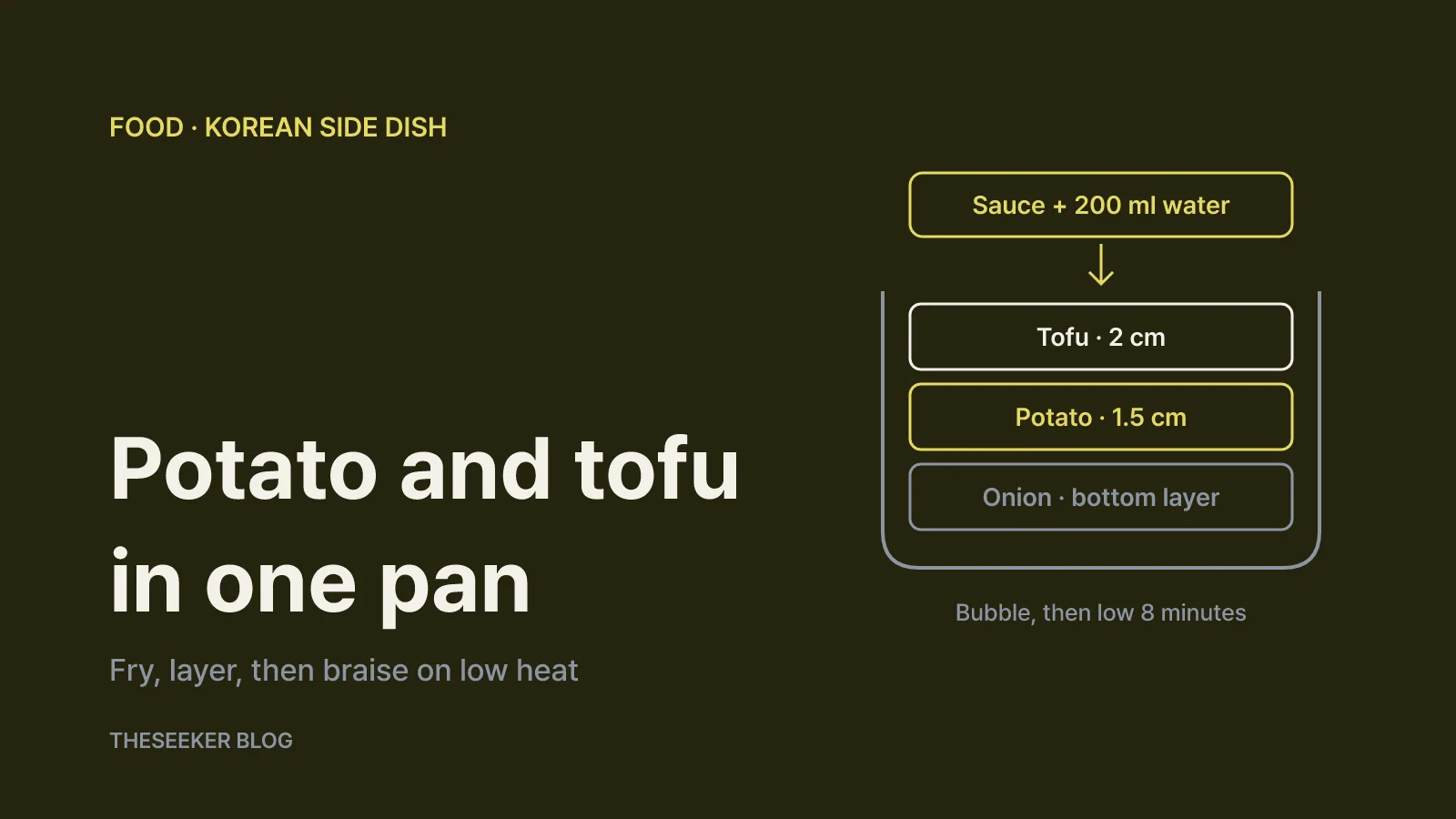
As of October 2026, the simplest way to cook potatoes and tofu together Korean-style is a one-pan braise called gamja dubu jorim. Slice firm tofu about 2 cm (3/4 inch) thick, pat it dry and pan-fry both sides until golden. In the same skillet, lay down sliced onion, add potato slices about 1.5 cm (5/8 inch) thick, and set the tofu on top. Pour over a soy sauce and gochugaru seasoning plus 200 ml of water, cover, bring it to a bubble over medium-low heat, then turn it down and braise for about 8 more minutes until the potato is tender. Finish with a spoonful of toasted sesame oil.
This guide follows a two-serving recipe published on 10000recipe, Korea's large recipe-sharing site, and compares it with a four-serving version from the Korean recipe platform Wtable so you can scale or adjust the sauce. Potato prep and leftover storage follow public guidance from Health Canada and the USDA. Everything happens in one skillet, so there is less washing up, and you get two classic Korean side dishes — braised potatoes and braised tofu — in a single banchan that goes well with a bowl of rice.
Ingredients and sauce ratio for two servings
The base recipe is rated beginner level and takes under 30 minutes. Korean recipe sites measure a tablespoon as 15 ml and a teaspoon as 5 ml, which is close enough to US spoons that you can use them directly.
Main ingredients
- 1 block of firm tofu
- 1 potato
- 1/2 onion
- 1/2 stalk of Korean green onion (daepa) or a few scallions
- Neutral cooking oil for pan-frying
Braising sauce
- 3 tablespoons regular soy sauce (Korean jin-ganjang)
- 1 tablespoon minced garlic
- 1 tablespoon gochugaru (Korean red pepper flakes)
- 1/2 tablespoon hot gochugaru
- 1 tablespoon allulose (or another sweetener, see below)
- 1/2 teaspoon ground black pepper
- 200 ml water, about 6.8 fl oz or a little under 1 US cup, added separately
- 1 tablespoon toasted sesame oil, added off the heat
An easy way to remember the seasoning is soy sauce 3 : chili flakes 1.5 : garlic 1 : sweetener 1, in tablespoons. The water dilutes it while the potato cooks, and the potato and tofu share the sauce, so the finished dish is savory rather than harsh.
To feed four, Wtable's version is a useful reference. It uses a 500 g (about 17.6 oz) block of tofu, 2 potatoes, 1/2 onion, 1 green onion, 1 Korean green chili and 1/2 red chili, with 4 tablespoons soy sauce, 2 tablespoons gochugaru, 1 tablespoon gochujang, 1 tablespoon sugar, 1/2 tablespoon minced garlic and 1 tablespoon sesame oil. Instead of water it adds 1 1/2 cups of anchovy-kelp stock and slices the potatoes thinner, about 1 cm (3/8 inch), for a total time of 20 minutes. The gochujang makes the sauce thicker and spicier.
One caution about cups: Wtable does not state its cup size, and one reader comment reports that measuring with a 250 ml cup turned the braise into something closer to soup. 10000recipe's measuring guide uses a 200 ml cup, which is smaller than a US cup. Start with less liquid and top up only if the pan starts to look dry.
Step-by-step: one skillet from start to finish
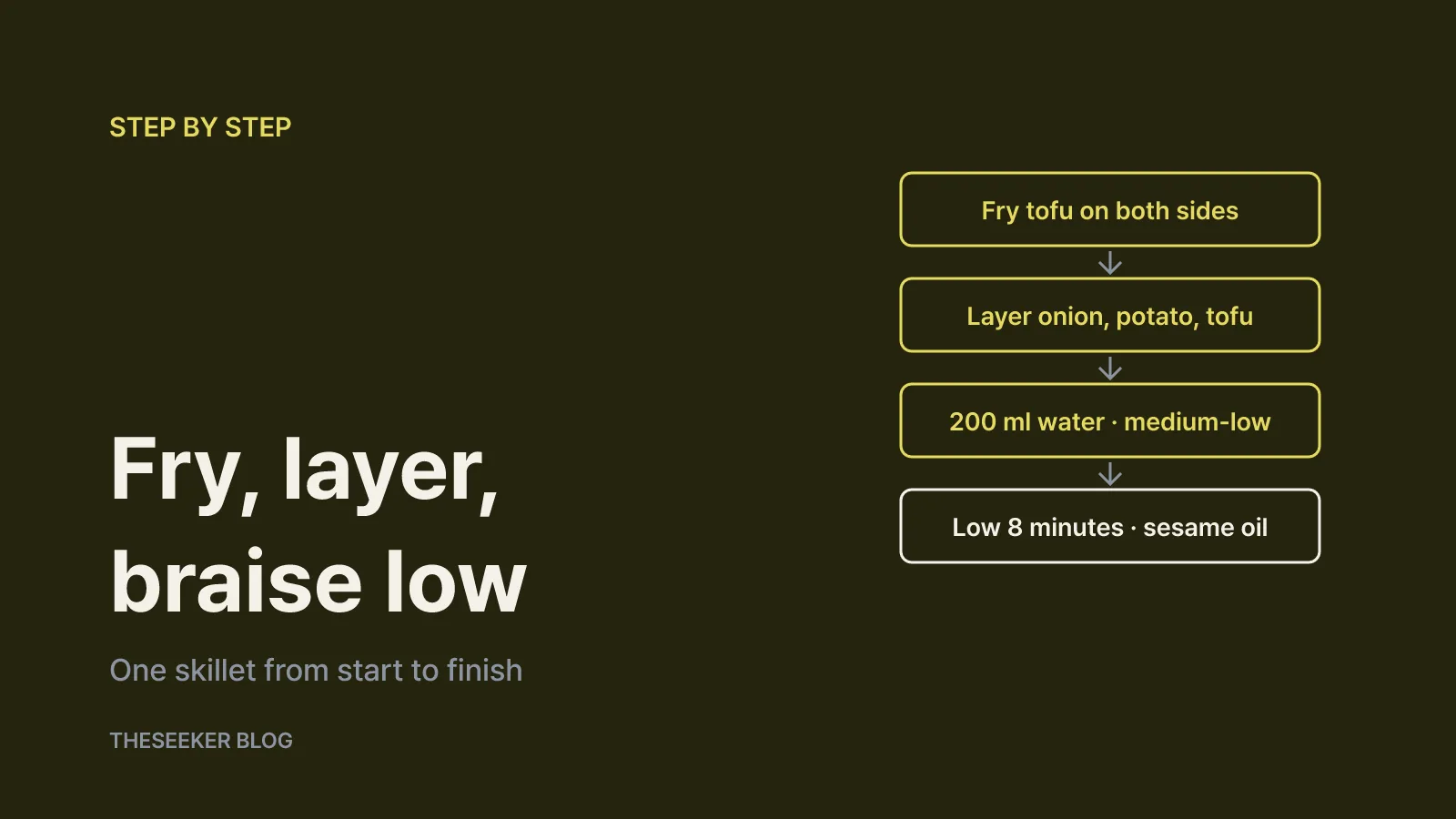
- Prep the aromatics. Slice the onion into thick strips and cut the green onion on the diagonal.
- Slice the potato. Peel it and cut it into 1.5 cm (5/8 inch) slices. Trim away any green patches or sprouting eyes now.
- Slice and dry the tofu. Cut it into 2 cm (3/4 inch) slabs and blot the surfaces with paper towels.
- Pan-fry the tofu. Heat oil in the skillet and fry the tofu until golden on both sides. Set it aside on a plate.
- Mix the sauce. Combine the soy sauce, garlic, both kinds of gochugaru, allulose and pepper in a small bowl.
- Layer the pan. Spread the onion over the bottom of the same skillet, place the potato on the onion, then the tofu on the potato. Top with the green onion and sauce.
- Add water and bring to a bubble. Pour in the 200 ml of water so the sauce spreads evenly, cover and cook over medium-low heat until you hear it bubbling.
- Braise gently. Turn the heat to low, flip the tofu once and braise for about 8 minutes, until the potato is cooked through.
- Finish. Turn off the heat and drizzle in the sesame oil.
Test the thickest potato slice with a chopstick or skewer: if it slides in without pressure, it is done. If the potato is still firm but the liquid is nearly gone, add two or three tablespoons of water, cover and give it another minute or two at a time. If the potato is done and there is plenty of sauce left, uncover and spoon the sauce over the tofu while it reduces, so the glaze clings to the outside.
Three things that prevent a failed braise: thickness, moisture and heat
Match the thickness. The 10000recipe author notes that potatoes cut too thick take longer to cook and do not absorb the seasoning well. Tofu cut too thin cracks when you fry it and soaks up too much sauce while the potato cooks, which makes it salty. That is why the potato is 1.5 cm and the tofu slightly thicker at 2 cm: the two finish cooking and seasoning at about the same time.
Dry the tofu. Wet tofu makes hot oil spit in every direction. Pressing the slabs between paper towels is enough to make frying calmer. Do not skip the frying step either — a firm, golden surface keeps the tofu from breaking up during the braise and helps the sauce soak in. A firm tofu labeled for pan-frying holds together best when you flip it.
Put onion on the bottom and keep the heat low. The potato needs to sit near the bottom of the pan to cook, but direct contact makes the sauce more likely to scorch. Onion releases moisture as it cooks, so a layer of it underneath protects the potato. Start at medium-low and drop to low once it bubbles. High heat tends to burn the glaze before the potato centers are tender.
Potato prep: cut away green spots and sprouts
Prep matters as much as seasoning. According to Health Canada's guidance on glycoalkaloids, the natural compounds in potatoes — alpha-solanine and alpha-chaconine — become a concern mainly in potatoes that are sprouting, green or bruised. Higher intakes can cause a bitter or burning feeling in the mouth along with nausea, vomiting, stomach cramps and diarrhea.
The same guidance points out that baking, boiling, frying and microwaving do not significantly reduce these compounds, so a long braise will not fix a bad potato. Health Canada recommends that you:
- Store potatoes in a cool, dry, dark place.
- Cut away green, cut, bruised, rotting or sprouting parts, and discard the whole potato in severe cases.
- Peel potatoes to lower glycoalkaloid levels.
- Not assume levels have dropped if the green color fades after dark storage.
- Avoid potato sprouts, flowers and the area around the eyes.
- Skip raw or cooked potatoes that taste bitter or cause a burning sensation.
Because this recipe uses peeled potatoes, you will see any green layer or eyes as you slice. If a piece tastes bitter in the finished dish, leave it.
Storing and reheating leftovers
Korean braised side dishes are often made ahead and eaten over several meals. The USDA Food Safety and Inspection Service guidance on leftovers gives clear rules for home cooks:
- Refrigerate within 2 hours. Bacteria grow rapidly between 40°F and 140°F (about 4–60°C). Chill leftovers within 2 hours of cooking, or within 1 hour if it is above 90°F (about 32°C). Food left at room temperature longer should be thrown away.
- Use shallow containers. Dividing a large batch helps it cool quickly. Hot food can go straight into the fridge.
- Cover tightly. Airtight containers keep moisture in and fridge odors out.
- Fridge 3 to 4 days, freezer 3 to 4 months. Frozen leftovers stay safe longer but lose moisture and flavor over time.
- Reheat to 165°F (74°C). Bring sauces to a rolling boil. In the microwave, cover the dish and stir or rotate it so it heats evenly.
For a packed lunch, the same rules apply: reheat, cool completely, pack it and keep it cold until you eat.
Easy variations
Milder: Leave out the hot gochugaru and use only the regular tablespoon. For kids, reduce the chili further and let soy sauce lead.
Thicker and richer: Follow Wtable's lead and add a tablespoon of gochujang, swapping the water for anchovy-kelp stock. Gochujang adds both sweetness and salt, so cut back slightly on the soy sauce or sweetener. One Wtable reader also added mushrooms.
Different sweetener: Allulose is used in the base recipe, but sugar, honey or rice syrup works in the same role. Sweetness levels differ, so start with a little less and adjust.
Pan-fried instead of braised: For a drier version, fry same-thickness potato and tofu slices in oil until golden on both sides, then serve the sauce, without the water, for dipping. Cover the pan over low heat so the potato cooks through, and check with a chopstick.
Whatever you change, keep the same sequence: dry and fry the tofu first, prep and slice the potato evenly, and keep the heat low. That is all it takes to get tender potatoes and intact, well-seasoned tofu out of a single skillet.
Sources
Frequently asked questions
What is the sauce ratio for Korean potato and tofu braise?
For two servings: 3 tbsp soy sauce, 1 tbsp minced garlic, 1 tbsp gochugaru plus 1/2 tbsp hot gochugaru, 1 tbsp allulose or other sweetener and 1/2 tsp black pepper, with 200 ml water added separately. Think soy 3 : chili 1.5 : garlic 1 : sweetener 1.
Do I have to fry the tofu before braising?
It is strongly recommended. A golden crust keeps the tofu from breaking apart and helps it absorb the sauce. Blot it dry first so the oil does not spit.
Why are my potatoes still hard?
Keep the slices about 1.5 cm (5/8 inch) thick and place them near the bottom of the pan under the tofu. If a chopstick does not slide in, add 2 to 3 tablespoons of water, cover and cook on low a minute or two longer.
Can I use a potato that has sprouted or turned green?
Health Canada advises cutting away green areas, sprouts, eyes and damaged parts, and discarding the potato if the damage is severe. Cooking does not significantly reduce glycoalkaloids, and potatoes that taste bitter should not be eaten.
How long do leftovers keep?
Per USDA FSIS guidance, refrigerate within 2 hours of cooking and eat within 3 to 4 days, or freeze for 3 to 4 months. Reheat to 165°F (74°C).
blog.theseeker.io/en/posts/potato-tofu-braise-one-pan-korean-side-dish
Chloe Morgan
Chloe covers easy recipes and how to prepare and store ingredients, written in quantities and steps that work in a home kitchen.
Read our editorial standards