Make-Ahead Korean Side Dishes: What Lasts a Week
Most homemade banchan should be eaten within 3 to 4 days in the fridge. Here is how long each type lasts and how to stretch one cooking session across a full week.
 Chloe Morgan
In this post
As of October 2026, food safety guidance from both the U.S. Department of Agriculture and South Korea's Ministry of Food and Drug Safety points to the same practical answer: most homemade Korean side dishes (banchan) should be eaten within 3 to 4 days of cooking when kept in the refrigerator at 40°F (4°C) or below. So a banchan plan that really lasts a week is not one big batch left in the fridge for seven days. It is a batch split in two: one half refrigerated for the first few days, the other half frozen on cooking day and thawed midweek. This guide covers how long stir-fried, braised and seasoned side dishes keep, how to cool and pack them, and a simple day-by-day order for eating them.
How long each type of banchan lasts in the fridge
Neither government chart lists dishes such as myeolchi bokkeum (stir-fried dried anchovies) or kongnamul muchim (seasoned soybean sprouts) by name, so the practical approach is to match each dish to the closest category and use the shorter limit when two sources disagree.
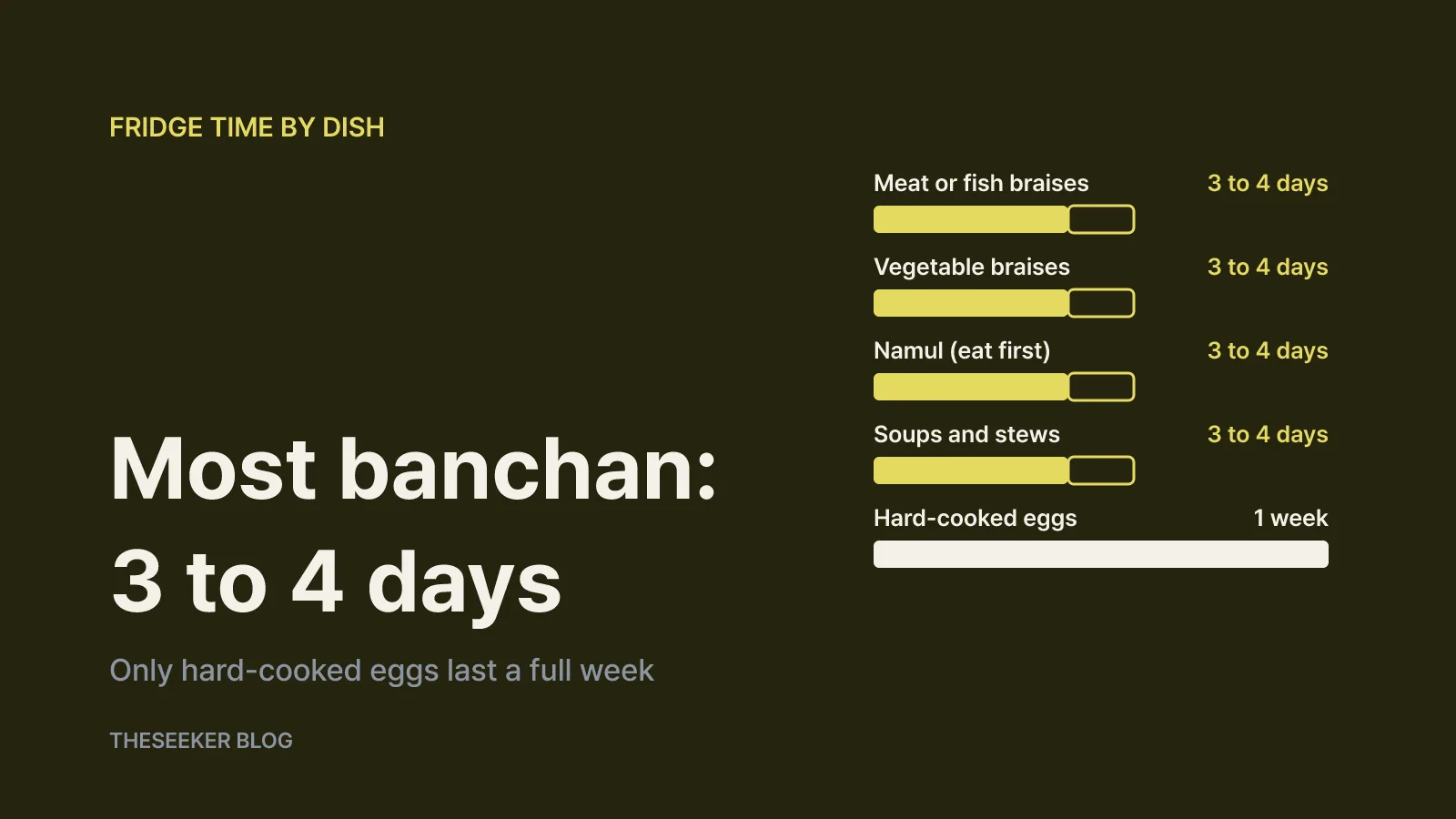
The USDA Food Safety and Inspection Service (FSIS) says in its leftovers guide that cooked leftovers can be kept in the refrigerator for 3 to 4 days or frozen for 3 to 4 months. The FoodSafety.gov cold storage chart lists cooked meat or poultry leftovers and soups and stews at 3 to 4 days, and hard-cooked eggs at 1 week. Korea's Food Safety Korea portal gives a cold storage table at 5°C that puts cooked meat and seafood at 3 to 5 days and soups at 3 to 4 days.
Applied to a typical banchan spread:
- Braised or stir-fried dishes with meat or fish (beef jangjorim, stir-fried anchovies, fish cake stir-fry, spicy pork): these are cooked meat and seafood. Korea says 3 to 5 days and the U.S. says 3 to 4, so plan on 3 to 4 days.
- Braised vegetables (burdock root, lotus root, soy-glazed potatoes): no separate category exists, so use the general cooked-leftovers limit of 3 to 4 days. A salty, sweet glaze may taste fine for longer, but none of the sources reviewed here gives these dishes an extended window.
- Seasoned vegetables (namul such as spinach, bean sprouts or radish salad): also no listed period. Keep them within the same 3-to-4-day ceiling and eat them first, since they are moist and mixed by hand.
- Hard-cooked eggs: 1 week in the fridge and not suitable for freezing. Eggs simmered in soy sauce are a cooked dish, so treat them like any other braise at 3 to 4 days.
- Soups and stews: 3 to 4 days refrigerated, or 2 to 3 months frozen for best quality.
Kimchi, pickled vegetables and salted seafood are fermented or cured, and they are outside the scope of this guide; follow the storage directions on the label for store-bought products. Every limit above assumes a properly cold fridge and food that was not left out for long. Count the days from the day you cooked the dish, not the day it went into the fridge.
A weekly banchan lineup and the order to cook it
Think in two portions: food you will finish within 3 to 4 days, and food you will freeze for the back half of the week. For two or three people, five dishes give you enough variety to rotate two or three at each meal:
- One protein braise, such as beef jangjorim or soy-braised pork. It freezes well, so half can go straight to the freezer.
- One dry stir-fry, such as small dried anchovies or fish cakes. Toasting anchovies in a dry pan before adding sauce drives off moisture and keeps them from turning soggy.
- One vegetable braise, such as burdock or lotus root, reduced until almost no liquid is left so it packs neatly.
- Two seasoned vegetables, like spinach and bean sprouts, blanched and dressed. Make only what you will eat early in the week.
- A few hard-cooked eggs, one of the rare items that holds for a full week in the fridge.
Plan your cooking order around clean handling. Korea's restaurant hygiene guidance calls for separate cutting boards and knives for vegetables, fish and meat, and for cooked versus raw food. At home, that translates to: blanch and squeeze the vegetables first; make the quick stir-fry next; then start the meat braise, washing the raw-meat board and knife right away and using a clean board to shred the cooked beef. Mix the seasoned vegetables last. The same guidance recommends gloves whenever food is mixed or tossed by hand.
Cooling, portioning and containers
How you cool and pack banchan decides how long it sits in the danger zone, which FSIS defines as 40°F to 140°F (Korea uses 5°C to 60°C). The FSIS guidance comes down to three habits:
- Refrigerate within 2 hours of cooking, or within 1 hour when the temperature is above 90°F (32°C). Perishable food left out longer should be discarded.
- Divide large batches into shallow containers so they cool quickly. A full pot cools slowly in the middle.
- Seal everything. Covered or airtight containers keep bacteria out, hold moisture and stop dishes from absorbing other odors.
FSIS notes that hot food can go directly into the refrigerator or be chilled quickly in an ice or cold-water bath. Korean guidance says to cool hot food before refrigerating it. A sensible way to satisfy both is to let steam escape briefly, portion into shallow containers, and refrigerate promptly rather than waiting for food to reach room temperature on the counter.
The Korean guidance also suggests keeping the refrigerator at 4°C or below and the freezer at -18°C (0°F) or below, checking with a thermometer, filling the fridge to only about 70 percent so cold air can circulate, and keeping strong-smelling foods away from items that absorb odors, such as milk and eggs. Label every container with the dish name and the cooking date, and put older containers in front so they are used first. At the table, spoon out what you will eat and return the container to the fridge right away instead of leaving it out through the meal.
Using the freezer to cover the second half of the week
The freezer is what turns a 4-day dish into a 7-day plan. FoodSafety.gov explains that food kept continuously at 0°F (-18°C) stays safe, and that freezer times in its chart are for quality. It lists cooked meat or poultry at 2 to 6 months and soups and stews at 2 to 3 months.
Good candidates for freezing are meat braises, soy-glazed pork, spicy stir-fried pork and soups. Freeze them flat in single-meal portions so they thaw faster. Skip the freezer for hard-cooked eggs, which the chart says not to freeze, and for mayonnaise-based salads, which do not freeze well. Seasoned vegetables have no freezer listing; if you want to try, freeze a small portion first and check the texture.
Thaw in the refrigerator whenever possible. FSIS says refrigerator-thawed leftovers should be used within 3 to 4 days. Cold-water thawing requires a leak-proof bag, and microwave-thawed food should be heated right away to 165°F (74°C).
Put together, a week looks like this:
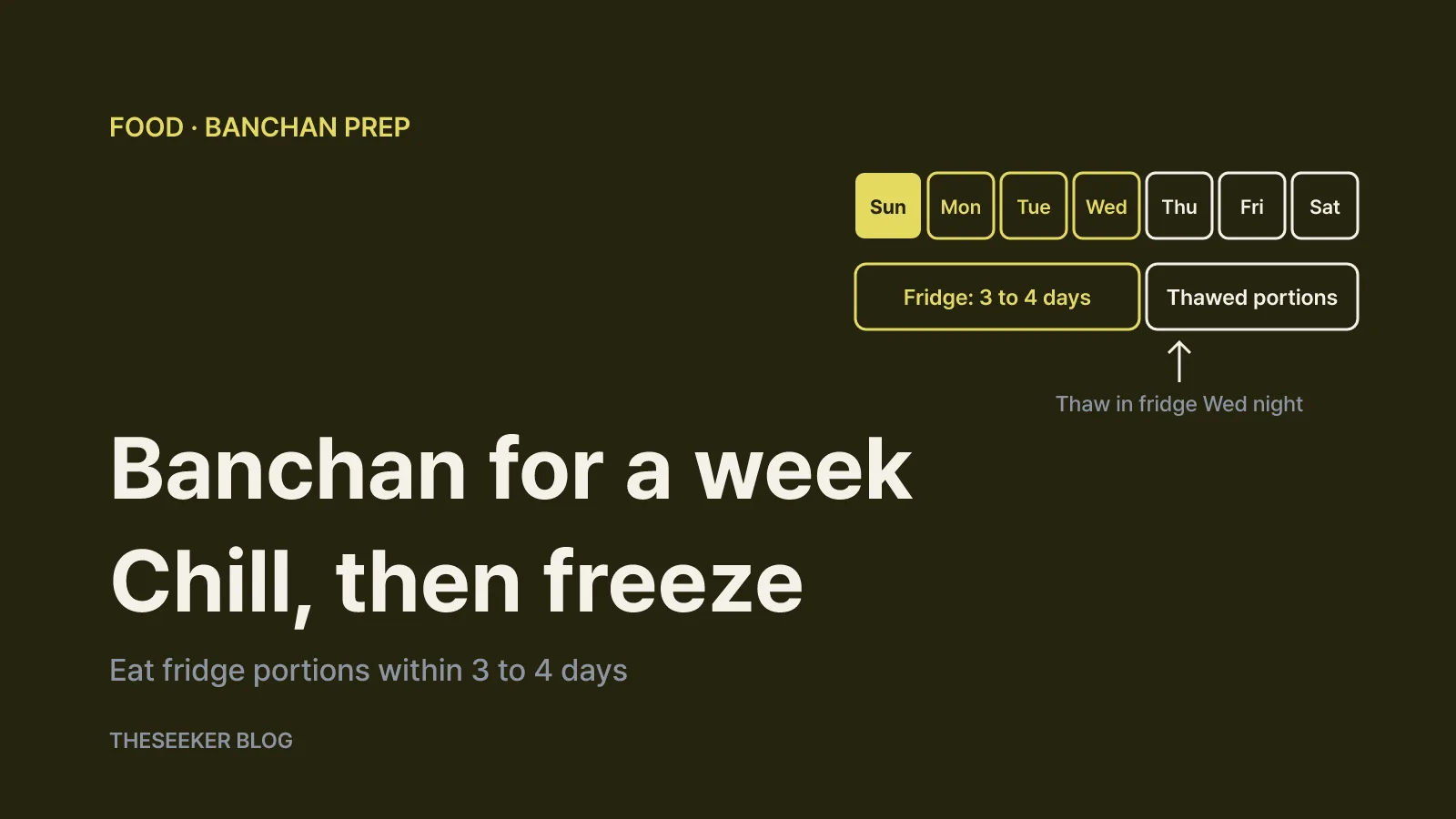
- Sunday: cook, refrigerate the Sunday-to-Wednesday portion and freeze the Thursday-to-Saturday portion as soon as it is cool.
- Monday to Wednesday: eat the seasoned vegetables first, then finish the refrigerated stir-fries and braises.
- Wednesday evening: move the frozen portions to the fridge to thaw.
- Thursday to Saturday: eat the thawed dishes within 3 to 4 days and dress a fresh batch of vegetables if you need one.
Reheating and when to throw banchan out
Both countries use the same reheating target: Food Safety Korea says to bring leftovers to a core temperature of 74°C for at least 1 minute, and FSIS says 165°F. FSIS adds that soups and sauces should come to a rolling boil, and that microwaved food should be covered, rotated and checked in several places because microwaves heat unevenly.
Many banchan are eaten cold, so for those the key is limiting time outside the fridge. FSIS says cold leftovers left at room temperature for more than 2 hours should be discarded; pack lunchbox banchan with an ice pack. Reheat only the portion you plan to eat, because every cycle of warming and cooling passes through the danger zone again.
Throw a dish out if any of these apply: it is past 3 to 4 days from cooking (1 week for hard-cooked eggs); you do not know when it was made; it sat out for more than 2 hours, or 1 hour on a day above 90°F; or it has been in the fridge for more than 3 to 4 days after thawing. Go by the date rather than how it looks or smells. The real secret to banchan that lasts a week is not a longer shelf life but a plan: cook on a set day, eat in a set order and freeze the second half on time.
Sources
Frequently asked questions
Can I keep stir-fried anchovies (myeolchi bokkeum) in the fridge for a week?
There is no official limit for this dish by name. Food Safety Korea lists cooked meat and seafood at 3 to 5 days at 5°C and USDA FSIS lists cooked leftovers at 3 to 4 days, so use the shorter window and freeze any portion meant for later in the week on the day you cook it.
How long does beef jangjorim last?
Treat it as cooked meat: 3 to 4 days in the refrigerator. FoodSafety.gov lists cooked meat at 2 to 6 months in the freezer for best quality, so freeze single portions and thaw one in the fridge the night before.
Can namul and other seasoned vegetables be frozen?
The official storage charts reviewed here do not list a freezer time for seasoned vegetables. Eat them first within the 3-to-4-day fridge window, and if you want to freeze some, test a small portion for texture before freezing a full batch.
Is it safe to put hot banchan straight into the refrigerator?
Yes. FSIS says hot food can go directly into the refrigerator or be chilled in an ice bath. Splitting it into shallow containers helps the center cool quickly and makes it easy to stay within the 2-hour limit.
What temperature should my refrigerator be?
U.S. guidance uses 40°F (4°C) or below, Food Safety Korea uses 5°C or below for cold storage, and the freezer should be 0°F (-18°C) or below. Use an appliance thermometer rather than relying on the dial setting.
blog.theseeker.io/en/posts/make-ahead-korean-side-dishes-storage-week
Chloe Morgan
Chloe covers easy recipes and how to prepare and store ingredients, written in quantities and steps that work in a home kitchen.
Read our editorial standards