Korean Pet Insurance: Coverage, Deductibles and Renewal
Since May 2025, new Korean pet insurance policies renew medical cover every year with at least a 30% co-pay and a KRW 30,000 minimum deductible. Here is what to check, and how to compare policies yourself.
 Owen Parker
In this post
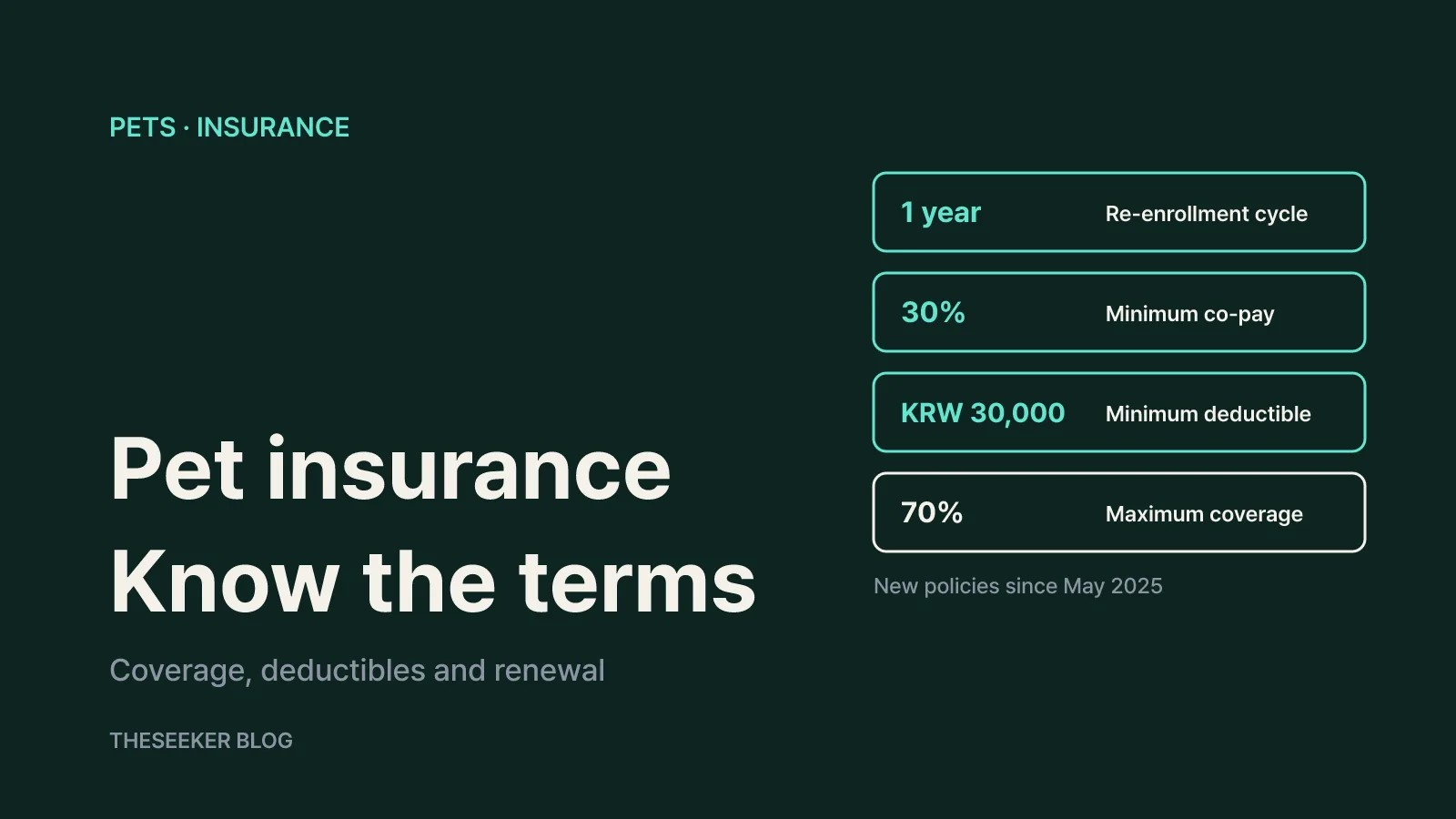
As of October 2026, the most useful way to compare pet insurance in Korea is to ignore the "best policy" rankings at first and check three things: what is covered (outpatient, inpatient and surgery), how the deductible is calculated, and how renewal works. New policies sold since May 2025 re-enroll medical cover every year, require a co-pay of at least 30%, apply a minimum deductible of KRW 30,000 and reimburse no more than 70% of eligible vet bills (KB Think). Older guides that mention zero-deductible plans or three-year renewal cycles describe a market that no longer exists for new buyers.
This guide is for dog and cat owners living in Korea, including expats comparing Korean non-life insurers. It does not recommend a specific insurer. It walks through the rules published by Korea's financial regulators, the dispute cases the Financial Supervisory Service (FSS) has highlighted and the 2025 product reform, so you can build your own comparison. Premiums and policy wording vary by product, so the final step is always to read each insurer's product summary and policy terms.
What changed in Korean pet insurance in May 2025
According to Yonhap News, insurers began selling revised pet policies on May 1, 2025, following supervisory guidance from the financial authorities. Before the change, policies could run for up to 20 years with re-enrollment every three or five years, and owners could choose reimbursement of 50% to 100%, so some plans had no co-pay at all. Under the new structure, re-enrollment happens every year, the co-pay rises to 30% and a KRW 30,000 minimum deductible applies.
The regulator's reasoning matters for how you read future price changes. Vet fees in Korea are not standardized, and the authorities worried that generous pet cover would see claims costs spiral the way human indemnity health insurance did. KB Think's summary of the reform notes that 3,511 diseases and 4,930 treatments have been given standard names and codes, but there is still no standard fee schedule, so the same procedure can cost different amounts at different clinics. That gap affects how quickly you hit a policy limit.
If you already have a policy, the new terms are not applied to your contract automatically, but insurers can change conditions when the policy renews or is re-enrolled. Check the co-pay and reimbursement rate in your original policy wording and ask what will apply at the next renewal.
Eligibility is narrow. Only dogs and cats kept as household companions qualify. Animals raised for sale and working animals such as police, military or racing dogs are excluded. Entry age is typically quoted as from 61 days old up to age 10, with cover ending at up to age 20, but these figures differ by product and rider.
Coverage: check outpatient, inpatient and surgery separately
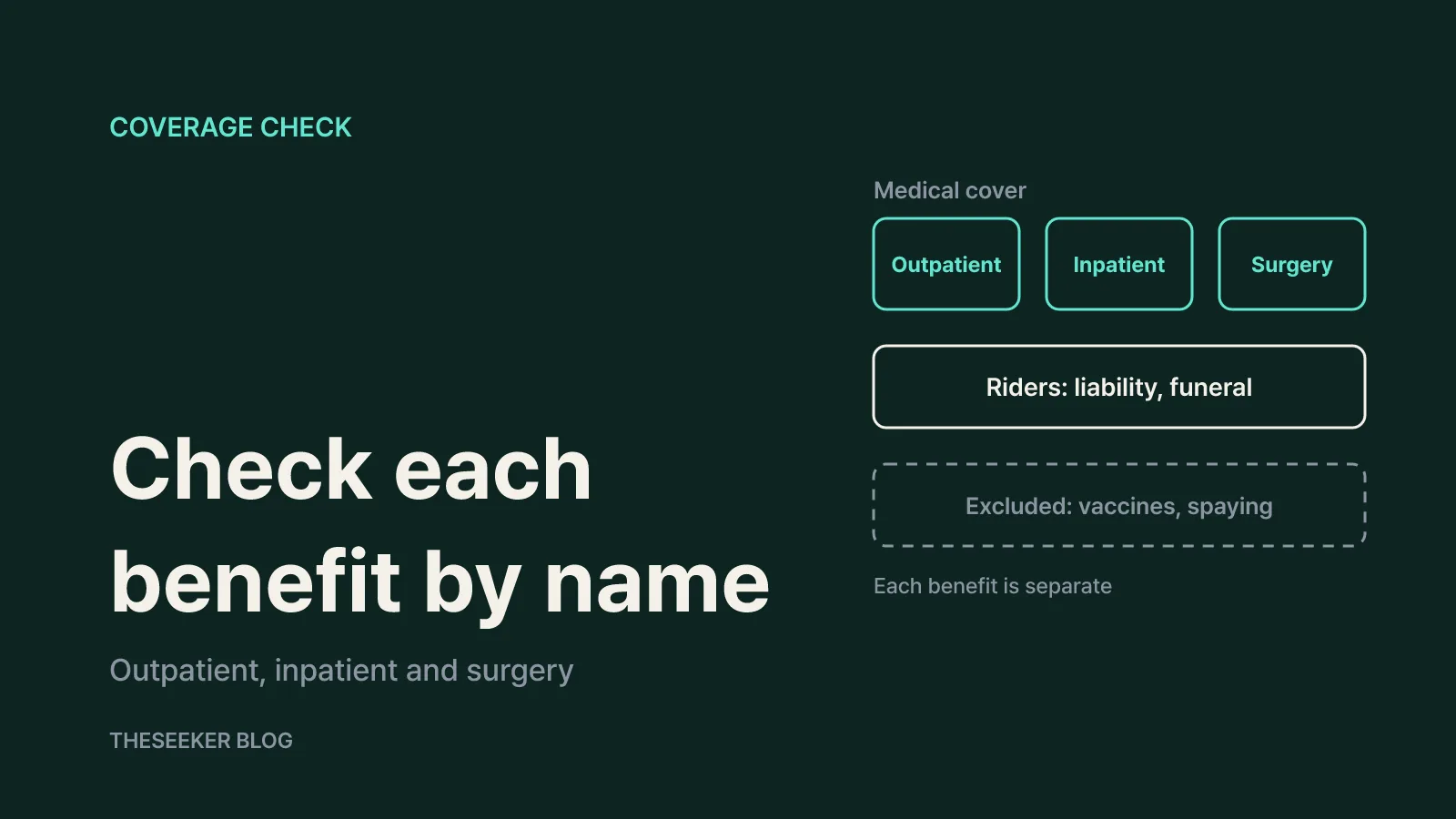
The medical part of a Korean pet policy reimburses actual costs for outpatient visits, hospital stays and surgery at Korean vet clinics when your pet is ill or injured. Riders commonly add liability cover for damage your pet causes to people or other animals, plus funeral or bereavement payments. Some products sell medical cover itself as a rider, so confirm each benefit by name rather than assuming it is included.
The FSS consumer tip on pet insurance, summarized by Wealth Management, includes dispute cases that show why this matters:
- Outpatient-only cover: A dog was hospitalized for surgery on an abdominal tumor, but the owner had bought outpatient cover only. Inpatient surgery costs were not paid, because outpatient and inpatient cover are separate benefits.
- Not legally "surgery": A claim for treatment of a lipoma was refused as surgery because the procedure did not involve cutting or excision as defined in the policy. Diagnostic biopsies, laparoscopic examinations, cosmetic procedures and contraceptive surgery are also outside the definition.
- Daily outpatient caps: An owner claimed about KRW 1.5 million for outpatient treatment of seizures but received KRW 150,000, because the daily cap for outpatient care without surgery was KRW 150,000.
Know the standard exclusions too: conditions that existed before cover started, treatment by unqualified practitioners, congenital and hereditary conditions, vaccinations and routine check-ups, spaying, neutering and contraception, pregnancy and birth, cosmetic procedures, and behavior counseling, training or walking fees. Dental care is a common source of confusion. In one FSS case, extractions and scaling during treatment of a cat's gum disease were refused as dental treatment, while recent guidance says preventive scaling is excluded but treatment of dental and oral disease may be covered depending on the product. If your breed is prone to dental problems, find that clause in the policy wording.
How deductibles change what you actually receive
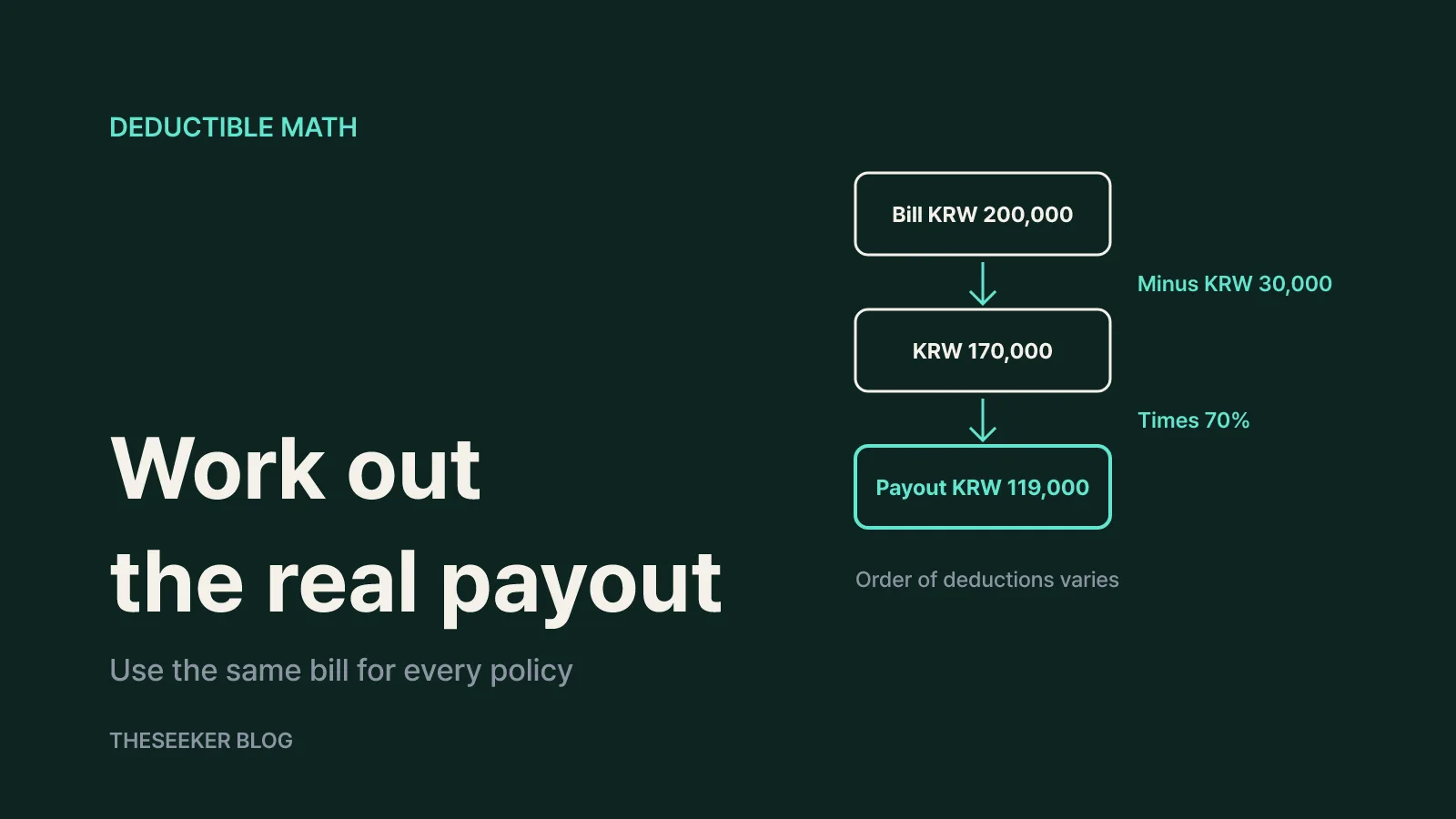
The co-pay rate is the share of eligible vet costs you pay yourself. For new medical cover, it is at least 30%, reimbursement is capped at 70%, and a minimum deductible of KRW 30,000 applies however small the bill. A higher co-pay lowers the premium but raises what you pay at every visit.
Running the numbers makes the difference concrete. In an example published by KB Think, a KRW 200,000 eligible bill under a policy that subtracts the KRW 30,000 deductible first and then pays 70% leaves KRW 170,000, and 70% of that is KRW 119,000. Under a policy where you pay the greater of 30% or KRW 30,000, a KRW 70,000 bill means 30% would be KRW 21,000, so the KRW 30,000 minimum applies and the insurer pays KRW 40,000. The order of deductions, and whether they apply per visit or per day, depends on the policy wording, so plug the same bill into each product you are considering.
One practical consequence: if your pet mostly needs small, frequent clinic visits, the KRW 30,000 minimum can make reimbursement small or close to nothing. Where insurance earns its keep is with large, one-off costs such as surgery and hospital stays, where the reimbursement rate and the annual limit decide the payout. Surgery limits, daily inpatient and outpatient caps and annual limits can all apply separately.
Renewal, waiting periods and disclosure duties
Medical cover is now re-enrolled every year. Premiums can rise with your pet's age and the insurer's rates, and terms can change. Yonhap reported that a treatment history could lead to a refused re-enrollment or a steep increase the following year. KB Think adds that receiving a claim does not automatically mean refusal: some products allow re-enrollment without underwriting, while expanding cover or switching products may require a new review. Before you buy, find out whether re-enrollment involves underwriting and when. Riders may follow a different renewal cycle from medical cover.
Waiting periods create gaps right after you buy. In the policy wording cited by the FSS, illnesses arising within 30 days of the start date are not covered (this does not apply to renewals), and conditions such as kneecap (patellar) or hip dislocation are excluded if they occur within one year. One owner was refused a claim for patellar luxation surgery performed within that first year.
Disclosure is strict. Before and after buying, you must truthfully report the purpose of keeping the pet, past illnesses, current medication and where you live. In one FSS case, an owner answered "no" to a question about vet visits in the past three months despite three treatments, and the insurer moved to cancel the policy. Another owner was refused because the dog had been handed to a relative living elsewhere. If your living arrangements change, tell the insurer.
Build your own comparison instead of trusting rankings
Rankings depend on what they measure, whether that is price, limits or the number of customers. A top pick built for a young mixed-breed dog says little about a ten-year-old cat with a history of kidney problems. Build a table instead:
- Filter by eligibility: entry age, species and disclosure questions about past illness.
- Match the benefit mix: outpatient, inpatient and surgery, whether medical cover is a rider, and whether you want liability or funeral riders.
- Record the deductible mechanics: co-pay rate, minimum deductible, order of deductions and per-visit or per-day application.
- Calculate payouts for scenarios: a small clinic visit, one surgery and a short hospital stay, using the same bill for every product.
- Compare renewal terms: renewal cycles for medical cover and riders, re-enrollment underwriting and age-based premium changes.
- Mark waiting periods and exclusions: the 30-day and one-year periods and how dental and hereditary conditions are handled.
- Check discounts last: pet registration and multi-pet discounts vary. The FSS cited 2% to 5% for registered pets in 2024, but confirm the current rate in each product summary.
For context, data from the Ministry of Agriculture, Food and Rural Affairs' 2025 survey, cited by KB Think, puts average monthly spending per pet at about KRW 121,000, of which vet care is about KRW 37,000. When you claim, expect to submit an itemized receipt, a detailed statement of charges and the medical record, and sometimes a diagnosis or test results. Ask the clinic for the itemized statement at every visit.
Sources
Frequently asked questions
What is the deductible for pet insurance in Korea after May 2025?
For new medical cover, the co-pay is at least 30%, reimbursement is capped at 70%, and a KRW 30,000 minimum deductible applies regardless of the bill. The order of deductions varies by policy, so calculate the payout on the same bill for each product.
Do the new yearly re-enrollment rules apply to existing policies?
They are not applied automatically to contracts bought before the reform, but insurers can change terms at renewal or re-enrollment. Check your original policy wording and ask what will apply at the next renewal.
Will a claim stop me from re-enrolling next year?
Not necessarily. Some products allow re-enrollment without underwriting, but a treatment history can raise the premium, and expanding cover or switching products may trigger a new review. Confirm the re-enrollment rules before buying.
Is my pet covered right after I buy a policy?
Many policies have waiting periods. In wording cited by the FSS, illnesses within 30 days of the start date and conditions such as patellar luxation within one year are not covered. Check the start date for accidents, illness and specific conditions.
Can I trust pet insurance rankings?
Rankings reflect whatever they measure, such as price, limits or customer numbers. A comparison table based on your pet's age, breed and history, covering benefits, deductibles, limits and renewal terms, is more reliable.
blog.theseeker.io/en/posts/pet-insurance-korea-coverage-deductible-renewal-checklist
Owen Parker
Owen covers the care, health and costs of living with pets, drawing on guidance published by public agencies and veterinary associations.
Read our editorial standards