How to Keep a Baby Journal: Apps vs Notebooks
Log feeds, diapers and sleep in an app, line growth notes up with well-child visits, and keep first moments in a notebook. A practical split that parents can actually sustain.
 Grace Whitman
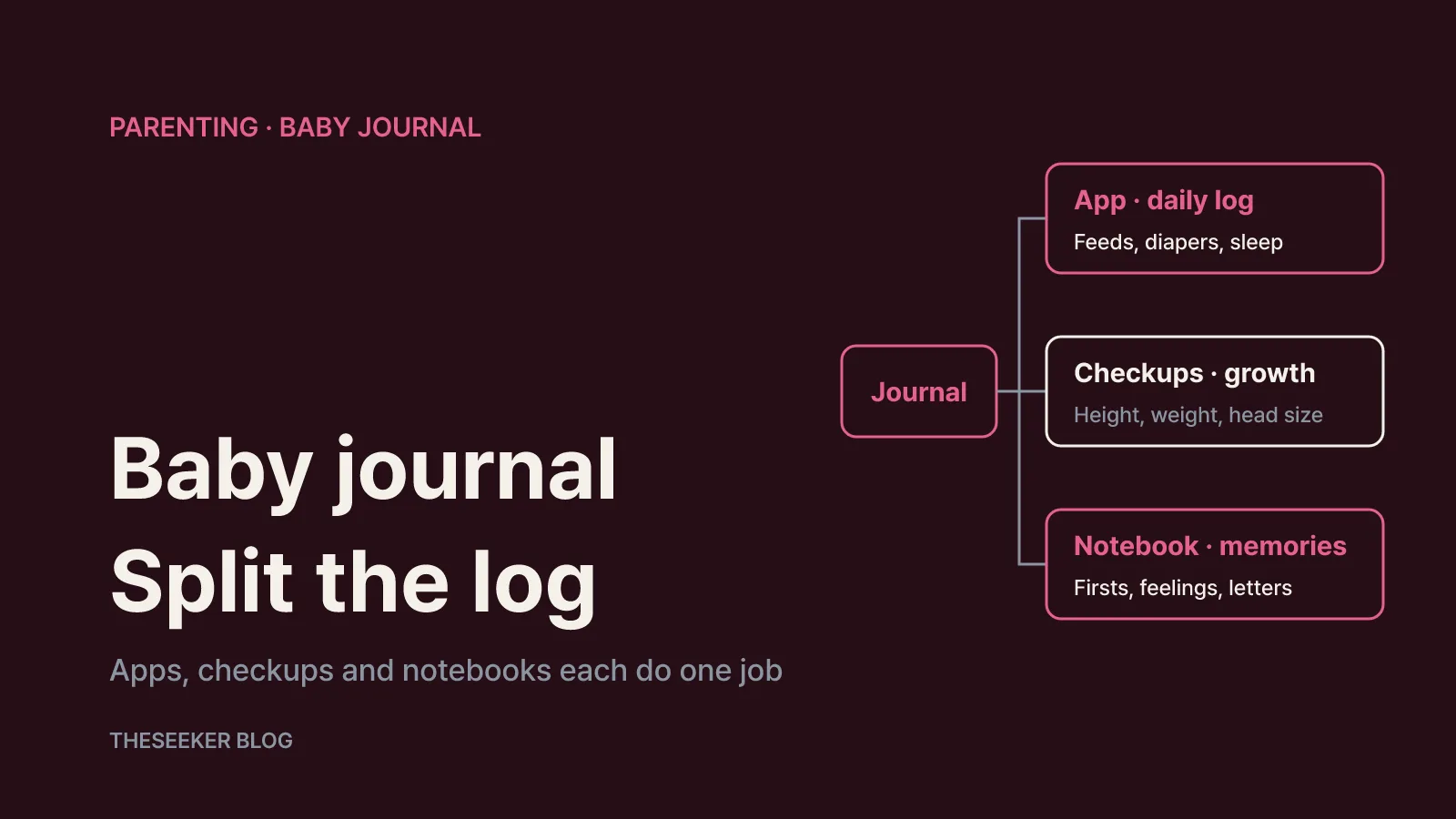
In this post
- Baby tracking app, paper notebook or social media: the trade-offs
- What to log in the newborn weeks: feeding, diapers and sleep
- Line up growth records with scheduled checkups
- Recording firsts, milestones and your own feelings
- Habits that keep a baby journal going
- Check privacy before sharing baby photos
- Sources
- Frequently asked questions
As of October 2026, the most sustainable way to keep a baby journal is to stop treating it as one book. Use a tracking app or a simple log for the repetitive data (feeds, diapers, sleep), keep growth measurements and checkup notes together on a single page tied to your child's scheduled health visits, and save first smiles, first words and your own thoughts for a paper notebook or a private album. Social media works better as a sharing channel than as an archive, and every post deserves a quick privacy check first.
This guide walks through the trade-offs of each format, the entries that turn out to be genuinely useful later, habits that keep a journal going on exhausting days, and a short checklist before you share photos. It focuses on how to choose and what to write rather than ranking specific commercial apps.
Baby tracking app, paper notebook or social media: the trade-offs
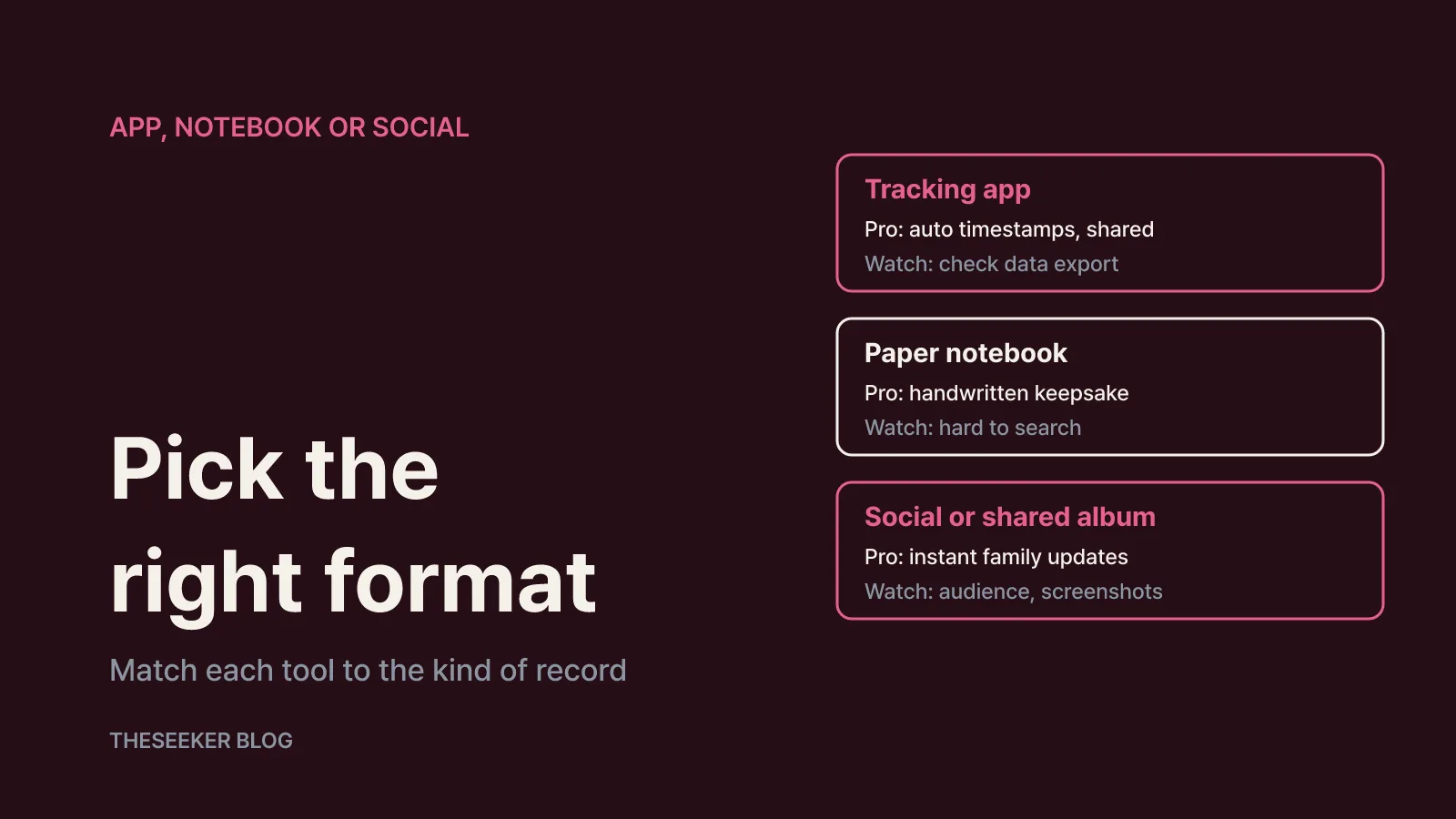
Most parents end up choosing between three formats. None is perfect; each fits a different kind of record.
← Swipe to see more
| Format | Best for | Strengths | Watch out for |
|---|---|---|---|
| Tracking app | Feeds, diapers, sleep | One-tap timestamps, summaries, shared logging between caregivers | Export options, what happens if the service shuts down, privacy policy |
| Paper notebook | Firsts, letters, handwritten notes | Screen-free, easy to hand down to your child | Hard to search, vulnerable to loss or damage |
| Social media or shared album | Photos and videos for family | Instant updates for relatives far away | Audience settings, screenshots, posts that last for years |
Tracking apps shine during 3 a.m. feeds when you have one free hand. A start and stop tap records the time automatically, and if a partner or grandparent can see the same log, nobody has to ask when the baby last ate. Before committing, check whether you can export your data as a file, what happens to your records if you delete the account or the service closes, and how the app says it handles photos and health details about your child.
Public health agencies make apps too. The US Centers for Disease Control and Prevention offers the free Milestone Tracker app for iOS and Android in English and Spanish. It uses illustrated checklists to follow developmental milestones from 2 months to 5 years, adjusts checklists to corrected age for babies born prematurely, keeps a snapshot of information from doctor visits, sends appointment reminders, and creates a PDF or email summary you can share with your child's doctor. CDC states the app does not replace validated developmental screening tools and that it does not collect or share personal information that can identify you or your child.
Paper notebooks are about meaning rather than speed. A dated line in your handwriting is something your child may treasure. They are a poor fit for repetitive logs, though, because you cannot search or total them. Photograph the filled pages once a month so a lost notebook does not mean lost memories.
Social media and shared albums are best treated as communication tools. Platform rules and accounts change, and anything shared can be saved or screenshotted by others. Keep originals in storage you control and post only a selected few.
The combination that tends to last is a hybrid: app for routine logs, one growth page for checkups, a notebook for memories and a private album for family.
What to log in the newborn weeks: feeding, diapers and sleep
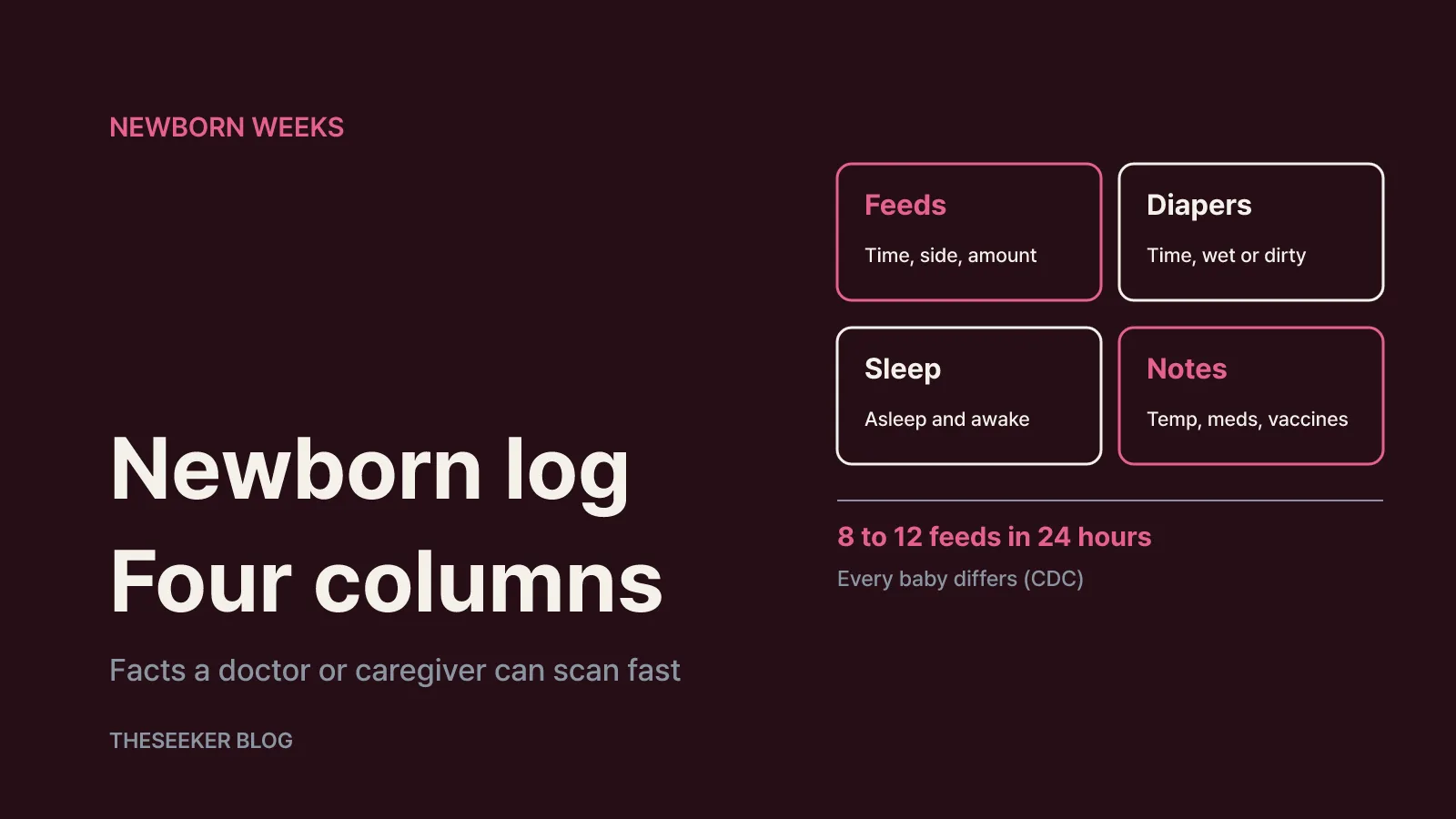
The first weeks are when records help most, and the goal is facts a doctor or the next caregiver can read at a glance.
According to CDC guidance on how much and how often to breastfeed, newborns may want to eat as often as every 1 to 3 hours in the first days. Over the first weeks and months, most exclusively breastfed babies feed every 2 to 4 hours on average, for about 8 to 12 feeds in 24 hours. Cluster feeding, when a baby feeds as often as every hour, is common at times, and some babies stretch to a 4 to 5 hour sleep. CDC notes that every baby is different and encourages parents to talk with a doctor or nurse if they are worried about sleep or intake.
Those shifting patterns are exactly why a simple log is useful. These columns are enough:
- Feeds: start time, duration, side if breastfeeding, amount if bottle feeding
- Diapers: time, wet or dirty, anything unusual about color or consistency
- Sleep: when the baby fell asleep and woke, night wakings
- Notes: temperature, medicines, spit-ups, how the baby did on and after vaccination days
The numbers are for knowing your own baby's normal, not for comparing with averages. When something changes, being able to say exactly when it started and how often it happens makes a conversation with your pediatrician far easier. Once feeding settles into a pattern, it is fine to trim the columns.
Line up growth records with scheduled checkups
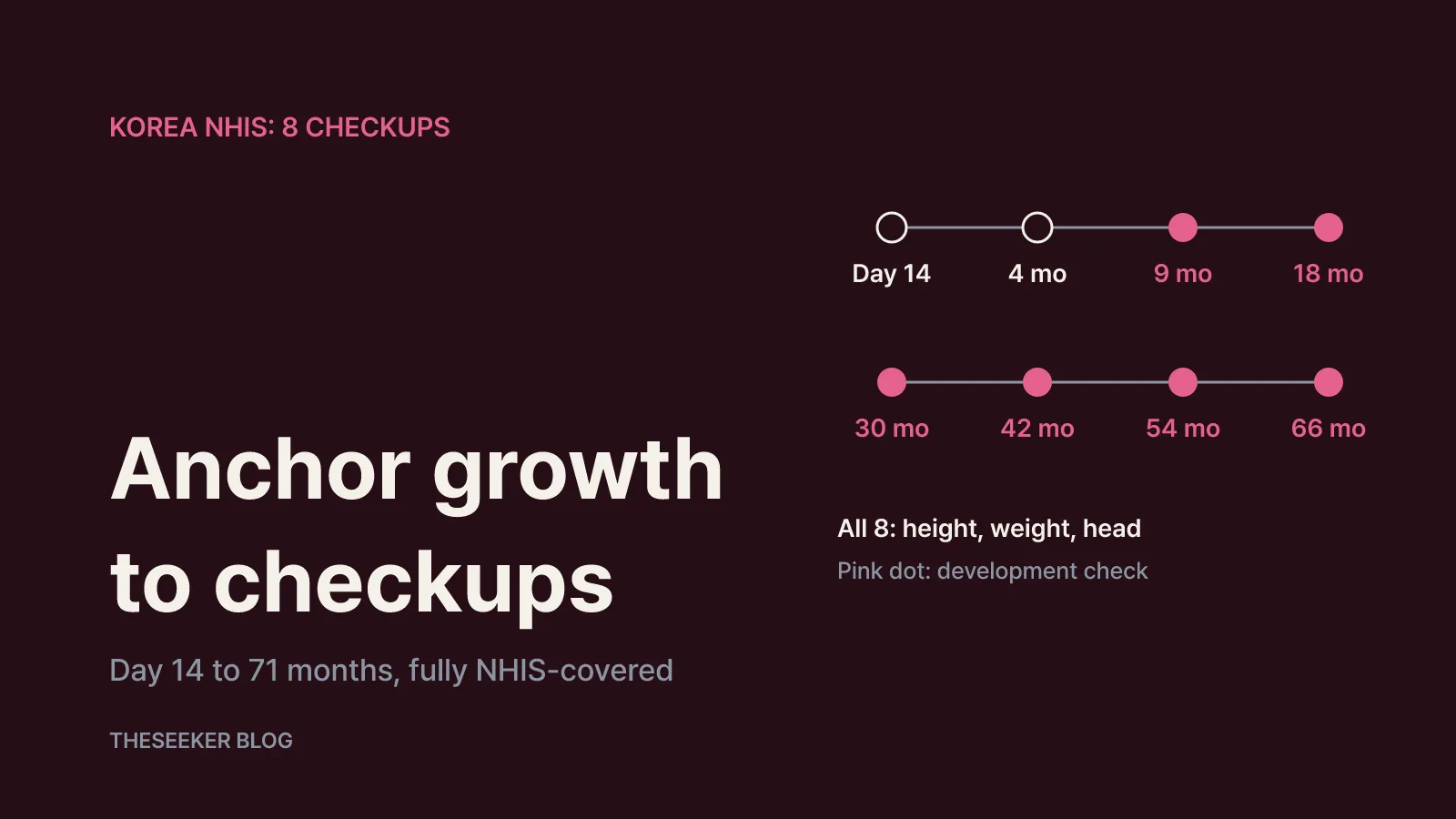
You do not need to weigh your baby at home every week. Instead, anchor growth notes to the well-child visits where professionals measure your child. Use whatever schedule applies where you live. In South Korea, for example, the National Health Insurance Service infant health screening runs from day 14 to 71 months, with the cost fully covered by the NHIS. It includes 8 checkups:
- Day 14 to 35
- 4 to 6 months
- 9 to 12 months
- 18 to 24 months
- 30 to 36 months
- 42 to 48 months
- 54 to 60 months
- 66 to 71 months
Separate dental checks fall at 18 to 29, 30 to 41, 42 to 53 and 54 to 65 months. Height, weight and head circumference are measured at every round, body mass index is added from the 30-month visit, developmental assessment begins at the 9-month visit, and the final round includes a vaccination check.
For each visit, add one line to your journal: the date and clinic, the three measurements, what the doctor told you to watch, and the window for the next visit. The NHIS site also lets parents look up screening results and fill in pre-visit questionnaires, which ask about daily life such as feeding, sleep and safety. Notes you have already kept make those questions much quicker to answer.
Recording firsts, milestones and your own feelings
The second half of a baby journal is the moments you will want to reread. CDC describes milestones as things children reach from birth to age 5 in how they play, learn, speak, act and move. A short scene captures them better than a checkmark. Write four things:
- When: date and age
- Where and what was happening: one line of context
- Your child's reaction: face, sound, gesture
- Your feeling: one sentence about what went through your mind
Timing varies widely, so there is no reason to compare dates with other families. If your child stops doing something they could do before, or you have a concern about development, bring your dated notes to the next appointment. Many parents also keep a page at the back of the notebook for letters written on birthdays.
Habits that keep a baby journal going
Journals usually stall because parents aim too high at the start. Lower the bar and fix the routine:
- Three lines a day: what happened, something new your baby did, how you felt
- Attach it to an existing habit: after the last feed or right after bedtime
- Split the work: whoever is on duty logs the routine data; take turns on a weekly summary
- Allow gaps: if you miss days, leave them blank and restart today instead of backfilling
- Pick photos weekly: choose a few and add a one-line caption
- Back up monthly: export app data and photograph notebook pages, then store copies in two places
A monthly summary on your baby's birth date works well too. Favorite games, new sounds, a hard week and what helped are more useful to your future self than another list of numbers.
Check privacy before sharing baby photos
If any part of your journal goes online, pause before posting. South Korea's Personal Information Protection Commission, in its 2024 privacy campaign, advised parents sharing their children's daily lives to:
- Check whether posts or videos contain your own or someone else's personal information before posting
- Never give personal details to people you do not know, even if they are connected on social media
- Set audience controls so only the minimum is visible
- Skip photos or videos that contain a child's personal information or that the child might find embarrassing or dislike when older
- Delete a post whenever the child says they do not want it shared
In practice, scan the whole frame: name tags, daycare bags, shipping labels with your address, recognizable buildings outside the window, and location data saved in the file. Bath time and diaper photos belong in a private family album, not a public feed.
Keep the full journal in storage you manage and treat anything public as a small, curated selection. That way you get a rich record of these years while still protecting your child's privacy.
Sources
Frequently asked questions
Is a baby tracking app or a paper journal better?
Use both for different jobs. Apps are best for repetitive logs like feeds, diapers and sleep because they timestamp automatically. A paper notebook suits firsts and letters to your child. Check an app's export options and privacy policy before you rely on it.
How long should I keep tracking newborn feeds?
There is no fixed end date. CDC notes that the time between feeds gradually lengthens over the first weeks and months. Once a pattern settles and your doctor has not asked for a log, you can scale back and log in detail again only when your baby is unwell or something changes.
What should I write in a baby journal besides milestones?
Add checkup details such as height, weight, head circumference and what the doctor said, a short monthly summary of favorite games and new sounds, and a sentence about how you felt. Those notes are often what parents value most later.
Is it safe to post baby photos on social media?
If you post, keep the audience small and make sure nothing reveals names, addresses or locations. South Korea's Personal Information Protection Commission advises skipping images a child may dislike when older and deleting posts whenever the child objects.
I missed a week. Should I go back and fill it in?
No. Leave the gap and start again today. Backfilling feels like homework and often causes parents to stop altogether. A three-line daily minimum makes it easy to pick the habit back up.
blog.theseeker.io/en/posts/baby-journal-apps-vs-notebooks-what-to-record
Grace Whitman
Grace covers child development, education and family support programs, working from official guidance to highlight the conditions and steps parents can check right away.
Read our editorial standards