Korean Technical Qualifications: Levels and How to Choose
Before chasing a 'best certifications' list, check what type of qualification it is, which level you are eligible for and what employers actually ask for. Here is how Korea's five technical levels, their eligibility rules and pass marks work.
 Hannah Price
In this post
As of October 2026, the most reliable way to pick a Korean certification that helps you get hired is to ignore difficulty rankings at first and answer three questions. What type of qualification is it: a national technical qualification, a national qualification created by a separate law, or a private one? Which level can you sit with your current education and work history? And do job postings in your target role require it, or merely list it as a plus? Korea's engineering and technical qualifications come in five levels, and only the entry level, Craftsman (기능사), has no eligibility requirement at all (Q-Net eligibility overview). This guide walks through the system using Q-Net, Korea's official law database and the government's private-qualification registry, then sets out a practical way to choose.
Three kinds of qualifications in Korea
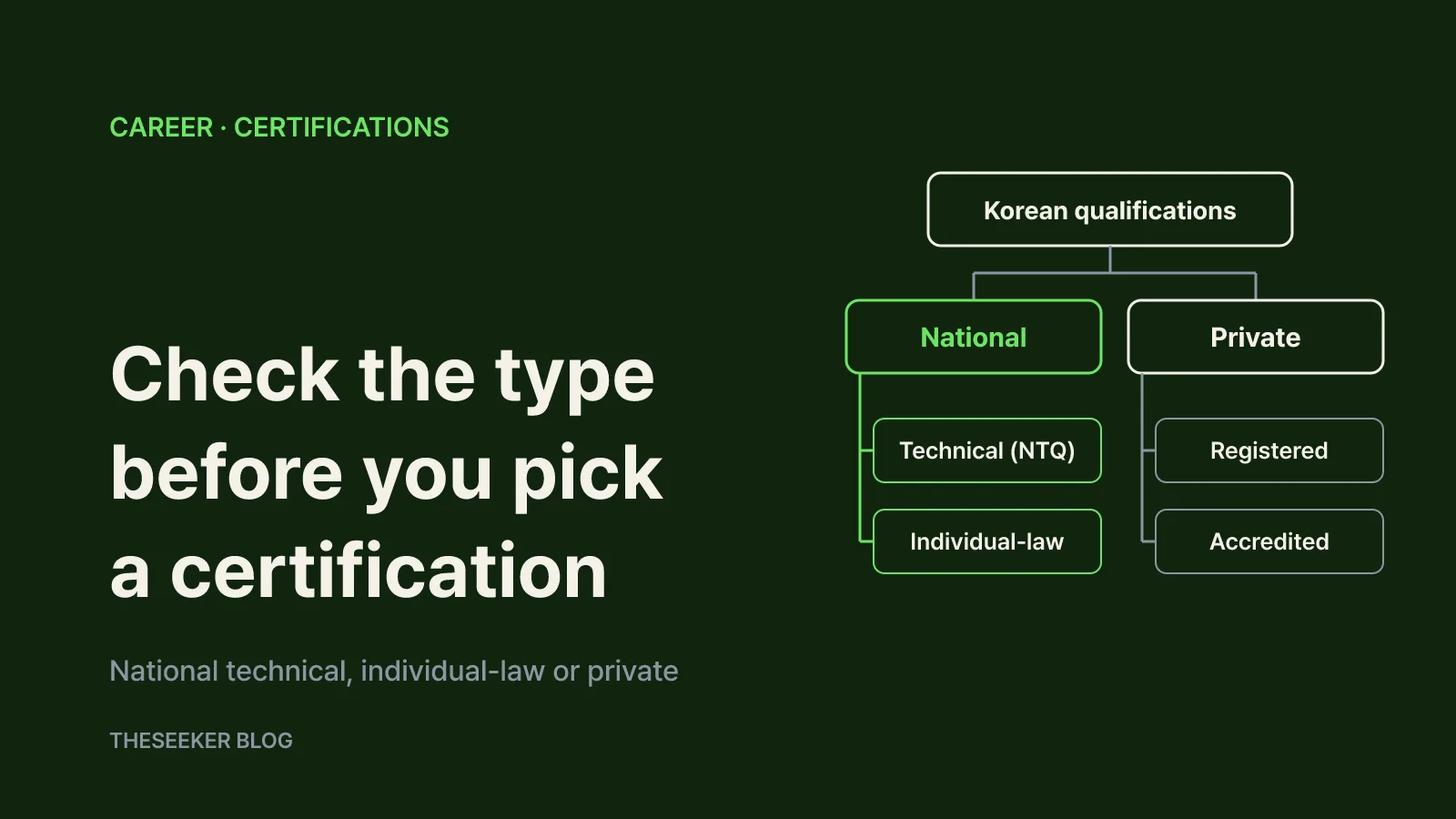
English-language discussions often lump every Korean credential together as a "license" or a "certificate". The national qualification overview on the Private Qualification Information Service, run by the Korea Research Institute for Vocational Education and Training (KRIVET), draws a clear line. A national qualification is created and administered by the head of a central government agency under the relevant law, and it comes in two forms.
- Qualifications under individual laws. These rest on a dedicated statute for each field. The examples given are physicians (Medical Service Act), attorneys, licensed real estate agents and youth counselors. The same page counts 209 such qualifications across 30 ministries and agencies as of October 2024, or roughly 600 once grades and specialisms are split out, excluding technical qualifications.
- National technical qualifications (NTQs). These are governed by the National Technical Qualifications Act and the Professional Engineers Act. They cover the engineering and technical track (the five levels below) and a service track that includes vocational counselors, computerized accounting and convention planners. Exams and applications are handled through Q-Net, run by the Human Resources Development Service of Korea (HRDK).
The government says it creates national qualifications mainly where public life, health and safety are directly affected, where public interests such as defense, policing, education or core infrastructure are at stake, and where demand is too small for a private body to run an exam.
Everything else is a private qualification: one created and run by an individual business, corporation or association. Some private qualifications are merely registered; a smaller set is nationally accredited. According to the national accreditation page, accreditation goes to registered qualifications run by a corporation that have been in operation for at least a year with at least three rounds of testing, and that pass a review by the Qualification Policy Deliberation Committee. Where a related national qualification exists, the private one must test to an equivalent standard. Registration alone, in other words, does not mean the government has vetted the exam. If an advert blurs the two, search the qualification's name in the registry before paying any fees.
The five technical levels and who can sit them
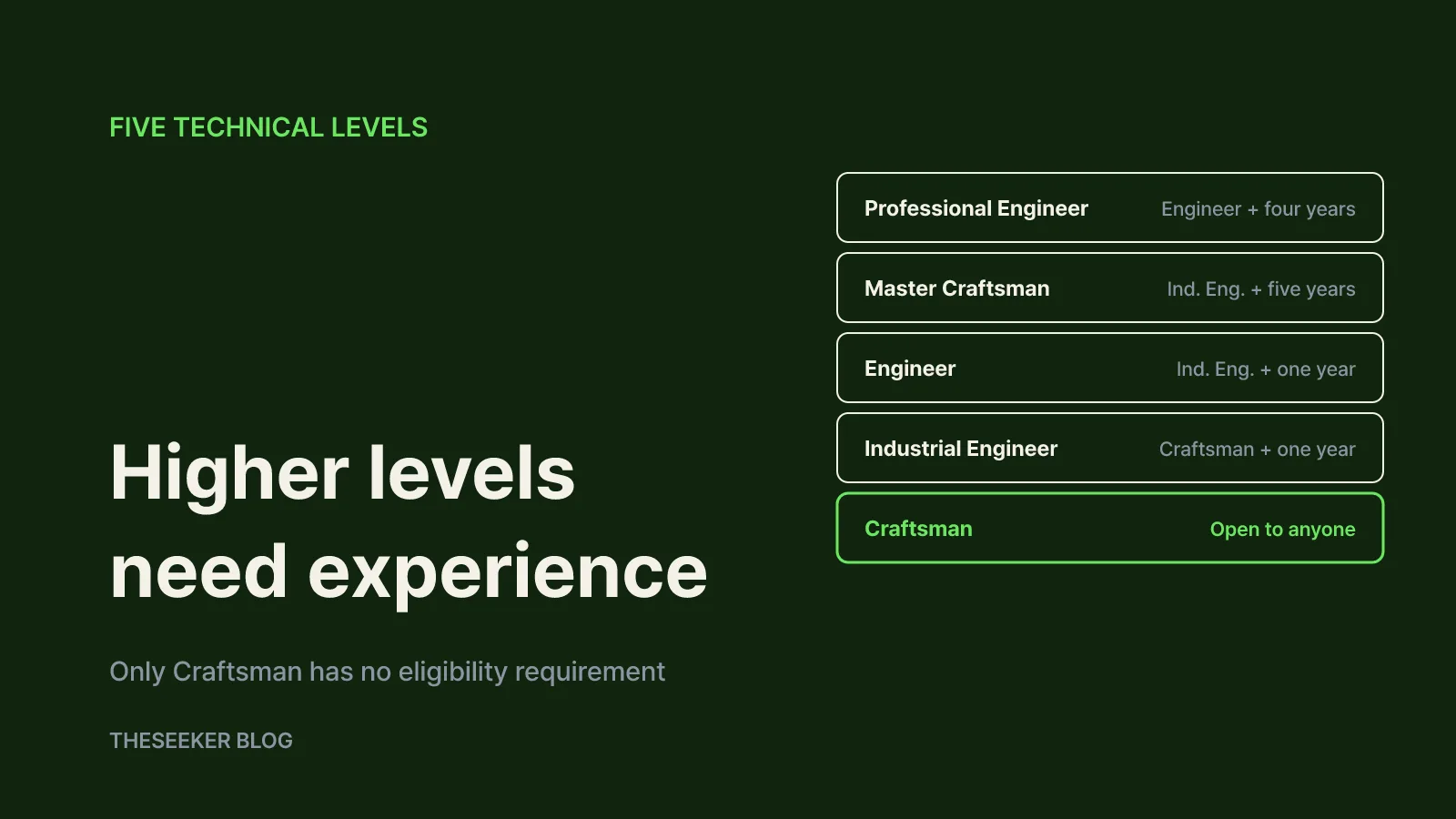
Q-Net's English pages translate the five engineering and technical grades as Professional Engineer (기술사), Master Craftsman (기능장), Engineer (기사), Industrial Engineer (산업기사) and Craftsman (기능사). Q-Net's testing criteria describe each roughly as follows.
- Professional Engineer: planning, research, design, analysis, supervision, assessment and project or technology management built on advanced knowledge and practical experience.
- Master Craftsman: top-level hands-on skill plus site management, supervising and training skilled workers, and linking management with the shop floor.
- Engineer: design, construction and analysis work grounded in engineering theory.
- Industrial Engineer: combined basic technical and skilled work grounded in foundational theory or trade skill.
- Craftsman: skilled work in production, operation, repair, maintenance, inspection and related task management.
Eligibility is set out in Appendix 4-2 of the Enforcement Decree. The Ministry of Employment and Labor's published interpretation explains that you need to satisfy just one route, whether that is a single condition or a combination such as a qualification plus experience. Typical routes are:
- Craftsman: no restrictions.
- Industrial Engineer: Craftsman plus one year of relevant experience; graduation (or final-year enrollment) in a related university or junior college program; or two years of relevant experience.
- Engineer: Industrial Engineer plus one year of experience; Craftsman plus three years; a related four-year degree (or final-year enrollment); a related three-year college diploma plus one year or a two-year diploma plus two years; or four years of relevant experience.
- Master Craftsman: Industrial Engineer or higher plus five years; Craftsman plus seven years; completion of a polytechnic master-craftsman course; or nine years of experience.
- Professional Engineer: Engineer plus four years; Industrial Engineer plus five; Craftsman plus seven; a related degree plus six; or nine years of experience.
"Relevant experience" has a specific meaning: work in the same job field as the target qualification, or in a similar field defined by ministry ordinance. A "prospective graduate" means someone in their final year on the date of the written exam. Service-track eligibility differs by qualification and is listed separately in Appendix 11-4 of the Enforcement Rules.
Judging difficulty by exam structure, not rankings
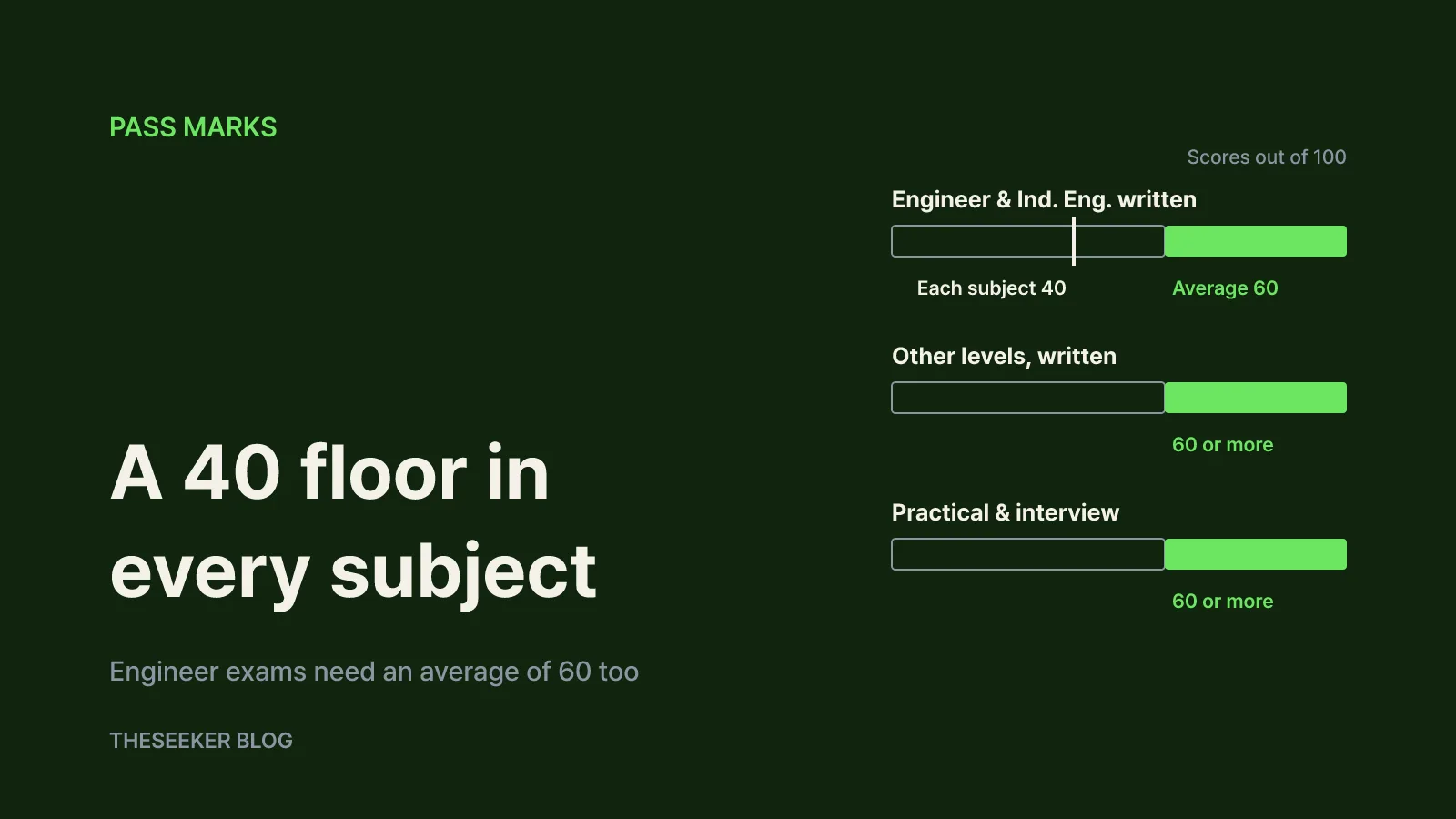
Online "hardest certifications" lists vary widely. What the rules let you compare objectively is exam format and the pass mark. Article 20 of the Enforcement Decree, in the version effective from 2 January 2026, sets these out.
- Professional Engineer: short-answer or essay written exam, then an oral interview; 60 out of 100 passes each stage.
- Master Craftsman and Craftsman: a 60-question, four-option multiple-choice written exam, then a hands-on practical test; 60 out of 100 passes each.
- Engineer and Industrial Engineer: a multiple-choice written exam of 20 questions per subject, where you need at least 40 in every subject and an average of 60 overall. A strong average does not save you if one subject falls below 40. The practical test then requires 60.
Two caveats apply to practical tests. For some qualifications the ministry allows a written subjective test, or a combined written and practical test, in place of the hands-on exam, and some run a practical test only. And skipping part of a practical test can mean failing regardless of score.
That leaves two layers of difficulty. The first is the entry barrier: higher levels demand years of experience before you can even apply. The second is the exam load: the per-subject floor at Engineer and Industrial Engineer level means you cannot leave a weak subject behind, and hands-on tests resist last-minute cramming. Pass rates change by qualification and by sitting, so check recent figures on each qualification's Q-Net page instead of relying on a ranking.
A four-step way to choose
- Start from the job, not the list. Collect around ten postings for the role you want and sort each certification mention into "required" or "preferred". Note other requirements that appear alongside it, such as years of experience, a driving licence or shift work.
- Identify the qualification type. Confirm whether each name is a national technical qualification, a qualification under an individual law, or a private one, and check the issuing body, since similar names can belong to different schemes.
- Find the level you can sit now. Graduates of related programs can often go straight to Engineer or Industrial Engineer. Without a related degree or experience, Craftsman is the open door. Someone switching into electrical work, for example, could take the Craftsman exam, then move to Industrial Engineer after one year in the field or Engineer after three.
- Plan backwards from your hiring window. Most technical qualifications require passing the written exam before the practical one, so budget practice time and check Q-Net's annual schedule, fees and application windows.
Why a certificate alone will not get you hired
Korean YouTube has recently featured stories of people in their fifties who earned electrical qualifications yet struggled at the hiring stage. The system's own definitions help explain why. A qualification confirms that you met a testing standard; employers also weigh site experience, working conditions and fit. The upper levels are explicitly defined around practical experience, and eligibility ties promotion to years in the field. In crowded fields, a common qualification works as a baseline rather than a differentiator.
So pair exam preparation with the things a certificate cannot show. Keep a record of the tasks you practise for the hands-on test, look for assistant roles, internships or approved training that count as relevant experience, and make sure your work can be documented, because higher-level applications require proof of experience. Before each exam, recheck the current Q-Net notice and the law database, as rules and schedules can change.
Sources
Frequently asked questions
Can I take the Engineer (기사) exam without a related degree?
Yes, through other routes. Four years of relevant experience, Craftsman plus three years, Industrial Engineer plus one year, or completing an approved engineer-level training course each qualify under Appendix 4-2 of the Enforcement Decree.
Which Korean technical qualification has no eligibility requirement?
On the engineering and technical track, the Craftsman (기능사) level is open to anyone. Service-track qualifications set their own requirements, listed in Appendix 11-4 of the Enforcement Rules.
Is an average of 60 enough to pass the Engineer written exam?
No. Engineer and Industrial Engineer written exams require at least 40 out of 100 in every subject as well as an overall average of 60.
Are private qualifications worthless for job hunting in Korea?
Not necessarily, but registered and nationally accredited private qualifications differ. Accreditation requires at least a year of operation, three rounds of testing and a government committee review. Check the registry and compare against what job postings ask for.
Should I trust certification difficulty rankings?
Use the official comparison points instead: eligibility, exam format and pass marks. Pass rates vary by qualification and sitting, so look up recent figures on Q-Net.
blog.theseeker.io/en/posts/korea-national-technical-qualifications-how-to-choose
Hannah Price
Hannah covers job searching, the workplace and preparing for professional exams, confirming dates and requirements against notices from the bodies that run them.
Read our editorial standards