Move-In Report for a Company Dorm or Gosiwon in Korea
Living in a company dormitory or a gosiwon in Korea still means filing a move-in report within 14 days. Here is how to write the room address, when the landlord or manager is involved, and how online and in-person filing differ.
 Emma Collins
In this post
- Company dorms and gosiwon rooms still require a move-in report
- How to write the address for a dorm or gosiwon room
- When the landlord or building manager gets involved
- Filing online through Gov24 vs. at a community service center
- Checklist before you file and what to do when you move out
- Sources
- Frequently asked questions
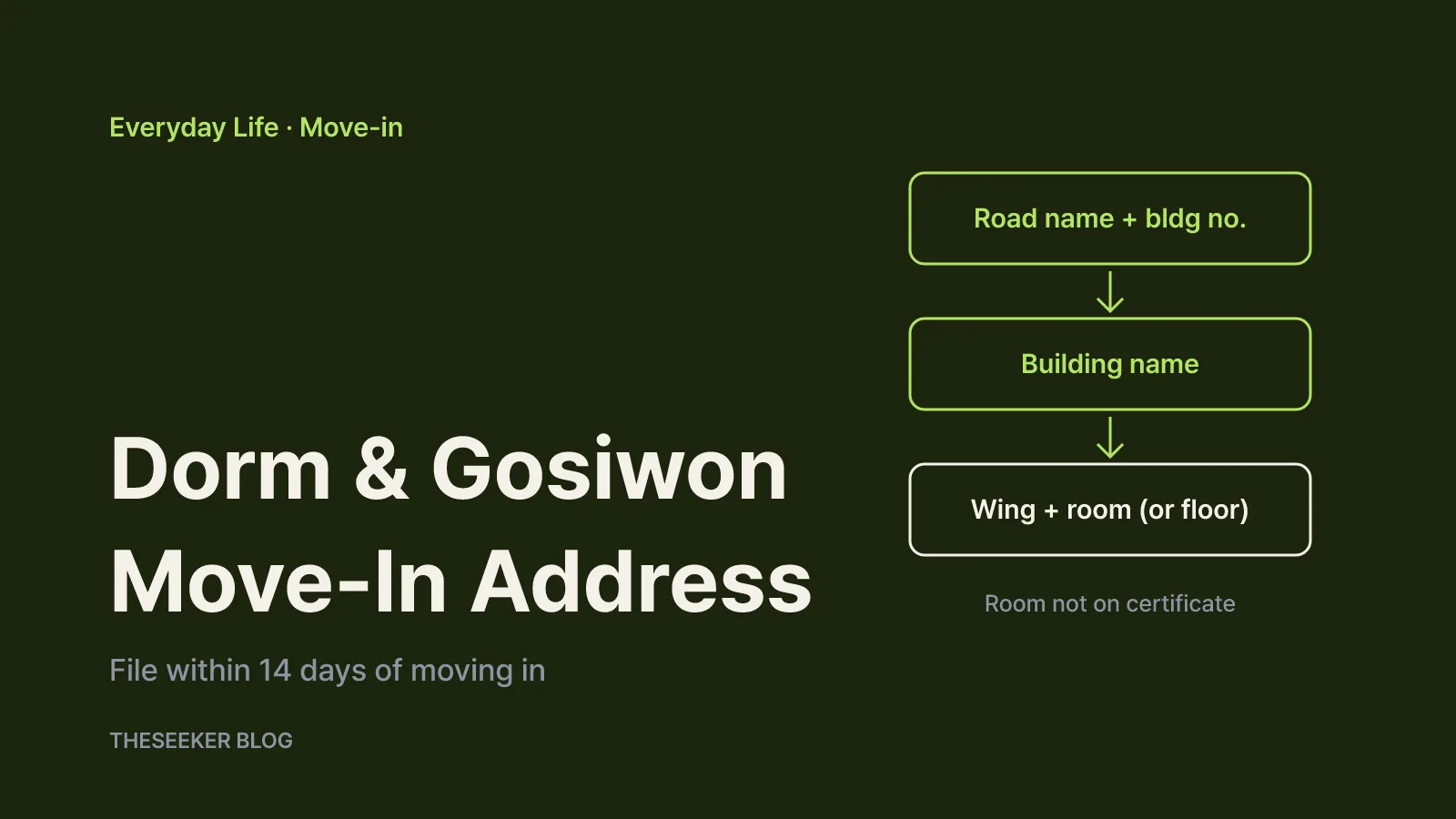
As of October 2026, the short answer is yes: if you move into a company dormitory or a gosiwon (a small single-room residence) in Korea and actually live there, you file a move-in report (jeonip singo) within 14 days of moving, exactly as you would for an apartment. The address starts with the road name and building number, and since July 29, 2024 residents of dormitories, multi-occupancy facilities and similar quasi-housing are also expected to record the building name and the unit or room number, or the floor if there is no room number. A landlord's consent form is not a required document for the report itself, but the building manager or owner often needs to help with proof of residence and with assigning a detailed address. This guide covers the resident registration move-in report for Korean nationals; registered foreign residents report a change of address through a separate immigration procedure, so check that process on its own terms.
Company dorms and gosiwon rooms still require a move-in report
The move-in report follows where you actually live, not the type of building. Korea's Ministry of Government Legislation explains on its Easy-to-Find Practical Law service that the person obliged to report must do so within 14 days of moving, either at the local eup, myeon or dong community service center or online through Gov24 (Resident Registration Act, Article 16(1)). The list of people who can carry that duty includes the head of household and the person moving, and it explicitly names the manager of a dormitory or shared lodging as well as the residents of that lodging. That is why your first question in a company dorm should be whether HR or the dorm office files for everyone, or whether each resident files individually.
Missing the deadline without a valid reason can lead to an administrative fine of up to 50,000 won (Resident Registration Act, Article 40(4)). The simplest habit is to note the day you moved your belongings in and mark the 14-day deadline on your calendar.
The report matters for more than avoiding a fine. According to the same guidance, a move-in report is treated as also covering several other address updates, including the residence change for people with military service obligations, the registered seal (ingam) change, and the address update for National Health Insurance subscribers (Article 17). In practice, that keeps reserve-force notices, insurance bills and other official mail from going to an old address. If you leave the dorm or gosiwon and never update your registration, the mail keeps piling up at the old building.
A gosiwon is usually classified under the Building Act as a multi-occupancy living facility, and many company dorms are built as dormitories. Neither is divided into separately owned units the way an apartment complex is, which is exactly why the address format confuses people.
How to write the address for a dorm or gosiwon room
The backbone is the road-name address: city, district, road name and building number, such as "OO-ro 152." Check it on the blue road-name plate on the building or on your room contract. The name of the gosiwon or your employer is not a substitute for the road name and building number, so confirm those first.
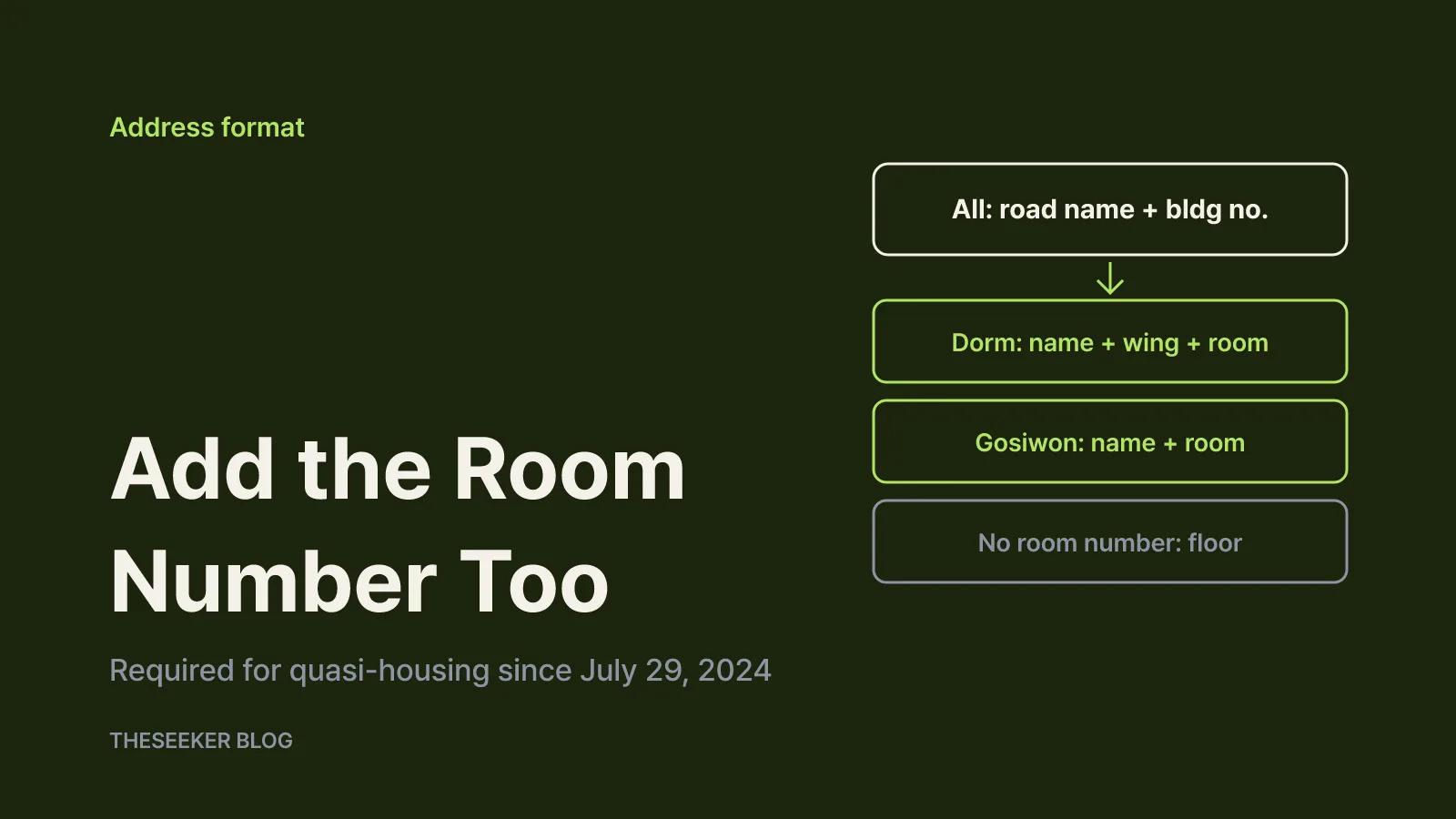
Next comes the room. In an announcement summarized on Korea.kr on June 11, 2024, the Ministry of the Interior and Safety explained that previously, for multi-household houses and quasi-housing, only the building number had to be recorded, and the building wing and room number were added in parentheses only when the resident asked. An amendment to the Enforcement Decree of the Resident Registration Act changed that: multi-household houses and quasi-housing, including dormitories, multi-occupancy living facilities, senior welfare housing and officetels, now record the building name, wing and room number like an apartment does, and the floor when there is no room number. The change took effect on July 29, 2024.
In practice, the address usually looks like one of these:
- Company dorm: road name + building number + dorm building name + wing + room (for example, OO-ro 152, OO Dormitory Building B, Room 302)
- Gosiwon without wings: road name + building number + building name + room (for example, OO-ro 152, OO Gosiwon Room 201)
- No fixed room or shared quarters: road name + building number + floor
The key caveat: that building name and room number are not your legal address in public-law terms. According to the ministry, the information is not printed on the resident registration certificate or abstract; it is kept as electronic data and used for purposes such as finding households in welfare crisis, sending mail and managing health insurance. So if you print your certificate after reporting and see only the building number, your report did not fail.
If you want the room to appear on the certificate itself, the building needs an official detailed address (sangse juso). Gunpo City's guidance explains that buildings such as studio-style rooms and multi-household houses lack separately owned units, so the wing, floor and room could not be written as an address, which caused problems with tax notices, reserve-force and civil defense notices and other official mail. The building owner or a tenant can apply to the city, county or district office, and the city lists processing as within 14 days of the application. Once the detailed address is granted, residents are told to file a resident registration correction at the community service center within 14 days.
When the landlord or building manager gets involved
The move-in report is filed by the resident, or by the dorm manager. The Gov24 service page lists ID and a consent form for administrative information sharing for an in-person filing by the resident, with no landlord consent form. Still, the landlord or manager matters at four points.
First, proof of residence. After a report, the local tong or ri head may verify that the person really lives there. The ministry noted in a Korea.kr policy column that with more single-person households, absence or refusal often made that check difficult, so submitting a document showing residence, such as a lease or sales contract, at the time of reporting allows the follow-up check to be skipped. For a gosiwon, that is typically the room contract or a residence confirmation signed by the operator; for a company dorm, a move-in confirmation issued by the employer.
Second, how the dorm is run. Because the dorm manager is also a reporting party, ask whether your employer files for new residents so you do not duplicate the report, and if you file yourself, get the exact building name, wing and room from the dorm office.
Third, detailed address applications. The applicant is the owner or a tenant, and Gunpo's process chart shows that a tenant first asks the owner to apply before applying directly. Cooperation from the gosiwon operator or the company that owns the dorm speeds this up.
Fourth, head-of-household confirmation. If you move in alone and form a new household, you are the head of household. If you join a household already registered at that address, its head must confirm your report. The Gov24 FAQ says an online report is automatically cancelled if that confirmation is not completed within 8 days.
Filing online through Gov24 vs. at a community service center
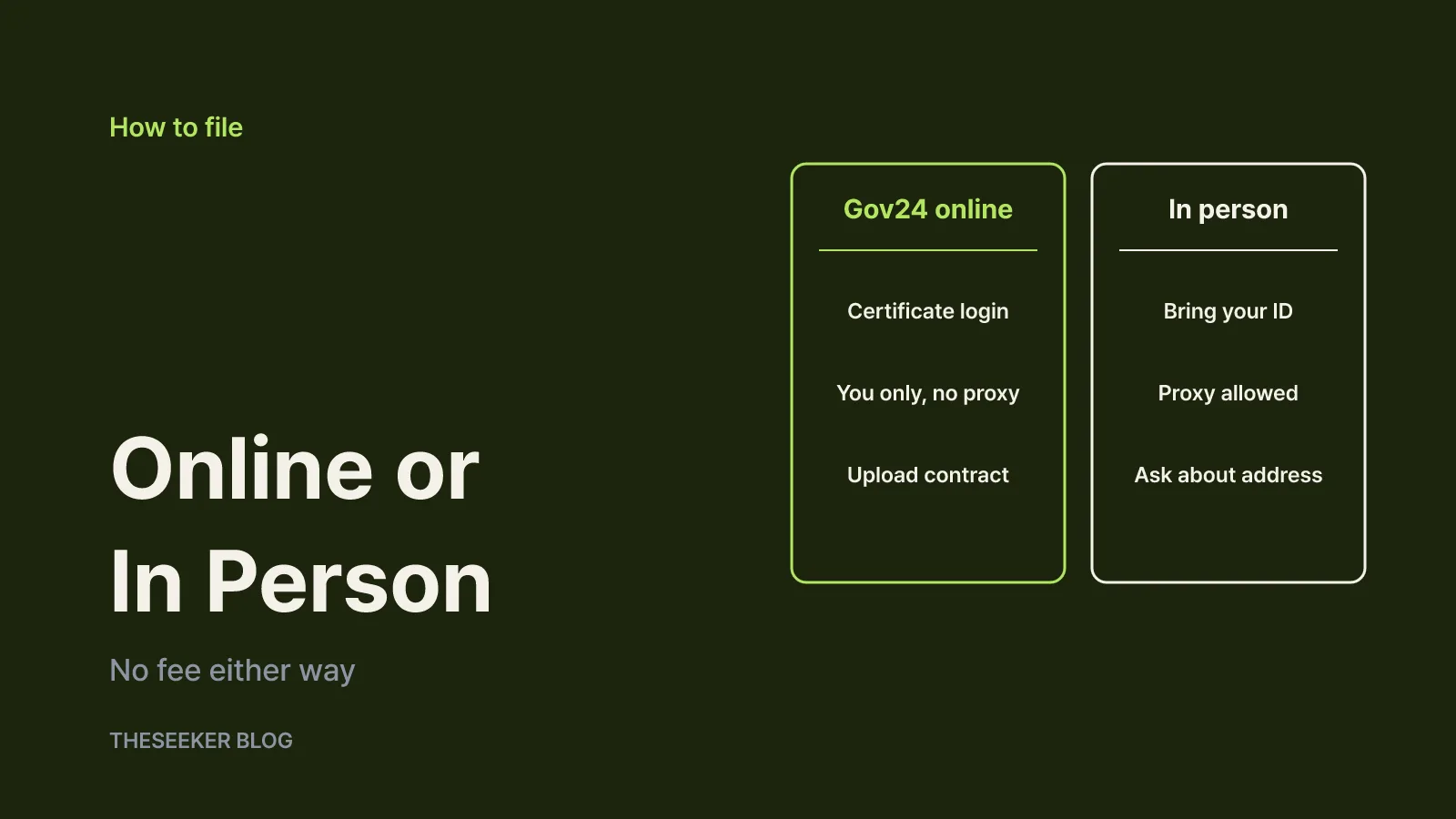
According to Gov24, you can file online or in person, there is no fee, and processing is listed as immediate, within 3 working hours.
Online, you log in to Gov24 with a digital certificate and enter your details, your previous address and your new address. Pick the road name and building number through the address search, then type the building name, wing and room in the detailed address field. If you are moving in alone, choose the option to form a new household, and upload your contract or residence confirmation in the optional document field for skipping the follow-up check. Gov24 states that online filing cannot be done by a proxy.
In person, go to the community service center that covers your new address and bring your ID. A proxy needs the IDs of both people and a power of attorney form. A visit is easier when you are unsure how to write the address or want to ask about a detailed address application at the same time. Overseas Korean nationals and people returning from long stays abroad must file in person.
- You have a certificate and know the exact building number and room: file online.
- You want staff to check the address or handle a detailed address correction: visit.
- A family member is filing for you: visit, since online proxy filing is not allowed.
Checklist before you file and what to do when you move out
- Move-in date: count 14 days from the day you started living there.
- Exact address: road name and building number from the plate or contract; building name, wing and room from the manager.
- Proof of residence: a room contract or move-in confirmation saved as a file.
- Household setup: decide whether you form a new household or join an existing one.
- Employer filing: in a company dorm, ask whether HR files for you.
If you paid a deposit, think about a fixed date stamp (hwakjeong ilja) too. The government guidance recommends that tenants report on the day they move in and get the fixed date on the lease, and explains that once a tenant takes possession and completes the report, protection against third parties starts at midnight the next day. Gosiwon contracts can differ from ordinary leases, so if the deposit is large, ask the community service center how it applies.
When you leave, simply file a new move-in report at your next home within 14 days; you do not need a separate visit to the old dorm or gosiwon. If the building received a detailed address while you lived there, confirm that your registration was corrected.
Sources
Frequently asked questions
Can I register my address at a gosiwon in Korea?
Yes. The move-in report is based on where you actually live, and the 2024 decree amendment set out how to record addresses for quasi-housing such as dormitories and multi-occupancy facilities. File through Gov24 or a community service center within 14 days of moving.
Why doesn't my room number appear on my resident registration certificate?
Since July 29, 2024 the building name and room are recorded at the move-in report, but that information is not a legal address, so it is kept as electronic data and not printed on certificates. To show the room on the certificate, the building needs an official detailed address, followed by a registration correction.
Do I need the landlord's or gosiwon operator's consent?
Gov24 does not list a landlord consent form for the move-in report. You may still want a room contract or residence confirmation from the operator to skip the follow-up check, and a detailed address application involves the owner or a tenant who first asks the owner.
Will my employer file the move-in report for a company dorm?
Both the manager of a dormitory or shared lodging and its residents are listed as reporting parties. Some employers file for everyone and some leave it to each resident, so ask HR first and get the exact building name, wing and room if you file yourself.
Can a family member file online for me?
No. Gov24 says online move-in reports cannot be filed by a proxy. A proxy must visit the community service center with both people's IDs and a power of attorney form.
blog.theseeker.io/en/posts/company-dorm-gosiwon-move-in-report-address
Emma Collins
Emma covers paperwork, procedures and practical tips for daily life, checking agency guidance to lay out what to prepare and in what order.
Read our editorial standards