Gov24 Resident Certificate Options: What to Include
When you issue a Korean resident registration certificate (deungbon), you choose which details to show. Here is what each option means and how to match it to what the recipient asked for.
 Emma Collins

In this post
As of October 2026, the safest rule for a Korean resident registration certificate (주민등록표 등본, often called a deungbon) is simple: include exactly the items the receiving organisation lists, and nothing more. If you tick nothing, the certificate shows only basic details such as names, dates of birth and the current address. If you choose the full-detail option, it adds past address changes, the back half of resident registration numbers, the reason the household was formed and more. Matching the recipient's wording saves you a second trip and keeps unnecessary personal data off the page.
This guide does not walk through how to get the certificate from Gov24, an unmanned kiosk or a community service centre. It focuses on the option screen that makes people hesitate. The item names below come from the official application form, Form No. 7 under the Enforcement Rules of the Resident Registration Act. Online and kiosk screens may word things slightly differently, so compare the labels you see with the explanations here.
The nine optional items on a household certificate
The Gov24 service page explains that the deungbon is a household-level record listing every member of one household. The chobon (초본), by contrast, is a detailed record of a single person. That is why most of the optional items on the deungbon are about the household.
The application form states that you can select only the items you need to protect personal information, and that leaving the choices blank produces a basic version. For the household certificate, the nine items are:
- Past address changes – where the household lived before. Choose either the full history or "most recent N years".
- Reason for household formation – why this household record was created.
- Date of household formation – when it was created.
- Date of occurrence / date of report – when a change actually happened and when it was reported.
- Reason for change – selectable separately for the household and for individual members, showing when and why people moved in or out.
- Names of the head and members other than the person requested – leave this out and other members' names are hidden.
- Back half of resident registration numbers – selectable separately for yourself and for other members.
- Each member's relationship to the head of household – spouse, child and so on.
- Co-residents – non-family residents registered at the address.
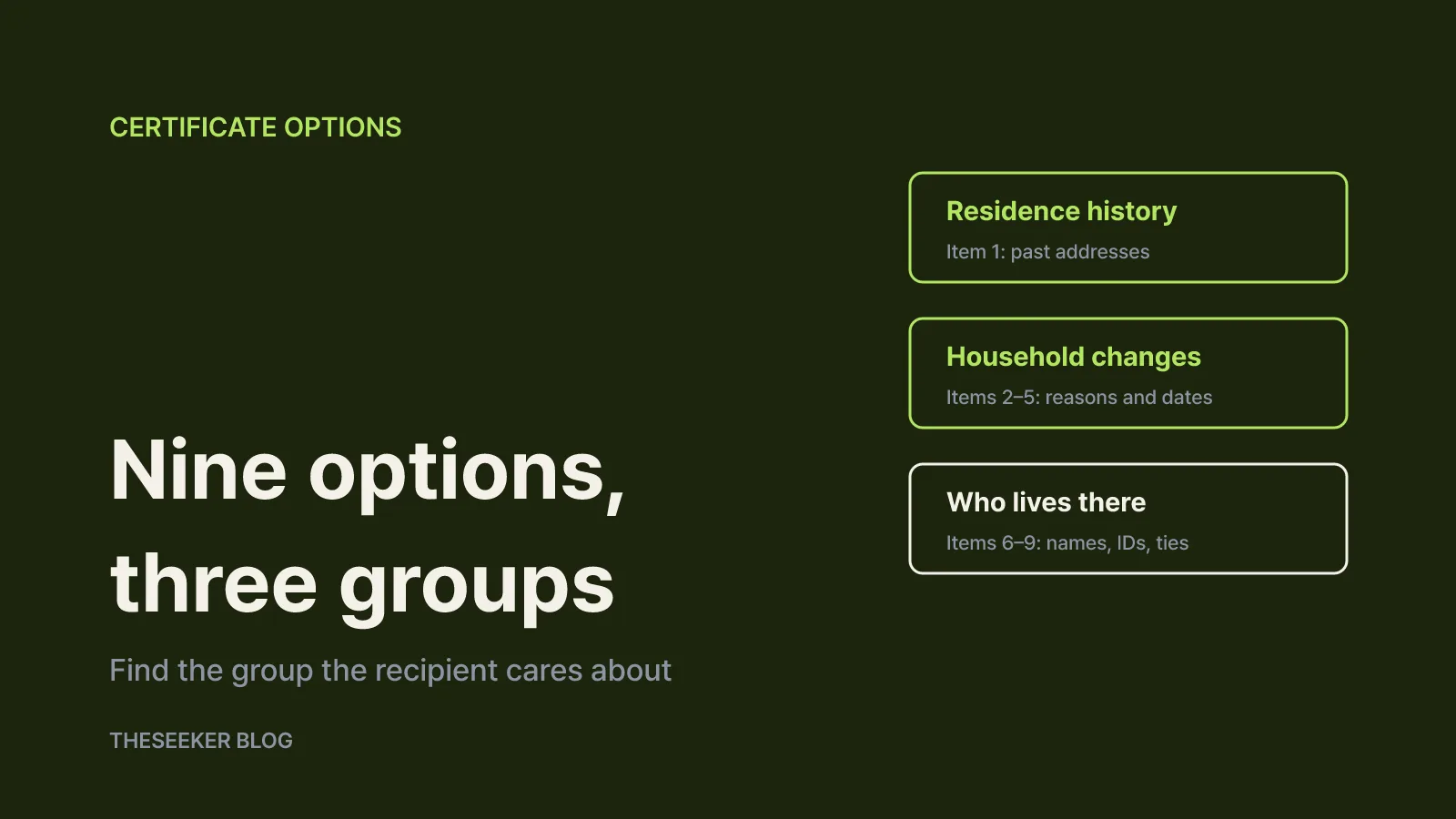
It helps to think of these as three groups: item 1 is residence history, items 2–5 describe how and when the household changed, and items 6–9 show who lives there and how they are related. When you read a document checklist, work out which group the recipient cares about first.
Address history: full record or a set number of years
According to a Ministry of the Interior and Safety press release, since 1 March 2021 applicants can set the period of past address changes shown on the certificate, with the stated aim of reducing unnecessary exposure of personal data. The form's notes add that a period you enter yourself must be in one-year units.
- If the checklist says something like "address changes for the last year", enter that period.
- If it says "full address history", choose the full option.
- If the document is meant to prove how long you have lived somewhere but no period is given, ask the recipient before you issue it.
There is a practical catch. A notice on Incheon's housing portal, posted on 5 March 2026, concerns a housing interest-support programme that asks for a certificate with one year of address history. It explains that after the city's administrative reorganisation (Dong-gu, Jung-gu and Seo-gu), the address-change section can show entries such as "administrative district reorganisation" or district splits instead of the move-in date. In that case applicants were asked to reissue the certificate with the full history rather than the last year, because the purpose was to confirm whether household members had moved in or out during the past year.
The lesson applies elsewhere too. If your area has recently been renamed or split, a short address window may hide your real move-in date. Check the printout before you submit it.
When to include formation reason, dates and reasons for change
The household formation reason and date tell the reader when and why the household took its current shape. The occurrence/report dates and reasons for change show when individual members joined or left. These items matter most to recipients that assess household size, who is head of household and how long people have lived together, such as housing support schemes or loans.
If the purpose is simply to confirm a current address and family make-up, these items are often unnecessary. Look for phrases such as "including household formation reason and date" or "including move-in and change dates" in the checklist. Because reasons for change can be selected for the household and for members separately, include the member option whenever movements of individual members are being checked.
How much identity data to reveal
Items 6–9 are the most sensitive. A practical approach:
- To prove your own identity, include your own ID number and leave out other members' numbers unless requested.
- To show family relationships or dependants, members' names and their relationship to the head of household are likely to be needed.
- If the recipient asks for full ID numbers, confirm whose numbers they need before ticking the members' box.
The form also notes that when someone other than the person concerned or a household member obtains the certificate, the stated purpose is printed on it. Gov24 says online applications cannot be made by a proxy; a representative must visit with a power of attorney and identification.
A step-by-step way to choose
- Copy the exact wording from the recipient's checklist.
- Confirm whether they want a household certificate or an individual one; the individual chobon has its own options, including personal detail changes and military service records.
- If they say "full details", choose the full option.
- If they list specific items, tick only those, using the three groups above.
- If they say nothing, ask whether the basic version is acceptable.
- Check move-in dates, names and ID numbers on the result before submitting.
Cost is modest. Gov24 lists a fee of 400 won per copy at an office, free online issuance for the person or household members, and half the fee at an unmanned kiosk. The real cost of choosing the wrong options is usually the delay of issuing it again.
Sources
Frequently asked questions
What appears if I do not select any options?
According to the official application form, only basic details such as name, date of birth and address are provided. If the recipient needs to check how long your household has lived somewhere, that version may not be enough.
How many years of address history should I include?
Use the period the recipient asks for. Since 1 March 2021 you can enter the period yourself in one-year units. If an administrative boundary change hides your move-in date, reissuing with the full history is one way to fix it.
Do I always need the household formation reason and date?
Only when the recipient's checklist mentions them. Housing support programmes and loans that look at who lived together and for how long often ask for them; a simple proof of current address usually does not.
Is it risky to choose the full-detail option?
The document is still valid, but it hands over your household members' full ID numbers and past addresses. If nobody asked for those, leaving them out limits how much personal data you share.
blog.theseeker.io/en/posts/resident-registration-certificate-include-options
Emma Collins
Emma covers paperwork, procedures and practical tips for daily life, checking agency guidance to lay out what to prepare and in what order.
Read our editorial standards